
If you're searching for the best lion's mane supplement, the most important thing to check is not the brand name or the price — it's whether the product uses fruiting body extract or mycelium grown on grain substrate. That single distinction separates supplements backed by human RCT evidence from ones that are largely starch. This article breaks down how to read a label for what actually matters (beta-glucan percentage and fruiting body sourcing), what the two key clinical trials tell us about dose and population, and which six products pass the real-mushroom test. You'll also get a clear look at four widely marketed brands that rely on mycelium-on-grain — with honest explanations of why that matters — plus a short interaction section covering anticoagulants and immunosuppressants.
Affiliate disclosure: this article contains affiliate links. As an Amazon Associate, UsefulVitamins.com earns from qualifying purchases at no extra cost to you.
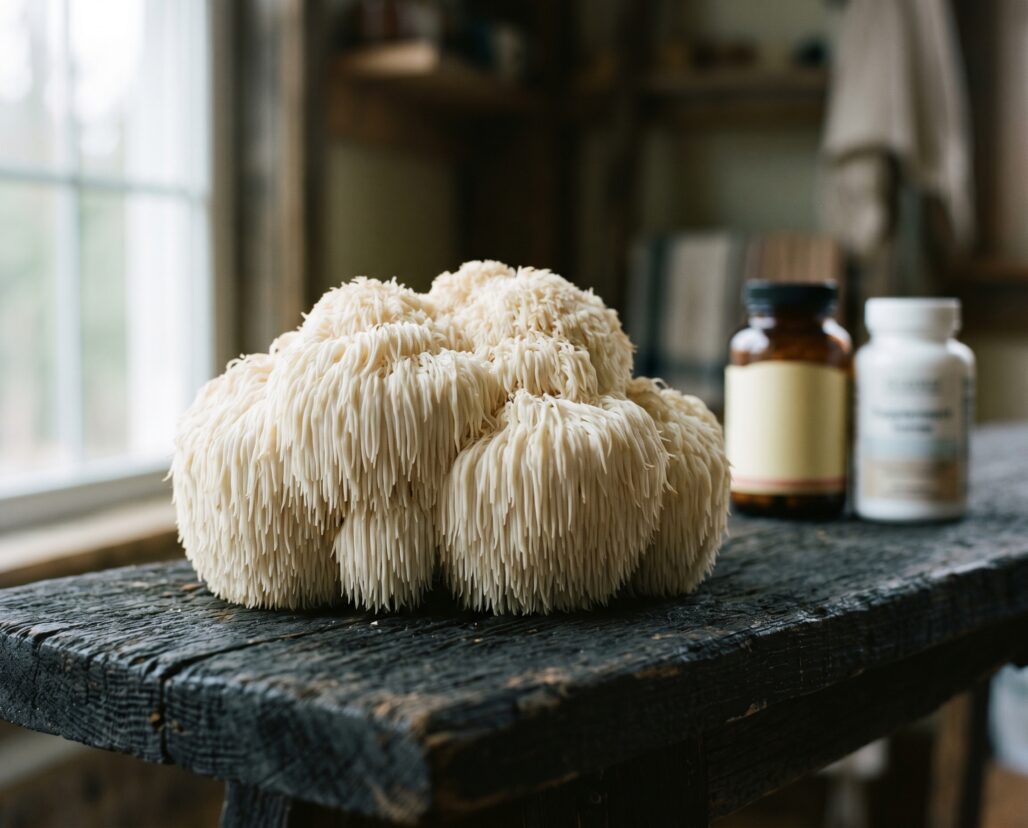
Summary / Quick Answer: what is the best lion's mane supplement?
For most adults, the best lion's mane supplement is Real Mushrooms Lion's Mane Capsules — because it specifies 100% fruiting body, publishes beta-glucan content in a third-party COA, and is consistently accessible at a reasonable cost per gram.
- Best for: Adults aged 50+ with mild cognitive concerns; menopausal women with anxiety or mood complaints; anyone who wants the form of lion's mane actually used in double-blind RCTs.
- Not ideal for: Healthy adults under 40 expecting rapid focus improvement — the human RCT evidence does not currently support that use case; anyone buying a cheap "lion's mane mycelium" product without beta-glucan disclosure.
- What to check before buying: "Fruiting body" stated explicitly on the label; beta-glucan percentage disclosed (20%+ preferred); third-party COA available; no grain starch as a filler.
- Decision shortcut: If the label says "lion's mane mycelium" without a beta-glucan percentage, or if no COA is published, treat it as an unverified product regardless of price.
What you'll find in this guide
- Why fruiting body vs mycelium-on-grain is the only question that matters
- What the clinical trials actually tested — and who they tested it on
- The 6 real-mushroom picks
- The 4 mycelium-on-grain skips — and why
- How to read a beta-glucan COA without a chemistry degree
- Dosing derived from clinical trials
- Side effects and drug interactions
- Frequently asked questions
Why fruiting body vs mycelium-on-grain is the only question that matters {#fruiting-body-vs-mycelium}
Most lion's mane supplements sold on Amazon are not made from lion's mane mushrooms. They are made from the mycelium — the root-like network — grown on a grain substrate (typically oats or brown rice), then dried and powdered without separating the grain from the fungal material. Independent testing by organizations including ConsumerLab has repeatedly found that these products contain 40-80% starch by weight, with minimal beta-glucan content and often trace or undetectable levels of hericenones, the active compounds associated with nerve growth factor stimulation.
Buying mushroom supplements without verifying fruiting-body content is like buying olive oil labeled "Mediterranean blend" — the label tells you everything except what's actually in it.
The fruiting body is the actual mushroom: the visible, cascade-of-spines structure that appears on dead hardwood in late summer. The fruiting body contains both hericenones (the primary active compounds in the fruiting body structure itself) and beta-glucan polysaccharides. These are what was used in the human RCTs. Mycelium grown on grain has not been used in any of the positive controlled human trials for lion's mane.
What "full spectrum" and "biomass" mean on labels
These are marketing terms, not quality markers. "Full spectrum" and "mushroom biomass" almost always describe mycelium-on-grain products. The term implies completeness — as if including the mycelium is a bonus rather than a cost-cutting measure. Some companies combine small amounts of fruiting body with mycelium-on-grain and label the result as "dual extract" or "full spectrum," making comparison difficult without a COA.
Actionable takeaway: Ignore "full spectrum," "biomass," and similar branding. Look for the words "fruiting body" followed by a disclosed beta-glucan percentage. If neither appears, move on.
What the clinical trials actually tested — and who they tested it on {#what-the-rcts-show}
The two anchor RCTs for lion's mane are small but methodologically solid. Both used fruiting body preparations. Neither tested healthy adults seeking nootropic effects.
The first, Mori et al. 2009 (PMID 18844328), published in Phytotherapy Research, enrolled 30 Japanese adults aged 50-80 diagnosed with mild cognitive impairment. The design was double-blind, placebo-controlled. Participants took four 250mg tablets of Yamabushitake (H. erinaceus) fruiting body powder three times daily — 3 grams per day total — for 16 weeks. Cognitive function was measured using the Revised Hasegawa Dementia Scale (HDS-R). The treatment group showed significantly elevated cognitive scores at weeks 8, 12, and 16. Scores declined within 4 weeks of stopping supplementation, implying the benefit depends on continued intake.
The second, Nagano et al. 2010 (PMID 20834180), published in Biomedical Research, enrolled 30 menopausal women randomized to H. erinaceus cookies or placebo over 4 weeks. Primary outcomes were depression (CES-D scale), anxiety (ICI scale), and sleep quality. The H. erinaceus group showed significantly lower depression and anxiety scores than placebo, with improvements in apathy and palpitation subscores.
A third trial, Saitsu et al. 2019 (PMID 31413233), used fruiting body supplementation over 12 weeks in older adults and found significant improvement on the Mini Mental State Examination (MMSE), consistent with Mori 2009 and supporting the evidence base for MCI-adjacent populations.
The real question isn't whether lion's mane does anything interesting in a cell culture — it clearly does. The real question is whether the human dose proves out in placebo-controlled trials. For older adults with MCI and for menopausal women with mood complaints, the answer is a cautious yes. For healthy adults under 40 expecting sharper focus, the evidence is not there yet.
Actionable takeaway: The RCT evidence covers older adults with MCI and menopausal women. Any product claiming to replicate those results should use fruiting body extract at doses consistent with trial quantities (the Mori 2009 effective dose was 3g/day). Products using mycelium-on-grain have not been tested in any of these trials.
The 6 real-mushroom picks {#the-picks}
Tier 1: fruiting body certified — the three core picks
These products specify fruiting body sourcing, publish beta-glucan content, and have third-party quality documentation. They are the closest commercial equivalents to the supplement form used in human trials.
Real Mushrooms Lion's Mane is the reference standard in this category. The company specifies 100% fruiting body, publishes a COA showing beta-glucan content above 25%, and the product has been independently reviewed by ConsumerLab. Cost per gram of verified fruiting body extract is reasonable relative to certified alternatives.
Skip if: you need a low capsule count — approaching clinical trial quantities (3g/day) requires 3-6 capsules daily at typical serving sizes.
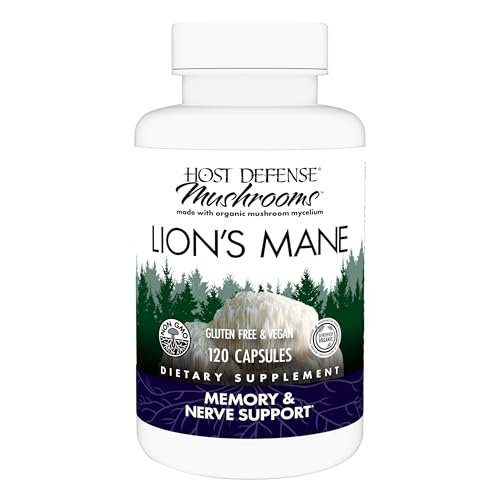
Host Defense Lion's Mane (Paul Stamets' Fungi Perfecti line) uses mycelium, but cultivates it on a sterilized substrate and fully extracts it with grain starch removed prior to encapsulation. They publish polysaccharide content. Third-party NSF certification adds a quality layer. This is not a mycelium-on-grain product, but it is not a fruiting-body-only product either.
Skip if: you prefer a purely fruiting-body product with no mycelium inclusion at any stage.
FreshCap Lion's Mane sources fruiting bodies grown on hardwood substrate — the natural growth medium for H. erinaceus — and publishes beta-glucan content. COA documentation is a deliberate marketing differentiator for this brand. Good choice for anyone who wants to verify the supply chain before buying.
Skip if: budget is the primary constraint — FreshCap sits at the higher end of the price-per-gram range.
Tier 2: dual-extract premium
Four Sigmatic Lion's Mane Capsules use fruiting body with a dual-extract process: hot-water extraction captures beta-glucans; alcohol extraction captures hericenones. This maximizes recovery of both active compound families from genuine fruiting body material. Note that Four Sigmatic's lion's mane coffee products are separate from the capsule line; only the capsule version delivers a concentrated, standardized dose.
Skip if: you want the lowest cost per gram — the dual-extraction premium is real, and Tier 1 options serve most users at lower cost.
Tier 3: mycelium blend with caveats
Om Mushroom Superfood Lion's Mane combines mycelium (grown on oat substrate) and fruiting body. Om does disclose polysaccharide content, which is more transparent than most blend products. The oat substrate means some starch carryover exists; this is not a pure fruiting body product and cannot be treated as a direct equivalent to the Mori 2009 trial intervention.
Caveat: preferable to unlabeled mycelium-on-grain if budget constrains your choices; not appropriate if you want to match clinical trial conditions.
Skip if: you need maximum beta-glucan concentration per capsule or require fruiting-body-only sourcing.
The 4 mycelium-on-grain skips {#the-skips}
A product does not need to be a fraud to be a poor choice. These brands are widely sold, often well-reviewed, and genuinely popular — and they rely on mycelium-on-grain substrate that results in high starch content and low beta-glucan density.
NutriCost Lion's Mane is a high-volume budget option. The label says "lion's mane mycelium" without specifying extraction or beta-glucan content. NutriCost's cost advantage is real — it is among the cheapest products available. But without a beta-glucan COA, there is no way to verify how much active compound is present versus grain starch. An adaptogen brand can have impressive sales volume and still miss the minimum transparency bar for a meaningful supplement.
Genius Mushrooms combines lion's mane with reishi and cordyceps in a single capsule. The lion's mane component is listed as mycelium without beta-glucan disclosure. Combination products divide capsule capacity across three fungi, meaning the per-serving lion's mane dose is a fraction of a single-ingredient product. At trial-relevant quantities (3g/day of lion's mane), the practical capsule count becomes both impractical and expensive.
Three additional skip categories by type: (1) private-label bulk mycelium capsules from generic supplement brands with no COA, consistently found to contain 50%+ starch on independent testing; (2) loose bulk "lion's mane extract powder" without beta-glucan disclosure or third-party certification; (3) 10-mushroom complex blends where any individual mushroom dose is too low to be clinically meaningful.
The pattern across all four skips is consistent: high starch, undisclosed or absent beta-glucan data, no COA, no basis for expecting the compound profile that clinical trials actually used.
How to read a beta-glucan COA without a chemistry degree {#reading-coa}
A certificate of analysis (COA) is a lab report from an ISO-certified third-party laboratory confirming what is in the supplement. For lion's mane, two numbers matter:
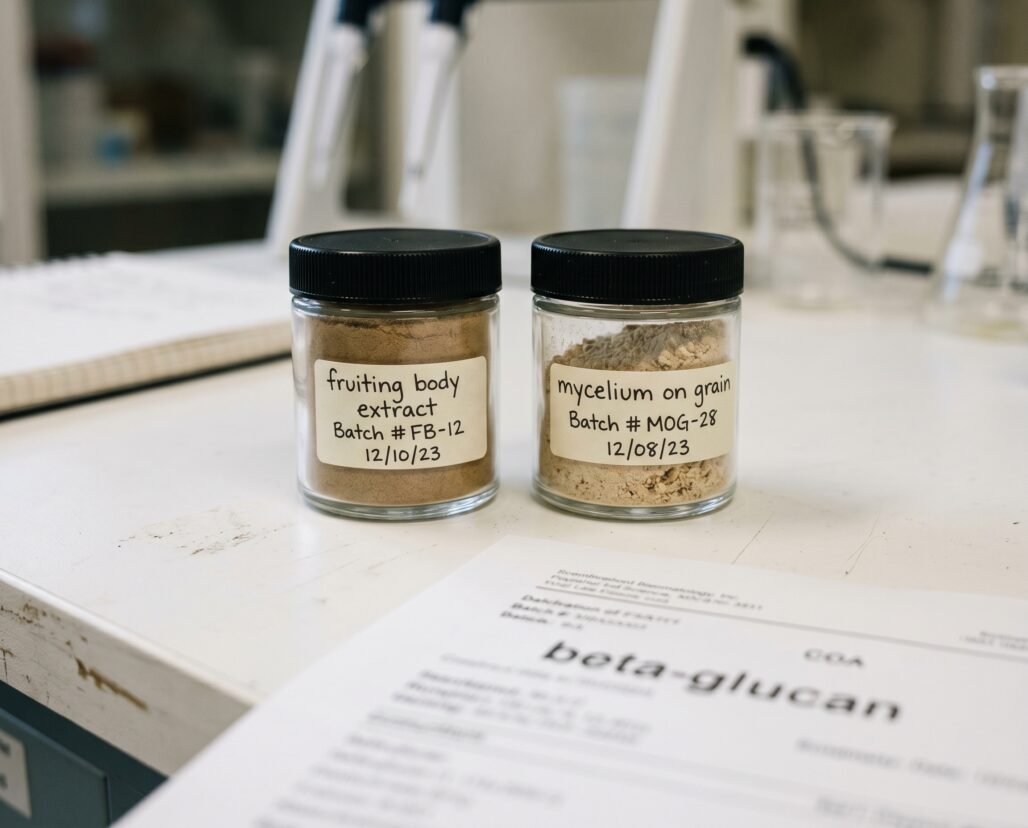
Beta-glucan percentage: In genuine fruiting body extracts, beta-glucan content typically runs 20-35%. In mycelium-on-grain products, it frequently runs below 5%, with the remainder being alpha-glucan (starch from the grain substrate). A product with 25% beta-glucan and 10% alpha-glucan is a strong fruiting body indicator.
Heavy metals panel: Medicinal mushrooms bioaccumulate metals. A credible COA includes lead, cadmium, arsenic, and mercury limits.
| What to look for | Fruiting body signal | Mycelium-on-grain signal |
|---|---|---|
| Beta-glucan % | 20%+ | Often <5% |
| Alpha-glucan % | Low (10-15%) | High (30-60%) |
| Label language | "Fruiting body" stated | "Mycelium," "biomass," "full spectrum" |
| Third-party COA | Published or available on request | Often absent |
If a brand does not publish a COA or make it available on request, treat it as an unverified product regardless of marketing claims.
Dosing derived from clinical trials {#dosing}
This section describes doses from research, not a prescription for any individual reader.
The Mori 2009 RCT used 3 grams per day of fruiting body powder (four 250mg tablets three times daily) for 16 weeks. Effects appeared at week 8. The Nagano 2010 trial used approximately 0.5g of lion's mane per day in cookies over 4 weeks — a lower dose, different matrix, different population.
Most commercial capsule products run 500-1000mg per capsule. To match the Mori 2009 dose with a 500mg capsule, you would need 6 capsules daily — a relevant cost consideration. Products in the 1-3g range with genuine fruiting body extract are at least dose-consistent with trial conditions. Mycelium-on-grain products cannot be compared to trial dosing regardless of milligrams stated on the label.
Most clinical trials saw effects at 8-16 weeks of sustained use. Expecting results in 1-2 weeks is inconsistent with the evidence.
Side effects and drug interactions {#side-effects-interactions}
Reported side effects from trials
In the human RCTs reviewed here, lion's mane was well-tolerated. Mori 2009 reported no adverse effects across 16 weeks. The Memorial Sloan Kettering integrative medicine database notes the most commonly reported adverse effects as abdominal discomfort, nausea, and skin rash — consistent with the broader medicinal mushroom literature. These effects are generally mild.
A small number of case reports describe allergic reactions, including respiratory symptoms, in individuals with known mushroom or mold allergy. Anyone with that allergy profile should discuss lion's mane with a physician before use.
Drug interactions
Anticoagulants (warfarin, apixaban, rivaroxaban, dabigatran): Preclinical evidence from in vitro and animal studies suggests that H. erinaceus polysaccharides may inhibit platelet aggregation, creating a theoretical additive bleeding risk when combined with anticoagulant or antiplatelet medications. No controlled human trial has quantified this interaction, but the preclinical signal warrants disclosure to a prescriber before starting lion's mane if you are on blood thinners.
Immunosuppressants (tacrolimus, cyclosporine, mycophenolate, biologics): The beta-glucan polysaccharides in H. erinaceus have documented immunomodulatory effects in vitro and animal models (He et al. 2017, PMID 28087447). For patients on deliberate immunosuppression (post-transplant, autoimmune conditions), an immune-modulating supplement is a theoretical concern. Clinical interaction data are not available; discuss with your transplant physician or immunologist before use.
Diabetes medications (metformin, sulfonylureas, insulin): Anti-hyperglycemic effects have been observed in animal models of lion's mane polysaccharides. While no human interaction data exist, the theoretical concern of additive glucose lowering is worth disclosing to a prescriber if you are on pharmacological glucose control.
Pregnancy and breastfeeding: No adequate human safety data exist for lion's mane during pregnancy or lactation. The default precautionary position applies: avoid supplement doses during pregnancy or breastfeeding unless a physician has specifically reviewed the evidence for your individual situation.
Actionable takeaway: Lion's mane's interaction profile is not as extensively documented as ashwagandha's or St. John's Wort's, but the preclinical signals for anticoagulant and immunosuppressant interactions are real enough to require a conversation with your prescriber if you fall into those categories.
Frequently asked questions {#faq}
What is the difference between fruiting body and mycelium-on-grain?
The fruiting body is the visible mushroom — the structure with hericenones and beta-glucans that was used in both human RCTs. Mycelium-on-grain is fungal root material grown on oats or rice substrate, then powdered without removing the grain. Independent testing consistently finds 40-80% starch content in these products, with minimal beta-glucans. The label terms "mycelium," "biomass," and "full spectrum" typically indicate mycelium-on-grain sourcing.
How do I know if a product has real fruiting body?
Check the label for the words "fruiting body" explicitly stated. Then look for a certificate of analysis disclosing beta-glucan percentage — 20%+ indicates a genuine fruiting body extraction; below 5% suggests mycelium-on-grain. If the company does not publish a COA or make it available on request, that absence is itself a signal.
Can lion's mane improve focus and memory in healthy adults?
The human RCTs enrolled older adults with mild cognitive impairment (Mori 2009) and menopausal women with mood complaints (Nagano 2010). No adequately powered human RCT has demonstrated cognitive improvement in healthy adults under 50 as of 2026. The popular nootropic framing extrapolates from the MCI trial data and in vitro NGF findings — which is a reasonable hypothesis, but not a verified clinical result.
How long before lion's mane produces any effect?
In Mori 2009, measurable cognitive improvement appeared at week 8 and built through week 16. Effects reversed within 4 weeks of stopping. In Nagano 2010, mood improvements appeared over 4 weeks at a lower dose in a different population. Expecting results in days or 2 weeks is inconsistent with the evidence; plan for at least an 8-12 week trial at adequate dose before drawing conclusions.
Can I take lion's mane every day?
The Mori 2009 trial used daily dosing for 16 weeks without reported adverse effects. There are no long-term human safety studies beyond that timeframe. Most integrative medicine practitioners suggest re-evaluating continued use at 4-6 months. If you are on anticoagulants, immunosuppressants, or diabetes medications, discuss daily use with your prescriber before starting.
Is Host Defense considered mycelium-on-grain?
Host Defense uses mycelium, but their process fully extracts from the mycelium with subsequent starch removal — they do not encapsulate raw mycelium-on-grain powder. They publish polysaccharide content, which puts them in a different category from unlabeled mycelium-on-grain products. Users who require fruiting-body-only sourcing should choose Real Mushrooms or FreshCap.
As an Amazon Associate, I earn from qualifying purchases. Product recommendations are based on real reviews and independent research.
Related reading {#related-reading}
- Lion's Mane Mushroom: The Honest Guide to Hericium erinaceus and Cognitive Effects
- Lion's Mane Fruiting Body vs Mycelium: Why It Matters More Than Any Other Label Detail
- Best Ashwagandha Supplement in 2026: Which Extracts Are Actually Standardized?
- Best Rhodiola Supplement in 2026: Rosavin and Salidroside Content Compared
Adding this to a few other supplements? Our companion app, StackMyMed, scans the label, tracks your real daily intake, and schedules the best time to take it around everything else in your routine.
Conclusion: the bottom line on lion's mane supplement quality
The fruiting body versus mycelium-on-grain issue is the single most practically important factor in lion's mane supplementation, and it is the one most supplement marketing glosses over. Both RCTs that produced positive results — Mori 2009 (PMID 18844328) and Nagano 2010 (PMID 20834180) — used fruiting body preparations. Mycelium-on-grain products, which constitute the majority of cheap lion's mane supplements, have not been tested in controlled human trials and frequently contain more starch than mushroom.
The six picks (Real Mushrooms, Host Defense, FreshCap, Four Sigmatic capsules, Om with caveats) have meaningful fruiting body content and at least some active-compound disclosure. The four skip categories share the same structural flaw: no beta-glucan data, no COA, no basis for comparing them to trial conditions.
Next steps:
- Check any lion's mane product you currently own for "fruiting body" on the label and a beta-glucan percentage in the COA. If neither is present, you likely have a mycelium-on-grain product.
- For a deeper look at the science behind these quality claims, read Lion's Mane Fruiting Body vs Mycelium before your next purchase.
- For the full evidence review covering mechanism, dosing, who benefits, and who should skip it, see the Lion's Mane Complete Guide.
- If you are on anticoagulants or immunosuppressants, speak with your prescriber before starting any lion's mane supplement regardless of quality tier.
This article is for informational purposes and not medical advice. Herbal adaptogens — even traditional ones — can interact with thyroid medication, antidepressants, anticoagulants, immunosuppressants, blood-pressure drugs, and more. Consult a licensed physician before starting any adaptogen, particularly if you are pregnant, nursing, taking prescription medications, or managing a chronic condition.
As an Amazon Associate, I earn from qualifying purchases. Product recommendations are based on real reviews and independent research.
