
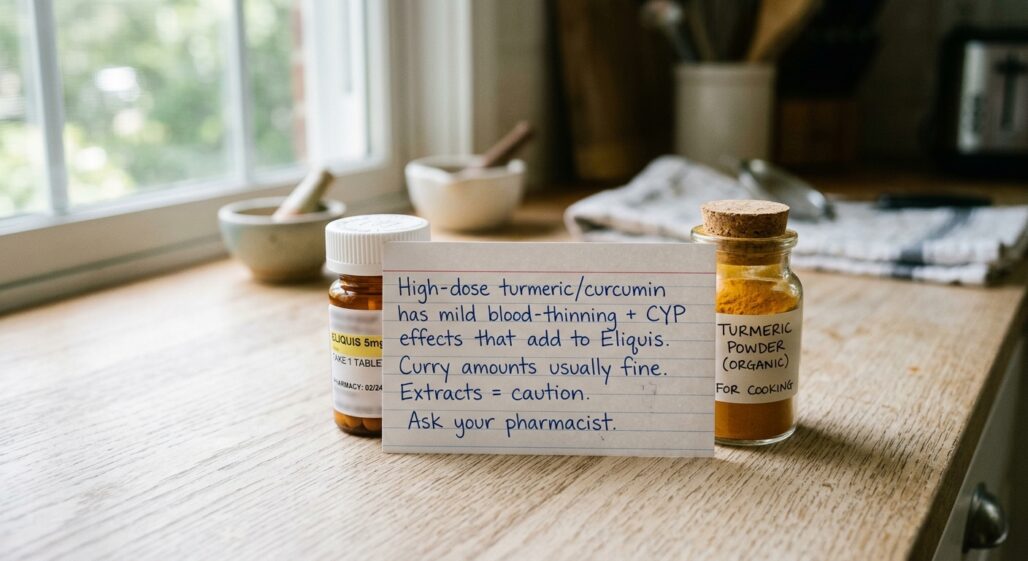
If you take Eliquis and you are eyeing a turmeric capsule for your joints, you are asking the right question before you swallow it. The short answer: culinary turmeric on your rice is almost certainly fine, but a concentrated daily extract is the version that earns a conversation with your pharmacist. This piece walks through what the interaction actually is, how big it likely is in real numbers, and the practical way to keep curcumin in your life without stacking bleeding risk.
Before you decide
This is general health information, not medical advice, and it is not a substitute for your prescriber or pharmacist.
Never stop, pause, or change your Eliquis dose on your own. Apixaban prevents strokes and dangerous clots, and stopping it abruptly is far more dangerous than most supplement interactions. If anything here worries you, the move is a phone call to your pharmacy, not a change to your pill box.
Who should be most careful: anyone on apixaban who also has reduced kidney function, is over 80, weighs under 60 kg, takes other antiplatelet drugs (aspirin, clopidogrel), or is already prone to bruising and bleeding. People in those groups have a thinner safety margin, so a small added effect matters more.
Call your doctor or pharmacist promptly if you notice unusual bruising, nosebleeds, bleeding gums, pink or red urine, or black/tarry stools. Those are bleeding-risk signals worth acting on regardless of what you think caused them.
What the turmeric-Eliquis interaction actually is
Eliquis (apixaban) is a direct oral anticoagulant, a "blood thinner" that blocks clotting factor Xa. Turmeric is a spice; its main active compound, curcumin, is what supplement makers concentrate into extracts. The interaction is a case of two mild effects pointing the same direction.
The concern runs on two tracks. First, curcumin has its own mild antiplatelet activity, so it gently discourages clotting on top of what apixaban already does. Second, curcumin can touch the metabolic and transport machinery that clears apixaban from your body, which could raise apixaban blood levels.
Apixaban is cleared by several routes at once. Roughly a quarter leaves through the kidneys, and a large share is metabolized in the liver, mainly by the enzyme CYP3A4, with the drug also moving across cells via the P-glycoprotein transporter. Anything that meaningfully blocks both CYP3A4 and P-glycoprotein at the same time can push apixaban levels up.
Here is the honest nuance most articles skip: curcumin is a potent enzyme blocker in a test tube but is famously hard to absorb, so whether that translates to a real-world Eliquis effect depends heavily on dose and formulation.
The mechanism, in plain pathways
On the platelet side, the data are mechanistically clear even if modest in humans. In lab work, curcumin inhibits platelet aggregation triggered by platelet-activating factor and arachidonic acid by suppressing thromboxane formation and calcium signaling. A separate line of research shows curcumin blunts collagen-receptor (GPVI) platelet activation by interfering with Syk kinase and PLCgamma2 signaling.
Mechanistically, that means curcumin is a weak, multi-pathway platelet brake, not a true anticoagulant. It is not in the same league as apixaban or aspirin; it is a small additive nudge that becomes relevant only when it lands on top of a drug already doing the heavy lifting.
On the metabolism side, curcuminoids inhibit a broad set of human enzymes (several CYPs, UGTs, and sulfotransferases), while the black-pepper compound piperine is a relatively selective CYP3A4 inhibitor. This is why "turmeric plus piperine" formulas deserve extra respect: the piperine added to boost absorption is itself a CYP3A4 blocker.
Now the wrinkle. In living animals, oral curcumin has actually been shown to activate CYP3A4 via its metabolites, sometimes lowering the levels of CYP3A substrates rather than raising them. Translation: the direction of a real Eliquis interaction is genuinely uncertain, which is an argument for caution and monitoring rather than confident reassurance.
How big is the effect, really?
This is where conservative framing matters, because the honest answer is "probably small for most people, but not zero, and poorly quantified."
There is no published human trial of turmeric taken with apixaban, so we are reasoning from the drug's known behavior plus curcumin's known biology. For scale: the apixaban label and reviews reserve a formal 50% dose reduction for drugs that strongly block both CYP3A4 and P-glycoprotein, such as ketoconazole, itraconazole, and ritonavir, per the StatPearls apixaban monograph. Curcumin is nowhere near those drugs in potency at normal supplement doses.
The clearest human signal that curcumin can change a drug's exposure at all comes from a different substrate. In a controlled study, a 2 g curcumin dose meaningfully raised blood levels of sulfasalazine in healthy volunteers by inhibiting the BCRP transporter. Apixaban is also a BCRP and P-gp substrate, so the proof-of-concept that "enough curcumin can move a transporter-handled drug" is real, even if the apixaban-specific magnitude is unmeasured.
The practical read: a sprinkle of turmeric in food is a non-event, while a high-dose, high-absorption extract is the scenario where a small interaction could become clinically meaningful. That gradient, not a yes/no verdict, is the accurate picture.
What to do: a practical, conservative plan
You do not have to choose between turmeric and your heart medication. You have to be deliberate about form and dose, and you have to loop in your pharmacist.
Keep culinary turmeric without anxiety. The teaspoon in a curry, a golden-milk latte, or a spice blend delivers a small fraction of curcumin, much of which is poorly absorbed. The NIH NCCIH considers ordinary oral turmeric likely safe for short-term use, and food-level amounts are not the concern here.
Treat concentrated extracts as the decision point. Standardized "95% curcuminoid" capsules, and especially high-absorption forms (with piperine, phospholipid/Meriva-type, or nano formulations) deliver many times the curcumin of food. NIH LiverTox notes daily doses ranging from 100 mg to well over 1,000 mg in these products, and flags that the high-bioavailability versions are the ones linked to rare liver injury, an independent reason for caution on Eliquis.
If you and your pharmacist decide an extract is reasonable, sensible guardrails are: choose a plain (non-piperine) form, keep the dose modest, take it consistently rather than in erratic large boluses, and report any bleeding signs immediately. A tracking tool like StackMyMed can help you log the stack and spot conflicts, but it spots and spaces, it does not replace your pharmacist.
| Turmeric form | Approx. curcumin load | Eliquis concern level | What to do |
|---|---|---|---|
| Culinary spice (food/curry/golden milk) | Low, poorly absorbed | Minimal | Enjoy as usual |
| Standardized 95% curcuminoid capsule | High | Moderate, dose-dependent | Clear with pharmacist first |
| High-absorption (piperine / phospholipid / nano) | Very high effective dose | Highest of the three | Pause and ask before starting |
Actionable takeaway: the form on the label, not the word "turmeric," decides how much attention this deserves.
Who is most at risk
Not every Eliquis user carries the same risk if they add curcumin. A few groups sit closer to the edge.
Stacked bleeding risk is the big one: if you also take aspirin, clopidogrel, an SSRI, fish oil at high doses, or an NSAID like ibuprofen, each adds a little to bleeding tendency, and curcumin becomes one more layer. Our companion explainers on vitamin K and Eliquis and on whether fish oil meaningfully thins blood alongside anticoagulants walk through those neighboring stacks.
Reduced kidney function, advanced age, low body weight, recent surgery, a history of GI bleeding, and liver impairment all narrow the margin. In those situations the conservative default is to skip concentrated curcumin extracts entirely until a clinician signs off.
Refer out, clearly: if you are managing atrial fibrillation, a recent clot, or a mechanical concern that put you on apixaban in the first place, that is a conventional-care-first situation. Botanical support is a side conversation, never the steering wheel.
When to see a clinician
Some signs warrant a same-day call rather than a wait-and-see approach.
Get prompt medical attention for bleeding that will not stop, vomiting blood or material that looks like coffee grounds, black or bloody stools, a severe headache, sudden weakness, or any large unexplained bruise. These can be signs of serious bleeding on an anticoagulant and are an emergency, not a supplement question.
For non-urgent planning, book a brief pharmacist consult before you start or stop any turmeric extract, before any surgery or dental procedure, and any time your other medications change. Pharmacists do this review constantly and it is usually free.
You can also pre-screen a planned combination using our drug and supplement interaction checker and read the broader guide to drug-supplement interactions for the general framework, then bring that to your clinician.
Turmeric and Eliquis FAQ
Can I eat curry or use turmeric in cooking on Eliquis?
For most people, yes. Food-level turmeric delivers small, poorly absorbed amounts of curcumin and is not the part anyone is worried about. The supplement aisle, not the spice rack, is the decision point.
Is a turmeric supplement definitely dangerous with apixaban?
Not definitely, but it is the uncertain part. There is no human apixaban-turmeric trial, the platelet and enzyme effects are real but modest, and high-dose extracts are where a small interaction could matter. That uncertainty is exactly why a pharmacist check is the right move.
Does adding black pepper (piperine) change things?
Yes, in two ways. Piperine sharply boosts curcumin absorption, and piperine is itself a CYP3A4 inhibitor. A turmeric-plus-piperine product is the formulation that deserves the most caution alongside Eliquis.
How long should I stop turmeric before surgery?
Follow your surgical team's instructions, which often means pausing supplements with any blood-thinning potential about a week before a procedure. Do not guess; ask the team managing your operation.
Are there better-studied turmeric options?
If your goal is joint comfort, our overview of how the major turmeric supplement forms compare covers standardized extracts and absorption claims, which you can pair with your pharmacist's input on the Eliquis question.
Conclusion: the bottom line on turmeric and Eliquis
Curcumin and apixaban are a "mild plus mild" situation, not a hard contraindication. The risk lives almost entirely in concentrated, high-absorption extracts taken daily, while culinary turmeric is a non-issue for nearly everyone. The smart posture is gradient-aware caution, not fear.
Next steps:
- Keep cooking with turmeric; you do not need to fear the spice rack.
- Pause any high-dose or piperine-containing extract and clear it with your pharmacist before resuming.
- Watch for bruising, bleeding gums, or dark stools and report them promptly.
- Never adjust your Eliquis dose yourself; that decision belongs to your prescriber.
- See how we review supplements and more from the UsefulVitamins Editorial Team for the evidence standards behind this guidance.
This article is for informational purposes and is not medical advice. Supplements, including turmeric and curcumin, can interact with prescription medications. Consult a licensed physician or pharmacist before starting, stopping, or combining any supplement with Eliquis or other anticoagulants, particularly if you are pregnant, nursing, have kidney or liver impairment, or are scheduled for surgery.
Reviewed by the UsefulVitamins Editorial Team.
