
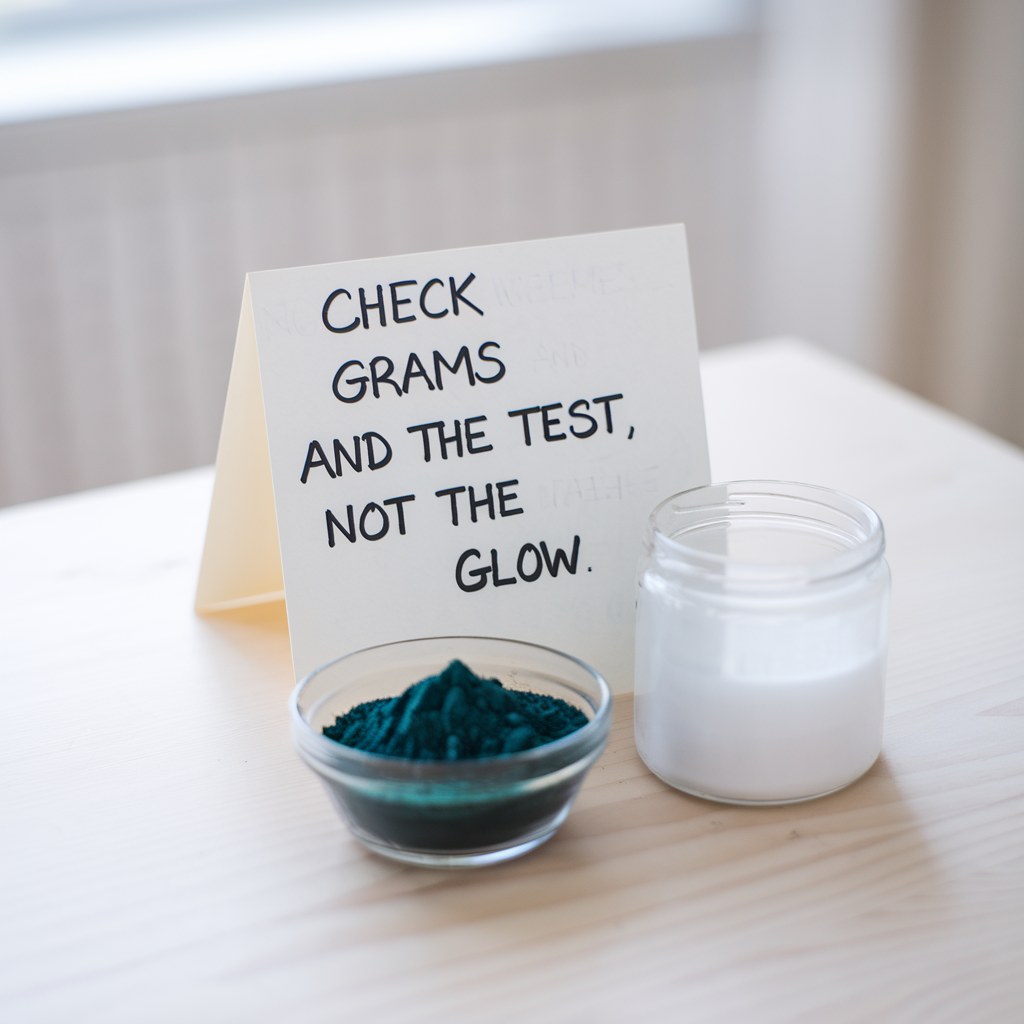
Spirulina gets sold as a green superfood powder, a tablet, and an ingredient in blends. This page covers the serving size, the panel, and the contaminant checks. It doesn't cover immunity, detox, or anemia claims.
Before you decide
Write down what you think a serving is. If your answer is "a spoonful," the label still owes you grams. If it's "it's a superfood, so the amount doesn't matter," that's marketing talking. And if you already use another green powder, chlorophyll drops, chlorella, or an algae-oil omega-3, those are different products. Don't add them up in your head as if they were one ingredient.
The NIH Office of Dietary Supplements (ODS) doesn't publish a dedicated spirulina fact sheet the way it does for vitamins and minerals. NCCIH's safety index also sends readers to general blue-green algae information rather than a spirulina-only page. That gap is useful to know. It means we rely on FDA language, food-composition data, and testing basics, and we don't invent an official daily spirulina dose.
What spirulina is (and what it is not: chlorella, chlorophyll drops, algae oil)
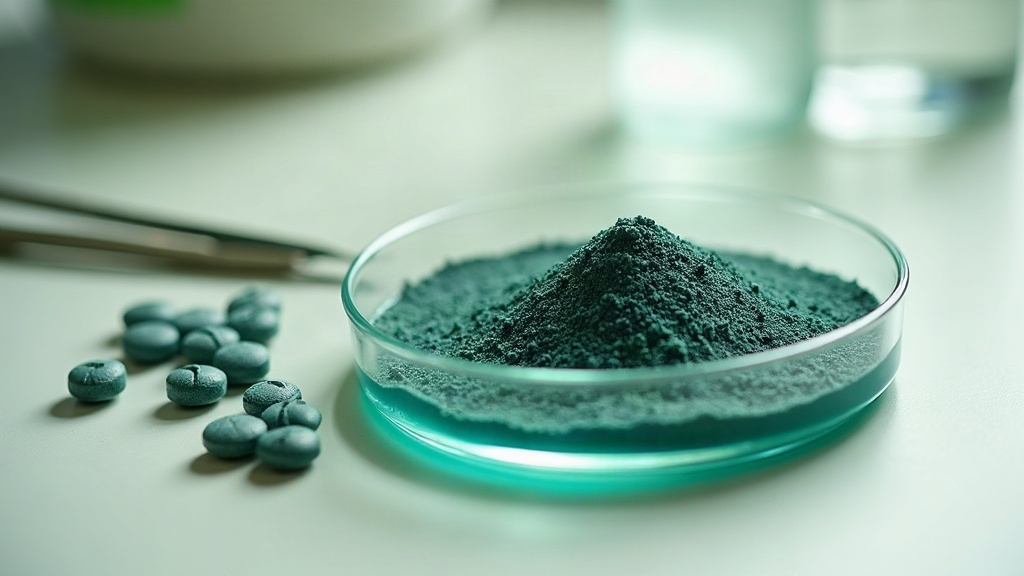
What's sold as spirulina is a cyanobacterium, most often from the genus Arthrospira (you'll still see the older name Spirulina on labels). It's grown in water, then dried into a powder or pressed into tablets. It's a type of blue-green algae, which is why FDA discusses it alongside other cyanobacteria products.
It isn't chlorella, a different green alga with its own cell wall and its own bottles. It isn't liquid chlorophyll, which we've already looked at skeptically in does liquid chlorophyll do anything. It isn't algae oil, the EPA/DHA product we cover in vegan omega-3 algae oil. And it isn't the algae used in some calcium products. "Algae" on a label tells you the family, not the exact organism.
Another cyanobacterium you may see in the same aisle is AFA, Aphanizomenon flos-aquae, often wild-harvested. FDA's microcystin work has focused on AFA from lakes where toxin-producing Microcystis can grow nearby. Spirulina grown in controlled ponds isn't automatically contaminated. It isn't automatically clean either. The test still matters.
Serving size on real labels: grams, teaspoons, and tablets
Powder labels often use 3 grams, 1 teaspoon, or 1 tablespoon as a serving. Those aren't interchangeable. A tablespoon of fluffy dried powder can weigh a lot more than a teaspoon, and two brands can pack a "teaspoon" differently. Tablets usually list milligrams per tablet, such as 500 mg. Six tablets only add up to 3 grams if each one is truly 500 mg of spirulina and not 500 mg of a blend.
FDA tells consumers to follow the directions on the label and not to take more than the labeled amount. That matters most for children. In FDA's 2016 testing of blue-green algae products, most labels were written for adults, while some also listed amounts for children under 12. FDA advises checking with a pediatrician before giving a child a dietary supplement. An adult serving isn't automatically a child-sized serving.
We won't invent a therapeutic dose. A labeled 3 gram serving shows how brands portion the powder. It isn't a medical target.
What Supplement Facts usually lists (protein, % DV, extras)
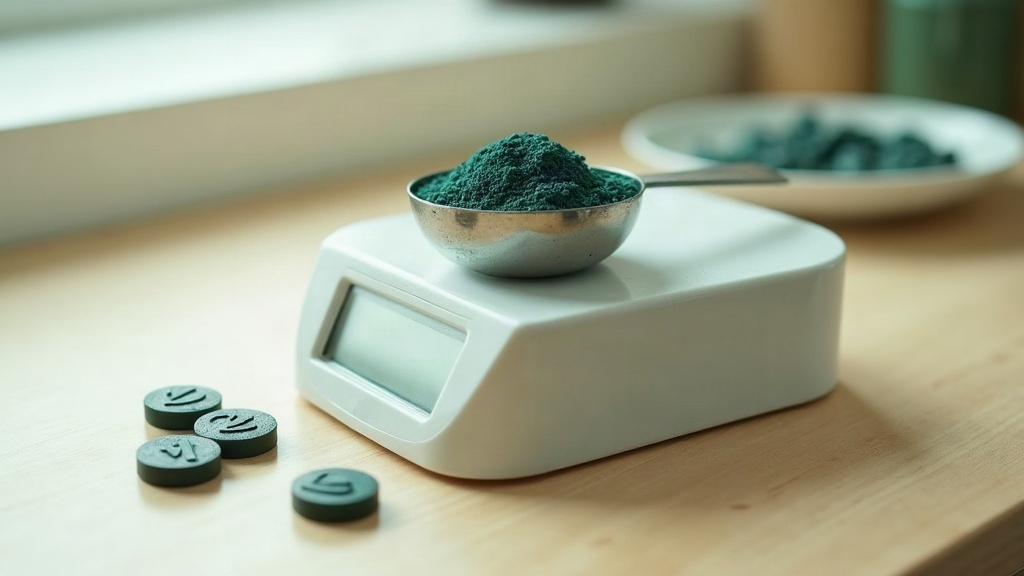
USDA FoodData Central lists dried spirulina as a protein-dense powder with a mix of vitamins and minerals. That's useful context for what a green powder is. It doesn't mean spirulina treats a protein gap, fixes iron-deficiency anemia, or replaces food. A 3 gram serving is a small slice of those 100 gram food-composition numbers.
On Supplement Facts you'll often see calories, protein, and a few % Daily Values, either because the brand chose to list them or because a nutrient is present in more than a trivial amount. FDA's Daily Value page explains those percentages, and our supplement label reading guide covers the rest of the panel. Watch for extras: other algae, digestive blends, "greens" proprietary mixes, or added vitamins that make the serving look more impressive than the spirulina itself. If spirulina is buried in a blend, you may not know how many grams you bought. We dig into that problem in do greens powders actually work.
Contaminants worth checking: microcystins, heavy metals, and why source water matters
The FDA page on blue-green algae products and microcystins is the main consumer source we want you to read. Microcystins are natural toxins made by some cyanobacteria, including Microcystis. You can't see, smell, or taste them. FDA says that at significant levels they can cause liver and kidney damage. When it decides whether a product is a concern, the agency uses provisional guidelines from the WHO and the EPA, plus the serving size.
In 2016, FDA scientists surveyed 51 AFA-containing dietary supplements. Many had little to no microcystins. Others sat at or near an informal industry standard. In 2018 and 2020, FDA oversaw Class II voluntary recalls of AFA-based supplements and a beverage after testing found higher microcystin levels than those provisional guidelines, once labeled servings were considered. The recalled lots were linked to AFA harvested between 2015 and 2017. That history is a reason to ask for testing. It isn't a reason to assume every green powder on the shelf is unsafe.
Heavy metals are the other routine question for anything grown in water. Cyanobacteria can take up metals from the water they grow in. FDA's color-additive specification for spirulina extract (used as a food color, not a blanket safety certificate for every supplement) requires the extract to meet limits for lead, arsenic, and mercury and to test negative for microcystin toxin. That rule tells you what FDA required for that specific color additive. It doesn't mean every spirulina tablet was tested to the same standard. You still want a lot-level certificate or a seal you can verify. The same metals question comes up with protein powders, which we cover in lowest heavy metal protein powders.
How to read a test or seal without over-trusting the marketing
A leaf icon or the words "tested for purity" aren't a method. We've already unpacked what NSF, USP, Informed, and similar programs actually check in third-party tested supplements, so we won't repeat the seal rules here. For spirulina, the questions to ask of a certificate of analysis (COA) are simple:
- Does it name a lot number you can match to your bottle?
- Does it test for microcystins, or only for "purity" in general?
- Are heavy metals reported with units and limits?
- Is the lab named, and is the method more than one marketing sentence?
FDA also suggests checking current recall alerts and reporting problems through its usual channels. That's basic consumer hygiene, not panic.
The practices FDA discussed with AFA harvesters make a handy checklist, even for cultured spirulina: checking the harvest for other cyanobacteria, testing water and biomass at harvest, testing again before sale, using more than one method, and giving buyers a lot-level COA. You can't do any of that at home. You can ask whether it happened. A company that says "we test everything" with no lot number is telling you much less than one that shares a dated COA.
Source water matters because microcystins and metals come from where the algae grew, not from the color of the powder. Pond-grown spirulina and lake-harvested AFA come from different supply chains. A dark green color, a "raw" claim, or a harvested-from-nature story won't tell you which one you bought, and a nice story doesn't replace a contaminant panel. If the ingredient list only says "blue-green algae," ask which organism it is. FDA notes that labels may say "blue-green algae" or name Aphanizomenon flos-aquae specifically. If spirulina is what you meant to buy, it should be named as spirulina or Arthrospira.
Powder vs tablets vs blends
Powder makes the serving weight easy to see if the label uses grams. It also makes it easy to take more than you meant if you scoop by eye. Tablets fix the portion but can hide how many tablets equal the grams you thought you were getting. Blends are the hardest to read, because spirulina may be one line among many. If you're buying spirulina for spirulina, a single-ingredient panel is easier to check.
Who should be extra cautious, without turning this into a clinic visit script
FDA advises checking with a healthcare provider before buying or using a blue-green algae supplement if you're pregnant, nursing, or have a chronic medical condition, and checking with a pediatrician before giving one to a child. We'll stick to that wording. We won't declare spirulina safe in pregnancy, safe for everyone, or unsafe for everyone.
People who react to other algae or to iodine-containing sea products sometimes approach green powders with caution. If you have a known allergy or thyroid condition, that's a reason to involve a clinician. It's not a diagnosis we'll make from a keyboard. And no, spirulina isn't a detox, an antiviral, or a protein prescription.
FAQ
Is spirulina the same as chlorella? No. They're different organisms sold in similar-looking jars. This page is about spirulina.
How much is a serving? Whatever the label lists, ideally in grams. A kitchen teaspoon is only as accurate as the weight behind it. Add tablets up in milligrams.
Does NIH have an official spirulina dose? We didn't find a current NIH ODS spirulina fact sheet. Treat labeled servings as labeled servings, not as a government dosage schedule.
What are microcystins? Toxins that some cyanobacteria make. FDA has found them in some blue-green algae products and has explained how it evaluates risk and handles recalls. Ask whether your lot was tested.
Is a third-party seal enough? Only if you know what the seal checks. Start with our third-party testing explainer.
Can spirulina replace protein food or treat anemia? No. Food-composition data describe nutrients in a dried powder. They don't turn a teaspoon into medical nutrition.
The bottom line
If you buy spirulina at all, buy a labeled powder or tablet with a serving you can weigh and a test you can read. Don't confuse it with chlorella, chlorophyll drops, or algae oil. Use FDA's blue-green algae guidance for microcystins and our third-party testing page for seals. Leave immunity, detox, and disease treatment claims on the shelf.
Next steps:
- Read FDA's page on blue-green algae products and microcystins, linked above.
- Decode seals and certificates with third-party tested supplements.
- If a greens product is really chlorophyll water, see does liquid chlorophyll do anything.
- Our review method is in how we review supplements.
This article is for informational purposes and is not medical advice. It is not meant to diagnose, treat, cure, or prevent any disease. Talk with a licensed clinician before starting a supplement, especially if you are pregnant, nursing, taking prescription medication, or managing a chronic condition.
Reviewed by the UsefulVitamins Editorial Team.