
Stress and mental “noise” can make it hard to focus during the day and even harder to fall asleep at night. The best L-theanine supplements make that edge feel more manageable by supporting calm alertness – often without the heavy, sedating feeling people get from stronger sleep aids. This guide compares top L-theanine formats (capsules, powders, gummies, and caffeine stacks), explains what dose actually matches the research, and shows you what to look for on labels so you can choose a product that fits your goal and routine.
Summary / Quick Answer
The best L-theanine supplements are typically single-ingredient, 100-200 mg per serving, and made with a well-identified source (often the branded form Suntheanine) plus clear quality controls like GMP or third-party testing.
Quick picks by goal (most common use-cases):
- Pure, research-aligned L-theanine: Look for Suntheanine in 100-200 mg capsules.
- Sleep support (without heavy sedation): L-theanine 200 mg, sometimes paired with magnesium or calming botanicals.
- Focus without jitters: A 2:1 L-theanine:caffeine combo (example: 200 mg theanine + 100 mg caffeine).
- Best budget / custom dosing: L-theanine powder (measure carefully).
- Best for athletes who need testing reassurance: Products with NSF Certified for Sport.
Most people start here: 100-200 mg once daily, then adjust based on response.
Best L-theanine supplements: top picks by goal (and why they stand out)
If you have ever bought a “calm” supplement and felt nothing, the issue is often not L-theanine itself. It is the mismatch between dose, form, and your goal. L-theanine tends to be subtle, and that is part of its appeal. It supports relaxation without automatically pushing you toward sleep.
A practical way to choose is to start with the outcome you want, then match a product type to it.
Top products and who they fit best
| Goal | What to look for | Typical serving | Why it works well |
|---|---|---|---|
| Calm focus (daytime) | Pure L-theanine capsules | 100-200 mg | Easy to control dose, minimal extras |
| Sleep support (evening) | L-theanine + sleep-friendly add-ons | 200 mg | Calming support without “knockout” effects |
| Deep work + caffeine | 2:1 theanine:caffeine formula | 200 mg + 100 mg caffeine | Smoother stimulation, fewer jitters for many |
| Budget + flexibility | Powder | 100-200 mg (measured) | Lowest cost per gram, adjustable |
| Simplicity + compliance | Gummies or softgels | 100-200 mg | Convenient, but check sugar and additives |
Brands frequently cited for quality controls and clear labeling include Swanson (Suntheanine options), NOW Foods (GMP), Thorne (NSF Certified for Sport), Nootropics Depot (caffeine + theanine stacks), and BulkSupplements (powder). Consumer testing reports also commonly highlight that not all labels are equal, so it is worth favoring companies that publish testing standards or use recognized certifications.
A quick “label checklist” before you buy
- Dose per serving: 100-200 mg is the most common research-aligned range.
- Ingredient identity: “L-theanine” is fine, but “Suntheanine” signals a standardized, branded source used in many studies.
- Testing and manufacturing: Look for GMP, NSF, or credible third-party testing.
- Form that matches your routine: Capsules for simplicity, powder for precision, gummies if compliance is the main barrier.
If your goal is anxiety-style tension, pair this article with UsefulVitamins’ structured anxiety supplement protocol and the broader roundup of stress relief supplements to see where L-theanine fits compared with magnesium, saffron, and adaptogens.
What L-theanine does (and what it doesn’t): benefits backed by research
Swanson L-Theanine 200 mg, 60 Capsules
This product contains pure L-theanine at a research-aligned dosage of 200 mg per serving, making it ideal for calm focus during the day.
L-theanine is an amino acid found naturally in tea leaves, especially green tea. People often describe its effect as “taking the edge off” without feeling dulled. That description lines up with what researchers measure in controlled trials: changes in stress perception, sleep quality, and attention – particularly under demanding conditions.
Evidence-based benefits people use it for
Research suggests L-theanine may help with:
- Stress and tension: supporting a calmer state during acute stress.
- Sleep quality: improving subjective sleep quality, especially when stress is the barrier.
- Attention and focus: particularly when paired with caffeine.
- Mild anxiety symptoms: without acting like a sedative for most users.
For example, a clinical trial indexed in the PubMed record for Hidese et al. (2019) reported that daily L-theanine intake (commonly 200-400 mg in studies) improved aspects of sleep and reduced stress-related symptoms in healthy adults. Other controlled studies have also explored attention and relaxation effects, including work summarized in the research literature on caffeine + theanine combinations.
What it usually won’t do
It helps to set expectations. L-theanine is not typically the best choice if you want:
- A strong, immediate “knockout” sleep effect (melatonin or certain antihistamines feel more forceful).
- A stimulant-like surge in motivation (that is more caffeine, tyrosine, or prescription territory).
- A cure for chronic anxiety disorders (it may support symptoms, but it is not a stand-alone treatment).
How it compares to common alternatives
Here is a simple comparison many readers find clarifying:
| Option | Best for | Typical feel | Watch-outs |
|---|---|---|---|
| L-theanine | Calm alertness, stress-related sleep issues | “Smoother” mind | Can feel too subtle for some |
| Melatonin | Sleep timing, jet lag | Sleepier | Too high a dose can cause grogginess |
| Magnesium glycinate | Stress, sleep quality | Body relaxation | GI effects in some people |
| GABA | Occasional calm | Variable | Effects vary widely |
If you are building a broader cognition stack, L-theanine often pairs well with other tools, but it should be done intentionally. UsefulVitamins’ supplement stacking guide can help you avoid redundant ingredients and overly sedating combinations.
L-theanine dosage and timing: how to use it for focus vs sleep
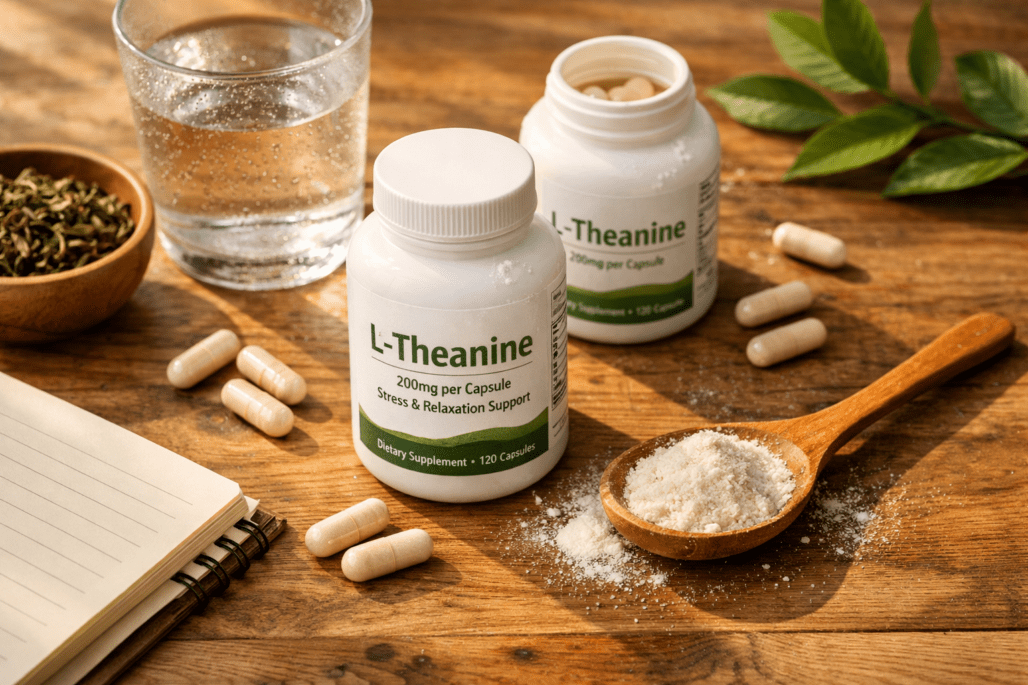
NOW Foods L-Theanine 200 mg, 60 Veg Capsules
This product offers L-theanine in a vegetarian capsule format, supporting relaxation without sedation, suitable for evening use.
Most supplement labels cluster around 100-200 mg per serving, and that is not arbitrary. It matches the dosing range used in many human studies and is where most people can “feel” the calming effect without unwanted drowsiness.
A practical dosing framework (simple and adjustable)
| Goal | Starting dose | When to take | Notes |
|---|---|---|---|
| Daytime calm | 100 mg | Morning or early afternoon | Increase to 200 mg if needed |
| Focus with caffeine | 200 mg theanine + 100 mg caffeine | Morning | The common 2:1 ratio is popular for smoother energy |
| Stress-related sleep trouble | 200 mg | 30-60 minutes before bed | Consider pairing with a sleep routine |
| Higher-stress periods | Up to 400 mg per day (split) | AM + PM | Many studies use 200-400 mg total |
A recurring theme in clinical use is that more is not always better. Going above 400 mg daily may not add much for many people, and it can tip some users into mild sleepiness.
Timing tips that actually matter
- For focus: Take L-theanine with caffeine, not hours later. Many people notice the “smoother” effect when both peak together.
- For sleep: If your problem is a racing mind, L-theanine often fits well 30-60 minutes before bed.
- For afternoon anxiety: Consider 100-200 mg mid-afternoon, but avoid pairing with late caffeine if sleep is fragile.
Stacking: what pairs well (and what to be careful with)
Common combinations:
- L-theanine + caffeine (2:1): Often used for attention and reduced jitters.
- L-theanine + magnesium glycinate: Popular for evening wind-down.
- L-theanine + ashwagandha or saffron: Common in stress-support formulas.
Be careful with:
- Multiple sedating ingredients at once (high-dose melatonin + strong botanicals + theanine), especially if you need to be alert in the morning.
- Caffeine sensitivity: If caffeine makes you anxious, use L-theanine alone or keep caffeine low.
If sleep is your main goal, compare your plan to UsefulVitamins’ sleep supplement protocol so you can choose the smallest effective stack.
How to choose a high-quality L-theanine supplement (testing, forms, and red flags)
BulkSupplements L-Theanine Powder, 100 grams
This powder form allows for flexible dosing, making it a budget-friendly option for those who want to customize their intake.
Nootropics Depot L-Theanine + Caffeine 200 mg + 100 mg, 30 Capsules
Nootropics Depot’s Caffeine 100mg + L-Theanine 200mg capsules offer a researched synergy for enhanced focus, cognitive performance, and smooth mental energy without typical caffeine jitters, as naturally found in green tea; ideal for productivity stacks, but use cautiously due to caffeine content and buy directly from their site since no Amazon listing was found[1][2].
The supplement aisle makes L-theanine look simple, but quality differences show up in three places: source, testing, and form. Think of it like buying olive oil. “Olive oil” on the label is not enough – you want to know where it came from and whether it was tested.
1) Source: Suntheanine vs generic L-theanine
You will often see Suntheanine, a branded form used widely in research and manufacturing. Many shoppers prefer it because it signals:
- tighter raw material specifications
- consistent identity and purity targets
- more traceability than “generic” sourcing
Generic L-theanine can still be good. The key is whether the company provides meaningful quality controls and transparent labeling.
A consumer testing resource like ConsumerLab’s L-theanine supplement review is useful for understanding how independent testing can differ from marketing claims, and what issues sometimes appear in the category.
2) Testing signals that matter
Look for:
- GMP manufacturing (baseline quality standard)
- NSF Certified for Sport if you are drug-tested or cautious about contaminants
- Third-party testing for identity and contaminants (heavy metals, microbes)
No single badge is perfect, but multiple signals together reduce risk.
3) Form: capsule vs powder vs gummy vs “energy shot”
Each form has trade-offs:
| Form | Pros | Cons | Best for |
|---|---|---|---|
| Capsules | Simple, precise dose | Swallowing pills | Most people |
| Powder | Cheapest long-term, flexible | Must measure carefully | Custom dosing, budget |
| Gummies | Easy to take | Sugar, additives, less “clean” | Compliance, taste |
| Softgels | Easy swallow | Fewer “pure” options | Convenience |
| Shots | Fast, portable | Often include caffeine/sweeteners | On-the-go focus |
Red flags to avoid
- “Proprietary blends” that do not list the exact L-theanine dose.
- Extremely high-dose claims without context.
- Multi-ingredient formulas that duplicate sedatives (easy to overdo).
If you are already using cognitive supplements like nootropic mushrooms, keep the rest of your stack simpler at first. That makes it easier to tell what is working.
Common questions and misconceptions (so you don’t waste money)
Most frustration with L-theanine comes down to expectations and timing. Here are the most common sticking points, with practical fixes.
“If 200 mg helps, won’t 600 mg help more?”
Not necessarily. Many studies and real-world protocols cluster around 200-400 mg per day total. Above that, some people just feel more tired, not more calm. If 200 mg feels too subtle, it is often better to adjust timing or pairing rather than endlessly increasing the dose.
Try this instead:
- Take 200 mg at the moment you need calm (before a meeting, commute, or stressful task).
- If using caffeine, aim for the 2:1 theanine:caffeine ratio.
“All L-theanine is the same, right?”
Quality and sourcing can vary. A branded source like Suntheanine is often preferred because it is standardized and widely used in manufacturing. Independent testing also matters. The point is not that generic is “bad,” but that traceability and testing reduce uncertainty.
To see how products are evaluated, summaries like Innerbody’s comparison guide can be helpful for shoppers, especially around testing and formulation details. See Innerbody’s review of L-theanine supplements.
“Will it make me sleepy?”
For most people, L-theanine supports relaxation without heavy sedation. But context matters:
- If you are already sleep-deprived, calm can feel like sleepiness.
- If you stack it with other calming ingredients, the combined effect can be stronger.
Rule of thumb: If you feel drowsy, reduce the dose or move it to evening.
“Is it safe with caffeine?”
For many people, yes. In fact, the combination is popular specifically because L-theanine may smooth some of caffeine’s edge. That said, caffeine sensitivity is real. If caffeine triggers anxiety for you, start with L-theanine alone and keep caffeine low or earlier in the day.
Quick troubleshooting guide
| Problem | Likely cause | Fix |
|---|---|---|
| “I feel nothing” | Dose too low or timing off | Try 200 mg; take it before stress |
| “I’m sleepy” | Dose too high or sedating stack | Drop to 100 mg or move to evening |
| “Still jittery with caffeine” | Too much caffeine | Reduce caffeine or keep 2:1 ratio |
| “Works sometimes” | Variable stress/sleep baseline | Use consistently for 1-2 weeks |
Conclusion
The best results with L-theanine usually come from a simple match: a clean product, a research-aligned dose (often 100-200 mg), and timing that fits your goal. For daytime calm, keep it straightforward. For focus, pair it thoughtfully with caffeine. For sleep, use it as part of a wind-down plan rather than a last-minute fix.
Next step: if stress is the main driver, review UsefulVitamins’ stress relief supplements for complementary options. If sleep is the priority, use the sleep supplement protocol to build a minimal, effective routine that you can actually stick with.
As an Amazon Associate, I earn from qualifying purchases. Product recommendations are based on real reviews and independent research.
