
If you have been scrolling Amazon or Whole Foods and seeing Vital Proteins on every collagen display and wondering whether the brand premium actually delivers something the cheaper tubs do not, the short answer is: Vital Proteins is a legitimately good product, but the premium is mostly paying for brand reach, not dramatically better biochemistry. Grass-fed bovine sourcing, third-party testing, and consistent manufacturing are real quality signals. Whether they are worth 30 to 50 percent more per gram than Sports Research or comparable grass-fed peptides is a math question, not a science question. You will also get a plain-English look at how Vital Proteins built its position, what the research actually supports, and which SKU from the lineup is worth buying at what price point.
Affiliate disclosure: this article contains affiliate links. As an Amazon Associate, UsefulVitamins.com earns from qualifying purchases at no extra cost to you.
Summary / Quick Answer: is Vital Proteins worth the premium?
Yes for buyers who value brand-level quality control and mainstream availability. Probably no for buyers optimizing strictly for cost per gram of equivalent quality. Here is the honest break-down.
Best fit for Vital Proteins
- Buyers who want a brand with consistent batch quality, widespread retail availability, and third-party testing
- First-time collagen users who value brand familiarity while they figure out whether daily collagen fits their routine
- Anyone who prefers the Vanilla or Beauty Collagen variants, which have better flavor engineering than most DTC alternatives
Not ideal for
- Cost-per-gram shoppers willing to buy from Amazon-native brands
- Competing athletes who need NSF Certified for Sport screening (Vital Proteins core line is not certified)
- Buyers sensitive to added sugars or flavorings (stick to the Unflavored SKU)
Decision shortcut
- Want the mainstream default: Unflavored 20oz tub
- Want flavored for coffee: Vanilla
- Want the skin-support angle and do not mind paying more: Beauty Collagen
What Vital Proteins is known for
Vital Proteins launched in 2013 as a direct-to-consumer collagen startup built around grass-fed bovine sourcing and the ambition of making collagen a daily-use wellness product rather than a niche bodybuilding supplement. The brand achieved mainstream traction partly through deliberate celebrity associations. Jennifer Aniston became a paid brand ambassador in 2020, and Kourtney Kardashian had previously built a cottage industry around "Vital Proteins in morning coffee" content. Neither endorsement is an evidence signal for the product, but both accelerated retail-shelf demand.
In 2020 Vital Proteins was acquired by Nestlé Health Science, which is worth knowing as context rather than a judgment. The acquisition brought the brand into mainstream distribution channels at scale, which is why you now see it in Whole Foods, Target, CVS, and every major Amazon collagen section. It also means the brand is no longer a scrappy startup, which affects how you weigh the brand-premium story.
The core product line is grass-fed pasture-raised bovine hydrolysate, third-party tested for heavy metals, with batch-level consistency that is objectively better than most smaller DTC competitors. The peptides are not branded (Vital Proteins does not use VERISOL, Peptan, or CH-Alpha labeled fractions). The formulation is generic hydrolyzed bovine collagen type I and III, at a molecular weight profile typical of the category.
Actionable takeaway: Vital Proteins is the most-distributed quality collagen brand in the United States. You are paying partly for that distribution, partly for the Nestlé-scale quality control, and partly for the brand premium built through marketing. None of those are bad reasons to pay more; they just are not chemistry reasons.
What makes Vital Proteins "premium"
When a brand charges a premium, the honest question is what that premium is actually buying. For Vital Proteins, three real things:
Source transparency and consistency. The grass-fed, pasture-raised bovine sourcing is documented and third-party verified. Smaller DTC brands make the same claim with less supply-chain oversight, which matters more than most buyers realize. If you are buying collagen to take daily for a year, batch consistency is a quality signal worth paying for, within limits.
Manufacturing and testing. Vital Proteins publishes certificates of analysis for heavy metals and discloses manufacturing practices. Post-Nestlé acquisition, the quality-assurance floor tightened further because Nestlé's internal compliance standards are stricter than most independent supplement brands. This is defensible.
Brand premium. The remaining 30 to 50 percent of the price gap versus Sports Research or equivalent grass-fed alternatives is brand equity: shelf placement, ambassador marketing, packaging, trust built through visibility. Premium brand reputation is not the same thing as premium results per dollar. The molecule in the tub is hydrolyzed grass-fed bovine collagen, the same molecule in the Sports Research tub that costs 25 to 35 percent less per gram.
A note on certification: Vital Proteins does have a separate "Vital Proteins Sport" line that is NSF Certified for Sport, but the core Collagen Peptides Unflavored line and the Beauty Collagen line are not. If banned-substance screening matters to you, buy the Sport-labeled SKU or a different NSF-certified brand like Momentous. Assuming the core line is certified because the brand is mainstream is a common and costly mistake.
Actionable takeaway: The quality floor is genuine, the certification claim is not universal across SKUs, and a meaningful portion of the price is brand rather than biochemistry. Knowing which portion is which changes the value calculation.
What the research shows for collagen (not brand-specific)
No head-to-head trial has compared Vital Proteins against a generic grass-fed bovine collagen and measured clinical outcomes. The closest you get is the general collagen peptide evidence base, which supports hydrolyzed bovine collagen in a specific dose range, regardless of brand.
In Proksch et al. 2014 (PMID 24401291), 114 women aged 45 to 65 took 2.5g of VERISOL branded bovine collagen peptides daily for 8 weeks. Eye wrinkle volume dropped by roughly 20 percent versus placebo, with significant increases in procollagen type I (65 percent) and elastin (18 percent). Note: VERISOL is Gelita's branded peptide fraction, not Vital Proteins's proprietary blend, so this trial supports the category rather than this specific brand.
In a companion 2014 study, Proksch et al. (PMID 23949208) tested 69 women aged 35 to 55 on 2.5g or 5g of bovine collagen hydrolysate daily for 8 weeks. Skin elasticity improved by up to 30 percent in the 5g group versus placebo. This is again brand-agnostic evidence.
For joint outcomes, Clark et al. 2008 (PMID 18416885) studied 147 athletes taking 10g of bovine collagen hydrolysate daily for 24 weeks with significant reductions in activity-related joint pain. Vital Proteins at 20g per two-scoop serving easily meets this dose range.
Actionable takeaway: The research supports the category, the dose range, and the general peptide form. It does not single out Vital Proteins over any other quality hydrolyzed bovine collagen. If a brand ambassador told you Vital Proteins specifically is trial-proven, they are overstating what the evidence actually says.
Is it worth the price?
The math works out roughly like this. Vital Proteins Unflavored 20oz typically runs $0.42 to $0.50 per gram of collagen at full retail. Sports Research grass-fed bovine runs $0.28 to $0.38 per gram for an equivalent-quality product. At a 10g daily dose over 30 days, that is $126 to $150 per month for Vital Proteins versus $84 to $114 for Sports Research. The annual difference is roughly $400 to $500.
Whether that gap is worth it depends on what you are actually paying for.
The real question is not whether Vital Proteins is good, it demonstrably is, but whether good is worth the 30 to 50 percent premium over Sports Research or Great Lakes Wellness. If you value retail shelf availability (buying at Target or Whole Foods) and you want the brand name on your pantry shelf, the premium is defensible. If you are a daily Amazon-only user indifferent to retail presence, the premium is mostly paying for things you are not using.
Actionable takeaway: Vital Proteins is a justified choice at premium pricing if brand and distribution matter to you. It is an overpaid choice if cost per gram is your primary optimization target. Both answers are reasonable.
Our picks from the Vital Proteins lineup
If you have decided Vital Proteins is the brand for you, these are the three SKUs worth ranking.
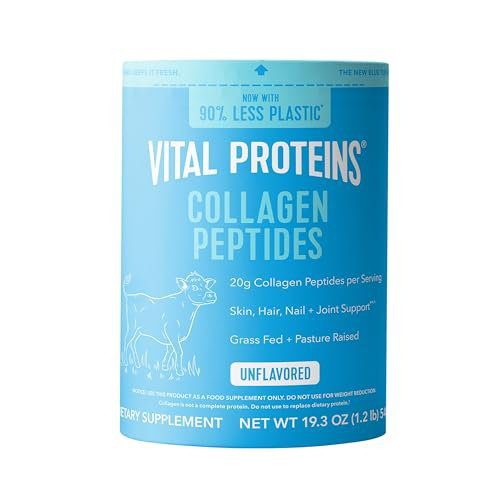
Vital Proteins Collagen Peptides Powder – Grass Fed Collagen Peptides for Hair, Nail, Skin, Bone & Joint Health, Unflavored, 27 Servings
Default pick for the brand with 20g per two-scoop serving of grass-fed unflavored hydrolysate, the SKU that 8 out of 10 Vital Proteins buyers start with.
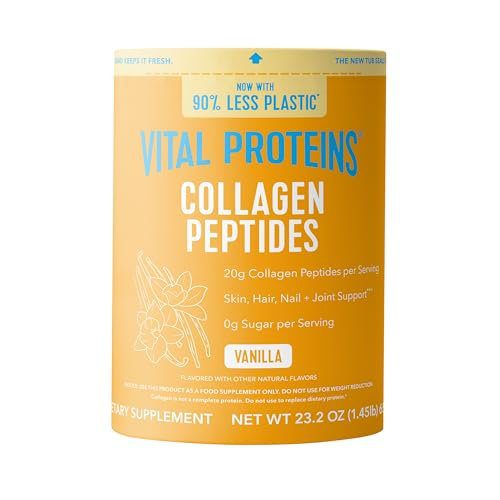
Vital Proteins Collagen Peptides Powder – Grass Fed Collagen Peptides for Hair, Nail, Skin, Bone & Joint Health, Vanilla, 23.2 Ounces
Flavored variant of the core formula with natural vanilla and a small amount of sugar, same grass-fed hydrolysate base, useful if black-coffee stir-in is too bitter for you.
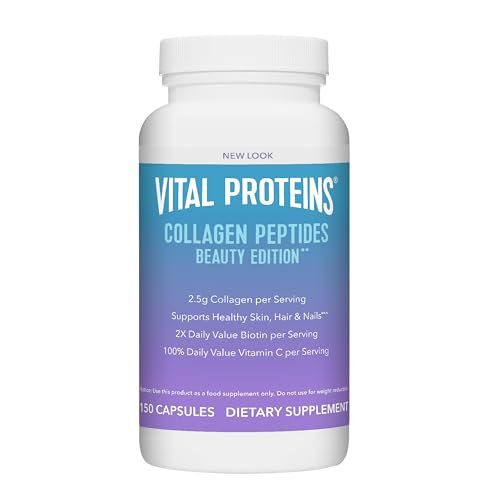
Vital Proteins Collagen Peptides Beauty Edition Capsules, 2.5g of Collagen Per Serving with Biotin and Vitamin C, 30 Servings
Premium-tier variant with added hyaluronic acid, vitamin C, and probiotics, marketed for skin, though the core collagen evidence does not require the extras.
FAQ
Is Vital Proteins the same product as Vital Proteins Beauty Collagen? No. The core Collagen Peptides line is single-ingredient bovine hydrolysate. Beauty Collagen adds hyaluronic acid, vitamin C, and probiotics at a premium price. The core collagen dose is smaller in Beauty Collagen, and the added ingredients are not individually evidence-matched for dramatic skin benefits beyond what the collagen alone provides.
Is it safe during pregnancy? Collagen peptides have a long general safety record, but pregnancy-specific guidance should come from your OB-GYN. Vital Proteins does not make pregnancy-specific claims on the core line, and the Beauty Collagen line explicitly is not positioned for pregnancy use.
Why is it so much cheaper at Costco? Costco negotiates bulk pricing on the same SKUs that retail at Whole Foods or directly from Vital Proteins. The product is identical. The cost gap is distribution margin, not quality. If you have a Costco membership, that is often the best price on the Unflavored 20oz tub.
Does the Vanilla contain real vanilla or flavoring? Natural vanilla flavor, plus a small amount of added sugar (check current label for grams per serving). If you are sugar-sensitive, the Unflavored SKU is the cleaner choice.
Can I take it alongside HRT, multivitamins, or other supplements? Generally yes, but confirm with your prescriber. Collagen is an amino-acid source with no known interactions with common medications. Pair it with vitamin C if collagen synthesis is your specific goal.
If you are managing a protocol like this, StackMyMed (our companion app) keeps your doses, timing, and interaction checks in one place. It does not replace medical advice — bring the log to your clinician.
Conclusion: the bottom line on Vital Proteins
Vital Proteins is a mainstream, quality-floor-verified, widely-distributed collagen brand that delivers a defensible product. The premium you pay over Sports Research or Great Lakes Wellness is roughly 30 to 50 percent more per gram, and that premium is buying brand equity, distribution, and Nestlé-scale quality control rather than dramatically different biochemistry.
For a buyer who values brand, availability, and the comfort of a mainstream name, that premium is easily justified. For a buyer optimizing for cost per gram of equivalent quality, better value exists a few brands over. Neither answer is wrong; the variables you care about decide the call.
Next steps
- See the broader roundup: Best Collagen Peptides in 2026: 8 We'd Actually Buy (and 3 to Skip)
- Start with the foundation: Peptides Explained: The Honest 2026 Guide to What Works, What's Hype, and What's Risky
As an Amazon Associate, I earn from qualifying purchases. Product recommendations are based on real reviews and independent research.
