
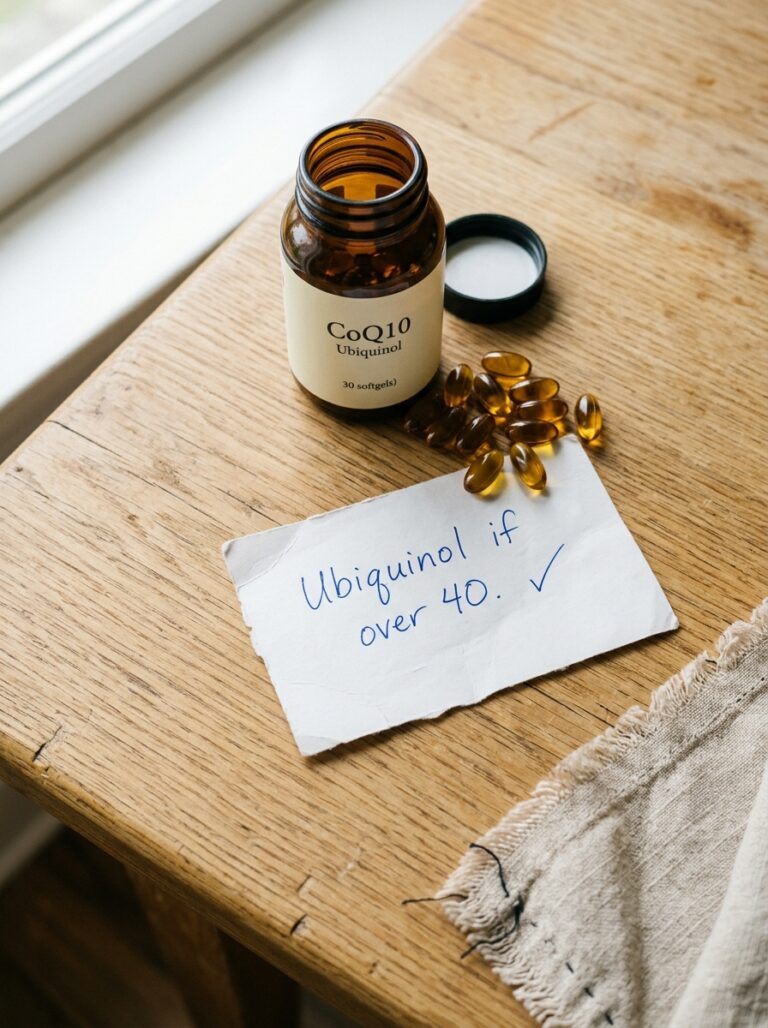
If you're looking at a CoQ10 bottle, you've probably noticed two things: it costs more than most supplements, and it comes in two forms with similar names. The marketing tells you it's for "energy," "the heart," and "anti-aging" all at once. The evidence is far more selective than that. Some uses have a real randomized trial behind them; others are riding on a mechanism that sounds good and a price tag that feels premium.
This guide grades CoQ10 by how strong the evidence actually is, so you can tell where it earns its cost and where you're paying for a story.
Before you decide
CoQ10 is a supplement, not a treatment, and the order of operations matters. If you have heart failure, the thing doing most of the work is your guideline-directed regimen: the ACE inhibitor or ARNI, the beta-blocker, the mineralocorticoid antagonist. CoQ10 is a layer on top of that standard of care, not a substitute for any of it. If you're skipping the prescribed treatment, the supplement conversation is moot.
The one interaction to clear before you start is warfarin. CoQ10 is structurally similar to vitamin K, which is exactly the pathway warfarin acts on, so there's a plausible mechanism for reduced anticoagulant effect. The clinical data are mixed, but this is a narrow-margin drug where you don't gamble on "probably fine."
If you take warfarin, treat CoQ10 as something to discuss with the clinician who manages your INR, not a solo add-on. The same caution applies if you're on insulin or in active cancer treatment, where CoQ10 has documented or theoretical interactions.
If none of that applies, the honest first question is whether you have a target the evidence can hit. "More energy" and "anti-aging" are not targets. A diagnosed condition, a specific symptom, or a defined risk profile is. You can see how I weigh evidence and conflicts of interest on the how we review supplements page.
What CoQ10 actually is
Coenzyme Q10 is a fat-soluble compound your body makes on its own, with the highest concentrations in the heart, liver, kidneys, and pancreas – the organs that burn the most energy. That distribution is the clue to what it does.
Its main job is inside the mitochondria, the part of the cell that produces ATP, the molecule your cells run on. CoQ10 shuttles electrons through the chain that ultimately generates that energy, which is why tissues with high metabolic demand carry the most of it. It also acts as a fat-soluble antioxidant, protecting cell membranes from oxidative damage.
Here's the part the "energy supplement" marketing leaves out: a healthy body synthesizes its own CoQ10, and a healthy person isn't running short. Supplementing doesn't push a normal level higher in a way that translates into feeling more energetic. The cases where it plausibly helps are ones where production or absorption has dropped, or where a specific tissue is under strain.
Two things lower your CoQ10: age and statins. Levels decline gradually from middle age onward, and statins, by blocking the same upstream pathway that makes cholesterol, also reduce CoQ10 synthesis. Both facts show up later in this guide, because they define who has a reason to consider it at all.
Ubiquinol vs ubiquinone (the absorption question)
CoQ10 exists in two interconvertible forms. Ubiquinone is the oxidized form; ubiquinol is the reduced form. Your body shifts between the two constantly as CoQ10 does its job, and notably, even when you swallow ubiquinone, most of what appears in your blood ends up as ubiquinol – the body converts it after absorption.
That conversion is why the form debate is narrower than the marketing suggests. The relevant question isn't which form is "active," because your body uses both. It's which form your gut absorbs more efficiently, and that depends on who you are.
In a comparison of plasma CoQ10 after supplementation, ubiquinol raised blood levels more than ubiquinone over four weeks. But other crossover work has found absorption is highly variable between individuals and, in younger healthy adults, not reliably different by form. The pattern that holds up: ubiquinol's absorption edge is clearest in older adults, where the gut handles the oxidized form less well.
| Form | What it is | Absorption edge | Worth the premium? |
|---|---|---|---|
| Ubiquinone | Oxidized form; the original and cheaper version | Adequate in younger adults; converts to ubiquinol after absorption | Yes, if you’re under ~40 and healthy |
| Ubiquinol | Reduced form; pre-converted, less shelf-stable, costs more | Higher plasma CoQ10 in older adults in head-to-head data | Yes, once absorption falls off with age (~40+) |
This is the single distinction the card on this guide turns on, and I unpack the head-to-head data in the CoQ10 vs ubiquinol absorption breakdown. The short version: paying the ubiquinol premium makes sense mainly past 40; before that, well-absorbed ubiquinone with a meal does the job.
Where the evidence is real (and where it isn't)

Most CoQ10 content treats every use as equally proven. It isn't. Graded by trial strength, the picture sorts into a clear hierarchy.
The strongest evidence is in chronic heart failure, as an add-on to standard care. The landmark trial is Q-SYMBIO, a randomized double-blind study that gave patients with moderate-to-severe heart failure 100 mg of CoQ10 three times daily, or placebo, on top of their guideline therapy. Over two years, the CoQ10 group had significantly fewer major adverse cardiovascular events, and a European subgroup analysis confirmed reductions in all-cause mortality and cardiovascular mortality. That's a hard mortality endpoint from a randomized trial – the kind of evidence most supplements never produce.
Statin-associated muscle symptoms are the genuinely mixed case. The mechanism is real: statins lower CoQ10. But the trials disagree. A 2025 analysis in long-term statin users found no meaningful reduction in muscle symptoms, and overall the literature splits roughly down the middle, with some meta-analyses showing a small reduction in pain and others showing none. The effect, where present, is modest. Anyone who tells you CoQ10 reliably fixes statin muscle pain is overstating a divided body of evidence.
Migraine prevention has a real but limited signal. A randomized controlled trial of CoQ10 for migraine prophylaxis found 100 mg three times daily cut attack frequency, with a 50% responder rate of about 48% versus 14% on placebo. Pooled analyses since have found CoQ10 reduces attack frequency by roughly two per month, with little effect on attack severity or duration. It's a reasonable adjunct, not a first-line therapy.
Fertility is the most preliminary of the four. In a randomized trial of CoQ10 pretreatment before IVF in young women with diminished ovarian reserve, the CoQ10 group had more retrieved oocytes and more high-quality embryos. The catch: live birth and clinical pregnancy rates trended higher but did not reach statistical significance. The intermediate markers improved; the endpoint that matters most hasn't been proven.
Who actually benefits
Stack those four uses against real-world groups and a short list of people emerges who have an evidence-based reason to consider CoQ10 – and a much larger group who don't.
People with chronic heart failure have the best case, because the Q-SYMBIO trial tested CoQ10 as an adjunct in exactly that population and found a mortality benefit. This belongs in a conversation with the cardiologist directing the regimen, not as a self-prescribed swap for any prescribed drug. The supplement is the layer; the guideline therapy is the foundation.
Statin users with muscle symptoms sit in a defensible-but-uncertain middle. Given the mixed evidence and CoQ10's strong safety record, a time-limited trial – say, 8 to 12 weeks while you and your doctor track whether the muscle complaints ease – is reasonable. Just go in knowing the odds are a coin flip, not a guarantee. I go deeper on this in CoQ10 for statin users.
Adults over roughly 40 are the group for whom the form question matters most, because that's when both natural CoQ10 levels and absorption efficiency start to decline. This is also the longevity-supplement crowd, and the honest framing is the same one I apply across longevity supplements: plausible mechanism, thin proof of life extension.
Who probably doesn't benefit: a healthy adult under 40 with no diagnosis, taking CoQ10 for "energy." There's no good evidence it lifts energy or performance in people who aren't deficient, and your money is better spent elsewhere. If energy is the goal, it is worth understanding how CoQ10 compares with PQQ for energy before paying for either.
Dose and how to take it
Effective doses cluster higher than most supplements. The heart failure and migraine trials used 100 mg three times daily, or 300 mg total, and the fertility and statin studies generally fell in the 100 to 300 mg/day range. General "wellness" products often contain 30 to 100 mg, which sits below most of the studied therapeutic doses.
Two practical rules govern absorption, and both come straight from CoQ10's chemistry.
First, take it with a fat-containing meal. CoQ10 is fat-soluble and poorly absorbed on its own – oral absorption is only a few percent. Taking it alongside dietary fat meaningfully improves uptake, so pair it with breakfast or dinner, not water on an empty stomach.
Second, split doses above 100 mg. Absorption is saturable, so a single large dose is taken up less efficiently than the same amount divided. The trials that used 300 mg gave it as 100 mg three times a day, and dividing doses also reduces the minor digestive upset some people get at higher amounts.
On form: under 40 and healthy, ubiquinone with a meal is fine and cheaper; past 40, ubiquinol is the better-absorbed choice. When you're ready to compare specific products, I keep a vetted shortlist in the best CoQ10 supplements roundup. Give any use four to twelve weeks before judging it – these are not same-day effects.
Side effects and interactions
For most people, CoQ10 is well tolerated. NCCIH reports no serious side effects, with mild effects like insomnia or digestive upset occurring in a small minority. The GI complaints – nausea, heartburn, loose stools – tend to show up at higher single doses and usually ease when the dose is split across the day.
The interaction that deserves real attention is warfarin. Because CoQ10 resembles vitamin K structurally, it can plausibly blunt warfarin's anticoagulant effect, risking treatment failure. A randomized crossover trial found no clinically significant change in warfarin dosing, but observational data have linked CoQ10 to bleeding events, and the trials don't fully agree. The safe move on a narrow-therapeutic-index drug is clear it with the clinician managing your INR before starting, and have your anticoagulation rechecked after you do.
A few smaller cautions: CoQ10 may interact with insulin and may not be compatible with some cancer treatments, so it's not a "start it and see" supplement during active chemotherapy. And if you have a cardiovascular diagnosis, the supplement supports standard care – it doesn't replace it, and it isn't a cure for any condition.
FAQ
Is ubiquinol really worth the extra cost?
Mainly if you're over about 40. That's when CoQ10 absorption falls off and ubiquinol's better-absorbed edge shows up most clearly in head-to-head data. Under 40 and healthy, well-absorbed ubiquinone with a fatty meal is usually fine and costs less.
Does CoQ10 give you more energy?
Not in people who aren't deficient. It's central to how cells make energy, but supplementing a normal level doesn't translate into feeling more energetic. The "energy supplement" framing outruns the evidence.
Should I take CoQ10 if I'm on a statin?
It's a reasonable, low-risk trial if you have muscle symptoms, but go in clear-eyed: the evidence is genuinely split, with some trials showing a small reduction in pain and others showing none. Track it with your doctor over 8 to 12 weeks rather than assuming it'll work.
How much should I take and when?
The studied therapeutic doses are largely 100 to 300 mg/day. Take it with a fat-containing meal and split anything over 100 mg into 2 to 3 doses, since absorption is poor and saturable.
Can I take CoQ10 with my blood thinner?
Not without checking first. CoQ10 can interact with warfarin because it resembles vitamin K, so talk to the clinician who manages your INR and have your levels rechecked rather than adding it on your own.
The bottom line on CoQ10
CoQ10 is one of the rare supplements with a hard randomized endpoint behind it – but only for one use. In chronic heart failure, Q-SYMBIO showed fewer major cardiac events when CoQ10 was added to standard therapy, and that's the strongest reason anyone has to take it. Migraine prevention has a real but modest signal, statin muscle pain is a genuine coin flip, and fertility is promising on intermediate markers but unproven on the outcomes that matter.
The form question is simpler than the marketing makes it: ubiquinol's absorption advantage shows up mainly past 40, so younger, healthy people can use cheaper ubiquinone with a meal.
If you're weighing it, three next steps:
- Match it to an actual reason – a heart failure regimen your cardiologist directs, statin muscle symptoms, or migraine prevention – not "energy."
- Take 100 to 300 mg/day with a fatty meal, split, and choose ubiquinol if you're over 40; compare options in best CoQ10 supplements.
- If you take warfarin, insulin, or are in cancer treatment, clear it with your clinician first.
Reviewed by Michael Ward, MD MPH, Preventive Medicine, focused on guideline-based chronic disease management. See more from Michael Ward. This article is educational and is not a substitute for individualized medical advice; talk to your doctor before starting a supplement, especially if you have heart failure or take warfarin.
