
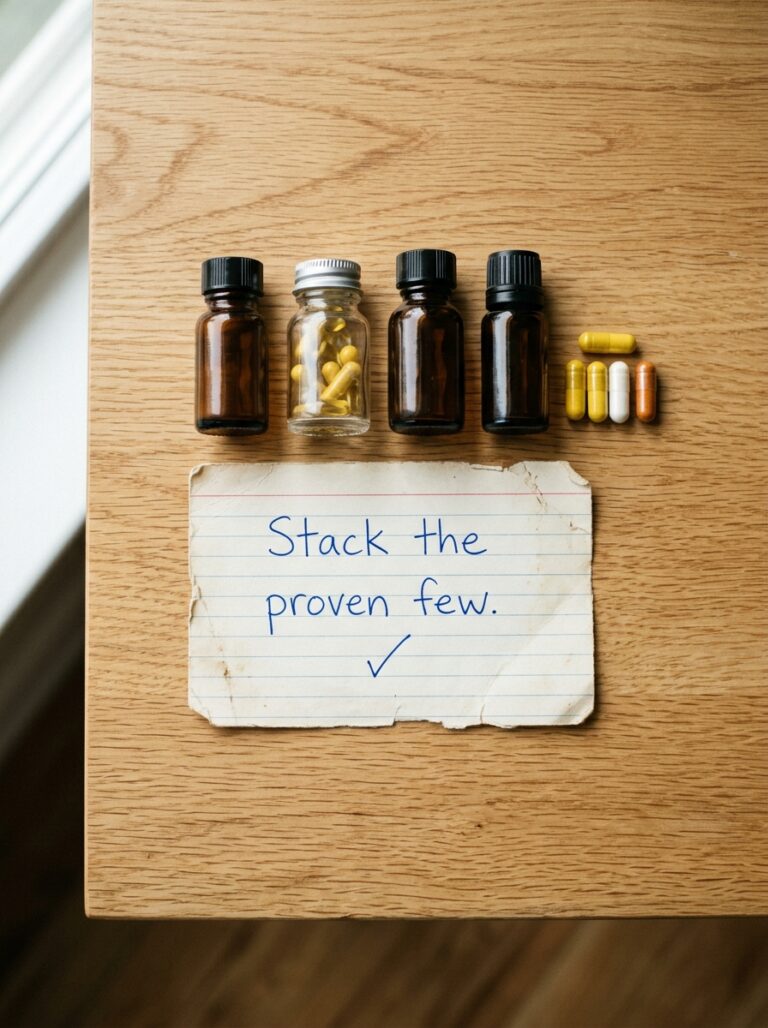
If you're researching longevity supplements, you've probably noticed the genre runs hot: NAD boosters, senolytics, "mitochondrial" pills, and a podcast economy promising you can dial back your biological clock. The honest scientific picture is quieter than the marketing. Most of these compounds extend lifespan in worms, flies, or mice, and only a handful have been tested in humans at all, usually on surrogate endpoints over a few months rather than on how long anyone actually lives.
This guide grades the field by evidence tier so you can see which molecules carry real human data, which are still animal-model promise, and which are mostly hope sold at a premium.
Before you decide

Geroscience supplements sit in a category where the marketing has outrun the human evidence, so a skeptical default is the correct one. Almost everything in this space was discovered by extending lifespan in short-lived model organisms, and a result in a worm or a mouse is a hypothesis about humans, not a finding in humans.
A few people should not experiment here at all without medical input. If you have an active cancer, are pregnant or breastfeeding, take immunosuppressants, or manage a serious cardiovascular, kidney, or liver condition, several of these compounds interact with those situations in ways that matter. Senolytics in particular act on cell-survival pathways and have no business in a self-directed routine during cancer treatment.
Before you spend anything, the unglamorous interventions still beat the bottle. The best-evidenced longevity tools remain resistance training, sleep, not smoking, and a plant-forward diet, and no capsule substitutes for them. You can see how I weigh mechanism against human-trial reality on the how we review supplements page.
What "longevity supplements" actually means
The field has a shared scientific framework, which helps cut through the noise. A landmark 2023 review in Cell catalogs twelve hallmarks of aging, including genomic instability, telomere attrition, epigenetic drift, loss of proteostasis, deregulated nutrient sensing, mitochondrial dysfunction, cellular senescence, and chronic inflammation. Each hallmark is something that accumulates with age and that, in animals, can be experimentally accelerated or slowed.
Longevity supplements are pitched as nudging one of these hallmarks. NAD precursors target nutrient sensing and mitochondrial function; senolytics target accumulated senescent cells; urolithin A targets mitophagy, the recycling of worn-out mitochondria. In plain terms, each molecule claims to clean up or restart one of the cellular processes that fray over decades.
Here's the catch that the hallmarks framework makes obvious. Nudging a hallmark in the right direction is necessary but not sufficient to prove a supplement adds healthy years to a human life. A compound can raise a biomarker, lower a marker of inflammation, even improve a strength test, without anyone having shown it changes how the person ages overall.
That gap between mechanism and outcome is the entire story of this category, and it's where the voice I bring to brain and metabolic biochemistry applies directly. The cells respond on paper; the human trials are short, small, and measure stand-ins for aging rather than aging itself.
The evidence tiers
The useful question is not "does this molecule affect aging biology" but "what has it done in humans, measured how, for how long." On that axis the popular compounds sort into three tiers. Tier 1 has at least one well-designed human RCT showing a functional or biomarker benefit; Tier 2 has human safety and mechanism data but weak or null efficacy; Tier 3 is essentially animal-only.
The table grades the molecules by the strongest human signal available, not by how loud the marketing is.
| Molecule | Target hallmark | Strongest human evidence | Tier |
|---|---|---|---|
| Urolithin A | Mitophagy / mitochondrial function | RCTs in older and middle-aged adults: improved muscle endurance and strength, better mito biomarkers | 1 |
| Glycine + NAC (GlyNAC) | Oxidative stress / mitochondrial function | RCT in older adults: improved strength, gait, and multiple aging-biomarker measures | 1 |
| NMN / NR (NAD precursors) | Nutrient sensing / NAD metabolism | RCTs reliably raise blood NAD and are safe; clinical-outcome benefits are inconsistent | 2 |
| Taurine | Senescence / inflammation (multi) | Strong animal lifespan data; human longevity trials not yet done | 2 |
| Spermidine | Autophagy | 12-month RCT in at-risk older adults found no cognitive benefit vs placebo | 2 |
| Calcium AKG | Epigenetic alterations | Small uncontrolled “biological age” study; no controlled outcome trial | 3 |
| Fisetin (senolytic) | Cellular senescence | Strong mouse lifespan data; human trials ongoing, no efficacy readout yet | 3 |
Notice what no row says: none of these has been shown to extend human lifespan, and the Tier 1 wins are on function and biomarkers, not survival. That is the honest ceiling on the whole category right now.
The proven few worth considering

Urolithin A is the molecule with the cleanest human story. It's a gut-microbiome metabolite of ellagitannins (from pomegranate and walnuts) that triggers mitophagy, the clearing of damaged mitochondria. In a randomized clinical trial in older adults, 1,000 mg daily was safe and improved muscle endurance and several plasma biomarkers of mitochondrial health, though the longer walking-distance endpoint did not reach significance. A separate four-month RCT in middle-aged adults reported roughly a 12% gain in muscle strength.
That's a real, replicated human signal on a functional outcome, which is rare in this aisle. It is not a lifespan claim, and not everyone makes urolithin A from food, which is part of the rationale for supplementing it directly. I cover the dosing and product landscape in the urolithin A supplements roundup.
The second compound with credible human trial data is GlyNAC, the pairing of glycine and N-acetylcysteine. The biochemistry is specific: glutathione, the cell's master antioxidant, depends on glycine, cysteine, and glutamate, and older adults are often glutathione-deficient. Supplying the building blocks restores it.
In a randomized clinical trial in older adults, 16 weeks of GlyNAC corrected glutathione deficiency and improved oxidative stress, mitochondrial function, strength, gait speed, and several aging-biomarker measures versus placebo. The benefits faded after stopping, which tells you it's a maintenance intervention, not a reset. Both components are inexpensive and you can read more on each in the glutathione and NAC guides.
The popular ones that are mostly hype
NMN and NR, the NAD precursors, are the loudest products in the category and the clearest case of mechanism outrunning outcome. NAD is a coenzyme central to energy metabolism that declines with age, and these supplements reliably raise blood NAD. A dose-ranging RCT in GeroScience found 300 to 900 mg of NMN daily was safe and raised NAD in a dose-dependent way.
But raising a biomarker is not the same as feeling or aging better. A 2024 systematic review of NMN RCTs found that most clinically relevant outcomes did not separate from placebo, even as NAD rose. There's also a glaring dose-trial-versus-supplement gap: the trials that showed anything used 600 mg or more, while many consumer bottles sit at 125 to 250 mg, below the studied range. If you commit, do the studied protocol or skip it; the NMN supplements guide breaks down the dosing reality.
Taurine generated headlines from a 2023 paper in Science showing taurine declines with age and that supplementation extended lifespan in mice and improved health markers in monkeys. It's mechanistically interesting and cheap. But the human longevity trial simply hasn't been run, so it remains a strong animal story awaiting a human readout; the dosing question is covered in the taurine supplements guide.
Spermidine is the cautionary tale. It drives autophagy and looked promising in a short pilot, but the larger SmartAge RCT gave spermidine to at-risk older adults for 12 months and found no significant benefit on memory versus placebo. A well-designed year-long human trial showing nothing is exactly the kind of result the marketing skips over. The spermidine supplements guide goes into the dietary-versus-supplement question.
Two more belong in the "promising but not there" bucket. Calcium AKG's much-cited "8-year younger biological age" came from a small, uncontrolled retrospective using a methylation test that is not a validated clinical endpoint. And fisetin, a flavonoid senolytic, has impressive mouse data extending lifespan but human senolytic trials are still in progress with no efficacy readout.
How to think about stacking (and what to skip)
The instinct to combine half the category into a "longevity stack" is exactly backward; more unproven inputs means more cost, more interaction risk, and no added evidence. A defensible approach starts from the tiers, not from a podcast's protocol.
If you're going to spend, weight toward Tier 1. Urolithin A and GlyNAC carry the human RCT data, so they're the rational anchors of any longevity-minded stack. NMN is a defensible add only if you'll run the studied 600 mg-plus dose and you treat it as a biomarker bet, not a felt-benefit guarantee.
Skip the redundancy. Stacking NMN plus NR plus a NAD "activator" is paying three times to nudge one pathway, and there's no human evidence the combination beats one done properly. The same logic applies to loading taurine, spermidine, and Ca-AKG together: you'd be triple-funding the unproven tier.
The most underrated "stack" item costs nothing extra. Resistance training and protein adequacy drive the same mitochondrial and muscle endpoints these supplements chase, and they have decades of human evidence behind them. Treat the proven few as adjuncts to that base, never as replacements for it.
Safety, interactions, and who should not experiment
For healthy adults, the Tier 1 compounds have clean short-term safety records, but "short-term and small" is the operative caveat across this whole category. The urolithin A, GlyNAC, and NMN trials ran weeks to months in modest samples, so multi-year safety in broad use is genuinely unknown.
The interactions that matter are condition-specific. NAC can interact with nitroglycerin and may affect clotting; high taurine intake warrants caution with blood-pressure medication; and senolytics like fisetin act on cell-survival pathways that should not be self-toggled during cancer therapy or immunosuppression. None of these is a reason for panic, but each is a reason to involve a clinician if it applies to you.
Two groups should not experiment on their own. Anyone pregnant or breastfeeding, and anyone with active cancer, advanced kidney or liver disease, or on immune-modulating drugs, should treat these compounds as off-limits without medical supervision. The geroscience evidence simply does not cover those situations.
A word on the prescription cousins. Metformin and rapamycin appear constantly in longevity conversations, but they are prescription drugs under study for aging, not supplements, and self-sourcing them is unsafe and outside anything this guide endorses. If you're curious about them, that's a conversation for a physician, not a supplement order. None of the above is a treatment or anti-disease claim; these are educational distinctions, and individual decisions belong with your clinician.
FAQ
Is there any supplement proven to make humans live longer?
No. No supplement has been shown in a human trial to extend lifespan. The strongest human longevity data is on surrogate endpoints like muscle endurance, NAD levels, and aging biomarkers over months, which is meaningfully different from added years of life.
What's the single best-evidenced longevity supplement?
On human trial quality, urolithin A has the most credible data, with replicated RCTs showing improved muscle endurance and mitochondrial biomarkers. GlyNAC is close behind. Both are functional and biomarker wins, not lifespan proof.
Are NMN and NR worth the money?
They reliably raise NAD and are safe, but a systematic review found most clinical outcomes didn't beat placebo. If you try NMN, use the studied 600 mg-plus dose rather than the under-dosed bottles common on shelves, and treat it as a biomarker experiment.
Do "biological age" tests prove a supplement is working?
No. Methylation-based "biological age" tests are research tools, not validated clinical endpoints, and the headline Ca-AKG result came from a small uncontrolled study. A lower number on one of these tests is not evidence you're aging more slowly.
Should I take metformin or rapamycin for longevity?
Those are prescription drugs under investigation for aging, not supplements. They carry real risks and require a physician's oversight; they're outside the scope of self-directed supplementation entirely.
The bottom line on longevity supplements
The longevity aisle sells the future as if it has arrived. The science is more modest: a framework of aging hallmarks, a lot of compelling animal data, and a thin layer of short human trials measuring stand-ins for aging rather than lifespan itself. The right question for any longevity supplement is not "does it affect aging biology" but "what has it actually done in a human trial, measured how, for how long."
By that test, the field narrows fast. Urolithin A and GlyNAC have the credible human RCT data, NMN raises a biomarker without reliably improving outcomes, and taurine, spermidine, Ca-AKG, and fisetin remain promising-but-unproven in people. No molecule here has earned a lifespan claim.
If you want to act on this, anchor any routine to the proven few, run them at studied doses, build them on top of training and sleep rather than instead of them, and clear the experiment with your clinician if you have a condition or medication that intersects. Stack the proven few, skip the hype, and keep your skepticism dialed up.
Reviewed by Maria Rodriguez, MS Nutrition Science, focused on cognitive and mood biochemistry. See more from Maria Rodriguez. This article is educational and is not a substitute for individualized medical advice; talk to your doctor before starting any supplement, especially if you are pregnant, managing a diagnosed condition, or taking prescription medication.
