
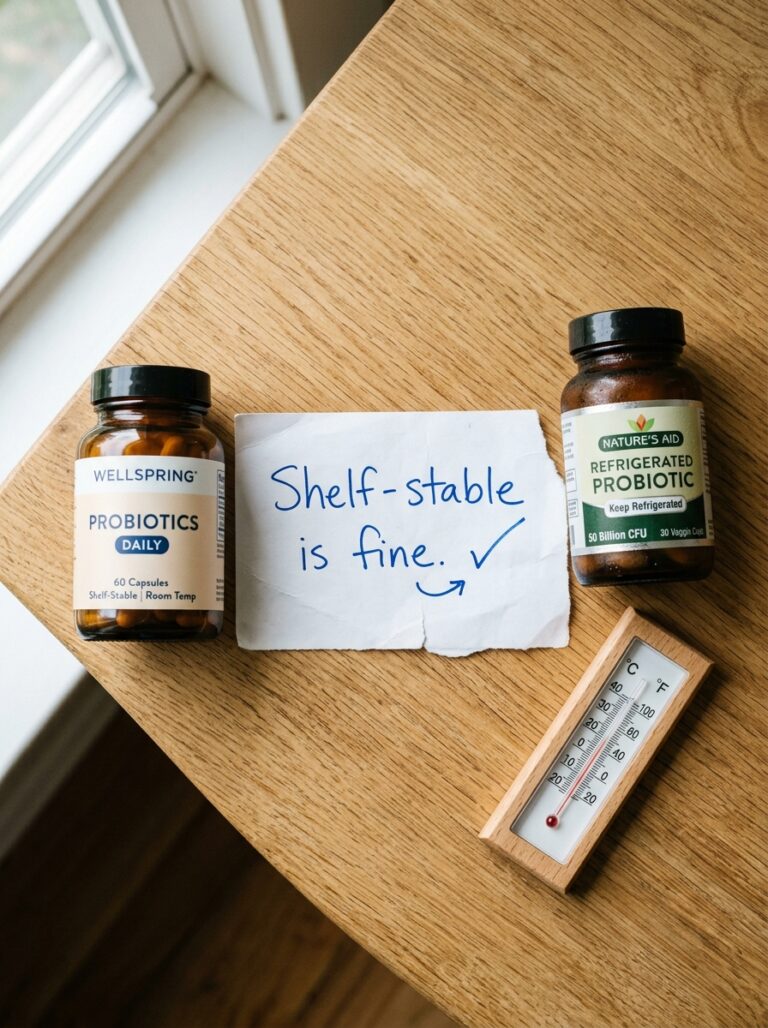
You're standing in front of two bottles of what looks like the same probiotic. One lives on the shelf, the other in a refrigerated case with a little "keep cold" sticker, and the cold one usually costs more. The instinct is that refrigerated means fresher and therefore better. That instinct is mostly wrong, and the real question isn't temperature at all, it's whether the organisms inside were built to survive at room temperature in the first place. If you'd rather skip straight to the practical end, the three probiotics we land on at the bottom are the ones we'd actually put in our own family's cabinet.
Affiliate disclosure: this article contains affiliate links. As an Amazon Associate, UsefulVitamins.com earns from qualifying purchases at no extra cost to you.
Before you decide
A quick word on who shouldn't be casually experimenting with probiotics at all, regardless of how they're stored. If you are severely immunocompromised, critically ill, recovering from major surgery, have a central venous catheter, or are caring for a premature infant, talk to your physician before starting any probiotic. Storage format is irrelevant to that conversation.
The same goes if you have a diagnosed digestive disease like ulcerative colitis or Crohn's, where a probiotic belongs in a plan your gastroenterologist directs rather than something you pick off a shelf. For the broader picture on strains, dosing, and who genuinely benefits, I'd start with the complete guide to probiotics, and you can see how I weigh evidence on the how we review supplements page.
Now the part that makes this whole storage question make sense. A probiotic supplement is a population of living cells in suspended animation. The drying process pulls almost all the water out so the cells go dormant, and the thing that kills them off afterward isn't simply heat, it's metabolic activity restarting.
Three variables drive that: water activity (how much free moisture is available to the cells), oxygen exposure, and temperature. Cold storage only addresses the last one. A bottle with high residual moisture and a leaky cap will lose viability in the fridge, and a well-dried, oxygen-protected spore product will sail through a warm cupboard.
That's why "refrigerated equals better" is the wrong mental model. The number that survives all of this is colony-forming units (CFU) measured at the end of shelf life, which is the only count that reflects what's actually alive when you take it.
The three storage formats compared
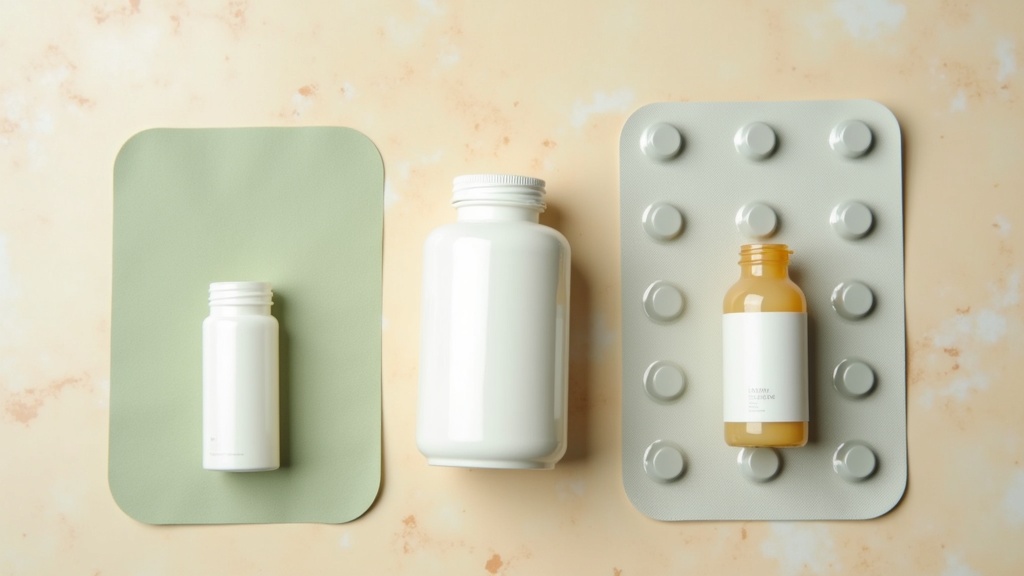
Most products you'll meet fall into one of three buckets. The differences come down to which organisms are inside and how the packaging defends them, not a simple fridge-or-shelf binary.
Shelf-stable, spore-forming strains
These are the most forgiving products on the market. Spore-forming organisms like Bacillus coagulans and Bacillus subtilis form a protective dormant shell that shrugs off heat, moisture, and time. In a 12-month study baking these strains into cookies and crackers, B. subtilis spores showed less than a 2-log reduction across every condition tested, with no meaningful difference between room temperature, refrigeration, and freezing.
A simulated round-trip to Mars, of all things, found B. subtilis spores held above a billion CFU per capsule after 545 days at ambient temperature, while non-spore strains in the same study lost about 100-fold of their count in under 200 days. For these strains, shelf-stable isn't a compromise, it's how they're designed to ship.
Shelf-stable, freeze-dried and blister-packed
The bigger category is freeze-dried Lactobacillus and Bifidobacterium species sealed against air and moisture, often in foil blister packs or bottles with desiccant. These strains are more delicate than spores, but good drying and packaging carry them a long way at room temperature. The deciding factor is water activity: keeping residual moisture low (roughly 0.25 or below) slows the cells' metabolism so they don't burn themselves out.
One study of freeze-dried Lactobacillus plantarum found that without protectants the cells became undetectable after 105 days at 4°C versus only 40 days at 30°C, but a proper protectant formulation dramatically cut the death rate at both temperatures. Oxygen matters just as much: vacuum or foil packaging consistently outperforms a loosely capped bottle because oxygen oxidizes the cell membrane. A well-packed blister card on a shelf can beat a poorly sealed bottle in the fridge.
Refrigerated, live-culture and delicate strains
Some products genuinely need cold, and the label will say so. These tend to be liquid live cultures, certain sensitive Lactobacillus and Bifidobacterium strains, and formulations that weren't engineered for ambient stability. Here the temperature effect is real and large.
In a stability comparison, the same probiotic coffee held 9.45 log CFU per gram with a roughly two-year shelf life at 4°C, but at 30°C its shelf life collapsed to about three months. For a strain that wasn't built to be shelf-stable, the fridge is doing heavy lifting, and leaving it in a warm car undoes it fast. The point isn't that refrigeration is pointless, it's that refrigeration is mandatory only when the manufacturer formulated the product to depend on it.
| Format | Typical organisms | Room-temp stability | Needs the fridge? |
|---|---|---|---|
| Shelf-stable, spore-forming | Bacillus coagulans, B. subtilis | Excellent, less than 2-log loss over a year | No, designed for ambient |
| Shelf-stable, freeze-dried + blistered | Lactobacillus, Bifidobacterium (dried) | Good when low-moisture and oxygen-sealed | No, if label confirms shelf-stable |
| Refrigerated, live-culture | Liquid cultures, delicate strains | Poor, drops fast above ~25°C | Yes, follow the label |
What cold storage actually protects
It helps to separate what refrigeration does from what it can't fix. Cold slows the metabolic clock, which is why a strain that would die in two weeks at room temperature can hold for a month or more in the fridge. In one comparison, Lactobacillus viability stayed above the effective threshold for up to four weeks at 4°C but fell to zero within two weeks at 23°C. That's a meaningful difference for a moisture-exposed or liquid product.
What cold storage cannot do is rescue a product that was poorly dried, badly sealed, or already low on viable cells when it left the factory. If water activity is too high, the cells keep metabolizing even when chilled, just more slowly, and oxygen damage continues either way.
This is the part that gets lost in the "fridge is fresher" assumption: temperature is one of three levers, and for a well-formulated shelf-stable product the manufacturer has already pulled the other two (low moisture, oxygen barrier) hard enough that the fridge becomes optional.
As a dietitian I find it useful to think of it the way I think of food safety: refrigeration buys time for something perishable, but it doesn't make a stable, shelf-designed product meaningfully "better." If you want to understand which strains are robust enough to be built this way, the differences are spelled out in probiotic strains explained.
How to choose

Match the format to your strain and your habits rather than defaulting to whichever bottle looks chillier.
If you take a spore-forming probiotic (Bacillus coagulans, B. subtilis), choose shelf-stable without hesitation. These hold their count at room temperature, and a refrigerated version offers you nothing extra to pay for. Bacillus coagulans is one of the most widely available shelf-stable forms, sold by many brands for well under a dollar a dose.
If you want a Lactobacillus or Bifidobacterium blend and you travel, keep odd hours, or won't reliably get a bottle home cold, choose a shelf-stable freeze-dried product in a blister pack or a bottle with desiccant. The packaging is doing the protecting, and you remove the single biggest real-world failure point, which is a refrigerated bottle warming up in transit.
If the label specifically says "refrigerate," then refrigerate it, and buy it from a store that kept it cold. This is mainly liquid live cultures and a few delicate strains. Get it home promptly, don't leave it in a hot car, and don't assume room temperature is "probably fine," because for these formulations it genuinely isn't.
If you can't tell which you have, read for one phrase: a CFU count "guaranteed through end of shelf life." A 2019 analysis of probiotic labels found that even among products with evidence behind them, fewer than half guaranteed potency through the end of shelf life rather than at manufacture. That line, not the storage instruction, is what tells you the maker stands behind the live count you'll actually swallow.
One practical note on verifying viability: the standard plate-count method only sees cells that grow into colonies, so newer methods can detect cells that are alive but slow to culture, which is why label counts and lab counts don't always line up perfectly. For a consumer, the takeaway is simpler than the science, buy from a maker that guarantees the count at expiry and stores the product the way its own label directs.
FAQ
My probiotic wasn't refrigerated at the store. Did I just waste my money?
Probably not, if it's a shelf-stable product. Spore-forming and properly freeze-dried, oxygen-sealed strains are designed to sit at room temperature. The exception is a product whose label says "keep refrigerated," in which case an unrefrigerated store display is a real warning sign.
Will refrigerating a shelf-stable probiotic make it last longer?
It generally won't hurt, and for a freeze-dried blend the cold can slightly extend the margin, but for a well-formulated shelf-stable product it isn't necessary. Just keep it dry, capped, and out of direct heat and humidity, including off the steamy bathroom counter.
Are refrigerated probiotics stronger or higher quality?
No. Refrigeration reflects how a strain was formulated, not how potent or high-quality it is. Many of the most stable, well-studied strains are deliberately shelf-stable. The fridge is a requirement for some formulas, not a quality upgrade.
Does the high CFU number on the front matter more than storage?
Neither is the headline you should chase. A high manufacture-time CFU count means little if most of those cells die before you open the bottle. The count guaranteed at expiry, stored as directed, is the meaningful figure.
Can heat in shipping have already killed it before I bought it?
For delicate refrigerated strains, prolonged heat in transit can reduce viability, which is one more reason to buy those locally from a store that kept them cold. Shelf-stable spore and freeze-dried products tolerate normal shipping conditions far better.
Recommended Products


As an Amazon Associate, UsefulVitamins.com earns from qualifying purchases at no extra cost to you. We only recommend products supported by published research or third-party testing.
The bottom line on probiotic storage
Shelf-stable versus refrigerated isn't really a contest between fresh and stale, it's a question of how the organisms inside were built. Spore-forming and well-dried, oxygen-sealed strains are engineered to hold their count at room temperature, and for those a shelf-stable bottle is genuinely fine.
Refrigeration earns its keep for liquid live cultures and the handful of delicate strains whose labels demand it, and for those the cold chain matters from the store shelf to your kitchen. The variable that quietly decides everything is the CFU guaranteed at the end of shelf life, stored the way the label directs, because that's the only number that reflects what's actually alive when you take it.
So skip the assumption that the chilled bottle is automatically the smarter buy. Read the storage instruction, follow it, and check that the maker guarantees the live count through expiry rather than at manufacture.
If you're managing a diagnosed condition, are pregnant, or are immunocompromised, clear any probiotic with your clinician first, and ask whether your symptoms warrant a workup before you assume the answer is on a supplement shelf at all.
Reviewed by Sarah Thompson, Registered Dietitian, focused on vitamin and mineral nutrition. See more from Sarah Thompson. This article is educational and is not a substitute for individualized medical advice; talk to your doctor before starting a supplement, especially if you are immunocompromised, pregnant, or managing a diagnosed condition.
