
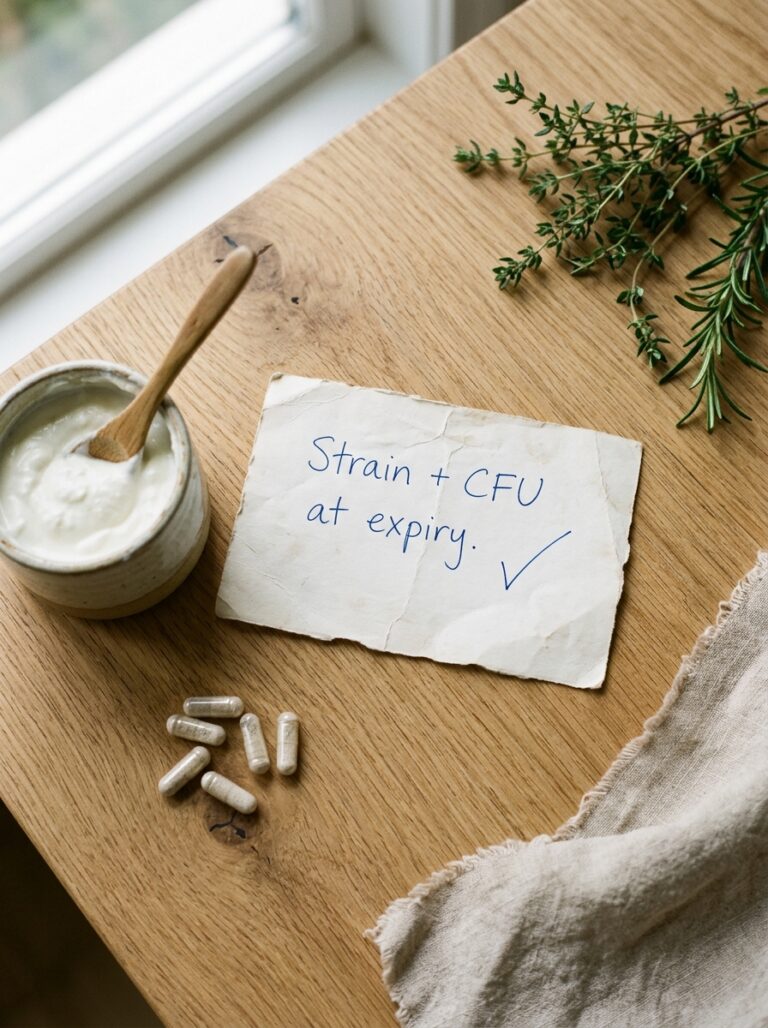
Walk down the supplement aisle and probiotics look like a single product sold at fifty different price points. They're not. A probiotic is a specific bacterial strain at a specific dose, and the version that helped someone's antibiotic recovery may do nothing for your bloating.
This guide sorts the strains from the marketing so you can match a product to an actual goal instead of buying the biggest CFU number on the shelf.
Before you decide

A few people should not start a probiotic on their own. If you are severely immunocompromised, recovering from major surgery, critically ill, have a central venous catheter, or are caring for a premature infant, talk to your physician first.
Rare cases of bloodstream infection from probiotic organisms have been documented in exactly these populations, and the standard guidance is caution, not a casual trial. The same applies if you have an active gastrointestinal disease such as ulcerative colitis or Crohn's, where probiotics belong in a treatment plan your gastroenterologist directs, not a self-prescribed add-on.
If none of that applies to you, the first step is honest about what you're trying to fix. "General gut health" is not a target the evidence can hit. A specific goal can be: you're starting a course of antibiotics, you have diagnosed IBS, or you want to add fermented foods to a thin diet.
Each of those points to a different answer, and some point away from a supplement entirely. Before you assume your gut is the problem, it's worth asking your doctor whether your symptoms warrant basic workup.
Persistent bloating, reflux, or bowel changes can have causes that no probiotic addresses, and the supplements that help leaky-gut symptoms or reflux are not always probiotics at all. You can see how I weigh evidence and conflicts of interest on the how we review supplements page.
What probiotics actually are

The working definition comes from an international expert panel: probiotics are "live microorganisms which, when administered in adequate amounts, confer a health benefit on the host." That sentence does a lot of quiet work.
"Live" rules out dead-cell products that may still claim probiotic status. "Adequate amounts" means dose matters and is strain-specific. And "confer a health benefit" sets a bar that a surprising number of marketed products have never actually cleared in a trial.
The organisms themselves are mostly bacteria from a handful of genera, with one common yeast in the mix. You'll see Lactobacillus (recently reclassified into several new genus names like Lactiplantibacillus and Lacticaseibacillus), Bifidobacterium, and the yeast Saccharomyces boulardii.
A probiotic is properly identified by three levels: genus, species, and strain. Lactobacillus rhamnosus GG is a different product from another L. rhamnosus strain, even though the species name is identical, because the trial evidence attaches to the strain, not the species.
This is also where probiotics get confused with two neighbors. Prebiotics are fibers that feed your existing bacteria, and synbiotics combine the two. If you're sorting out which is which, the distinctions matter for what you actually buy, and I cover them in detail in prebiotics vs probiotics vs synbiotics.
Why gut flora matters
Your large intestine houses trillions of microbial cells that ferment the fiber you can't digest, produce short-chain fatty acids your colon cells use for fuel, compete with potential pathogens for space, and interact with your immune system. This community is fairly stable in a healthy adult, which is the part people miss: a probiotic supplement does not "repopulate" your gut or permanently install new residents.
Most probiotic strains are transient. They pass through, exert whatever effect they have while present, and are largely gone within days to weeks of stopping.
That transience is not a knock against probiotics, but it reframes the value proposition. They are not a one-time reset. They work the way a regularly taken supplement works: while you take an effective strain at an effective dose for a defined purpose, you may get a defined benefit.
As a dietitian, I'd add the unglamorous point that the single biggest lever on your gut flora is what you eat every day. A diet broad in plants and fermented foods feeds and seeds the community far more consistently than any capsule. Supplements earn their place when the diet doesn't cover the requirement, or when a specific clinical situation calls for a specific strain.
The main strains and what they do

The strains worth knowing are the ones with repeated trial evidence behind a named goal. The table below groups the most studied. Treat it as a shortlist, not a ranking, because effects are tied to the exact strain listed, not the species in general.
| Strain | Best-studied use | Evidence note | Typical dose |
|---|---|---|---|
| Lactobacillus rhamnosus GG | Antibiotic-associated diarrhea | Ranked among the most effective in network meta-analysis | 10 to 20 billion CFU/day |
| Saccharomyces boulardii | Antibiotic diarrhea, C. difficile prevention | Yeast, so it survives antibiotics; supported in Cochrane review | 5 to 10 billion CFU/day |
| Bifidobacterium longum 35624 | IBS symptoms | One of the better-studied single strains for IBS | 1 billion CFU/day |
| Lactiplantibacillus plantarum 299v | IBS bloating and pain | Repeated small RCTs for functional symptoms | 10 to 20 billion CFU/day |
| Bacillus coagulans | IBS, shelf-stable spore former | Ranked well in IBS network meta-analysis | 1 to 6 billion CFU/day |
Notice what's missing: there's no single strain that does everything. A blend marketed for "total gut support" with a dozen unnamed species at a giant combined CFU count is harder to evaluate than a single named strain matched to a goal.
If you want to go deeper on how naming and reclassification work, I break it down in probiotic strains explained.
Who actually benefits (and who doesn't)
The most honest summary of the evidence is that probiotics have a few solid uses and a lot of hopeful ones. The 2020 American Gastroenterological Association guideline reviewed the field and found that for most digestive conditions there isn't enough evidence to recommend probiotics, while identifying a small set of scenarios where specific formulations may help, including prevention of C. difficile infection in adults and children on antibiotics and management of pouchitis after certain surgeries.
That's a narrow, evidence-bounded list, and it's worth taking seriously rather than reading it as a blanket endorsement.
The clearest real-world win is antibiotic-associated diarrhea. A network meta-analysis comparing probiotic options for preventing it ranked Lactobacillus rhamnosus GG among the most effective and best tolerated, and a focused review of LGG found it reduced the risk of antibiotic-associated diarrhea, with the strongest signal in children.
For preventing C. difficile-associated diarrhea specifically, a Cochrane review concluded that probiotics are likely effective when given alongside antibiotics in people who are not severely unwell.
For irritable bowel syndrome the picture is real but modest. A network meta-analysis of probiotics in IBS found certain species, including Bacillus and Bifidobacterium strains, outperformed others for symptom relief, while overall certainty remained limited by trial heterogeneity.
That's why major guidelines stop short of a strong recommendation: some people clearly improve, but the average effect is small and strain-dependent. If your interest is broader gut-barrier complaints, the relevant supplements aren't always probiotics, which is why I keep a separate guide to supplements for leaky gut.
Who probably doesn't benefit: a healthy adult with no symptoms taking a probiotic for general wellness. There's no good evidence that daily probiotics in a well person prevent disease or improve outcomes, and your money is better spent on dietary fiber and fermented foods.
CFUs, labeling, and what to look for
CFU stands for colony-forming units, the count of viable organisms in a dose. You'll see it written as "1 x 10^9" for one billion or "1 x 10^10" for ten billion. According to the NIH Office of Dietary Supplements, many products contain 1 to 10 billion CFU per dose, though some advertise 50 billion or more, and a higher CFU count does not automatically mean greater benefit.
The dose that worked in the trial for your goal is the dose that matters, and for several well-studied strains that's in the single-digit billions, not the headline-grabbing tens of billions.
The labeling detail that separates a serious product from a marketing one is when the CFU count is guaranteed. Live organisms die off over time, so a bottle that promises "50 billion at time of manufacture" may deliver a fraction of that by the time you open it.
Look for a count guaranteed "through end of shelf life" or "at expiry." This is the single most useful thing on a probiotic label, and it's the verdict on this guide's card for a reason.
| Label feature | What it tells you | Worth paying for? |
|---|---|---|
| Named strain (genus + species + strain code) | You can match it to actual trial evidence | Yes, essential |
| CFU guaranteed at expiry | The count you’ll actually get, not the peak | Yes, essential |
| Very high CFU (50 billion+) | A bigger number, not necessarily a bigger effect | Only if the trial used it |
| Third-party tested seal | Independent check on identity and count | Yes, a useful signal |
| “Proprietary blend” with no strain codes | You can’t verify anything | No, skip it |
Storage interacts with all of this. Some products need refrigeration; spore-forming and freeze-dried formulations are often shelf-stable. Neither is automatically better, but you have to follow the label, because a refrigerated strain left in a warm car loses viability fast. I compare the two formats in shelf-stable vs refrigerated probiotics.
How to take probiotics (dose, timing, with antibiotics)
Match your dose to the strain and goal rather than maxing out the CFU number. For the well-studied uses above, that usually means the dose used in the relevant trial, which is why a named strain is so useful, you can look up what was actually tested.
Most probiotics are taken once daily, and consistency over days to weeks matters more than the exact time of day for routine use.
Timing earns its keep mainly around antibiotics. If you're taking a probiotic to prevent antibiotic-associated diarrhea, start it close to when you begin the antibiotic rather than waiting until symptoms appear, and separate the two doses by roughly two hours so the antibiotic isn't actively killing the bacteria you just swallowed.
Saccharomyces boulardii is the exception worth knowing: it's a yeast, so antibacterial antibiotics don't touch it, which is part of why it shows up repeatedly in the antibiotic-diarrhea evidence. Continue the probiotic through the antibiotic course and often for a week or two after.
Food timing is less settled. Some manufacturers suggest taking capsules with a meal to buffer stomach acid, others recommend an empty stomach; the honest answer is that the evidence doesn't strongly favor one approach for most strains, so pick a routine you'll actually stick to.
As with most supplements, the diet around it matters: feeding the bacteria you take in with dietary fiber and fermented foods gives them something to work with.
Side effects and who should be cautious
For healthy adults, probiotics are generally well tolerated. The most common complaints are transient gas, bloating, and mild digestive changes in the first few days, which usually settle as your system adjusts. If symptoms are pronounced, dropping to a lower dose and building up tends to help.
The serious cautions are narrow but real, and they're the same group flagged at the top of this guide. People who are severely immunocompromised, critically ill, post-surgical, fitted with central venous catheters, or who have compromised gut barriers face a small but documented risk of the probiotic organism causing a bloodstream infection.
This is not a reason for the general public to avoid probiotics; it's a reason for high-risk individuals to involve a physician. Probiotics have also been studied in acute pancreatitis, where one trial found harm, so they should not be self-administered in serious acute illness.
If you have a diagnosed digestive disease, are pregnant, or take immune-suppressing medication, treat a probiotic as something to clear with your clinician rather than start solo, and ask whether testing for an underlying cause should come first. None of this is a cure claim: probiotics support specific situations within standard medical care, they don't replace it.
FAQ
Do I need a probiotic if I eat yogurt and fermented foods? Probably not for general health. Fermented foods deliver live cultures along with fiber and other nutrients, and for a healthy adult that's usually enough. A targeted supplement makes more sense for a specific goal like antibiotic recovery.
Is a higher CFU count better? Not on its own. The NIH notes that higher CFU counts don't automatically mean greater benefit. The dose that matters is the one studied for your strain and goal, which is often in the single-digit billions.
How long until probiotics work? It depends on the goal. For antibiotic-associated diarrhea, you take them across the antibiotic course. For IBS symptoms, trials typically run four weeks or more before judging effect, so give it at least that long.
Should I keep taking the same probiotic indefinitely? For a defined goal, no, you take it for the relevant period. Because most strains are transient and pass through, ongoing daily use in a healthy person without a specific aim has little evidence behind it.
Can I take a probiotic with my other supplements? Generally yes for healthy adults, though separate it from antibiotics by about two hours. If you take immune-suppressing medication or have a complex regimen, check with your pharmacist or doctor.
Taking this alongside other products? StackMyMed (our companion app) logs your full stack, finds the optimal timing for each dose, and flags interactions, so you are not tracking it all by hand.
The bottom line on probiotics
Probiotics are not one product, and "is this probiotic good?" is the wrong question. The right question is which named strain, at the dose used in its trials, matches the specific goal you have, and whether the label guarantees that count through the end of shelf life.
The evidence is genuinely strong for a short list, mainly antibiotic-associated diarrhea and C. difficile prevention, modest and strain-dependent for IBS, and thin to absent for general wellness in healthy people.
If you're symptom-free and eating a varied, plant-rich, fermented-food diet, your gut flora is probably better served by that than by any capsule. If you have a defined goal, match the strain, mind the dose, read the expiry CFU, and store it as directed.
Reviewed by Sarah Thompson, Registered Dietitian, focused on vitamin and mineral nutrition. See more from Sarah Thompson. This article is educational and is not a substitute for individualized medical advice; talk to your doctor before starting a supplement, especially if you are immunocompromised, pregnant, or managing a diagnosed condition.
