
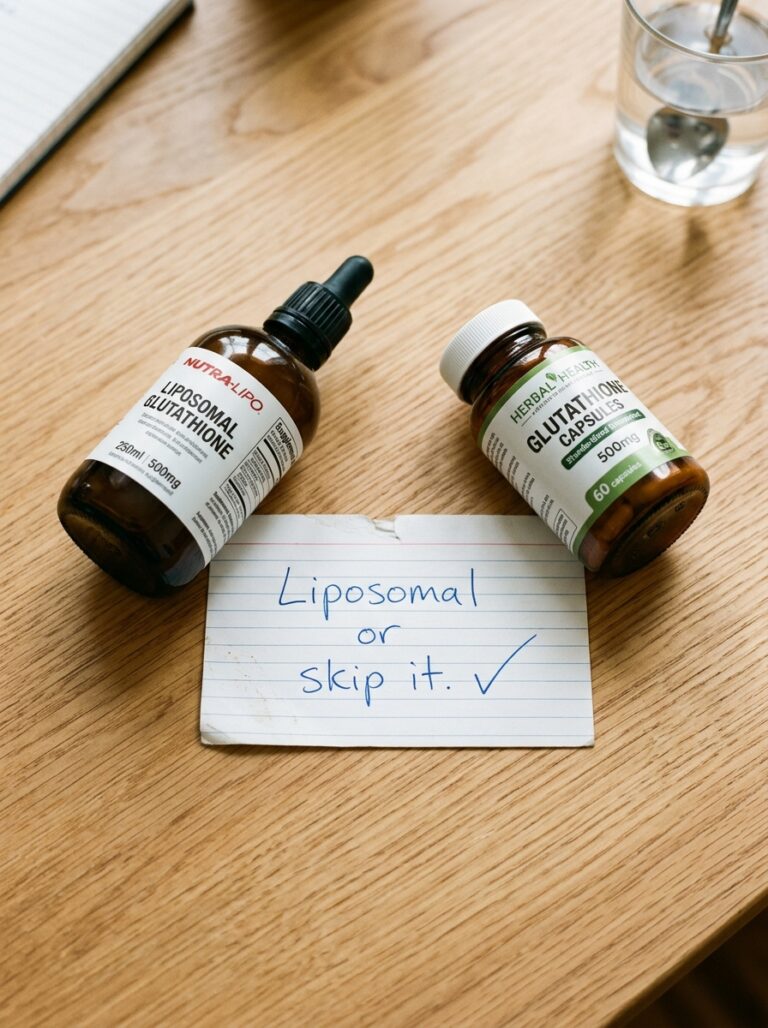
Glutathione is the body's master antioxidant, which is exactly why the supplement aisle sells it in a dozen forms at a dozen prices. The uncomfortable part is that the cheapest, most common form, plain oral reduced glutathione in a capsule, is the one your gut is best at destroying before it ever reaches your bloodstream. That single fact reorganizes the whole shelf.
So this roundup doesn't rank brands by marketing. It sorts glutathione by how the molecule actually gets into you, then points to the three forms worth the money. The three picks at the bottom are the ones I'd keep in my own family's cabinet if someone here decided to supplement.
Affiliate disclosure: this article contains affiliate links. As an Amazon Associate, UsefulVitamins.com earns from qualifying purchases at no extra cost to you.
Before you decide
Glutathione is not a fix for a specific symptom you can self-diagnose. If you're chasing it for fatigue, brain fog, liver concerns, or a skin goal, the honest first move is to ask your doctor whether the underlying issue warrants a workup, not to assume an antioxidant capsule is the answer.
A few groups should be especially careful. If you have asthma, are pregnant or breastfeeding, take nitroglycerin or other vasodilators, or manage a chronic condition, clear any glutathione or NAC product with a clinician first, because NAC in particular can interact with medications and has triggered bronchospasm in some asthmatic patients.
I'll also flag the claim that drives a lot of these purchases. Oral glutathione is widely marketed for skin lightening, and the clinical evidence for that use is weak. A 2022 review in dermatology concluded that the general consensus remains against treating hyperpigmentation by the oral route because absorption is so poor. Treat skin-lightening promises as marketing, not medicine.
You can see how I weigh mechanism against actual human trials on the how we review supplements page, and more about my background on my author page.
What glutathione actually does

Glutathione (GSH) is a tripeptide of glutamate, cysteine, and glycine, and it's the most abundant antioxidant your cells make for themselves. It neutralizes reactive oxygen species, recycles vitamins C and E back to their active forms, and supports the liver's phase-two detoxification enzymes.
The catch is that glutathione is overwhelmingly an intracellular molecule, synthesized inside your cells from amino acid building blocks, not something cells pull whole from the bloodstream and use directly. That distinction is the entire reason form matters so much.
Your cells run their own glutathione factory, and the limiting raw material on that production line is cysteine. Glutamate and glycine are abundant inside the cell; the formation step catalyzed by glutamate-cysteine ligase is rate-limiting, and cysteine supply is what gates it.
So there are really two strategies on the shelf. One is to deliver finished glutathione and hope enough survives to matter; the other is to deliver the precursor and let your own cells build it. Both can work. They just work very differently, and most roundups blur them together.
The absorption problem (why form matters)
Here's the part the typical "best glutathione" list skips. When you swallow plain reduced glutathione, the enzyme gamma-glutamyltransferase in your gut hydrolyzes the tripeptide, so very little intact glutathione crosses into circulation. The same dermatology review noted it's effectively impossible to raise serum GSH to a clinically useful level even after a single 3-gram oral dose.
That said, the picture isn't all-or-nothing. A six-month randomized trial of the branded Setria glutathione did raise body stores in a dose- and time-dependent way, with erythrocyte and plasma GSH up roughly 30 to 35 percent at 1,000 mg/day, and levels returning to baseline after a one-month washout. The most striking signal in that trial was in buccal (cheek) cells, where high-dose GSH rose about 260 percent, and natural killer cell activity roughly doubled. So plain oral GSH is not useless, it's just inefficient, slow, and most of the action shows up in tissues with direct mucosal exposure.
Liposomal glutathione wraps the molecule in a phospholipid shell to shield it from gut enzymes. In a four-week trial, oral liposomal GSH at 500 to 1,000 mg/day raised whole-blood glutathione about 40 percent within two weeks and roughly doubled GSH inside immune cells (PBMCs). The functional markers moved too: natural killer cell cytotoxicity climbed sharply in the lower-dose arm, and plasma 8-isoprostane, an oxidative-stress marker, fell about 35 percent. Faster and larger gains than the plain capsule, in a quarter of the time.
Sublingual and orobuccal forms take a different route, absorbing through the mouth lining and bypassing the gut entirely. A three-week crossover study in 20 people with metabolic syndrome found a sublingual GSH raised plasma glutathione and improved the reduced-to-oxidized (GSH/GSSG) ratio more than plain oral GSH or NAC, a difference that reached statistical significance. Notably, the same trial reported that NAC underperformed the sublingual form on direct glutathione measures, a useful reminder that a precursor and a finished molecule are not interchangeable.
Then there's the precursor route. NAC (N-acetylcysteine) doesn't supply glutathione at all; it supplies cysteine, the rate-limiting ingredient, so your cells can synthesize more on their own. The mechanism is well-established, though hepatocyte work shows the conversion is limited by how fast cells take NAC up and deacetylate it to cysteine. It's an indirect lever, but a real one. If you're weighing the two specifically for the liver, I break down NAC versus glutathione for liver detox separately. I cover it in depth in the best NAC supplements guide.
One practical consequence of all this: the form that wins on paper depends on what you're measuring. If the goal is raw blood glutathione fast, liposomal and sublingual lead. If it's whole-body antioxidant capacity supported on a budget over the long run, feeding synthesis with a precursor is defensible. The forms aren't competing for the same job, and that's why a single "best" answer is the wrong frame.
| Form | How it gets in | Human evidence | Verdict |
|---|---|---|---|
| Plain oral reduced GSH | Mostly hydrolyzed by gut enzymes | Raises stores slowly, ~30% over months at 1,000 mg | Inefficient, low value |
| Liposomal GSH | Phospholipid shell shields the tripeptide | ~40% whole-blood rise in 4 weeks, immune markers up | Best-supported direct form |
| Sublingual / orobuccal GSH | Absorbed through mouth lining, bypasses gut | Outperformed oral GSH and NAC in a crossover trial | Strong alternative |
| NAC (precursor) | Supplies cysteine; cells build their own GSH | Established precursor mechanism; indirect | Cheap, sensible base |
What to look for when buying

Start with the delivery form, not the milligram count on the front. A 500 mg liposomal dose can do more than a 1,000 mg plain capsule, because the question isn't how much you swallow, it's how much survives. Form beats dose here.
Look for a named, recognizable raw-material ingredient. Setria is the most studied branded reduced glutathione, and it's the exact material used in the six-month body-store trial, so a label that names it is buying the same molecule the research tested rather than an anonymous bulk powder.
Be skeptical about the word "liposomal," because it's the most abused term on the shelf. A legitimate liposomal product encapsulates the glutathione inside a phospholipid bilayer, usually phosphatidylcholine, and the label should say so specifically. A trace of soy lecithin sprinkled into a dry capsule is not a liposome; real encapsulation is typically a liquid or gel-cap format, lists the phospholipid source, and often states a particle-size or emulsion claim. If the bottle is a cheap dry powder capsule with "liposomal" only on the front panel, treat it as marketing.
Mind the dose the trials actually used. The liposomal immune-marker study ran 500 to 1,000 mg/day, and the oral body-store trial used 250 to 1,000 mg/day, so a product dosed far below that range is unlikely to reproduce the result. This dose-trial-versus-bottle gap is where a lot of cheap products quietly fail, advertising "glutathione" while delivering 50 to 100 mg per serving.
Favor third-party tested products and skip anything leaning on skin-whitening or "detox" language. That marketing is a tell that the brand is selling a claim the evidence doesn't support, and it usually rides on the poorly absorbed plain-capsule form. The same liposomal-versus-marketing scrutiny applies to its better-known cousin, which I unpack in the vitamin C: benefits, dosage, and liposomal form guide.
Recommended Products


As an Amazon Associate, UsefulVitamins.com earns from qualifying purchases at no extra cost to you. We only recommend products supported by published research or third-party testing.
FAQ
Is oral glutathione a waste of money?
Plain reduced-glutathione capsules are the weakest value, because gut enzymes break most of it down. A six-month trial did show slow, dose-dependent gains, so it's not zero, but liposomal, sublingual, or a precursor gets you more per dollar.
Liposomal vs regular glutathione, is liposomal really better?
On the human data, yes for absorption. Liposomal GSH raised whole-blood glutathione about 40 percent in four weeks, versus roughly 30 percent over six months for the plain oral form. The phospholipid shell is doing real work.
Should I just take NAC instead?
NAC is a reasonable, inexpensive base. It supplies cysteine, the rate-limiting ingredient your cells need to make glutathione, so it raises GSH indirectly. Clear it with your doctor first if you have asthma or take vasodilators.
Does glutathione lighten skin?
The evidence for oral glutathione as a skin-lightener is weak. A 2022 dermatology review found the consensus runs against the oral route because absorption is too poor to reach useful levels. Treat skin-whitening claims as marketing.
How long until glutathione supplements work?
It depends on the form. Liposomal studies measured meaningful blood changes within two to four weeks, while plain oral forms took months to move stores. Give any form several weeks before judging, and track it with a clinician if it's for a medical goal.
How can I tell if a "liposomal" glutathione is real?
Look past the front label. A genuine liposomal product names its phospholipid (usually phosphatidylcholine), comes as a liquid or gel-cap, and provides a trial-relevant dose, not a dry capsule with a trace of lecithin and "liposomal" printed on the bottle. If the format and ingredients don't support encapsulation, you're paying a premium for the same poorly absorbed powder.
Is glutathione the same as taking an antioxidant like vitamin C?
Not quite, though they're linked. Glutathione is your cells' own master antioxidant, and one of its jobs is recycling vitamins C and E back to their active forms, so they work as a team rather than substitutes. If you want food-first antioxidant coverage, a varied diet of colorful produce does more reliable work than any single capsule.
The bottom line on glutathione
Glutathione is real biochemistry, not hype, but the supplement market mostly sells the one form your gut is built to destroy. The right question isn't "which glutathione brand is best," it's "which form actually reaches my cells," and the answer points to liposomal, sublingual, or a precursor.
If you supplement, a liposomal product at a trial-relevant dose has the strongest human absorption data, sublingual is a solid alternative, and NAC is a cheap, mechanistically sound way to feed your own synthesis. A plain reduced-glutathione capsule sold on skin-whitening promises is the one to leave on the shelf.
And as always, this is a supplement, not a treatment. If you're reaching for glutathione to fix a real symptom, talk to your clinician about what's actually going on before you spend on the molecule. For where this fits in a longer-horizon plan, see the complete guide to longevity supplements.
Reviewed by Maria Rodriguez, MS Nutrition Science, focused on cognitive and mood biochemistry. See more from Maria Rodriguez. This article is educational and is not a substitute for individualized medical advice; talk to your doctor before starting a supplement, especially if you have asthma, are pregnant or breastfeeding, or take medications that may interact with NAC or glutathione. As an Amazon Associate we earn from qualifying purchases.
