
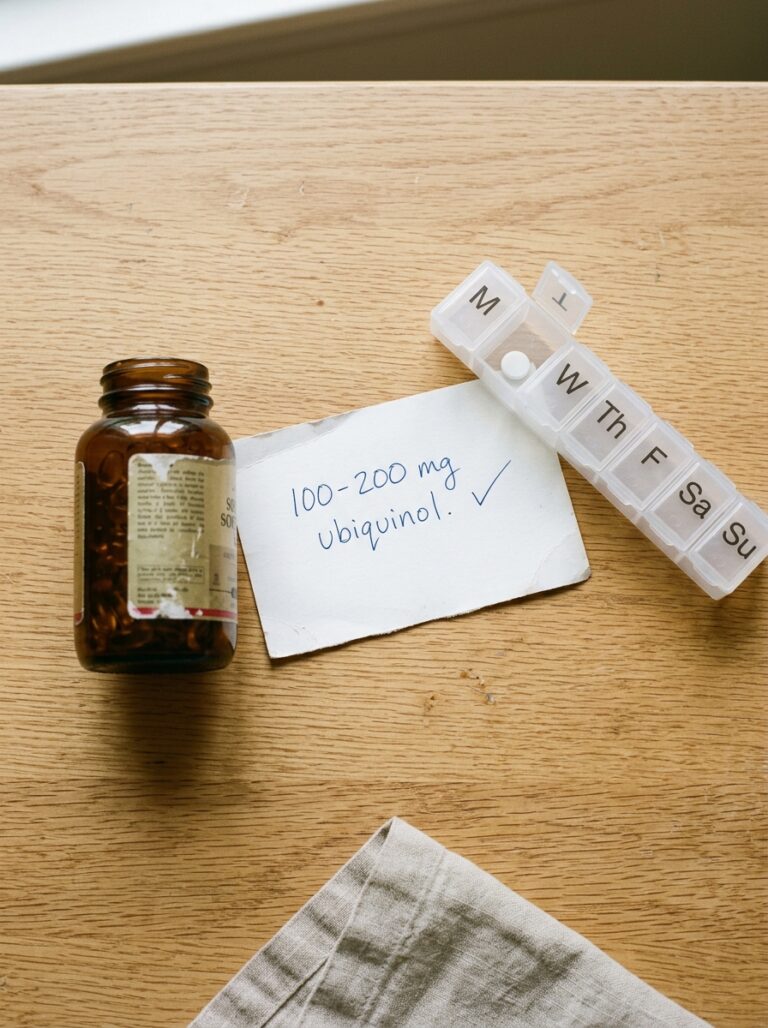
If you take a statin and you've read that it "drains your CoQ10," you've found a claim that is half true and frequently oversold. The chemistry is real: statins do lower your body's CoQ10. Whether replacing it fixes anything is a separate, much messier question. These are the picks I'd be comfortable putting in my own family's medicine cabinet, but read the verdict first.
Affiliate disclosure: this article contains affiliate links. As an Amazon Associate, UsefulVitamins.com earns from qualifying purchases at no extra cost to you.
Before you decide
Do not stop your statin to "test" CoQ10. Ever. A statin is a guideline-backed treatment that lowers your risk of heart attack and stroke, and CoQ10 is a supplement with mixed evidence for a side effect. Trading the first for the second is a bad deal no matter how your muscles feel.
If you're having muscle aches on a statin, the first conversation is with the doctor who prescribed it, not the supplement aisle. They can check whether your symptoms actually track with the drug, rule out other causes, and consider a dose change, a different statin, or a structured rechallenge.
The reason that conversation matters is that real-world muscle complaints and true statin myopathy are not the same thing. In the American Heart Association's scientific statement on statin safety, about 10% of patients stop a statin over muscle symptoms, while blinded trials show the actual statin-versus-placebo difference is under 1% – a large nocebo signal that no supplement addresses.
That word – nocebo – is the part most CoQ10 marketing pretends doesn't exist, and it's central to whether the supplement can possibly work for you. A nocebo effect is the negative-expectation twin of placebo: real, felt symptoms produced by the expectation of harm rather than by the drug itself.
The cleanest demonstration is the SAMSON n-of-1 trial, in which patients who'd quit statins over side effects cycled blindly through statin months, identical-placebo months, and no-pill months. Symptom intensity was essentially the same on the statin and the placebo – and far higher on both than during the no-pill months. Roughly 90% of the symptom burden showed up on placebo too.
Why this matters for CoQ10: if most of the aches are driven by taking a pill at all, then any pill you add – including CoQ10 – will tend to "work" in an open-label trial whether or not it does anything pharmacologically. That isn't a reason to dismiss your symptoms, which are genuinely felt; it's a reason to be humble about what's causing them and what's fixing them. Notably, half the SAMSON patients restarted a statin successfully once they'd seen their own data.
CoQ10 belongs in this picture as an optional add-on you trial while staying on therapy, supervised, not as a self-prescribed swap. It is also only one option among the supplements people use to support a statin, so weigh it against the rest rather than treating it as the obvious first pick. You can see how I weigh that kind of adjunct evidence on the how we review supplements page.
Why statins lower CoQ10
This part is not in dispute. Statins block HMG-CoA reductase, the rate-limiting enzyme of the mevalonate pathway – the same pathway your body uses to make cholesterol. CoQ10 is built downstream on that same pathway.
So when you turn down cholesterol synthesis with a statin, you also turn down CoQ10 synthesis as collateral. It isn't a flaw in any particular brand of statin; it's baked into how the whole class works.
The depletion is measurable. A 2018 meta-analysis of 12 randomized trials in nearly 1,800 patients confirmed that statin treatment significantly lowers circulating CoQ10, with the effect holding across statin types, intensities, and durations. Lipophilic and hydrophilic statins did it about equally.
To put a number on it, across controlled trials statins cut blood CoQ10 by somewhere between 16% and 54% – a wide band, but consistently downward. The direction of the effect is one of the most reproducible findings in this whole literature.
Here's the catch that gets skipped in the headlines: lower blood CoQ10 is not the same as proven harm. CoQ10 also rides on cholesterol-carrying lipoproteins, so part of the drop simply reflects lower LDL, not a tissue-level deficiency causing symptoms.
What you actually care about is the CoQ10 inside your muscle cells, not your bloodstream – and that's where the story frays. Muscle-biopsy studies find intramuscular CoQ10 is lowered in some statin-treated patients but not others, so even the depletion itself is inconsistent at the tissue level where aches would originate.
There's a deeper problem for the "just replace it" logic, laid out in a 2022 review in Advances in Nutrition: oral CoQ10 reliably raises blood levels, but has not been shown to reliably raise the CoQ10 concentration inside skeletal muscle. If the problem lives in the muscle and the supplement struggles to reach it, a perfect blood number may not translate into relief.
That gap between a clean biochemical story and a murky clinical one is the whole reason this article exists. The mechanism is tidy. The outcome data are not, and honest sources should say so.
What the trials actually show
This is where most CoQ10-for-statin roundups quietly overstate the benefit, so I'll be blunt: the randomized evidence that CoQ10 fixes statin muscle symptoms is genuinely mixed, and you can find a high-quality meta-analysis to support either side.
On the encouraging side, a 2018 meta-analysis of 12 RCTs in the Journal of the American Heart Association pooled 575 patients and found that CoQ10 supplementation reduced muscle pain, weakness, cramps, and tiredness versus placebo, with statistically significant improvements across all four symptom categories.
But read the same paper's fine print. Creatine kinase, the objective blood marker of muscle injury, did not budge – symptom scores improved while the biochemistry stayed flat. That disconnect is exactly what you'd expect if part of the effect is placebo response rather than corrected deficiency.
Now the other side. A 2022 meta-analysis in the Irish Journal of Medical Science restricted to 8 RCTs in 472 statin-treated patients reached the opposite conclusion: CoQ10 produced no significant benefit for muscle pain and no meaningful change in creatine kinase. Same drug, same question, opposite verdict.
The split usually comes down to which trials each review let in. The favorable analysis pooled a broader, more heterogeneous set of studies; the skeptical one applied tighter entry criteria – and the cleaner you make the inclusion list, the more the benefit tends to shrink. That's a familiar pattern when an effect is small and fragile rather than large and robust.
The single most rigorous trial points the same skeptical way. In a 2015 randomized, double-blind study of patients with confirmed statin myopathy – people whose pain reliably returned on simvastatin and vanished on placebo – adding a generous 600 mg of ubiquinol daily for eight weeks did not reduce muscle pain versus placebo. If CoQ10 were correcting a deficiency, this is the population in which it should have shone, and it didn't.
When competent studies split like this, the honest read is "small or no average effect, with large uncertainty," not "proven remedy." Effect sizes for symptom relief were modest even in the favorable analysis, and trial quality and blinding varied.
What that means in plain terms: CoQ10 is a coin-flip on whether it helps your muscles, but the downside is tiny and the cost is low. That asymmetry – possible modest upside, minimal risk – is the actual case for trying it, and it's a far more defensible pitch than "statins steal your CoQ10, so you must replace it."
What to look for when buying
Because the benefit is uncertain, spend the minimum that gets you a credible product and a studied dose, and skip the premium-form marketing. Here is what the evidence says actually matters.
Start with dose. The trials that found anything used roughly 100 to 200 mg of CoQ10 per day, and going far above that buys no proven extra benefit – just a bigger receipt. Below about 100 mg you're under the studied range.
Then form. CoQ10 sells as ubiquinone (the oxidized, cheaper form) and ubiquinol (the reduced form). In a head-to-head crossover study at 200 mg/day, ubiquinol raised plasma CoQ10 markedly more than ubiquinone – from 0.9 up to 4.3 µg/mL versus 2.5.
Don't over-read that, though. A broader review of CoQ10 absorption concludes that uptake is highly variable between individuals and that the bigger lever is taking it with fat, not which form is on the label. CoQ10 is fat-soluble; an empty-stomach dose is partly wasted.
The mechanics are worth understanding because they tell you how to take it. CoQ10 is a large, greasy molecule that absorbs poorly on its own; it needs dietary fat to trigger bile and form the mixed micelles that ferry it across the gut wall. Swallow a softgel with black coffee and you may leave much of the dose in the bottle, regardless of how premium it was.
That single habit – pairing the dose with your fattiest meal of the day – plausibly does more for your blood level than upgrading from ubiquinone to ubiquinol. A few grams of fat alongside the capsule is the cheapest absorption "enhancer" there is, and no label charges you for it.
Splitting matters too at the higher end. If you land on 200 mg, taking it as two 100 mg doses with separate meals tends to absorb better than one large slug, because the gut's capacity to micellarize CoQ10 at a single sitting is limited. At 100 mg, a once-daily dose with food is fine.
So the card verdict – 100 to 200 mg ubiquinol – is the sensible default, not a mandate: ubiquinol gives you the better-absorbed form as cheap insurance, but a ubiquinone product taken with a meal is a perfectly reasonable, cheaper choice.
| Label feature | What it tells you | Worth paying for? |
|---|---|---|
| 100 to 200 mg per serving | Matches the dose used in the trials | Yes, essential |
| Ubiquinol form | Better absorbed in head-to-head data, but not decisive | Nice, not required |
| Softgel in an oil base | Helps absorption of a fat-soluble nutrient | Yes, useful |
| Third-party tested seal (USP, NSF) | Independent check on identity and dose | Yes, a good signal |
| “Mega” 400 mg+ or proprietary blend | A bigger number, not a bigger proven effect | No, skip it |
For the deeper mechanics of forms, dosing, and who else takes CoQ10, see the complete guide to CoQ10, and for picks beyond this statin-specific angle, the best CoQ10 supplements roundup.
How to run an honest 8-to-12-week trial
Because the average effect is small and the nocebo pull is strong, a casual "I'll try it and see how I feel" almost guarantees a misleading answer. A little structure gives you something closer to real data on your own body.
Start by writing down where you are now. Before your first dose, jot a simple 0-to-10 muscle-ache score and note which muscles, what time of day, and how it affects walking, stairs, or sleep. Memory drifts and tends to flatter whatever you just spent money on; a baseline on paper doesn't.
Then hold everything else steady. Keep your statin, dose, and timing unchanged, and don't start three other supplements the same week – if you change five things at once, you learn nothing about CoQ10. Take 100 to 200 mg with a fatty meal, daily, and let it run.
Give it real time. CoQ10 builds up gradually and the trials that found anything ran roughly 8 to 12 weeks, so judging at two weeks is both too soon biochemically and most vulnerable to the early-enthusiasm bump. Re-score at the end against your written baseline, not against your hopes.
Then act on what you see. A clear, sustained drop in your ache score is reason to continue; little or no change is reason to stop and save the money. Either way, bring the result to your prescribing doctor – a documented no-benefit trial is genuinely useful information for the next decision about your statin.
Recommended Products

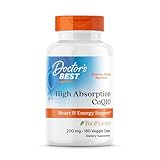

As an Amazon Associate, UsefulVitamins.com earns from qualifying purchases at no extra cost to you. We only recommend products supported by published research or third-party testing.
FAQ
Will CoQ10 stop my statin muscle aches?
Maybe, maybe not – the trial evidence is split. One major meta-analysis found symptom relief, another found none, and even the positive one showed no change in the muscle-injury blood marker. It's a reasonable 8-to-12-week trial, not a guarantee.
Can I stop my statin if I take CoQ10 instead?
No. A statin lowers your risk of heart attack and stroke; CoQ10 does neither. Any change to your statin is a decision for your prescribing doctor, never something to self-manage with a supplement.
Ubiquinol or ubiquinone – does it matter?
Ubiquinol absorbs better in head-to-head studies, but individual differences and taking it with food matter more than the form. If a ubiquinone product is cheaper and you take it with a fatty meal, that's fine.
How much should I take and for how long?
Stay in the 100 to 200 mg daily range used in the trials, taken with a meal, and give it 8 to 12 weeks before judging. If your muscles feel no different by then, there's little reason to keep buying it.
Is CoQ10 safe with my other heart medications?
It's generally well tolerated, but CoQ10 can mildly interact with warfarin and blood-pressure medicines. Run it past your doctor or pharmacist if you take a blood thinner or a complex cardiac regimen.
If statins lower my CoQ10, doesn't a low blood level prove I'm deficient?
Not on its own. Part of the drop just tracks your lower LDL, since CoQ10 travels on the same lipoproteins, and the level that matters is inside your muscle, not your blood. Muscle-biopsy studies find CoQ10 is depleted in some statin users but not others, so a blood number alone doesn't establish a meaningful deficiency.
Why might CoQ10 fail even when statins clearly deplete it?
Two reasons. Much of the muscle complaint may be a nocebo response that no nutrient corrects, and oral CoQ10 reliably raises blood levels but hasn't been shown to reliably refill the muscle. A tidy mechanism on paper doesn't guarantee the supplement reaches and fixes the right tissue.
Does the "mega" 400 mg-plus dose work better for muscle aches?
There's no good evidence it does. The benefit, where it shows up at all, was found at 100 to 200 mg, and absorption is capacity-limited, so a much bigger pill mostly means a bigger receipt. If anything, splitting 200 mg across two meals beats one oversized dose.
The bottom line on CoQ10 for statin users
The mechanism is solid and the supplement is cheap and safe, which is exactly why it gets oversold. Statins do lower your CoQ10 – but the randomized evidence that putting it back relieves muscle symptoms is genuinely mixed, with respectable meta-analyses landing on both sides.
Treat it as what it is: a low-risk, low-cost experiment worth 8 to 12 weeks at 100 to 200 mg with a fatty meal, run alongside your statin and ideally cleared with your doctor. If your muscles improve, keep it. If they don't, you've spent little and lost nothing.
What CoQ10 is never worth is trading away a treatment that protects your heart. Stay on the statin, take the supplement as an add-on if you want, and let the next blinded trial – not a marketing headline – settle the rest.
Reviewed by Michael Ward, MD MPH, Preventive Medicine, focused on guideline-based chronic disease management. See more from Michael Ward. This article is educational and is not a substitute for individualized medical advice; never start, stop, or change a prescription medication such as a statin without talking to your own physician.
As an Amazon Associate we earn from qualifying purchases. Product links may be affiliate links; this does not affect our editorial picks.
