
Affiliate disclosure: this article contains affiliate links. As an Amazon Associate, UsefulVitamins.com earns from qualifying purchases at no extra cost to you.
Before you buy
This is not a question of which whey "works" better. Both deliver about the same protein per scoop, both come from real whey, and both pass third-party banned-substance testing. Your muscles cannot tell them apart.
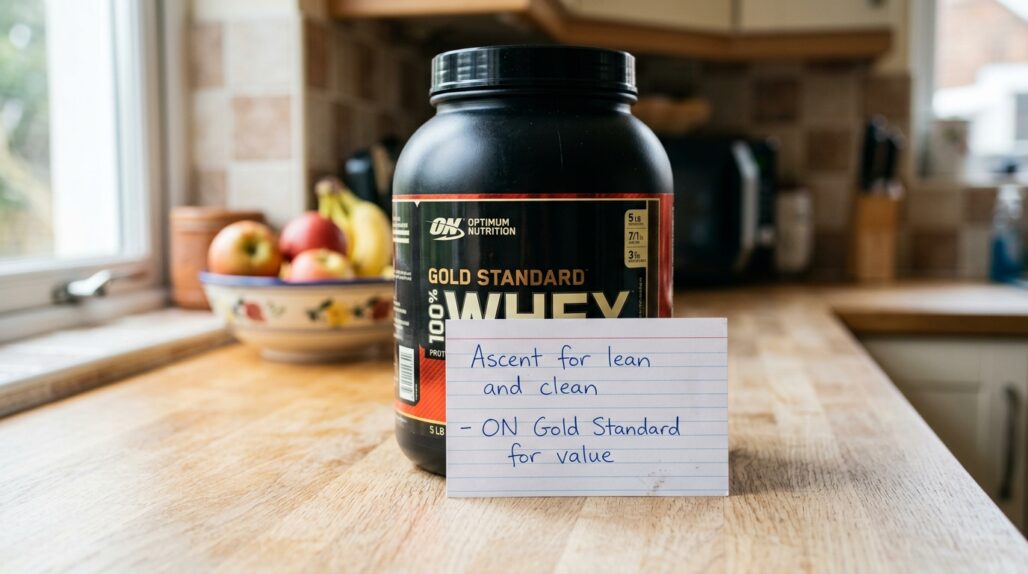
The real decision is about everything around the protein: additives, sweeteners, flavor, and price per gram. Ascent strips the formula down to native whey and stevia. Optimum Nutrition Gold Standard packs in more flavors, sells at a lower cost per serving, and uses artificial sweeteners to get there.
So the honest framing is simple. If you read labels and want the fewest extras, lean toward Ascent. If you want the best-tasting, cheapest, most-available tub and do not mind sucralose, the ON Gold Standard is hard to beat.
One thing to confirm before you spend anything: you may not need a powder at all if you already hit your protein target from food. Powder is a convenience tool, not a requirement.
What each whey actually is
The labels look similar, but the protein source differs in a way Ascent makes its whole pitch.
Ascent uses native whey. Native whey is filtered straight from milk rather than collected as a leftover from cheese production. Ascent's blend pairs that native isolate with regular whey isolate and a bit of whey concentrate. The result is a slightly leaner macro profile and a very short ingredient list.
ON Gold Standard uses a more conventional blend. Whey protein isolate is the primary ingredient, backed by whey concentrate and hydrolyzed whey peptides. That is the classic Gold Standard formula that has sat near the top of the category for years, as Optimum Nutrition describes on its official Gold Standard product page.
For muscle protein synthesis, both clear the bar. The NIH Office of Dietary Supplements notes that whey is a high-quality, leucine-rich protein, and both products land in the same leucine ballpark. The processing story matters more for label-readers than for your biceps.
Protein, carbs, and additives per scoop
Here is where the small differences show up. Numbers are from the brands and retail nutrition panels; serving sizes differ slightly, which matters when you compare.
| Per scoop | Ascent Native Whey | ON Gold Standard 100% Whey |
|---|---|---|
| Protein | 25g | 24g |
| Serving size | about 33g | about 30 to 32g |
| Total carbs | about 4g | about 3g |
| Sugar | about 2g | about 1 to 2g |
| Fat | about 1g | about 1 to 1.5g |
| BCAA | 5.5g | 5.5g |
| Sweetener | stevia leaf extract | sucralose and acesulfame potassium |
| Ingredient count | very short, no creamer | longer, includes lecithin and flavor system |
The macros are close enough to call a tie. The real separator is the additive line. Ascent leaves out artificial sweeteners and the small creamer or oil blend that ON uses to round out texture.
If you specifically avoid sucralose or acesulfame potassium, that single row decides it for you: buy Ascent. If you do not care, the difference is cosmetic.
A quick note on heavy metals, since it drives a lot of protein-powder anxiety. In Consumer Reports' 2025 protein-powder lead testing, ON Gold Standard 100% Whey (Double Rich Chocolate) landed among the better choices for daily use, but CR still measured detectable lead (about 56% of its daily level of concern) and suggested capping intake at roughly 1¾ servings a day, so lead was low but not zero. ON has also carried a Clean Label Project purity award. Treat these as encouraging third-party signals rather than a guarantee for every lot. If contamination is your top worry, our roundup of the lowest heavy-metal protein powders on Amazon goes deeper than any single brand claim.
Third-party testing and quality
This is the area where neither brand lets you down, which is rarer than it should be.
Ascent is Informed Sport and Informed Choice certified. That program tests batches for banned substances against WADA-level standards, which matters if you compete in a drug-tested sport. Ascent leans on this hard in its marketing, and the certification holds up.
ON Gold Standard is Informed Choice certified and has been for years, according to its Informed Choice listing. ON also labels the product as banned-substance tested.
The practical read: if you get drug tested, either one is a safe pick. Ascent's every-batch Informed Sport testing is the slightly stronger credential for elite competitors, but for a recreational lifter the gap is academic.
For anyone stacking protein with medication, run a quick check first. Whey itself is low-risk, but our drug and supplement interaction guide is worth a scan if you take prescriptions daily.
Cost per 25g of protein
Price is where ON earns its reputation, and it is the most honest way to compare two wheys: cost per fixed gram of protein, not cost per tub.
| Cost angle | Ascent Native Whey | ON Gold Standard 100% Whey |
|---|---|---|
| Per serving (large size) | about $1.40 to $1.70 | about $1.30 to $1.90 |
| Per 25g protein | about $1.40 to $1.70 | about $1.35 to $2.00 |
| Cheapest in bulk | 4 lb bag | 5 lb tub |
| Where it is cheapest | brand subscribe-and-save | Amazon and warehouse 5 lb |
Prices move constantly, so treat these as a snapshot, not gospel. As of writing, a 2 lb Ascent tub runs around $45 at the brand price, while a 5 lb ON tub often lands well under $2 per serving and dips lower on Amazon deals. Check current price before you buy either one.
The pattern is clear. In the largest sizes, ON usually costs less per gram of protein, sometimes noticeably so. Ascent narrows the gap on its 4 lb bag and subscribe-and-save, but it rarely undercuts a discounted 5 lb ON tub.
So if your only filter is dollars per gram, ON Gold Standard is the value default. Ascent asks a small premium for the cleaner label.
Taste, mixability, and sweetener feel
Both mix well in a shaker. Neither is gritty when prepped right.
ON Gold Standard tastes like a dessert shake. That is the sucralose talking, and it is exactly why some people love it and others avoid it. The flavor range is enormous, with well over a dozen options, which is a real advantage if variety keeps you consistent.
Ascent tastes cleaner and less sweet. Stevia gives it a milder, more natural profile that fans prefer and skeptics find a touch flat. Reviewers consistently rate its mixability highly, with little clumping in a standard shaker.
If sweetness and flavor variety drive your adherence, ON has the edge. If artificial-sweetener aftertaste bothers you, Ascent is the more pleasant daily drink. This is preference, not quality, and you should weight it heavily because the powder you actually finish is the one that works.

How they compare to the premium tier
Neither of these is a "premium" priced whey, and that context helps. If you are weighing them against pricier clean-label isolates, two of our reviews are worth reading.
The Transparent Labs whey review covers a grass-fed isolate that competes with Ascent on the clean-label angle but costs more. The Legion whey review looks at another label-forward option with naturally sweetened flavors.
The takeaway from those comparisons: Ascent gives you most of the clean-label benefit for less money, and ON gives you the lowest price in the category. The premium tier mostly buys grass-fed sourcing and marketing, not better results.
Value pick and how to choose
For most people, the choice comes down to a single question: do you care more about the label or the bill?


As an Amazon Associate, UsefulVitamins.com earns from qualifying purchases at no extra cost to you.
UsefulVitamins may earn a commission from purchases made through links on this page, at no extra cost to you. This never affects our verdicts.
If you want the cleanest label and stevia-only sweetening, buy Ascent and get the 4 lb bag to soften the price. If you want the cheapest reliable whey with the most flavors, buy ON Gold Standard in the 5 lb size and stop overthinking it.
Either way, buy the largest size you will realistically use within a few months, since the per-gram price drops sharply with volume.
FAQ
Is Ascent or Optimum Nutrition better for building muscle? Neither has a meaningful edge. Both deliver about 24 to 25g of high-quality whey with around 5.5g of BCAA per scoop, which is what drives recovery. Pick based on label, taste, and price.
Why is Ascent more expensive than Gold Standard? Ascent uses native whey and a short, additive-light formula with no artificial sweeteners, which costs more to produce. In the largest sizes, ON Gold Standard usually wins on price per gram of protein.
Does Optimum Nutrition Gold Standard contain artificial sweeteners? Yes. The flavored versions use sucralose and acesulfame potassium. If you avoid those, Ascent is stevia-sweetened instead.
Are both proteins safe for drug-tested athletes? Both carry banned-substance testing. Ascent is Informed Sport and Informed Choice certified, and ON Gold Standard is Informed Choice certified, so either is a reasonable pick for tested competitors. Confirm the current certification on the exact product you buy.
Which one mixes and tastes better? ON tastes sweeter and offers far more flavors. Ascent tastes cleaner and less sweet thanks to stevia. Both mix well in a standard shaker, so this is a personal preference call.
Do I even need a whey powder? Only if you struggle to hit your daily protein from food. Powder is a convenience, not a requirement, and a tub goes much further than a few protein bars for the same money.
The verdict
There is no loser here, which is the point. Ascent and ON Gold Standard are both well-made, tested wheys with nearly identical protein per scoop. Your choice is about priorities, not quality.
Buy Ascent if you read labels, avoid artificial sweeteners, and will pay a small premium for native whey and a shorter ingredient list. Buy ON Gold Standard if you want the lowest price per gram, the widest flavor range, and the most-available tub on any shelf.
Next step: decide which of those two sentences sounds more like you, then buy the largest size you will finish. That single decision saves more money than agonizing over which brand is "best."
This article is for general information and is not medical advice. Supplement needs vary, and prices and certifications change; verify the current label and check with a healthcare professional before adding any supplement, especially if you take medication or have a health condition.
Reviewed by the UsefulVitamins Editorial Team.
