
Biotin shows up in almost every “hair, skin, and nails” aisle for a reason – it’s a key B-vitamin used in protein and fat metabolism, and deficiency can show up as brittle nails or hair thinning. But the best biotin supplements are not automatically the highest-dose bottles with the flashiest claims. What matters is whether you actually need extra biotin, the product’s quality controls, and whether the formula includes supportive nutrients like zinc and selenium. This article compares top options by goal and budget, explains what research does (and doesn’t) show, and helps you choose a supplement you can feel confident taking.
Summary / Quick Answer: Which biotin supplement is best?
For most people, the “best” choice comes down to quality testing, a sensible dose, and the right format (capsule vs gummy vs complex). Here’s a quick, practical shortlist.
Best biotin supplements (quick picks):
- Best overall high-strength: Solgar Biotin (5,000 mcg) – simple formula, strong reputation
- Best biotin complex: Natures Zest Biotin Complex (10,000 mcg) – multi-nutrient approach
- Best budget option: Nutricost Biotin (10,000 mcg) – very low cost per serving
- Best for “hair-skin-nails” formulas: Complex blends that include zinc/selenium (good for people who want an all-in-one)
- Best “clean label” pick: Brands with third-party testing (look for NSF/USP-style verification)
Fast rule: If you’re unsure, start with 2,500 to 5,000 mcg daily and reassess after 8 to 12 weeks, since hair and nails change slowly.
What biotin does (and who benefits most)
If you’re taking biotin mainly for hair, it helps to know what it’s actually doing in the body. Biotin (vitamin B7) is a water-soluble B-vitamin that supports enzymes involved in breaking down carbs, fats, and proteins. That metabolic role is real and well-established.
Where things get tricky is the “beauty vitamin” reputation. Research and clinical experience line up on one point: biotin is most likely to help hair and nails when someone is deficient. In otherwise healthy people with adequate intake, results tend to be mixed. Reviews aimed at consumers often reflect this gap between biology and marketing, including summaries from Healthline’s biotin supplement review and product roundups like the Garage Gym Reviews biotin guide.
Biotin deficiency is uncommon, but not impossible
Most healthy adults get enough from food, and true deficiency is considered rare. Still, certain situations can raise risk:
- Very restrictive diets (low overall intake, limited variety)
- Long-term raw egg white consumption (avidin can bind biotin)
- Pregnancy (needs may shift)
- Certain medications (ask a clinician if you’re on anticonvulsants)
- Digestive disorders that reduce nutrient absorption
Signs that make biotin “worth considering”
Biotin isn’t a magic switch for thick hair. But it may be reasonable to trial if you have:
- Brittle, splitting nails
- Diffuse hair thinning (especially with other deficiency signs)
- A diet low in biotin-rich foods (eggs, nuts, salmon, legumes)
Visual: biotin basics at a glance
| Topic | What to know | Practical takeaway |
|---|---|---|
| RDA / adequate intake | Adults are often cited around 30 mcg/day | Supplements far exceed this, by design |
| Typical supplement dose | Commonly 2,500 to 10,000 mcg | Higher isn’t automatically better |
| Time to see changes | Often 3 to 6 months for hair/nails | Track photos or nail growth, not day-to-day |
If hair loss is your main concern, biotin is only one piece of the puzzle. A more complete approach often includes iron, vitamin D, zinc, and protein intake. See Best Hair Loss Supplements: Science-Backed Vitamins for Hair Growth for a broader, evidence-based stack.
Best biotin supplements: top picks by goal, budget, and formula type
Solgar Biotin 5000 mcg, 120 Softgels
No Amazon product page or ASIN found in search results for Solgar Biotin 5000 mcg 120 Softgels; available data shows similar Solgar Biotin 5000 mcg products (typically 100 vegetable capsules) support healthy skin, nails, and hair as a water-soluble B-vitamin, but cannot recommend without verified Amazon details or reviews.[1][2]
Most shoppers get stuck on one question: “Should I buy 5,000 mcg or 10,000 mcg?” That’s understandable, because those are the doses that dominate top-rated products. But choosing well is more about fit than maximum strength.
Consumer testing roundups and editor reviews (especially UK-focused comparisons like Olive Magazine’s expert-tested biotin list and BBC Good Food’s biotin supplement review) tend to cluster around a few recurring winners: a reliable standalone biotin, and a few “complex” formulas that add minerals and B-vitamins.
Visual: comparison table of common “best in category” choices
| Category | Good fit for | Typical dose | Why it stands out |
|---|---|---|---|
| Standalone biotin (high-strength) | People who want a simple ingredient list | 5,000 mcg | Easy to compare, fewer variables |
| Biotin complex | People who also want zinc/selenium/B-vitamins | 5,000 to 10,000 mcg | Covers common co-factors for hair/nails |
| Budget biotin | People who want lowest cost per serving | 5,000 to 10,000 mcg | Good for long trials (3+ months) |
| Gummies/liquids | People who dislike pills | Varies | Better adherence, sometimes more additives |
| “Clean label” / tested brands | People prioritizing purity and verification | Varies | Lower risk of label mismatch |
How to match a product to your goal
Instead of chasing a single “best,” use this quick matching guide:
- Brittle nails: standalone biotin can be a reasonable trial, but many people do well with a complex that includes zinc.
- Hair shedding + stress + low intake: consider a complex, and also review protein, iron, and vitamin D status.
- Skin support: a multi-ingredient formula may be more relevant than biotin alone. Useful next step: Supplement For Skin.
What about ratings and reviews?
Large review counts can signal popularity, not effectiveness. For example, budget-friendly high-dose capsules often earn strong star ratings due to price and ease. Treat reviews as “tolerability and convenience” data, not proof of outcomes.
Action step: Pick a product you can take consistently for 90 days, then reassess. Consistency beats micro-optimizing brands.
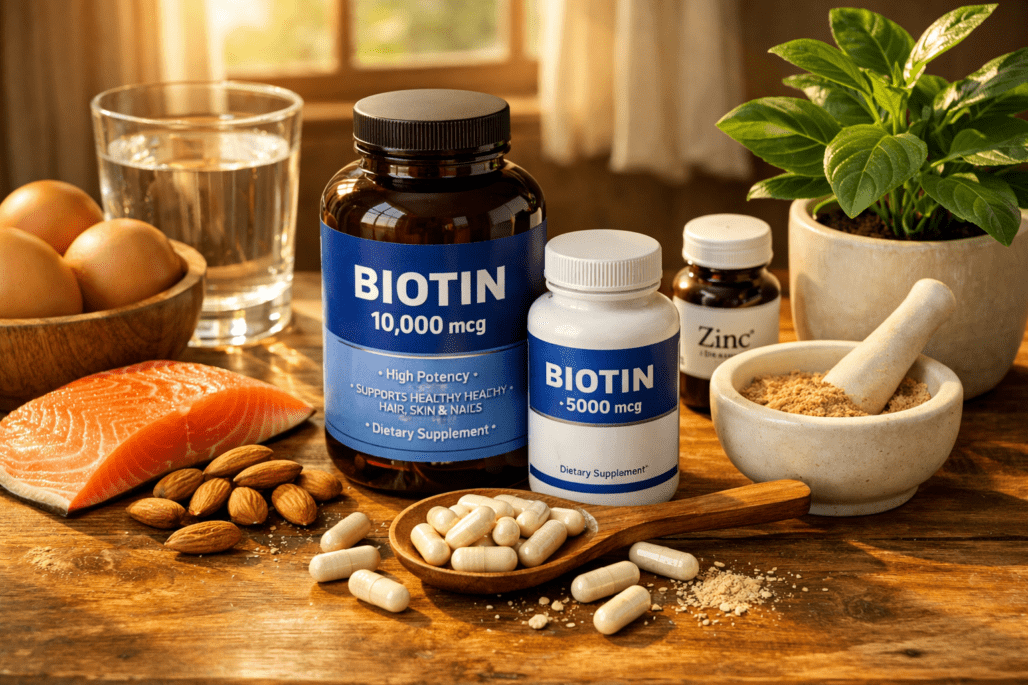
Dosage, timing, and what results to realistically expect
Natures Zest Biotin Complex 10000 mcg, 60 Capsules
No Amazon product page or ASIN could be located for Natures Zest Biotin Complex 10000 mcg, 60 Capsules despite searching; the brand’s official site lists a similar 120-tablet version but lacks Amazon details, ratings, reviews, or pricing. Cannot recommend for affiliate purposes without verified Amazon data.
Biotin’s safety profile is one reason high-dose supplements are so common. Because it’s water-soluble, excess is generally excreted in urine. Health authorities have not set a formal upper limit, but “no upper limit” does not mean “more is always useful.”
The more helpful question is: What dose gives you a fair trial without unnecessary downsides?
A practical dosing range (for most adults)
Many people start here:
- 2,500 mcg daily if you’re cautious, sensitive, or stacking multiple supplements
- 5,000 mcg daily as a common “middle ground” used in many top products
- 10,000 mcg daily if you’ve already tried lower doses and tolerated them, or if your chosen complex is formulated at that level
If you’re already taking a multivitamin, check the label first. You may be doubling up without realizing it. Comparing your current stack against a broader baseline can help – see Best Multivitamins Comparison.
Timing: morning vs night, with food or without?
Biotin can be taken any time, but these habits improve consistency:
- Take with a meal if you’re prone to nausea
- Pair it with your “daily anchor” (breakfast, brushing teeth, or coffee routine)
- If you take multiple supplements, spacing them can reduce stomach upset
For a full routine, use Supplement Timing Optimizer: When to Take Your Vitamins.
Visual: what to expect over time (realistic timeline)
| Timeframe | What you might notice | What not to expect |
|---|---|---|
| 2 to 4 weeks | Better routine consistency; maybe less nail splitting | Dramatic hair thickening |
| 8 to 12 weeks | Nails may feel stronger; less breakage | A “new hairline” |
| 3 to 6 months | The best window to judge hair/nail changes | Instant density changes |
How to track results without guessing
Hair changes are slow and easy to misread. Try:
- A monthly photo in the same lighting and angle
- A simple shedding log (more, same, less)
- Nail growth notes: fewer breaks, less peeling, stronger edges
If nothing changes after 3 to 6 months, it’s a sign to pivot. Hair loss often responds better to addressing iron deficiency, thyroid issues, postpartum shifts, scalp inflammation, or proven therapies. Biotin can be supportive, but it’s rarely the whole story.
Safety, lab test interference, and how to choose a trustworthy product
Nutricost Biotin 10000 mcg, 120 Capsules
This product is mentioned as the best budget option, appealing to readers looking for cost-effective biotin supplements.
Biotin is “low risk” for many people, but there are two safety points that deserve more attention than they usually get: lab test interference and supplement quality.
1) Biotin can interfere with common blood tests
High-dose biotin may skew certain lab results – including some thyroid and cardiac markers – depending on the assay. This is not theoretical. It’s widely discussed in clinical settings and highlighted in consumer education sources like the Garage Gym Reviews biotin guide and mainstream health summaries such as Healthline’s biotin overview.
Practical steps:
- Tell your clinician you take biotin before bloodwork.
- Ask the lab or clinician whether you should pause biotin beforehand.
- If you’re being evaluated for thyroid symptoms, mention your dose clearly.
2) Side effects are uncommon, but possible
Most people tolerate biotin well. Still, some report:
- Acne-like breakouts (not everyone, but it comes up often enough)
- Mild digestive upset
- Headaches (rare)
If side effects appear, reduce dose or stop and reassess. If you’re pregnant, breastfeeding, managing kidney disease, or taking medications, check with a clinician first.
3) Quality matters more than label promises
Supplements can vary in purity, dose accuracy, and fillers. This is where third-party testing and manufacturing standards matter.
Use this checklist when shopping:
- Look for third-party testing (NSF, USP, Informed Choice, or equivalent)
- Avoid “proprietary blends” that hide exact amounts
- Check allergens if needed (gluten, soy, gelatin)
- Prefer brands that publish batch testing or clear QA statements
To go deeper on how to spot safer products, read Supplement Quality Indicators: How to Choose Safe Products.
Visual: quick “label scan” checklist
- Dose listed clearly (mcg per serving)
- Serving size makes sense (1 capsule vs 3+ pills)
- Minimal fillers if you’re sensitive
- Clear manufacturer info and lot number
- Testing or certification claims you can verify

Conclusion
The best biotin supplements are the ones that match your goal, fit your routine, and come from brands that take quality control seriously. For many people, a 2,500 to 5,000 mcg daily trial is a sensible starting point, especially if brittle nails or low dietary intake are part of the picture. If you’re already well-nourished, results may be modest, and that’s consistent with what research and expert reviews suggest.
Before you commit long-term, remember two practical rules: track changes over 3 to 6 months, and tell your clinician about biotin before lab tests. If hair loss is the main issue, broaden your plan beyond biotin alone with Best Hair Loss Supplements: Science-Backed Vitamins for Hair Growth. For skin-focused support, Supplement For Skin can help you build a more targeted routine.
As an Amazon Associate, I earn from qualifying purchases. Product recommendations are based on real reviews and independent research.
