
Affiliate disclosure: this article contains affiliate links. As an Amazon Associate, UsefulVitamins.com earns from qualifying purchases at no extra cost to you.
If you are standing in the kitchen with an iron bottle in one hand and a magnesium bottle in the other, here is the short version: nothing dangerous happens when you take them, but the order and timing change how well the iron works. The fix is simple. You just need to keep them apart.
Do iron and magnesium actually interact?
Yes, but it is an absorption clash, not a toxic one. The two minerals do not react in your bloodstream or stack up a side effect. They compete in your gut, before either one gets absorbed.
Both iron and magnesium are divalent cations (Fe2+ and Mg2+), and a large simultaneous dose of one can compete with the other for absorption in the gut. Non-heme iron uptake runs largely through the divalent metal transporter 1 (DMT1), and high concentrations of competing minerals are thought to blunt that uptake. When the gut is crowded with both at once, iron bioavailability drops.
The key word is concentration. This crowding matters most when both doses are large and taken together. At ordinary supplement amounts taken at sensible times, the effect is modest.
How strong is the evidence? Honestly, mixed:
- The mechanism itself is solid. Mineral-on-mineral competition for absorption in the gut is well established, and the NIH Office of Dietary Supplements notes that minerals competing at the gut is exactly why iron is kept away from calcium and antacids.
- Hard harm data at normal doses is thin. The clearest documented case of magnesium actually causing iron-deficiency anemia involved an extreme amount, described below, not a regular supplement.
- Some evidence even points the other way. A small 2022 intervention study (Milinkovic and colleagues) gave female students 375 mg of magnesium a day and saw certain iron parameters slightly improve, not fall, though the authors still advised lab monitoring when stacking the two.
So the fair grade is: moderate confidence in the competition mechanism, low confidence that normal supplement doses cause real-world iron loss. The spacing rule is a low-cost precaution, not a reaction to a documented disaster.
The one case that shows how far this can go
The most extreme report in the literature is a reminder that the dose is what matters. A 28-year-old woman with anorexia nervosa was hospitalized for iron-deficiency anemia that would not resolve despite nine months of oral iron (Tani and colleagues, 2019). The hidden cause was magnesium oxide laxative overuse at 16.7 to 66.7 grams a day, roughly 100 times the supplemental upper limit.
At that dose, the magnesium oxide did two things to the iron: it raised stomach pH and helped form a macromolecular polymer that locked the iron up so it could not be absorbed. Her anemia only turned around after the magnesium overuse stopped.
Two takeaways. First, this is what extreme magnesium oxide misuse looks like, not a 200 mg evening dose of glycinate. Second, the form of magnesium matters. Magnesium oxide, the cheap antacid and laxative form, is the worst offender here. Chelated forms such as magnesium glycinate (bisglycinate) and citrate show little of this interference.

The practical rule: timing, dose, and who should care most
Here is the spacing that works, and it lines up with how clinicians already tell people to take iron.
| Question | Straight answer |
|---|---|
| Do they interact? | Yes, in the gut. Large simultaneous doses compete for absorption, so taking them together lowers iron absorption. It is a timing problem, not a safety emergency. |
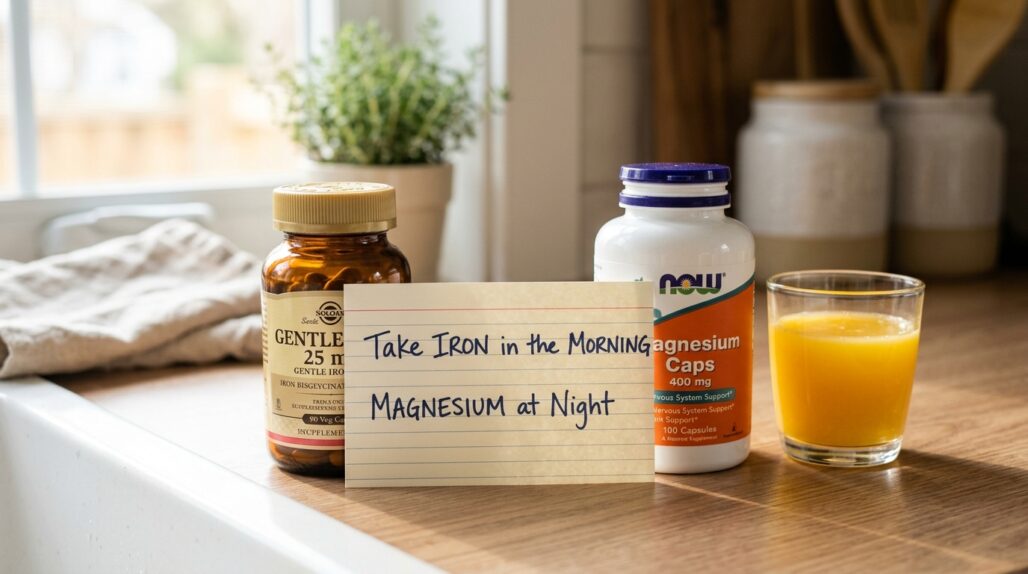
| How do I take them? | Iron in the morning on an empty stomach with vitamin C or orange juice. Magnesium about 2 hours later, or with your evening meal. Keep at least a 2-hour gap. |
| Which form of magnesium? | Prefer magnesium glycinate or citrate. Avoid magnesium oxide if you are also taking iron, since oxide is the form tied to blunted iron absorption. |
| Who should be careful? | Anyone treating iron-deficiency anemia: menstruating women, vegetarians and vegans, people after bariatric surgery, and those eating little on GLP-1 medications. |
| When do I call a doctor? | If iron therapy is not improving your energy or your labs, or you get persistent diarrhea, severe cramps, or dark stools with belly pain. |
A few specifics behind that table:
- Iron absorbs best alone and acidic. Cleveland Clinic advises taking oral iron on an empty stomach, ideally with vitamin C, and keeping it away from milk, antacids, and calcium. Magnesium belongs in that same keep-apart group.
- Magnesium has its own ceiling. The NIH sets the supplemental upper limit at 350 mg of elemental magnesium a day, with diarrhea as the warning sign that you have gone too high. Staying under that limit also keeps the gut concentration low enough that competition stays minor.
- Stay inside your prescribed iron dose. If a clinician put you on iron for anemia, do not raise it on your own to “make up” for any loss. Fix the timing instead, and let your labs guide the dose.
The 2-hour gap is the same convention used for iron versus calcium and iron versus antacids, so if you already separate those, you are most of the way there. This is education about timing, not a reason to change a prescription on your own.
What to actually do: the safe way to take both
The cleanest setup is two anchors in your day. Put iron at the morning anchor, on an empty stomach, with a small glass of orange juice. Put magnesium at the evening anchor, with dinner, which also softens any loose-stool effect. That single change keeps them roughly 8 to 10 hours apart, well beyond the 2-hour minimum, and lets each mineral land on an open transporter.
If mornings are chaotic, even a 2-hour gap within the same part of the day is enough. The point is not the exact clock time. It is not swallowing a big iron dose and a big magnesium dose in the same mouthful.
The cleanest way to avoid surprise overlaps like this is to keep every prescription and supplement in one place and have the conflicts flagged before you add something. You can do that in StackMyMed (our own free app): log your iron and your magnesium together, and it surfaces the absorption-timing note as something to ask your pharmacist about. It does not diagnose or decide for you, it just catches the overlap. The low-tech version works just as well: write your full list, including doses and forms, on a card and show it to your pharmacist at pickup.


As an Amazon Associate, UsefulVitamins.com earns from qualifying purchases at no extra cost to you.
UsefulVitamins may earn a commission from purchases made through links below, at no extra cost to you. We only suggest products that fit the safe approach described above. Prices change, so check the current price before buying.
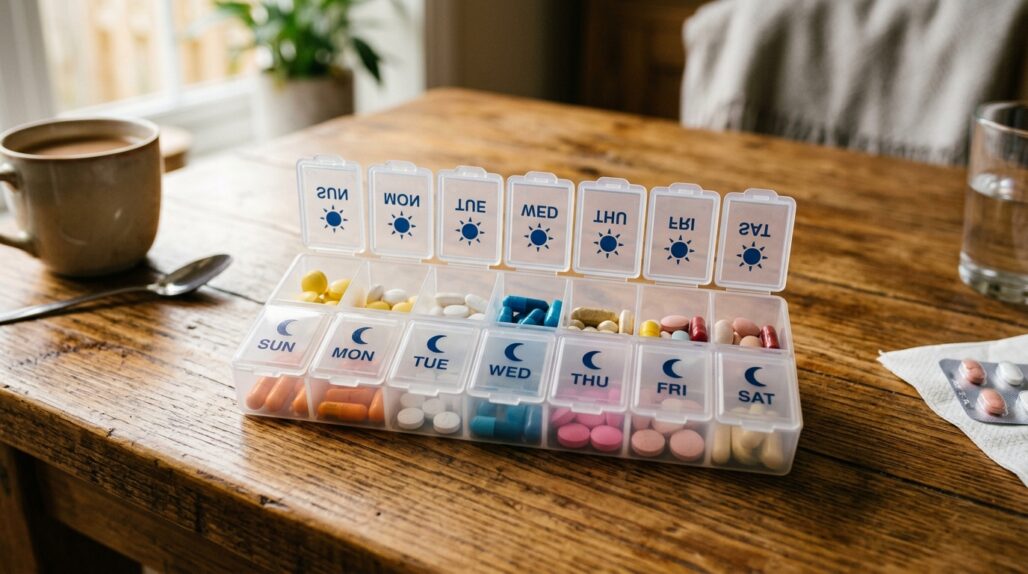
A sensible kit for keeping these two apart, rather than a combined iron-magnesium tablet (a poor choice when you are correcting a deficiency): a gentle chelated iron, a non-competing magnesium, and an organizer that makes the morning-and-evening split automatic. For picking among brands, our guide to the best iron supplements and our best magnesium supplement roundup walk through forms and tolerability, and the iron dose calculator helps you sanity-check the amount against your needs.
What about iron and other things you take?
Magnesium is not the only mineral iron competes with. The same divalent-cation crowding shows up with calcium, and the same keep-apart logic applies. If you take a multivitamin, check whether it already contains iron, magnesium, calcium, or zinc, since a "hidden" dose in a multi can quietly double what you swallow at once.
Two relatives worth knowing:
- Iron and thyroid medication. Iron can bind levothyroxine and cut its absorption, which is a more clinically watched timing rule than the magnesium one. See iron and thyroid medication timing for the spacing.
- Magnesium and zinc. These two also share transporters, though the bigger concern there is high-dose zinc and copper, not magnesium.
None of this means iron is hard to take. It means iron rewards a little planning: take it alone, with something acidic, and away from competing minerals. Do that and the iron actually gets absorbed.
FAQ
Can I take iron and magnesium at the same time if my doses are small? You can, and the impact is minor at small doses, but separating them is free and removes the question entirely. If you are correcting a real iron deficiency, take the gap seriously.
Does magnesium “block” iron? Not in a dramatic way at normal doses. They compete at the same gut transporter, so a big simultaneous dose lowers iron absorption. The only documented case of magnesium causing anemia involved roughly 100 times the safe magnesium amount.
Which magnesium is safest to pair with iron? Magnesium glycinate or citrate. Avoid magnesium oxide alongside iron, since oxide is the antacid-style form linked to blunted iron absorption through raised stomach pH.
How long should I wait between iron and magnesium? Aim for at least 2 hours. The easy version is iron in the morning, magnesium at night, which spaces them far more than the minimum.
I have been on iron for weeks and still feel tired. What now? Tell your doctor. It could be poor absorption from timing or another cause, and Mayo Clinic advises rechecking ferritin and hemoglobin rather than guessing. Do not just pile on more iron.
Can a combined iron-plus-magnesium tablet work? For general topping up, maybe. For treating a diagnosed deficiency, no: putting both minerals in the same pill guarantees they compete, which is the opposite of what you want when you need the iron to land.
The bottom line
Iron and magnesium are safe to take together in the sense that the pairing will not hurt you. The catch is absorption: they compete at the same gut transporter, so taking large doses at once can quietly waste your iron. Keep them about 2 hours apart, put iron in the morning with vitamin C and magnesium in the evening, choose a chelated magnesium over oxide, and stay under the 350 mg supplemental magnesium limit. If you are treating diagnosed anemia and it is not improving, that is your cue to call your doctor and recheck your labs, not to self-adjust the dose.
This article is educational and is not medical advice, and it does not replace a prescription or your clinician's guidance. Talk to your doctor or pharmacist before changing how you take iron, magnesium, or any medication.
Reviewed by the UsefulVitamins Editorial Team.
