
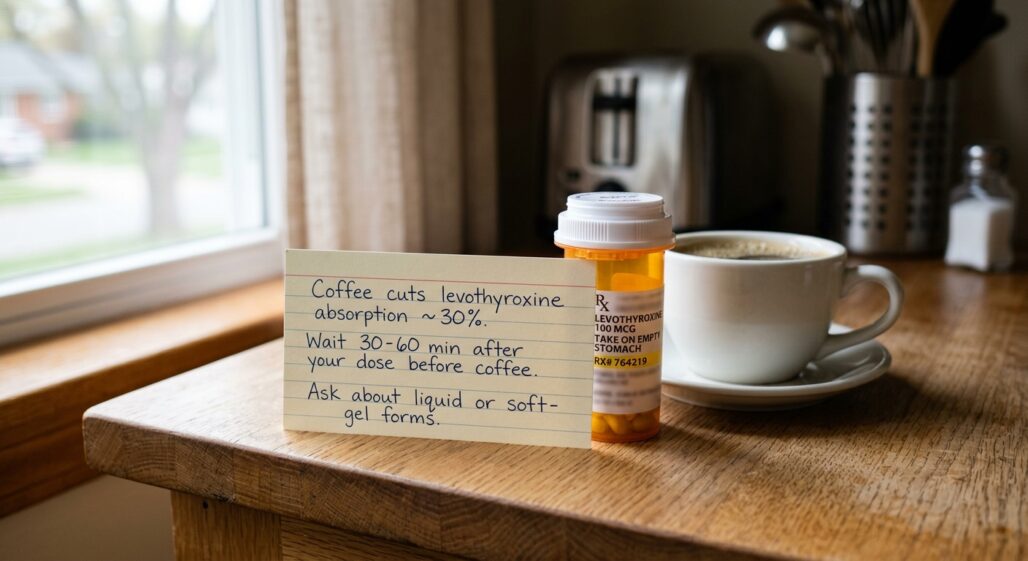
If you take levothyroxine and you are searching for the coffee-and-levothyroxine wait time, you are almost certainly asking the right question for the wrong-feeling reason: your morning routine and your medication are quietly fighting each other. The short answer is that coffee taken at the same time as a levothyroxine tablet can blunt absorption by roughly a quarter to a third, and a 30-to-60-minute gap mostly fixes it. This is a real interaction with controlled-study backing, not a wellness rumor. Below I will walk through the mechanism, the actual effect-size numbers, exactly how to space your dose, which formulations sidestep the problem, and when this is worth a call to your clinician.
Before you decide
This is general health information, not medical advice, and it is not a reason to change anything on your own. Never stop, skip, or adjust a levothyroxine dose because of something you read online, including this page. Levothyroxine is the standard of care for hypothyroidism, and the timing tweak here is about getting full value from the dose you already take, not about reducing it.
The people who need to be most careful are those whose thyroid levels are hard to control, anyone recently started or re-titrated, pregnant patients (whose thyroid targets are tighter), and people with thyroid cancer on suppressive dosing. If your TSH has been bouncing despite a stable prescription, an inconsistent coffee gap is one cheap, fixable suspect worth raising.
Call your doctor or pharmacist if your dose feels off, if symptoms return, or before you change formulations. A pharmacist can confirm your specific product and check the rest of your morning lineup. That conversation costs nothing and is the safest move here.
What the coffee-levothyroxine interaction actually is
Levothyroxine is a narrow-margin drug: small changes in how much you absorb can move your blood levels enough to matter. The label and standard guidance already tell patients to take it on an empty stomach. The coffee problem is really a sub-case of the broader rule that levothyroxine wants an empty, acidic stomach and nothing else competing for the same window.
The proposed mechanism is physical sequestration. Compounds in coffee, including caffeine and the natural fibers and oils, appear to bind the drug in the gut so that more of it passes through and less crosses into your bloodstream. The seminal work described coffee as a weaker version of known levothyroxine "sequestrants" like dietary fiber and aluminum-containing antacids.
This is the same family of problem as taking the pill with minerals. We cover the related timing math in our guide to iron and thyroid medication timing and the parallel mineral case in calcium and levothyroxine timing. Coffee is gentler than those, but the logic is identical: separate the dose from the thing that grabs it.
It helps to think of your stomach in that first hour like a single checkout lane. If the tablet and the coffee try to go through at once, some of the drug gets bumped out of line and never gets scanned into your blood. Give the tablet a clear head start and the lane stays open.
How big is the effect, with the actual numbers
This interaction was characterized in a careful crossover study, and the numbers are specific rather than vague. In the 2008 Thyroid study by Benvenga and colleagues, swallowing levothyroxine with coffee lowered the average incremental rise in serum T4 by 36 percent in thyroid patients and 29 percent in healthy volunteers, with the peak rise down by 30 percent and 19 percent respectively. Time to peak level was pushed back by roughly 38 to 43 minutes.
The single most important detail is timing-dependence. When the same patients drank the coffee 60 minutes after the dose instead of with it, their absorption was statistically indistinguishable from drinking plain water. The interference essentially disappeared with a one-hour gap.
The 2021 systematic review in Pharmaceuticals (Basel) pooled this with the rest of the food-and-supplement literature and landed on a plain recommendation: delay coffee by about an hour after levothyroxine. The American Thyroid Association's patient-facing summary frames it the same way, noting reductions ranging from roughly 25 percent up to 57 percent in individual patients when coffee and drug went down together.
Here is the honest caveat that most listicles skip: the effect size is variable person-to-person, and a quarter-to-a-third absorption drop is the typical signal, not a guaranteed outcome for everyone. For someone whose levels are rock-steady, a sloppy gap may never show up on labs. For someone fighting a stubborn TSH, it can be the missing piece.
What to do: timing, spacing, and which forms

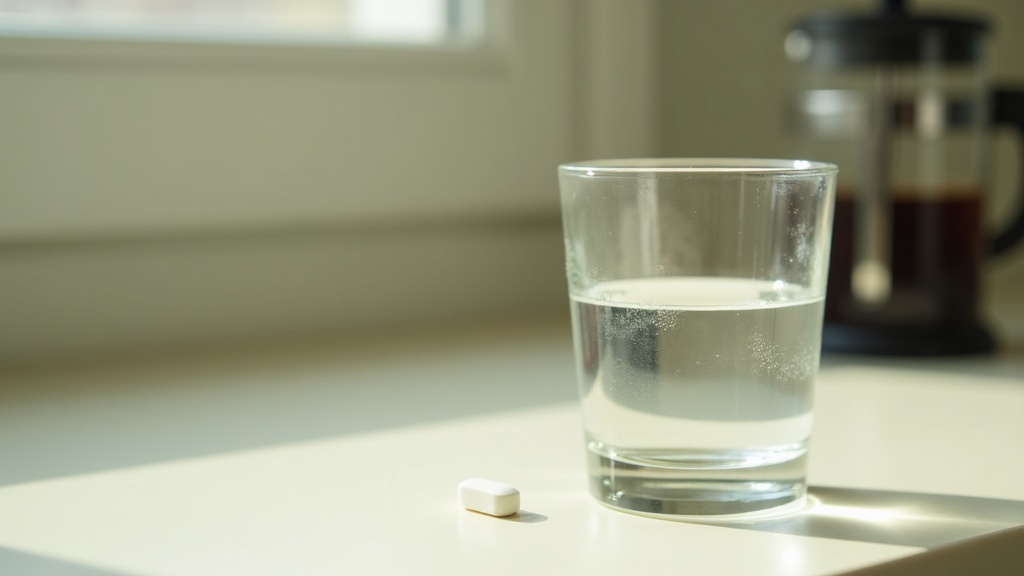
The practical move is boring and effective. Take your levothyroxine tablet with water, on an empty stomach, then wait at least 30 to 60 minutes before coffee, breakfast, or other beverages. The NIH/NCBI StatPearls levothyroxine chapter puts the empty-stomach window at 30 to 60 minutes before breakfast (or 3 to 4 hours after dinner), and coffee belongs in that same protected window.
If mornings are chaotic, two alternatives work. The first is the bedtime dose: taken several hours after dinner, well away from food and coffee, which sidesteps the breakfast scramble entirely. The second is simply moving your first cup to after you have showered and dressed, which usually buys the gap without any willpower.
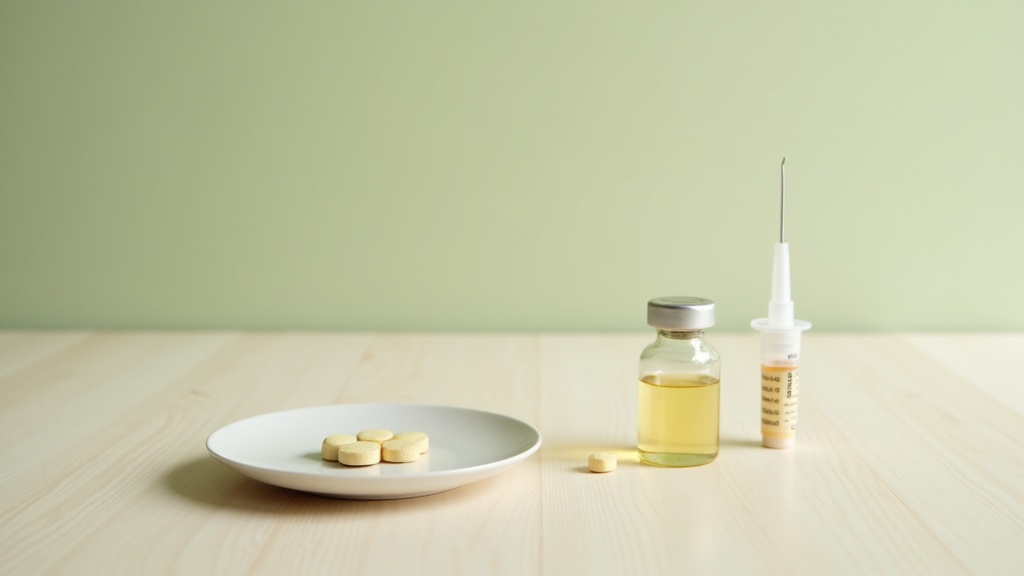
Formulation is the other lever, and it is the part most articles bury. Tablets are the ones affected; the newer delivery forms behave differently. In a 2013 Endocrine study, Vita and colleagues switched patients with documented coffee malabsorption to a soft-gel capsule, and their thyroid control held even when they took coffee within five minutes of the dose. At ENDO 2022, the Endocrine Society reported that an oral levothyroxine solution was absorbed normally with coffee taken five minutes later.
| Form | Affected by coffee? | Practical gap needed |
|---|---|---|
| Standard tablet | Yes, ~25-36% absorption drop when taken together | 30-60 minutes before coffee |
| Soft-gel capsule | Minimal in the switch study | Less sensitive, but still ask your prescriber |
| Oral liquid solution | Not affected at 5 minutes in the ENDO 2022 data | More dosing flexibility, by prescription only |
A note on the rest of your morning: coffee is the gentle offender, but iron, calcium, and antacids are stronger and need a wider 4-hour separation per the StatPearls guidance. If you stack several supplements with your thyroid pill, our drug-supplement interaction checker is a fast way to spot the clashes before they cost you a dose. The soft-gel and liquid options are real fixes, but they are prescription decisions, not something to self-select.
If you want a phone-based way to log this stack and get nudged about spacing, our companion app StackMyMed helps you spot and space conflicts like this one; it is a reminder tool, not a replacement for your pharmacist.
Who is most at risk
Not everyone who drinks coffee with their pill ends up undertreated. The people who feel this most are those with the least absorption margin to spare. That includes anyone recently diagnosed or mid-titration, where the prescriber is still chasing the right number and a hidden 30 percent loss muddies the picture.
Pregnant patients sit at the top of the list. Thyroid hormone requirements rise in pregnancy and the target TSH is tighter, so a consistent coffee gap matters more, and any timing or formulation change should go through your OBGYN and endocrinologist. The same caution applies to people on suppressive dosing after thyroid cancer.
Older adults on multiple medications are another group, because the coffee gap competes with iron, calcium, and antacid timing all in the same crowded morning. A steady, identical routine every day beats a perfect routine you only manage half the time when you are juggling several pills. For the broader map of what fights thyroid meds, see our ultimate guide to drug-supplement interactions.
When to see a clinician
Lab numbers, not symptoms, are the referee here. If your TSH has drifted up despite an unchanged dose, an inconsistent coffee gap is worth raising before anyone assumes the dose itself is wrong. Bring your actual morning sequence to the appointment: what you take, with what, and how long before your first cup.
Do not respond to a high TSH by quietly raising your own dose. The fix might simply be the timing, and a dose bump on top of a fixed gap could overshoot. This is squarely a "ask your doctor or pharmacist" decision, and our how-we-review-supplements process reflects the same defer-to-clinician standard we apply to every interaction piece.
Book a visit if symptoms of under-treatment return (fatigue, cold intolerance, weight changes), if you are pregnant or planning to be, or if you want to discuss switching to a soft-gel or liquid form. Those formulation changes are legitimate options, but they belong to your prescriber.
FAQ
How long should I wait after levothyroxine before coffee?
At least 30 to 60 minutes for the standard tablet. The controlled data show the interference largely vanishes by the one-hour mark, so a full hour is the safer default if your levels are sensitive.
Does decaf coffee also interfere?
The studied effect is attributed to coffee compounds including fibers and oils, not caffeine alone, so decaf is not automatically safe. The same 30-to-60-minute gap is the prudent move.
What about tea or other hot drinks?
Tea has been reported to reduce levothyroxine absorption as well in early research. Plain water is the only beverage that belongs in the protected window; treat tea like coffee and space it out.
Can I just take my pill at night to avoid the whole coffee problem?
Often, yes. A bedtime dose taken several hours after dinner avoids both food and coffee, and many people find it easier to keep consistent. Confirm the switch with your prescriber so your monitoring stays aligned.
Is the liquid or soft-gel form definitely better?
The evidence suggests they are less vulnerable to the coffee interaction, which is genuinely useful for people who cannot keep a gap. But they are prescription products, sometimes pricier, and the choice is your doctor's, not a self-upgrade.
Conclusion: the bottom line on coffee and levothyroxine
This is one of the cleaner interactions in thyroid care because the fix is free and the evidence is specific. Coffee with a levothyroxine tablet can cost you roughly a quarter to a third of the dose's absorption, and a 30-to-60-minute gap mostly erases that loss. What this article adds beyond the usual "wait an hour" advice is the formulation escape hatch: the soft-gel and liquid forms behaved differently in controlled data, which gives coffee-loyal patients a real, prescriber-guided option instead of just willpower.
Next steps:
- Take your tablet with water on an empty stomach, then wait at least 30 to 60 minutes before coffee or food.
- If a gap is impossible, ask your prescriber about a soft-gel or liquid form rather than self-adjusting.
- Bring your exact morning sequence and recent TSH to your next appointment, and review the rest of your stack with the ultimate guide to drug-supplement interactions.
Reviewed by the UsefulVitamins Editorial Team. This article is for informational purposes and is not medical advice. Do not start, stop, or change a prescription on your own; consult your physician or pharmacist, especially if you are pregnant, nursing, or managing a chronic condition. See more from the UsefulVitamins Editorial Team.
