
If you spent several hundred dollars on a GLP-1 pen and left it on your car dashboard in July, there is a reasonable chance it is no longer working as intended. That is not a minor inconvenience — that is several hundred dollars of peptide chemistry that has been irreversibly denatured, with no visible sign on the pen to tell you anything went wrong. Peptide drugs require more careful handling than most medications precisely because their active ingredient is a protein molecule: large, fragile, and sensitive to heat and light in ways that aspirin or a standard antibiotic simply is not. Getting storage right is not optional fine print. It is the last step in the FDA approval process that actually happens in your hands, and the step most patients get wrong.
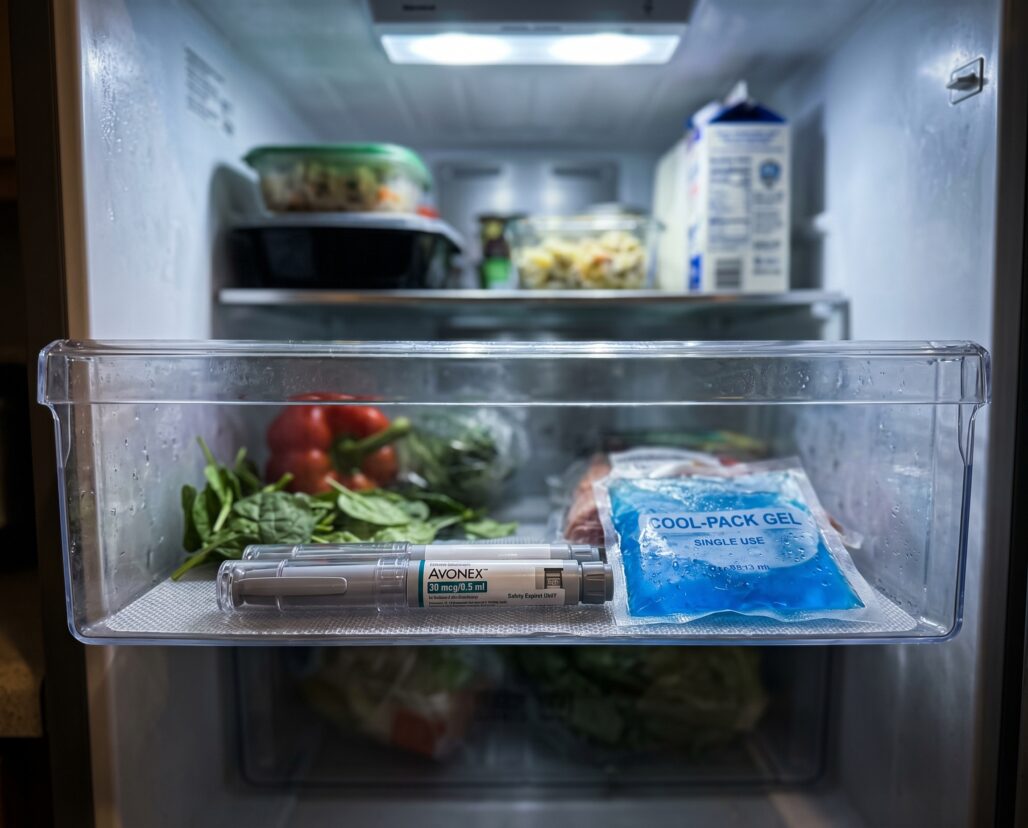
The rules described here apply to FDA-approved peptide drugs — products with prescribing information filed publicly and reviewed by the agency. Compounded peptides have storage requirements that vary by formulation; those are addressed in a dedicated section below. If you are still evaluating how to obtain these drugs through a legal pathway, the article how to buy peptides legally covers the pharmacy options in detail.
Summary: What You Need to Know First
Most injectable peptide drugs require refrigeration at 36 degrees F to 46 degrees F (2 degrees C to 8 degrees C) before first use. After opening or first injection, many can be kept at room temperature for a defined window that differs by product: 28 days for insulin glargine, 56 days for Ozempic, 28 days for Wegovy single-dose pens, 21 days for Mounjaro and Zepbound. Those windows are not interchangeable. Freezing destroys most injectable peptides. Cloudy or discolored solution should never be injected. Oral semaglutide (Rybelsus) stores at room temperature, sealed in its original bottle. Supplement-grade collagen powders require no refrigeration. Travel is manageable under TSA rules that permit medically necessary refrigerated medications in carry-on luggage with appropriate cold packs.
Why Peptide Storage Matters More Than Most Medications
A peptide drug's active ingredient is a chain of amino acids that holds its therapeutic shape only within a narrow set of physical conditions. Heat accelerates hydrolysis reactions that break peptide bonds. Ultraviolet light photo-oxidizes specific amino acid residues. Repeated freeze-thaw cycles trigger aggregation, where peptide molecules clump into larger structures the body can no longer absorb.
The dangerous part is that most degradation pathways are invisible. A solution heat-damaged at 90 degrees F for two hours looks identical to one properly refrigerated throughout. The only protection is strict adherence to the storage conditions in each drug's FDA prescribing information, which were established during stability studies submitted as part of the original new drug application.
Refrigerated Peptides: Insulin, GLP-1 Pens, and Glucagon Kits
Insulin
Insulin is the original FDA-approved peptide drug. The prescribing information for insulin glargine (Lantus) specifies:
- Unopened vials and pens: Refrigerate at 36 degrees F to 46 degrees F (2 degrees C to 8 degrees C). Do not freeze. Do not use if the product has been frozen.
- After first use: May be stored in the refrigerator or at room temperature — not to exceed 86 degrees F (30 degrees C) — for up to 28 days. Discard 28 days after first use regardless of remaining volume.
- Light protection: Keep in the original carton.
The 28-day discard rule applies even when the vial never leaves the refrigerator. Other insulin formulations follow similar but not identical timelines — rapid-acting insulins such as insulin lispro (Humalog) also carry a 28-day open-vial limit, while NPH insulin (Humulin N) specifies no more than 77 degrees F (25 degrees C) at room temperature. Always verify the specific instructions for your formulation, because they vary by product and delivery device.
Ozempic and Wegovy (Semaglutide)
Semaglutide is available as two distinct injection products with meaningfully different storage timelines.
Ozempic (semaglutide for type 2 diabetes) uses multi-dose pens. According to the FDA-approved prescribing information for Ozempic:
- Before first use: Refrigerate at 36 degrees F to 46 degrees F (2 degrees C to 8 degrees C). Do not freeze. Do not use if it has been frozen.
- After first use: May be stored at room temperature — 59 degrees F to 86 degrees F (15 degrees C to 30 degrees C) — or returned to the refrigerator for up to 56 days. Keep the pen cap on. Protect from excessive heat and direct sunlight.
Wegovy (semaglutide for weight management) uses single-dose pens. Each pen delivers one weekly injection and is discarded afterward. Wegovy pens must be refrigerated before use. Once removed from the refrigerator, an unused single-dose pen can be kept at room temperature — not to exceed 86 degrees F (30 degrees C) — for up to 28 days before the pen cap is removed. Do not freeze. Do not use if frozen.
The practical gap is significant: an Ozempic pen with remaining doses can sit on a nightstand for nearly two months. A Wegovy pen should stay refrigerated until the week it will be used.
Mounjaro and Zepbound (Tirzepatide)
Tirzepatide is available as Mounjaro (type 2 diabetes) and Zepbound (weight management). Both use single-dose pens. According to FDA prescribing information for Mounjaro and Zepbound:
- Unopened pens: Refrigerate at 36 degrees F to 46 degrees F (2 degrees C to 8 degrees C). Do not freeze. Store in original carton to protect from light.
- Room temperature window: May be stored unrefrigerated at temperatures not to exceed 86 degrees F (30 degrees C) for up to 21 days. Discard after 21 days at room temperature even if medication remains.
- One-way clock: Once a pen has been stored at room temperature, do not return it to the refrigerator. The 21-day window is not a pause button.
Glucagon Emergency Kits
Traditional glucagon kits consist of a vial of lyophilized (freeze-dried) glucagon powder and a syringe of diluent. According to FDA prescribing information for glucagon for injection:
- Before reconstitution: Store at 68 degrees F to 77 degrees F (20 degrees C to 25 degrees C). Do not freeze. Keep in original carton to protect from light.
- After reconstitution: Use immediately. Discard any unused portion. The reconstituted solution should be clear and colorless — do not use if cloudy or particulate matter is visible.
Newer glucagon formats — Baqsimi nasal powder and Gvoke prefilled syringe — have separate storage requirements. Always read the specific prescribing information for the formulation you carry.
Rybelsus and Vyleesi: Room Temperature Products
Rybelsus (oral semaglutide) is the only oral GLP-1 receptor agonist currently FDA-approved in the US. Store at room temperature — 68 degrees F to 77 degrees F (20 degrees C to 25 degrees C) — in a dry place. Keep tablets in the original bottle until immediately before use; the bottle contains a moisture-absorbing desiccant. Transferring tablets to a pill organizer or storing them in a humid bathroom cabinet exposes them to moisture and may reduce absorption.
Vyleesi (bremelanotide injection) for hypoactive sexual desire disorder should be stored at or below 77 degrees F (25 degrees C), not frozen, and protected from light according to its FDA-approved prescribing information. Each auto-injector is a single-dose device; use immediately after activation.
In-Use Temperature Limits Per Drug: Quick Reference
Storage windows differ by product and are not interchangeable. The table below reflects the FDA prescribing information current as of this writing; always verify current labeling, as manufacturers periodically update stability data.
| Drug | Before First Use | Room Temp Limit | Max Days Out of Fridge |
|---|---|---|---|
| Lantus (insulin glargine) | Refrigerate 36-46 F | 86 F (30 C) | 28 days from first use |
| Ozempic (semaglutide inj.) | Refrigerate 36-46 F | 86 F (30 C) | 56 days from first use |
| Wegovy (semaglutide inj.) | Refrigerate 36-46 F | 86 F (30 C) | 28 days (cap on, unused) |
| Mounjaro / Zepbound | Refrigerate 36-46 F | 86 F (30 C) | 21 days; do not return to fridge |
| Rybelsus (oral semaglutide) | Room temp, no fridge needed | 77 F (25 C) | N/A; keep sealed in original bottle |
| Vyleesi (bremelanotide) | Below 77 F (25 C), no fridge needed | 77 F (25 C) | Use immediately once activated |
| Glucagon Emergency Kit | 68-77 F (20-25 C), no fridge needed | 77 F (25 C) | Use reconstituted dose immediately |
Travel and the Cold Chain
Traveling with injectable peptides is straightforwardly manageable with the right approach. TSA allows medically necessary medications in any volume in carry-on luggage, including refrigerated medications. Because aircraft cargo holds on many routes are unheated and may damage temperature-sensitive drugs, carry-on is the safer choice.
Gel packs at security: TSA permits gel ice packs in carry-on bags if they are completely frozen solid when presented for screening. A partially melted or slushy pack falls under the standard 3-1-1 liquids rule and may be restricted to 3.4 ounces or less. For travel days longer than a few hours, two gel packs and a compact insulated case rated to hold temperature for eight or more hours provides practical redundancy.
At the checkpoint: Inform the TSA officer you are traveling with medically necessary refrigerated medication. Place it in a bin separately for X-ray. A TSA Notification Card, available on the TSA website, can be handed to the officer discreetly if you prefer not to explain your medication verbally.
International travel: A letter from your prescribing physician or pharmacist confirming the drug name, dose, and your status as a patient is useful at customs. It is not required within the US but can accelerate screening at some international airports.
Using in-use windows as a travel buffer: An Ozempic pen's 56-day room-temperature window is workable on any trip. Mounjaro and Zepbound's 21-day window is more constraining but sufficient for most itineraries. Time your injection day to maximize remaining stability when the pen leaves the refrigerator.
Collagen Peptide Supplements
Hydrolyzed collagen sold as a dietary supplement does not require refrigeration. Collagen hydrolysate is a denatured protein already broken into short peptide fragments during manufacturing; its stability is controlled by moisture and oxygen exposure, not temperature. Store in a cool, dry place, sealed tightly after each use. If the container includes a silica gel desiccant packet, leave it in. Refrigeration is not required and can introduce condensation in humid environments. Follow the printed expiry date.
What Spoiled Peptide Product Looks Like
Degraded injectable peptides rarely announce themselves the way spoiled food does. However, FDA prescribing information identifies specific visual signs to check before every injection:
Cloudiness: Injectable peptide drugs should be clear and colorless when properly stored. Any hazy, milky, or turbid appearance indicates aggregation or contamination. Do not use. This applies to insulin, GLP-1 pens, reconstituted glucagon, and bremelanotide.
Discoloration: Yellow, brown, or otherwise off-color solution indicates oxidative degradation. Do not use.
Visible particles: Small specks or fibers in the solution indicate particulate contamination. Hold the pen or vial against a light source and inspect before each injection. Do not inject if particles are visible.
Frozen or previously frozen product: Any pen or vial exposed to freezing temperatures — including those placed too close to the freezer compartment of a household refrigerator — should be discarded. FDA prescribing information for every injectable peptide covered in this article explicitly states: do not use if the product has been frozen.
When in doubt, contact your pharmacy before injecting. The cost of a replacement pen is lower than the cost of a missed therapeutic effect — or an injection-site reaction from a degraded solution.
Compounded Peptides: Follow Your Pharmacist's Instructions
If you use a peptide dispensed by a 503A or 503B compounding pharmacy, the storage timelines above do not automatically apply. Compounded formulations may use different concentrations, carriers, or preservative systems that change their stability profile. Follow the storage instructions your compounding pharmacist provides in writing. If you did not receive written storage instructions for a compounded injectable, contact the pharmacy before use.
Frequently Asked Questions
Can I store my GLP-1 pen next to the freezer element in my refrigerator?
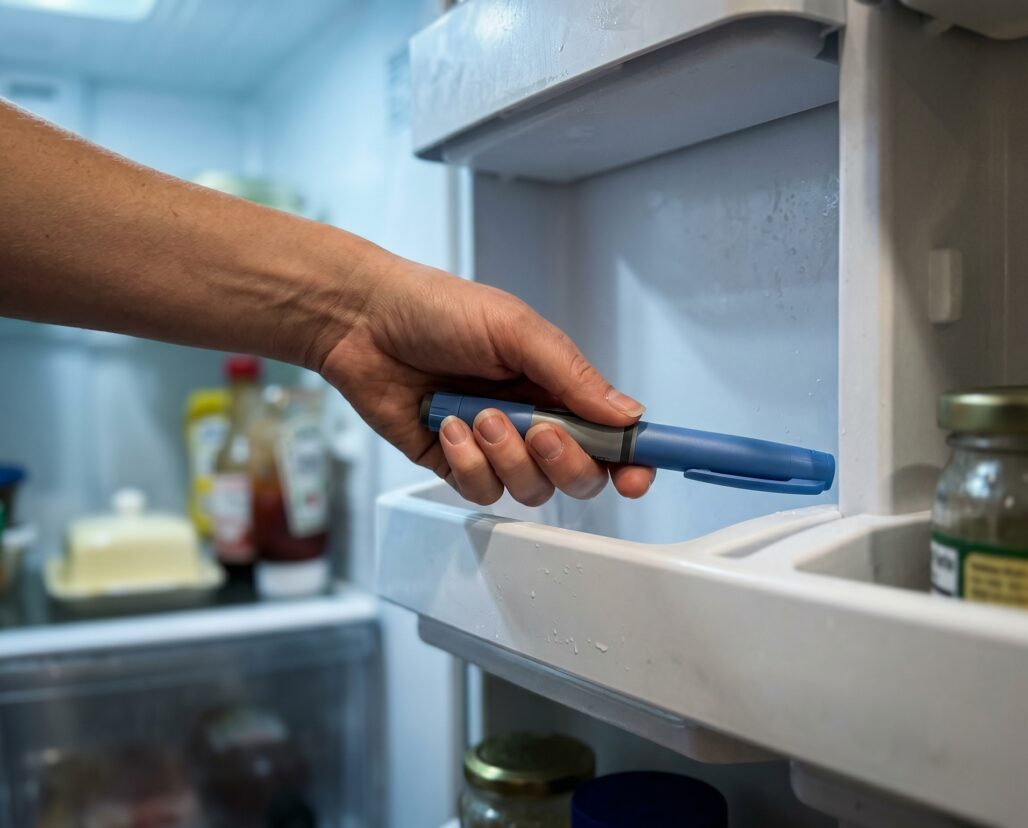
No. Place pens on a middle shelf away from the back wall and freezer compartment. Temperatures adjacent to the cooling element in household refrigerators often drop below 32 degrees F, which freezes the medication. FDA prescribing information specifies 36 degrees F to 46 degrees F — not as cold as possible.
My Mounjaro pen was left out for 22 days. Can I still use it?
No. Prescribing information specifies a maximum of 21 days at or below 86 degrees F. A pen that has exceeded that window has passed its validated stability limit. Discard it and contact your prescriber about a replacement.
Does it help to put my injectable pen in the refrigerator for a few hours to reset the room-temperature clock?
For Ozempic, yes — the 56-day clock can be paused by returning the pen to the refrigerator. For Mounjaro and Zepbound, no — the prescribing information explicitly states do not return to the refrigerator once room temperature storage has begun. The rule differs by product, which is why checking the specific label matters.
Conclusion
Peptide storage is specific rather than complicated. Injectable peptide drugs require refrigeration before first use, each has a defined room-temperature window that differs by product and is not interchangeable across brands, none should be frozen, and every clear injectable solution should be visually inspected before use. Rybelsus stays at room temperature in its original sealed bottle. Collagen supplement powders tolerate room temperature with a dry, closed container. Travel is manageable with frozen gel packs in carry-on luggage — TSA explicitly permits medically necessary medications in any volume.
The storage section of an FDA prescribing information document is not boilerplate. It is the output of stability studies conducted during drug development, defining the exact conditions under which the manufacturer will guarantee potency through the labeled expiry date. Staying within those conditions is the only way to know that the dose you are injecting is the dose your physician prescribed.
This article is for informational purposes and not medical advice. Peptides, especially those marketed for therapeutic use, can interact with medications and health conditions. Consult a licensed physician before starting any supplement, particularly if you are pregnant, nursing, taking prescription medications, or managing a chronic condition.
