
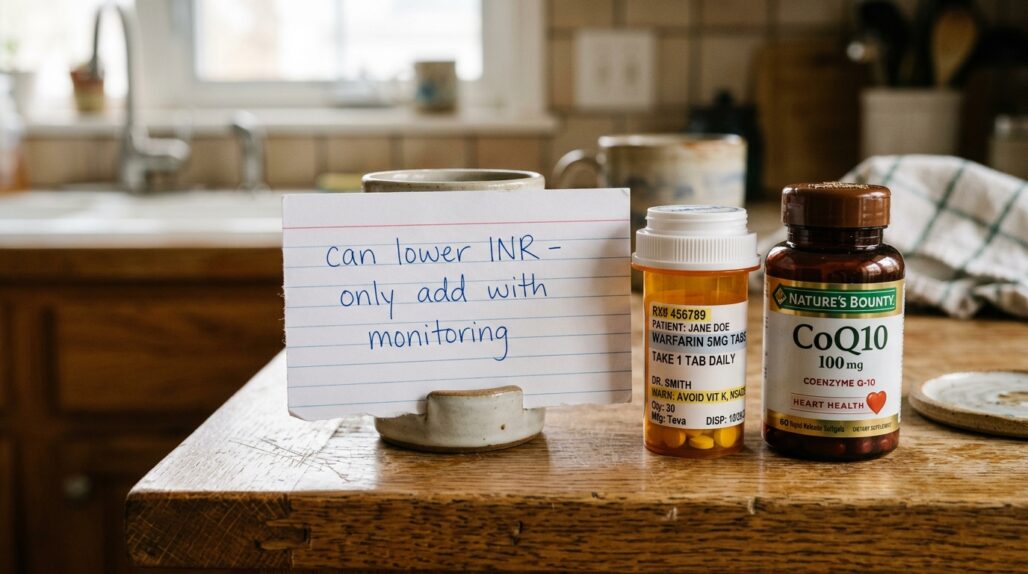
Before you decide
This article is general health information, not medical advice for your specific situation. Warfarin is one of the most monitored drugs in medicine for a reason: small shifts in how your body handles it can move your INR out of the safe window in either direction.
The people most affected here are anyone on warfarin (Coumadin, Jantoven) who is thinking about adding CoQ10 – often because they also take a statin and read that statins lower the body's own CoQ10. That overlap is exactly where this question comes up, and it is worth getting right.
If you are on a newer blood thinner like apixaban or rivaroxaban instead of warfarin, the concern below mostly does not apply to you. We cover why further down.
What the CoQ10 and warfarin interaction actually is
Warfarin works by blocking the recycling of vitamin K, the cofactor your liver needs to build several clotting factors. Anything that acts even a little like vitamin K can blunt warfarin and push your INR down, which means thinner protection against clots.
CoQ10's chemical name is ubiquinone, and that "quinone" part matters. CoQ10 is structurally related to menaquinone, the family of compounds known as vitamin K2. Because of that resemblance, researchers have proposed that CoQ10 may carry a mild vitamin-K-like, pro-clotting effect that partly counteracts warfarin.
The shared structure is the leading explanation, but the exact mechanism has never been pinned down. As the Drugs.com professional interaction monograph summarizes it, the mechanism is unknown, though CoQ10 is structurally related to vitamin K2 and may have procoagulant effects. So treat the structural-similarity story as a credible hypothesis rather than a settled fact.

How strong is the evidence?
This is where honesty matters, because the picture is genuinely mixed.
On the "real interaction" side sit the case reports. The original signal came from a 1994 report in The Lancet by Spigset, titled reduced effect of warfarin caused by ubidecarenone, describing a patient whose warfarin worked less well on CoQ10. A 1998 Danish case report by Landbo and Almdal told a similar story: a 72-year-old woman's warfarin became less effective after she started CoQ10, and her response returned to baseline once she stopped it. That stop-start pattern is what makes clinicians take the signal seriously.
On the other side is the best controlled data we have. A randomized, double-blind, placebo-crossover trial published in Thrombosis and Haemostasis gave 24 stable warfarin patients 100 mg of CoQ10 daily for four weeks and found no meaningful change in INR or required warfarin dose. No dose adjustments were needed.
So how do you square a clear case-report signal with a negative trial? The most reasonable read is that the interaction is real but uncommon and individual – most people see little change, while a minority respond noticeably. With warfarin, you cannot know in advance which group you are in, and that uncertainty is exactly why monitoring beats guessing.
Who is most at risk
The risk is not evenly spread. A few situations stack the odds and deserve extra care.
| Risk factor | Why it raises concern | Practical takeaway |
|---|---|---|
| On warfarin, not a DOAC | Warfarin depends on vitamin K, so a vitamin-K-like effect can blunt it | This whole article applies to you – involve your clinic |
| Adding CoQ10 because of a statin | Statin plus warfarin plus new CoQ10 is the exact overlap behind most case reports | Flag all three drugs together to your prescriber |
| Unstable or hard-to-control INR | A small extra push can swing you out of range faster | Avoid adding variables; ask before any supplement |
| Starting and stopping CoQ10 often | Each change can move your INR up or down | Keep intake steady; do not dose on and off |
The statin connection is the one to underline. Statins modestly lower the body's own CoQ10 production, which is why many cardiology patients reach for a CoQ10 supplement in the first place. As a review in Circulation: Heart Failure notes, studied CoQ10 doses commonly run from around 100 mg up to several hundred milligrams daily, though US guidelines do not routinely recommend it for statin users. The trouble is that the cardiology patient on a statin is often the same person on warfarin – so the two questions land on one prescription list.
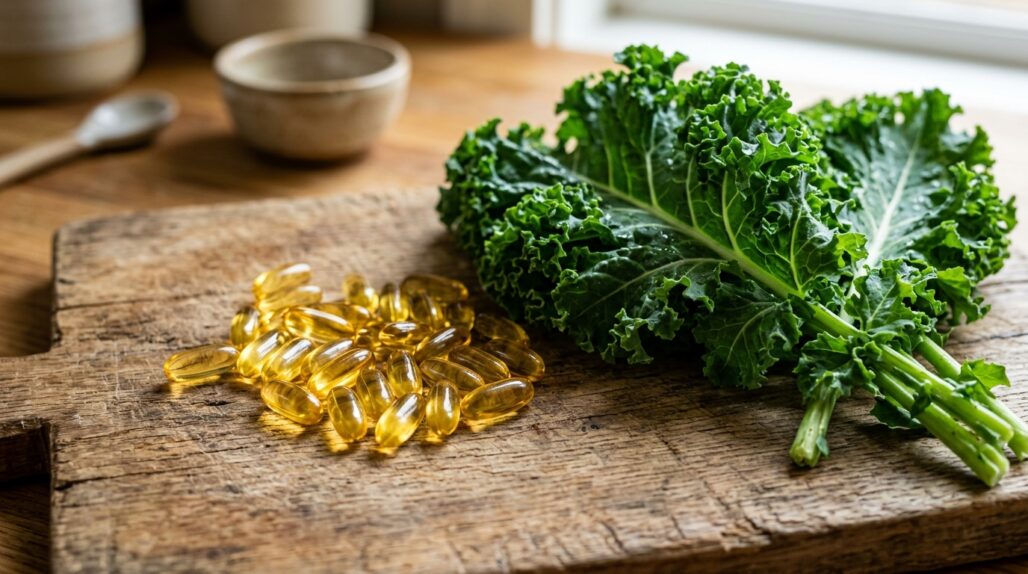
What to do if you want to take CoQ10 on warfarin
You do not have to rule CoQ10 out. You do have to make any change visible and measurable. Plan it with your anticoagulation clinic rather than adjusting on your own.
- Tell your prescriber or pharmacist first. They may want to time the start around a scheduled INR check.
- Get an INR test about 1 to 2 weeks after starting CoQ10, since that is when a shift would show up.
- Keep your dose and brand consistent. Switching products or skipping days creates the same swings as starting and stopping.
- Do not stop CoQ10 abruptly either. Stopping can move your INR the other way, so treat discontinuation as a monitored change too.
- Watch for warning signs of reduced anticoagulation, such as new leg swelling, calf pain, or shortness of breath, which can signal a clot.
The NCCIH notes that CoQ10 may interact with warfarin and otherwise considers it well tolerated, with mild effects like digestive upset or trouble sleeping being the usual complaints. The interaction caution, not general toxicity, is the reason to loop in your clinic.
If you want one simple habit: keep an accurate, current list of every supplement and dose you take, and bring it to each INR visit. A free app like StackMyMed can log your stack and flag combinations worth raising with a pharmacist. It is a prompt for that conversation, not a substitute for clinical judgment or INR testing.
Why this does not apply to apixaban or other DOACs
If your blood thinner is apixaban (Eliquis), rivaroxaban (Xarelto), or edoxaban, the vitamin-K story here is not relevant. These newer drugs are direct factor Xa inhibitors, as described in the StatPearls overview of apixaban, and they block a single clotting factor without touching the vitamin K pathway.
Because the CoQ10 concern is built entirely on vitamin-K-like activity, that specific mechanism gives DOACs no obvious route to interact with CoQ10. There is no routine INR to monitor on these drugs either. For more on what does and does not affect those medications, see our guide on vitamin K and Eliquis.
That does not mean DOACs are immune to every supplement. Separate bleeding-risk products are the issue there, which we cover in fish oil and anticoagulant bleeding. The point is narrower: the CoQ10-versus-vitamin-K mechanism is a warfarin problem, not a DOAC one.

When to call a clinician
Some situations are worth a same-day message rather than waiting for your next routine check.
- Your INR has dropped below your target range after a CoQ10 change.
- New or worsening leg swelling, calf tenderness, or warmth that could point to a clot.
- Sudden shortness of breath or chest pain, which can be an emergency – call urgent care or emergency services, do not wait.
- You realize you have been on CoQ10, a statin, and warfarin together without your clinic knowing.
When in doubt, your anticoagulation clinic would rather hear from you and check a number than have you guess. If you want to understand how vitamin K intake itself maps to dosing, our warfarin and vitamin K calculator explains the consistency principle that underlies all of this.
FAQ
Does CoQ10 raise or lower INR? The documented direction is downward. Case reports describe CoQ10 reducing warfarin’s effect and lowering INR, which means slightly less clot protection, though a small randomized trial found no change at 100 mg daily.
How much CoQ10 affects warfarin? There is no proven threshold. Case reports involved everyday supplement doses, while the controlled trial used 100 mg daily with no effect, so any dose change is best treated as a reason to check your INR.
I take a statin and warfarin – is CoQ10 safe to add? It may be, but that exact trio is the setting behind most case reports. Ask your prescriber and plan an INR check rather than adding it on your own.
How soon would an interaction show up? If a shift happens, it would typically appear within one to two weeks, which is why clinics retest INR in that window after a supplement change.
Is CoQ10 a problem with Eliquis or Xarelto? The vitamin-K-style concern does not apply to those factor Xa inhibitors, since they work without the vitamin K pathway and have no routine INR to disturb.
Should I just avoid CoQ10 entirely on warfarin? Not necessarily. Many people take it without trouble, but the safe path is to make the change with your clinic and monitor, not to start or stop it quietly.
Conclusion: monitor, do not guess
CoQ10 and warfarin can interact because CoQ10 resembles vitamin K2 closely enough to nudge warfarin's effect and lower your INR in some people. The signal is real in case reports, absent in a small trial, and unpredictable for any one person – which is the textbook case for measuring instead of assuming.
If you want CoQ10, the move is straightforward: tell your anticoagulation clinic, keep your dose steady, and get an INR check a week or two after any change. For the wider picture of supplements that affect blood thinners, start with our ultimate guide to drug-supplement interactions or run your combination through the drug-supplement interaction checker.
This article is for general education and does not replace personalized advice from your doctor, pharmacist, or anticoagulation clinic. Never start, stop, or change a supplement or medication based on what you read here without professional guidance.
Reviewed by the UsefulVitamins Editorial Team.
