
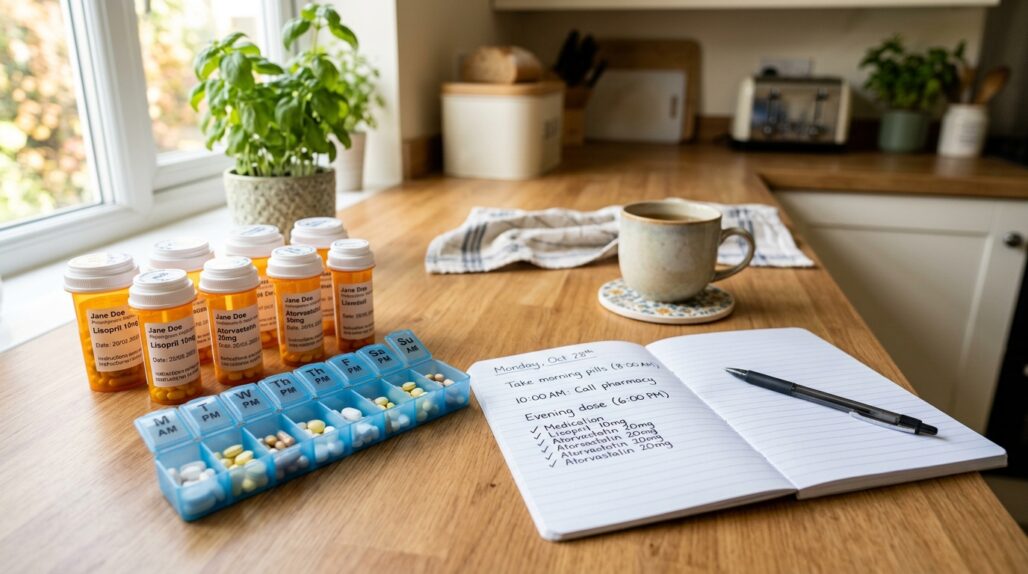
You do not have to fix anything this week
If you have just become the person who keeps track of a parent's medications, the instinct is to start fixing right away. Resist that for now. The first week is for seeing the whole picture, not editing it.
Most medication problems in older adults trace back to one thing: nobody has a single, current view of everything being taken. Pills get prescribed by different doctors, supplements get added without anyone noting them, and old bottles linger in the cabinet. The U.S. Food and Drug Administration recommends keeping one list of all prescription medicines, over-the-counter products, vitamins, and supplements, used regularly or only sometimes, in their guidance on creating and keeping a medication list. That single list is your week-one job.
Your parent will likely still want a say in their own care, and that is healthy. You are setting up the system. The medical calls stay with the professionals.
Step one: gather every bottle in the house
Before you write anything down, do a physical sweep. Medications hide. Check the obvious spots and the easy-to-miss ones.
- The kitchen counter, fridge door, and a drawer near where meals happen
- The bathroom cabinet and any nightstand
- A purse, a coat pocket, the car glovebox, and any travel bag
- The fridge itself, for anything that needs refrigeration like some insulins or eye drops
- A "junk" drawer where as-needed pills and old samples collect
Put it all on one clear surface, like a kitchen table. Include the supplements and the things people forget to call medication: vitamin D, fish oil, melatonin, laxatives, antacids, pain relievers, and herbal products. MedlinePlus, the patient-education service from the National Library of Medicine, makes the same point in its caregiving medication management guidance: the list should cover prescriptions, over-the-counter medicines, vitamins, and herbal remedies, not just the prescriptions.
Do not throw anything out yet, even bottles that look expired or duplicated. You want the pharmacist to see exactly what was in the house.
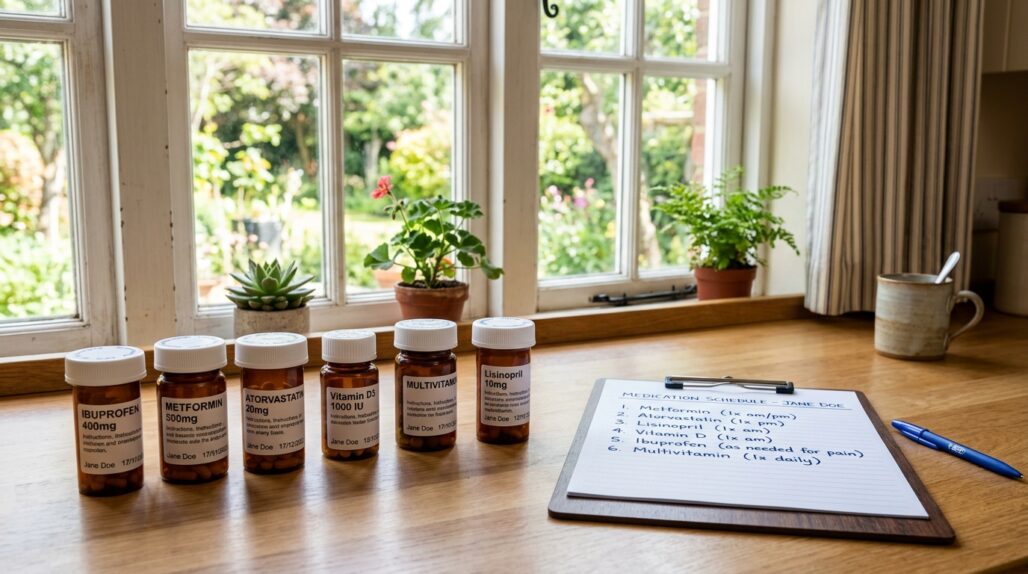
Step two: build one master list
Now write it down. One document, one source of truth. You can use the free FDA "My Medicine Record" form, a notes app, a spreadsheet, or plain paper on the fridge. The format matters less than having a single version everyone trusts.
For each item, capture these details. This is the template – copy it onto paper and you have a working list with zero apps.
| Field | What to write | Example |
|---|---|---|
| Name and strength | Brand and generic, plus the mg or mcg | Lisinopril 10 mg |
| Dose and schedule | How much, how often, what time | 1 tablet, once daily, morning |
| What it is for | The condition or reason | Blood pressure |
| Prescriber | Which doctor ordered it | Dr. Reyes, cardiology |
| Pharmacy and refills | Where it is filled, when it runs low | Corner Pharmacy, refill due May 12 |
| Notes | With or without food, as-needed, start date | Take with breakfast |
Two fields people skip but should not: allergies and as-needed medications. Write down any drug allergy and the reaction at the top of the list. And capture the "I only take it when my knee hurts" items, because those are exactly the ones that vanish from a doctor's records.
Keep the original bottles and the list together this week. Snap a photo of the list on your phone so a copy travels with you to appointments. The FDA advises sharing the record at every visit, and a photo means you always have it.
Step three: set up the daily basics
With the list built, set up a routine that does not depend on memory. You are aiming for "good enough to be safe this week," not perfect.
- Choose one organizing method. A weekly pill box with morning and evening slots works for many people. For a long or complex regimen, ask the pharmacy about blister or "bubble" packaging, where each dose is sealed by day and time. If you go the pill-box route, our walkthrough on how to safely fill a weekly organizer for many medications covers the small mistakes that cause big problems.
- Fill the organizer carefully. Do it once a week, in good light, with no distractions, working one bottle all the way through before opening the next. AHRQ's patient-safety case review on pill organizer risks notes that filling errors and worn-off day labels are a real source of mistakes, so double-check against the list when you finish.
- Pick a fixed cue. Tie doses to something that already happens daily, like breakfast or brushing teeth. A consistent anchor beats a vague intention.
- Note refill dates. Mark on the list when each prescription runs low so you are never scrambling at an empty bottle.
A pill organizer is a tool, not a guarantee. If your parent has trouble with small compartments, fine print, or remembering whether a dose was taken, that is worth raising with the pharmacist rather than pushing through.

Step four: keep it current every day
A medication list is only useful if it stays true. The fastest way to lose the picture is to let the list drift while the routine changes. So the week-one habit that matters most is updating the list the moment anything changes: a new prescription, a stopped one, a dose adjustment, a new supplement.
The low-tech version is simple. Keep the paper list on the fridge and a pen beside it, and write in every change as it happens. If you would rather not re-key everything by hand, you can scan each bottle into StackMyMed (our own free app) to keep the full stack organized in one place, so day one is about seeing the whole picture rather than fixing it. Either way, the goal is the same: one current list you can hand to a pharmacist. The app does not decide what is safe; it just keeps the list together so you can raise any possible interaction with your pharmacist.
Whichever method you use, build in a moment after each appointment to update the list. That single habit prevents most of the confusion that builds up over months.
Step five: book a pharmacist medication review
Once the list exists, the highest-value move is a medication review with a pharmacist. This is often free, and pharmacists are trained to catch exactly the problems that pile up in older adults: duplicate drugs, combinations that may interact, and medications that may no longer be needed.
A pharmacist geriatric assessment study published in the National Library of Medicine's PMC archive found meaningful deprescribing potential in the everyday medications older adults take, meaning some items can often be simplified or stopped under medical guidance. You bring the full list and all the bottles. The pharmacist flags concerns and coordinates with the prescriber, who makes any actual change.
Bring the supplements too. Things like vitamin K, fish oil, St. John's wort, and high-dose minerals can affect prescription medications, and they are invisible to a doctor who never hears about them. If you are unsure whether your parent's current vitamins and herbals sit well with their prescriptions, our guide on whether a parent's supplements are safe with their medications is a useful primer before the appointment. If you spot a possible duplicate or a worrying combination yourself this week, do not change anything on your own. Note it and raise it at the review.

Step six: loop in family and your parent
You should not carry this alone, and you do not have to. Decide early who does what.
- Agree on who holds the master list and how others see updates, since splitting medication duties between siblings is where the most friction tends to start
- Note a local backup person if you live far away
- Keep your parent in the loop and respect their preferences where you safely can
- Share the list with the primary doctor and the pharmacy so everyone works from the same version
The Family Caregiver Alliance, in its guide to medications and aging, stresses keeping one updated list and sharing it across the care team. Clear roles now prevent the "I thought you handled the refill" gaps later.
FAQ
Should I throw out expired or duplicate medications this first week? Not yet. Keep everything together so the pharmacist can see the full picture at your review. Many pharmacies and police stations run safe drug take-back programs for disposal afterward.
Do supplements really need to go on the list? Yes. The FDA specifically recommends listing vitamins, minerals, and herbal products alongside prescriptions, because some affect how medications work and a doctor cannot account for what they never see.
What if two doctors prescribed similar-looking medications? Write both on the list and flag them for the pharmacist. Possible duplicates are common when several specialists are involved, and the pharmacist can confirm with the prescribers rather than you guessing.
Is a pill organizer safe for someone with memory or vision trouble? It can be, but it depends on the person. If small compartments, fine print, or recalling whether a dose was taken are a struggle, ask the pharmacy about blister packaging and mention it at the review.
Can I stop a medication that seems unnecessary? No, not on your own. Note your question and bring it to the pharmacist or prescriber. Some medications need to be tapered, and stopping the wrong one can be risky.
How often should I update the master list? Every time something changes – a new prescription, a stopped drug, a dose tweak, or a new supplement – and again after each appointment. A current list is the whole point.
The bottom line
The first week is about visibility, not optimization. Gather every bottle, build one accurate master list with the name, dose, schedule, prescriber, and purpose of each item, and set up a simple daily routine you can keep. Then book a pharmacist medication review and let the professionals sort out duplicates, interactions, and anything that can be simplified.
The single most important action is to keep that list current and bring it – bottles included – to a pharmacist. You organize the picture; your parent's pharmacist and doctors make the medical calls.
This article is for general information and is not medical advice. It does not replace guidance from your doctor or pharmacist, and it should not be used to start, stop, or change any medication or supplement. Talk to a qualified health professional about your parent's specific situation.
StackMyMed is made by UsefulVitamins. It helps you organize your list and flag things to discuss with a pharmacist or doctor; it is not a diagnosis or treatment tool and does not replace professional medical advice.
Reviewed by the UsefulVitamins Editorial Team.
