
Affiliate disclosure: this article contains affiliate links. As an Amazon Associate, UsefulVitamins.com earns from qualifying purchases at no extra cost to you.
If you searched "omeprazole vitamin B12 deficiency," you have probably read that proton pump inhibitors can drain your B12, and you want to know whether you actually need a supplement and how big a dose. The honest answer is it can lower the B12 you pull from food, but that does not mean every omeprazole user is deficient or needs a high dose. This article walks through the exact step omeprazole blocks, how large the effect is in real studies, the test that settles the question, and which B12 form sidesteps the problem.
Before you decide

This is general information, not medical advice, and it is not a reason to change anything about your prescription on your own. Omeprazole is doing a real job, often protecting an inflamed or eroded esophagus, and stopping or cutting an acid-suppressing drug without your prescriber is the riskier move here, not a B12 gap you can close cheaply.
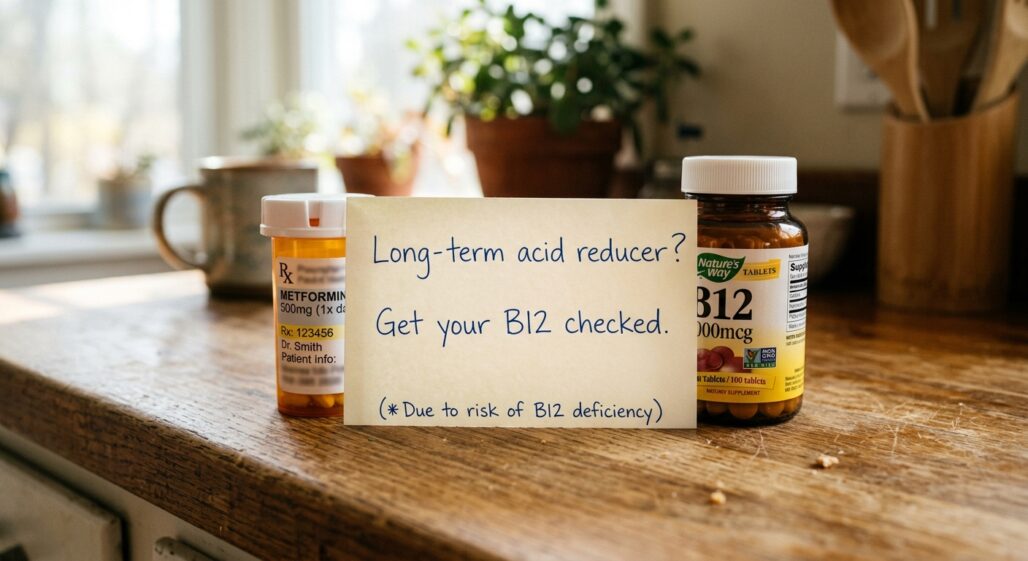
A few people should be more careful than the average reader. If you have taken a proton pump inhibitor for more than a year, are over 65, eat vegan or near-vegan, or also take metformin, your baseline B12 buffer is thinner and the interaction matters more.
Call your doctor or pharmacist if you notice tingling or numbness in the hands or feet, unusual tiredness, a sore smooth tongue, balance problems, or new memory or mood changes. Those can be early signs of B12 depletion, and they deserve a blood test, not a guess from a search result. Bring a full medication and supplement list to that visit so the whole stack gets checked together.
What the omeprazole and B12 interaction actually is
Vitamin B12 in food is bound to protein. To use it, your stomach has to release it from that protein first, and that release depends on stomach acid and the enzyme pepsin. Omeprazole works by shutting down acid production, which is exactly why it eases reflux, but the same acid suppression that calms your esophagus also slows the release of B12 from the food you eat.
The mechanism is well described in a 2018 review in Advances in Nutrition, which explains that without enough acid, pepsinogen is not converted to pepsin, so protein-bound B12 is not freed for absorption further down the gut. This is a food-absorption problem, not a problem with how your intestine handles free B12.
Here is the part most articles skip. The same review notes that supplemental crystalline B12, the kind in tablets and fortified foods, is not protein-bound, so it does not need stomach acid to be absorbed. That single fact is why a modest supplement is a sensible fix while reflexively stopping the drug is not. The drug blocks one specific door; a crystalline supplement uses a different one.
How big is the effect, and how fast
The cleanest human data come from a small but well-controlled 1994 trial in Annals of Internal Medicine, where healthy volunteers acted as their own controls. After omeprazole, absorption of protein-bound B12 fell sharply and in a dose-dependent way: at 20 mg daily it dropped from about 3.2 percent to 0.9 percent, and at 40 mg it fell from about 3.4 percent to 0.4 percent. Importantly, absorption of free, unbound B12 was not impaired, which lines up exactly with the supplement workaround.
That is short-term absorption, not deficiency. Deficiency takes time, because the liver stores a multi-year reserve of B12. The large 2013 JAMA case-control study from Kaiser Permanente, covering more than 25,000 people with B12 deficiency, found that two or more years of proton pump inhibitor use was associated with roughly a 65 percent higher odds of B12 deficiency (odds ratio 1.65), with higher daily doses carrying more risk than lower ones.
Regulators frame the timeline conservatively. The FDA prescribing information for omeprazole warns that daily acid-suppressing treatment over a long period, generally longer than three years, may lead to B12 malabsorption from low stomach acid. So the realistic picture is months of reduced food absorption that can, over a year or more of continuous use, tip some people into a measurable deficiency.
Two caveats keep this honest. These are association studies, not proof that the drug alone causes deficiency, and not every long-term user becomes low. Risk concentrates in people who already eat little B12 or have other absorption strikes against them.

Confirm a real deficiency before you treat one
Blood work changes the question. Without it you are guessing which supplement to add and at what dose, and a normal-looking total B12 can still hide a problem. Ask your doctor about checking a serum B12 level, and pair it with methylmalonic acid, a more sensitive marker that rises when B12 is functionally low even if the total level looks borderline. A 2022 cohort in Annals of Medicine and Surgery similarly found significant associations between PPI use beyond a year and low B12, reinforcing that long-term users are the group worth testing.
If you are about to start years of omeprazole, the Advances in Nutrition review suggests it is reasonable to assess B12 status at the start and recheck it periodically rather than wait for symptoms. A test costs little and removes the guesswork that drives people to either ignore a real deficiency or over-supplement a phantom one.
The companion app StackMyMed can help you log a stack like omeprazole plus a B12 supplement and flag interactions to raise with your prescriber, but it helps you spot and space things, it does not replace your pharmacist.

What to do: dose, form, and timing
If a test confirms you are low, or your clinician decides prophylaxis makes sense, the good news is the fix is cheap and the dose is modest. The NIH Office of Dietary Supplements sets the adult RDA at just 2.4 mcg per day, and the average mixed diet usually covers it, so a B12 supplement here is closing an absorption gap, not building a megadose stockpile.
For maintenance or insurance in an omeprazole user, a daily oral or sublingual cyanocobalamin in the 50 to 250 mcg range is a reasonable target, because that crystalline form bypasses the acid-dependent step. There is no advantage to chasing 1,000 mcg or more for simple prevention. Active absorption caps at roughly 1.5 to 2.5 mcg per dose, so most of a megadose is simply passed through, not banked. Confirmed clinical deficiency is a different scenario your doctor may treat with higher oral doses or injections.
On timing, you do not need to elaborately space a B12 tablet away from omeprazole the way you would for some minerals, because supplemental B12 does not rely on the acid the drug suppresses. Take it in a way you will remember consistently. For a related mineral concern, see our companion piece on omeprazole and magnesium depletion, which follows a different mechanism and different rules.
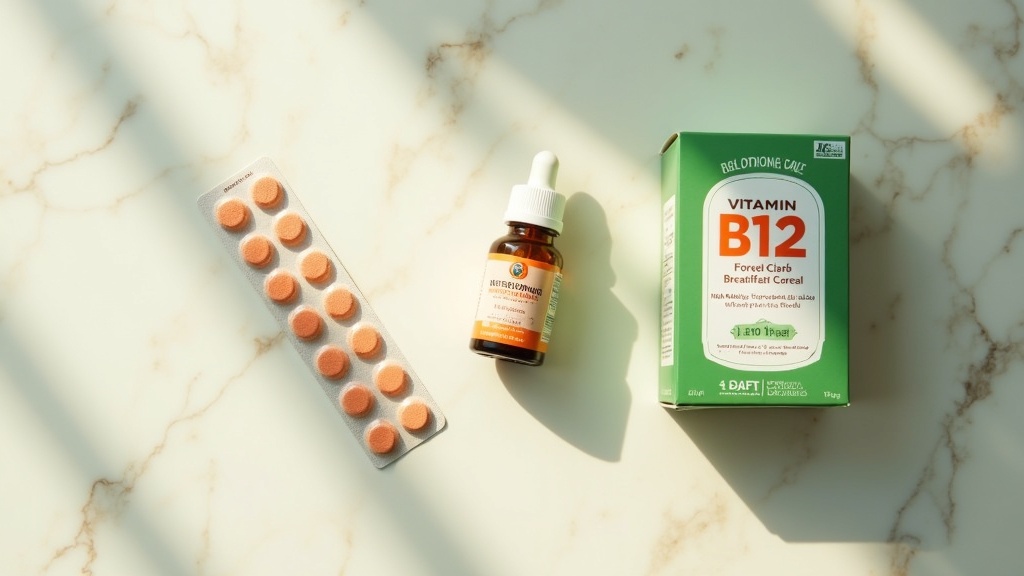
If you prefer food first, fortified breakfast cereals and nutritional yeast supply crystalline B12 that absorbs without much acid, and animal foods still contribute even with reduced absorption. For dose specifics across scenarios, our vitamin B12 dosage guide breaks down maintenance versus repletion ranges.
What to look for when buying
Choose a plain cyanocobalamin or methylcobalamin in a sublingual tablet, lozenge, or small oral tablet, and skip the splashy 5,000 mcg "energy" bottles for routine prevention. The form that earns its place is the lowest effective crystalline dose from a brand with third-party verification, not the highest number on the label. For broader picks, see our roundup of the best vitamin B12 supplements.


As an Amazon Associate, UsefulVitamins.com earns from qualifying purchases at no extra cost to you. We only recommend products supported by published research or third-party testing.
Who is most at risk
The interaction matters far more for some people than others. Risk stacks when low stomach acid meets a thin dietary supply or a second absorption hit. Older adults already make less acid with age, vegans and strict vegetarians get little dietary B12 to begin with, and people on metformin face a separate B12-lowering mechanism that adds up alongside a PPI.
Use this quick read of who should pay attention.
| Group | Why risk is higher | Reasonable step |
|---|---|---|
| Long-term PPI user (1+ years) | Sustained low acid reduces food B12 release over time | Ask for B12 plus MMA testing |
| Adults over 65 | Age-related low acid compounds the drug effect | Test, then low-dose crystalline B12 if low |
| Vegan or near-vegan | Little dietary B12 to buffer reduced absorption | Routine fortified food or supplement plus testing |
| Also taking metformin | Second, independent B12-lowering mechanism | Closer monitoring with your prescriber |
If you take several supplements and prescriptions, our ultimate drug and supplement interactions guide and the interaction checker can help you map the whole picture before your next appointment.
When to see a clinician
See a clinician promptly if you notice neurological symptoms, because B12-related nerve damage can become permanent if a real deficiency is left to run. Tingling, numbness, unsteady walking, vision changes, or new cognitive or mood changes all warrant a same-week call rather than a wait-and-see approach.
You should also loop in a professional before stopping or changing omeprazole. The right move is rarely to abandon the drug; it is to test B12, supplement modestly if indicated, and let your prescriber decide whether the acid suppression is still needed at the current dose. To understand how we weigh evidence for guidance like this, see how we review supplements.
FAQ
Does omeprazole always cause B12 deficiency?
No. It reduces absorption of B12 from food, and the deficiency risk rises mainly after one to three or more years of daily use, per the FDA label and the JAMA cohort. Many users never become deficient, especially with a good diet.
How long until B12 gets low on omeprazole?
The body holds a large B12 store, so depletion usually takes many months to years of continuous acid suppression, not weeks. Short courses are very unlikely to matter.
Will a B12 supplement still absorb if omeprazole lowers my stomach acid?
Yes. Supplemental crystalline B12 is not protein-bound and does not need stomach acid, which is exactly why a tablet, sublingual, or fortified food works around the interaction.
Do I need a 1,000 mcg dose?
For routine prevention, no. Active absorption caps near 1.5 to 2.5 mcg per dose, so a 50 to 250 mcg daily crystalline dose is plenty of insurance. Higher doses are for confirmed deficiency under medical care.
Should I just stop omeprazole instead?
Not on your own. Talk to your prescriber. Closing a B12 gap with a cheap supplement is far safer than stopping a drug that may be protecting your esophagus.
Conclusion: the bottom line on omeprazole and B12
Long-term omeprazole genuinely lowers how much B12 you extract from food, and after a year or more that can become a measurable deficiency in some people. The smart response is a B12 plus MMA test to confirm the gap, then a modest 50 to 250 mcg crystalline supplement that sidesteps the very step the drug blocks, never a self-directed stop of your prescription. That is the angle most articles miss: the fix and the problem operate through different doors.
Next steps:
- Ask your doctor for a serum B12 and methylmalonic acid test if you have been on a PPI for a year or more.
- If supplementing, pick a low-dose sublingual or oral crystalline B12 from a third-party-verified brand. See the best vitamin B12 supplements.
- Review your full stack and book a conversation with your prescriber or pharmacist; never adjust omeprazole on your own.
As an Amazon Associate, I earn from qualifying purchases. Product recommendations are based on real reviews and independent research.
Reviewed by the UsefulVitamins Editorial Team.
This article is for informational purposes and not medical advice. Supplements can interact with medications and health conditions. Consult a licensed physician or pharmacist before starting any supplement or changing a prescription, particularly if you are pregnant, nursing, taking prescription medications, or managing a chronic condition.
