
If you're buying collagen peptides for the first time, two things happen fast: you find a product that looks solid, then you see the price tag and start wondering whether you actually need to spend $50+ a month. NOW Foods lands squarely in that second moment of hesitation. It costs roughly half of what Thorne charges, and a fraction of Pure Encapsulations pricing. But "cheaper" is a neutral fact, not a verdict. The real question is whether the quality controls supporting a $15 bottle are genuinely comparable to those behind a $45 one, or whether the gap in price reflects a gap in rigor you'd rather not discover after six months of use. This review digs into NOW's manufacturing claims, what independent data actually shows about collagen peptides broadly, and where this particular product fits in the wider landscape of collagen supplements.
Affiliate disclosure: this article contains affiliate links. As an Amazon Associate, UsefulVitamins.com earns from qualifying purchases at no extra cost to you.
Summary: What You Need to Know Up Front
NOW Foods Collagen Peptides is a single-ingredient bovine hydrolysate providing 10g of collagen protein per 11g serving. It carries GMP certification audited by Intertek, and NOW's in-house labs hold ISO/IEC 17025:2017 accreditation from the American Association for Laboratory Accreditation (A2LA). The product does not carry NSF Certified for Sport status. Pricing runs roughly $15 to $20 for the 8 oz (227g) size, which works out to approximately $0.75 to $1.00 per serving at the 10g dose. That is meaningfully less than Thorne or Pure Encapsulations on a per-gram basis. For buyers who are not competitive athletes, do not require third-party banned-substance screening, and are comfortable with vendor-conducted in-house testing as the primary quality signal, NOW Foods is a defensible choice. For buyers who need NSF Certified for Sport, or who specifically want independent analytical verification from a lab with no commercial relationship to the manufacturer, the calculus shifts.
Brand Background: Family-Owned Since 1968
NOW Foods was founded in 1968 by Elwood Richard, and the company has remained family-owned across more than five decades of operation. That is not marketing copy designed to sound warm. It carries a structural implication: NOW does not answer to quarterly earnings pressure from external shareholders in the way a publicly traded supplement company does. The brand's headquarters and manufacturing are based in the Chicago suburb of Bloomingdale, Illinois.
The company's quality infrastructure is larger than many consumers expect from a budget-positioned brand. NOW operates its own in-house analytical and microbiological laboratories, both of which hold ISO/IEC 17025:2017 accreditation from A2LA. As of 2025, those labs run more than 31,000 tests per month across the product line. Tests cover identity verification, potency, heavy metals, pesticides, agricultural chemical residues, and screening for potential adulterants including undisclosed pharmaceuticals. GMP compliance is audited externally by Intertek under the Supplement Safety and Compliance Initiative (SSCI) benchmarks, which map to the FDA's 21 CFR Part 111 dietary supplement manufacturing regulations.
Where NOW's setup diverges from brands like Thorne and Pure Encapsulations is at the layer of independent analytical verification. NOW does submit products to outside labs for duplicate testing and holds Informed Sport certification for its sports-focused product line. However, the standard Collagen Peptides product does not carry Informed Sport certification, and vendor-conducted testing, however technically rigorous, is structurally different from testing performed by a laboratory that has no commercial relationship with the manufacturer. That distinction matters for some buyers and not at all for others.
Product Profile: What's Actually in the Tub
NOW Foods Collagen Peptides Powder contains one ingredient: hydrolyzed collagen (bovine). The product is confirmed BSE-free. Each 11g serving (two level tablespoons) delivers 10g of collagen protein, which aligns with the dose range used in the clinical literature for skin and joint endpoints. There are no fillers, artificial flavors, sweeteners, or flowing agents. The product is free from wheat, gluten, soy, corn, milk, egg, fish, shellfish, and tree nut ingredients, making it one of the cleaner unflavored formats on the market for buyers managing multiple food sensitivities.
The collagen is sourced from bovine connective tissue, primarily providing type I and type III collagen. Type I collagen is the dominant structural protein in skin, tendons, ligaments, and bone. Type III is most concentrated in skin and blood vessels and tends to co-express with type I in many tissue types. This is the same source profile used by most mass-market collagen powders, including Sports Research and Vital Proteins, so NOW's ingredient is not unusual in character.
Hydrolysis breaks native collagen chains into shorter peptide fragments with molecular weights typically in the 3,000 to 6,000 dalton range. These smaller fragments have higher solubility and are better absorbed through the gut wall than intact collagen protein. The powder dissolves readily in warm or cold liquid, leaves no detectable taste or smell in water or coffee, and does not gel at room temperature.
Pricing Reality: The Cost-Per-Gram Comparison
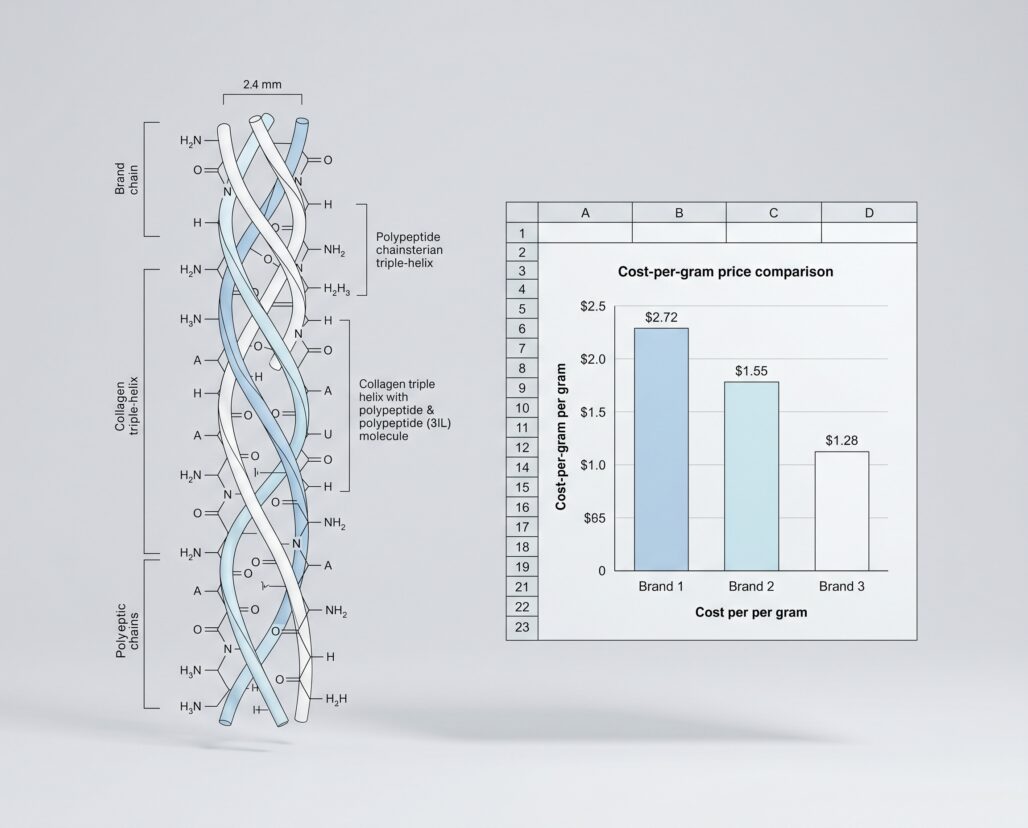
The 8 oz (227g) container retails for approximately $15 to $20 depending on the retailer. At 20 servings per container and a $17 midpoint price, that works out to roughly $0.85 per serving for 10g of collagen protein.
For comparison, Thorne's collagen powder products typically retail at $45 to $55 for 30 servings (NSF Certified for Sport versions), which puts the cost per serving at $1.50 to $1.83 for a roughly comparable gram dose. Pure Encapsulations' collagen formats, often in capsule form, run $0.13 to $0.18 per gram, which on a 10g equivalent dose translates to $1.30 to $1.80 per serving.
That gap is real. On an annualized basis, daily collagen supplementation at NOW's price point costs roughly $310 per year. The same frequency at Thorne pricing runs $550 to $670. The molecule you are getting, hydrolyzed bovine collagen peptides providing glycine, proline, and hydroxyproline, is functionally the same across these brands at the raw ingredient level. The premium paid to Thorne or Pure Encapsulations buys certifications, brand positioning, and, in the case of NSF Sport, independent banned-substance screening. It does not change the peptide chemistry.
If budget is a genuine constraint and you are not a competitive athlete subject to drug testing, the cost difference is worth factoring explicitly rather than defaulting to premium brands out of vague trust.
Quality and Testing Claims: What the Evidence Shows
NOW's in-house testing infrastructure is more developed than the brand's mass-market pricing might suggest. ISO 17025 accreditation is a meaningful credential: it means the lab's testing methods, calibration protocols, and quality management systems have been independently verified against an international standard. The Intertek GMP audit adds an external check on manufacturing process compliance.
The honest limitation is that ISO 17025 accreditation describes laboratory competence, not independence. When a brand tests its own products in its own labs, those results are vendor-conducted. The incentive structure is different from a testing lab that has no commercial relationship with the product manufacturer. ConsumerLab, which independently tests supplements purchased on the open market, has reviewed collagen products and found meaningful variation in actual protein content relative to label claims across the category. Specific test results for NOW's collagen peptides are behind ConsumerLab's subscription wall, so independent verification for this exact product cannot be confirmed from publicly available sources at time of writing.
What can be confirmed: NOW's testing claims are more detailed and specific than most brands at this price point, the GMP certification is externally audited, and the lab accreditation is real and verifiable. The product does not carry NSF Certified for Sport status, which means third-party banned-substance screening has not been independently conducted on this formula.
Where NOW Foods Earns Its Place
The strongest case for NOW Foods Collagen Peptides is its profile for the everyday, non-athlete buyer. If you are supplementing for skin hydration, joint comfort, or general connective tissue support, the clinical evidence for collagen peptides does not discriminate by brand. It discriminates by dose and consistency.
A 2023 systematic review and meta-analysis published in Nutrients examined 26 randomized controlled trials involving 1,721 participants. Researchers found that hydrolyzed collagen supplementation significantly improved both skin hydration and skin elasticity compared to placebo, with consistent effects across collagen sources including bovine. A separate double-blind, placebo-controlled trial published in the Journal of Cosmetic Dermatology found that oral collagen peptide intake increased natural moisturizing factor content in the stratum corneum at both 1g and 5g daily doses over 12 weeks, suggesting a mechanistic pathway for the hydration improvements seen in RCT data. A 2023 review in Nutrients examining orthopedic applications found improvements in joint stiffness, mobility, and pain reduction in populations receiving collagen supplementation alongside physical activity.
None of these studies used NOW Foods specifically. They used hydrolyzed bovine collagen peptides as a category. That is how the evidence works for commodity supplement ingredients: the molecule is the molecule. If NOW's product delivers what the label states, it will produce the same category-level outcomes as any other hydrolyzed bovine collagen at an equivalent dose.
The risk with any lower-cost product is label accuracy. Without independent analytical verification from a third party with no commercial interest in the result, you are trusting the brand's self-reported testing. NOW's testing infrastructure is more credible than average for its price tier, but that trust assumption is still present.
Where It Falls Short
There are four scenarios where NOW Foods Collagen Peptides is not the right choice.
First, competitive athletes subject to anti-doping rules. Without NSF Certified for Sport or Informed Sport certification on this specific product, there is no independent banned-substance screening. For recreational gym-goers, this is irrelevant. For anyone tested under WADA or USADA protocols, the absence of third-party certification is not a risk worth accepting.
Second, buyers who specifically require independent analytical verification of protein content, heavy metals, and contaminants from a lab with no commercial relationship to the manufacturer. NOW's in-house labs are credentialed, but they are still the brand's own labs.
Third, buyers who want specialty collagen types, such as type II (cartilage-specific, often from chicken sternum), or clinically studied branded peptide variants like Fortigel or Verisol. NOW's standard collagen product is types I and III from bovine connective tissue. This is the most studied category for skin and general joint support, but it is not differentiated at the ingredient level.
Fourth, buyers who want a marine collagen source for personal, environmental, or dietary reasons. This is a bovine product only.

Frequently Asked Questions
Is NOW Foods Collagen Peptides third-party tested?
NOW Foods operates ISO 17025-accredited in-house laboratories and submits products to external labs for duplicate testing and specialized certifications. However, vendor-conducted testing differs from independent third-party verification by a lab with no commercial relationship to the manufacturer. The standard collagen peptides product does not carry NSF Certified for Sport or Informed Sport certification.
What collagen types does NOW Foods Collagen Peptides contain?
The product provides hydrolyzed bovine collagen primarily delivering type I and type III collagen peptides. Type I is the dominant structural protein in skin, bone, and tendons. Type III is concentrated in skin and vascular tissue.
How does the dose compare to clinical study doses?
Most published clinical trials on collagen peptides for skin and joint outcomes used doses in the 5g to 15g per day range. The 10g per serving in this product falls within that range. Consistency of daily intake matters more than choosing between 10g and 15g for most endpoints.
Does it dissolve in cold liquids?
Yes. Hydrolyzed collagen is highly water-soluble across temperatures. Users consistently report clean dissolution in both cold water and hot coffee with no gel formation or clumping.
Is this product safe during pregnancy or nursing?
This is a dietary supplement, not an FDA-approved drug, and the evidence base for collagen peptide supplementation during pregnancy or breastfeeding is limited. Defer to your OB-GYN for guidance before use.
What is the difference between this and NOW's Multi Collagen product?
NOW also offers a Multi Collagen Protein product combining types I, II, and III from multiple sources. The standard Collagen Peptides reviewed here is a single-source bovine type I and III product. Multi Collagen formats add type II for cartilage support and broaden the source mix, but the evidence base for multi-collagen blends is less developed than for the individual type I/III category.
Conclusion: An Honest Verdict
NOW Foods Collagen Peptides is not a premium product, and it does not claim to be. It is a single-ingredient, unflavored bovine hydrolysate with real GMP certification, credible in-house testing infrastructure, and pricing that puts it within reach of buyers who would otherwise skip collagen supplementation entirely because of cost. That is a legitimate position in a crowded market.
The honest caveats are equally specific. If you need NSF Certified for Sport, look at Momentous or Thorne's certified products. If you need independently verified label accuracy from a lab with no stake in the result, NOW's in-house testing, however credentialed, is not structurally equivalent to that. If you want clinically studied branded peptide variants, this is not the product.
For the majority of buyers who are supplementing for skin hydration, joint comfort, or connective tissue support on a consistent daily basis, the molecule is the molecule. The clinical literature supports bovine hydrolyzed collagen peptides in the 5g to 15g range. This product provides exactly that, at a price that makes daily consistency considerably more realistic than a $50 bottle.
As an Amazon Associate, I earn from qualifying purchases. Product recommendations are based on real reviews and independent research.
This article is for informational purposes and not medical advice. Peptides, especially those marketed for therapeutic use, can interact with medications and health conditions. Consult a licensed physician before starting any supplement, particularly if you are pregnant, nursing, taking prescription medications, or managing a chronic condition.
As an Amazon Associate, I earn from qualifying purchases. Product recommendations are based on real reviews and independent research.
