
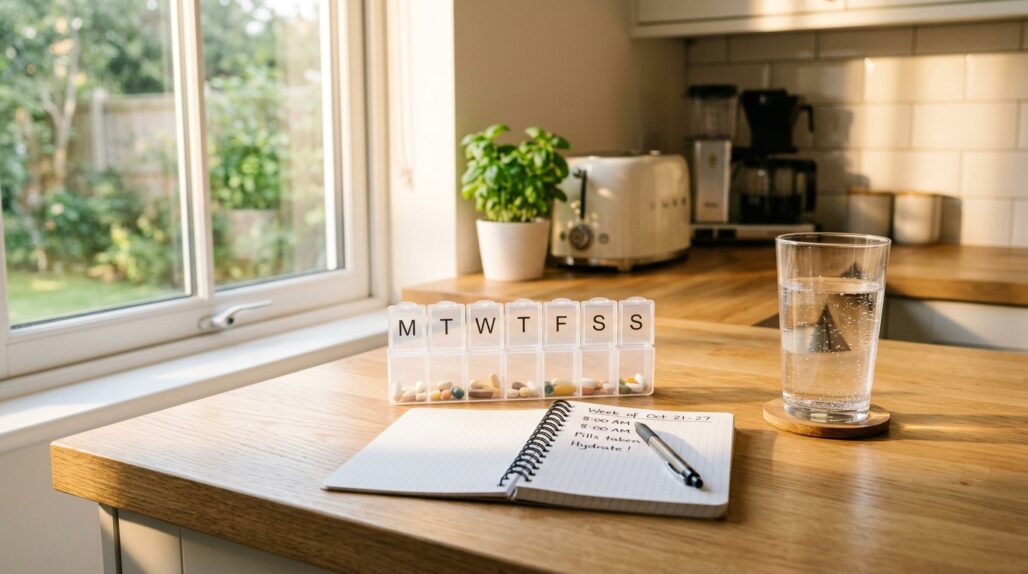
You did everything the productivity advice said. You parked your vitamin D next to the coffee maker. You told yourself "after I pour my coffee, I take my supplement." It worked for about nine days. Then a busy morning came, the bottle drifted behind the fruit bowl, and the streak quietly ended.
This is not a willpower problem, and you are not bad at routines. Forgetting is the single most common reason people miss doses, and it has more to do with how the cue is built than with how disciplined you are. The good news: the fix is mechanical, not moral.
Why this trips people up
Habit stacking is a real and useful idea. The concept, popularized by James Clear in his writing on building new habits onto existing ones, is simple: attach the thing you want to do to something you already do. Pour coffee, take vitamin. Brush teeth, take magnesium. The existing habit acts as the trigger.
The trouble starts with the anchor you pick. Clear's own guidance is that the cue has to be specific, immediately actionable, and happen at the same frequency as the habit you are adding. "After breakfast" feels solid until you realize you skip breakfast twice a week, eat it at your desk on others, and grab it in the car on the worst days. An anchor that wobbles cannot hold anything up.
There are usually four reasons a supplement stack breaks down:
- The anchor is not as consistent as you assumed. Coffee, breakfast, and "when I get home" all shift around more than we admit.
- The cue gets moved or buried. You cleaned the counter, and the bottle that was your visual reminder is now in a cupboard.
- The routine was too ambitious. Five bottles at three different times is a lot to start, and one missed slot tends to collapse the whole thing.
- Travel or a schedule change wipes out the trigger entirely. A hotel has no kitchen counter, and a different shift has no familiar morning.
None of these are character flaws. They are design flaws, and design is fixable.
Pick an anchor that actually holds
Before you rebuild anything, audit your candidate anchors honestly. The best one is the routine you genuinely do every single day, at roughly the same time, no matter what. For many people that is brushing teeth, feeding a pet, or taking a shower far more than it is "having coffee," which skips on weekends and busy mornings.
Research on how people actually remember their medicine backs this up. A study summarized by the NIH library on everyday memory strategies for medication adherence found that the most-used approaches were keeping pills in one consistent place, putting them somewhere highly visible, and linking the dose to an existing daily activity. Most people who succeeded used more than one of these at once.
So test your anchor against three questions:
- Do I do this 7 days a week? If the honest answer is "most days," it is not strong enough on its own.
- Does it happen at a single, predictable moment? "Sometime in the morning" is too loose. "Right after I brush my teeth" is tight.
- Can I physically put the bottle where I will see it at that moment? If not, the anchor and the cue are in two different rooms, and the link breaks.
If your supplement needs food or a specific time of day, your anchor has to match that requirement. Pair fat-soluble vitamins with a meal you reliably eat, not one you sometimes skip. For the deeper logic of when each one belongs in your day, our supplement timing sequence guide walks through morning, midday, and evening slots.

Make the cue impossible to miss
A habit stack runs on sight, not memory. The CDC's review of what improves medication adherence notes that simply forgetting drives a large share of missed doses, and that low-cost tools like pillboxes and reminders meaningfully help. The point of a visible cue is to remove the act of remembering from the equation.
Two moves do most of the work here:
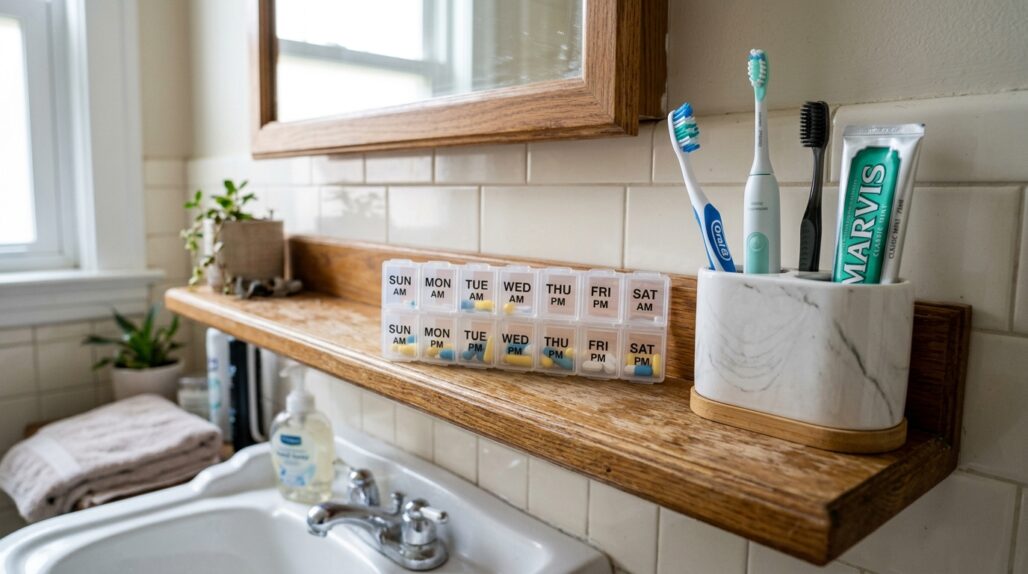
- Put the bottle or organizer directly at the anchor. If your anchor is brushing teeth, the supplement lives on the bathroom shelf beside the toothbrush, not in the kitchen. The cue and the trigger have to share a physical spot.
- Resist tidying it away. The visible bottle is not clutter; it is the whole system. If a clean counter matters to you, use a small dedicated tray so the cue stays out without looking like a mess.
A weekly pill organizer earns its keep here for a second reason: it tells you at a glance whether you already took today's dose. If you often stand there wondering, our piece on whether you already took your supplement today covers a few ways to settle that question without doubling up.
Start smaller than feels necessary
The most common rebuild mistake is going big again. You re-commit to the full stack, all five bottles, three times a day, and the size of the routine becomes its own failure point.
Behavior-design work, including BJ Fogg's Tiny Habits model, makes the case that a habit you can do reliably beats an ideal one you do sporadically. Apply that here directly: start with one supplement at one slot. Get a real two-week streak on that single item before you add the next. A small routine that holds is worth far more than a complete one that collapses every ten days.
Build in forgiveness, too. A streak that depends on perfection breaks the first time life interferes. Decide in advance that one miss is a normal Tuesday, not a reason to quit. The goal is the long-run percentage, not an unbroken chain.
A printable rebuild template
You can run this whole method on paper. Copy the grid below onto a sticky note or the back of an envelope and keep it where you take your supplements. Fill the anchor and cue once, then just tick the days.
| Step | What to decide or do | Your answer |
|---|---|---|
| 1. Anchor | The daily action you never skip | e.g. after brushing teeth |
| 2. One supplement | Start with a single item, not the full stack | e.g. vitamin D, morning |
| 3. Cue placement | Where the bottle sits, in plain sight at the anchor | e.g. bathroom shelf |
| 4. Backup | A reminder for travel or off days | e.g. phone alarm 8am |
| 5. Track 14 days | Tick each day; aim for most, not all | M T W T F S S |
Add a backup that travels with you
Even a good visual cue has one weakness: it lives in a fixed spot, and you do not. The morning you are in a hotel, at a relative's house, or running out the door, the bottle-by-the-toothbrush system has nothing to fire it. That is the gap a reminder fills.
Reminders are not a gimmick. A systematic review of electronic reminder interventions for chronic medication found they can improve how consistently people take their medicine. And the research on everyday memory strategies for medication adherence points the same way: most people who succeed lean on more than one cue at once, so keeping your visible bottle and adding a reminder tends to beat relying on either alone. The lesson is to layer, not replace: keep your visible bottle, and add a prompt that reaches you wherever you are.
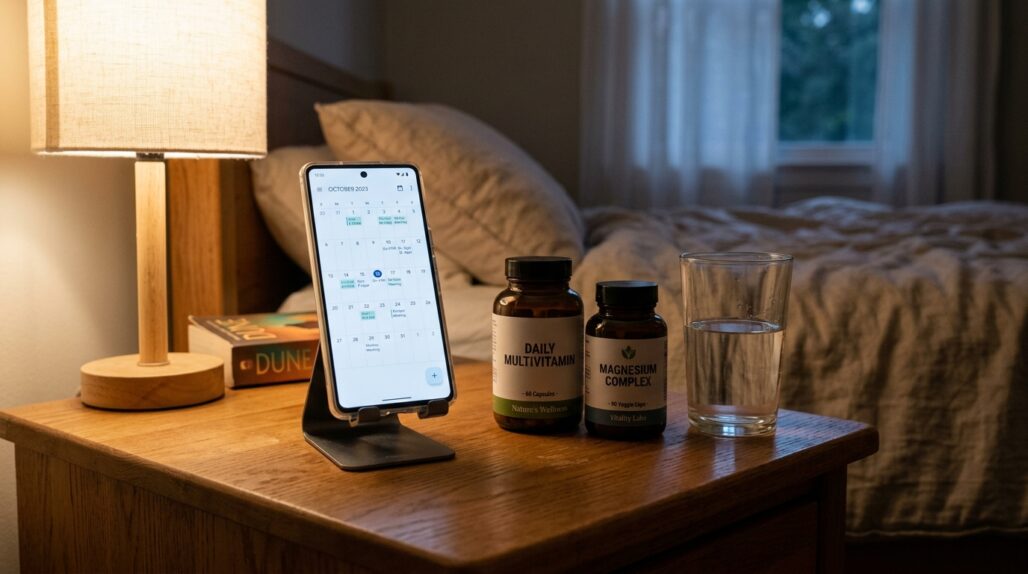
That backup can be low-tech. A daily phone alarm labeled with the supplement name, a recurring calendar event, or a note on the mirror all work. If your visual cue keeps getting moved or buried, a backup that travels with you helps – StackMyMed (our own free app) sends the reminder to your phone so your routine does not depend on a bottle staying in one spot, and for any prescription you are trying to keep on track, let your pharmacist confirm the timing rather than the app. Whether you use an alarm or the app, the principle is the same: the reminder follows you when the bottle cannot.
If your routine slid for several days, not just one, do not try to "make up" doses. Reset cleanly instead – our missed-dose reset plan walks through how to restart without doubling up. And for context on how we vet the products we write about, here is how we review supplements.
FAQ
Is habit stacking actually a good method for supplements? Yes, when the anchor is rock-solid. The method works; most failures come from anchoring to a routine you only do some days, or from letting the cue get tidied out of view. Fix the anchor and the cue placement before you blame the technique.
What is the most reliable anchor to use? Whatever you genuinely do daily at a predictable moment. For many people that is brushing teeth, a shower, or feeding a pet rather than coffee or breakfast, which skip more often than we notice. The test is honest 7-days-a-week consistency.
Why do I forget even when the bottle is right there? Usually because the bottle is not actually at the anchor, or it got moved. The cue has to share the exact spot and moment as the trigger habit. If it drifted to a cupboard or behind something, the visual prompt is gone even though the bottle still exists.
How many supplements should I start with? One. Get a steady two-week run on a single item at a single slot before adding the next. A small routine you keep beats a full routine that collapses every week or two.
What should I do when I travel and the whole routine breaks? Lean on the backup reminder, since the physical cue stays home. A phone alarm or calendar prompt travels with you. Pack the supplements where you will see them at your usual anchor moment, even in a new place.
When should this become a conversation with a pharmacist? When the thing you keep missing is a prescription, when missed doses are frequent, or when you are unsure how a particular medicine should be handled if a dose is skipped. A pharmacist can also help simplify a complicated regimen so it is easier to keep.
The bottom line
A supplement routine does not fail because you lack discipline. It fails because the anchor was shaky or the cue got buried. Rebuild it the boring, reliable way: pick a routine you truly never skip, keep one bottle in plain sight at that exact moment, start with a single supplement, and add a reminder that travels with you for the days your kitchen counter is not around. The single most useful move today is to choose one honest daily anchor and put one bottle next to it. And if what keeps slipping is a prescription, or you are not sure how a missed dose should be handled, that is a quick and worthwhile conversation with your pharmacist or doctor.
This article is general information, not medical advice. It does not replace guidance from your own pharmacist or doctor, who can account for your specific medications, conditions, and circumstances. Do not start, stop, or change the timing of a prescription on your own.
StackMyMed is made by UsefulVitamins. It helps you organize your list and flag things to discuss with a pharmacist or doctor; it is not a diagnosis or treatment tool and does not replace professional medical advice.
Reviewed by the UsefulVitamins Editorial Team.
