
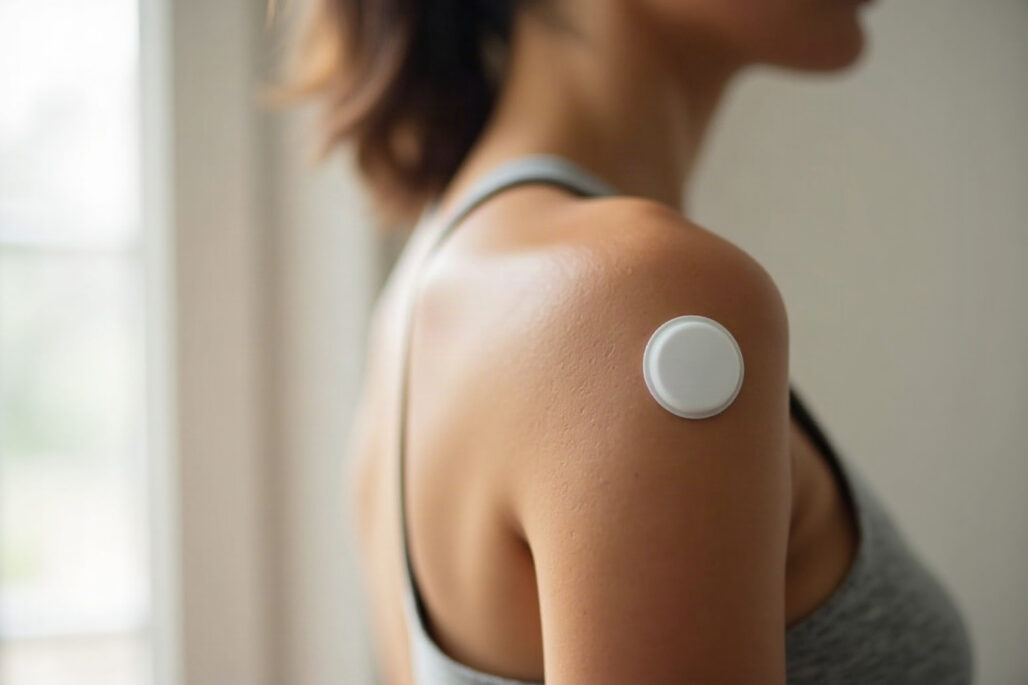
Two continuous glucose monitors can now be bought without a prescription: Stelo by Dexcom and Lingo by Abbott. Both stick to the back of your arm, both send a glucose reading to your phone, and both are sold to people who do not have diabetes and are not on insulin. On paper they look almost identical. The differences that matter are how often they sample, how long you wait to start, and what a month actually costs.
The numbers side by side
| Specification | Stelo by Dexcom | Lingo by Abbott |
|---|---|---|
| Wear time per sensor | 15 days plus a 12-hour grace period | 14 days |
| Warm-up before first reading | 30 minutes | 60 minutes |
| How often it samples | reads every 5 minutes, app updates every 15 minutes | every 1 minute |
| Reported accuracy (MARD) | 8.3% | 9.3% |
| Prescription | not required | not required |
| Intended user | 18+, not on insulin | 18+, not on insulin |
| Price, checked 22 Aug 2026 | $99 for a 2-sensor pack, $89/month on subscription | $54 for a 2-week plan with 1 sensor, $89 for 2 and $249 for 6 at retail |
| HSA/FSA | eligible | eligible |
MARD stands for mean absolute relative difference. It is the average gap between the sensor and a laboratory blood measurement, so lower is better. Both figures are manufacturer-reported, not independently audited, and a single percentage point of MARD is well inside the range where two sensors worn at the same time will disagree with each other anyway.
Where they genuinely differ
Sampling: one minute against fifteen
This is the real split. Lingo reads every minute and shows you the curve as it moves. Stelo reads every five minutes internally but pushes an update to the app every fifteen.
If your reason for buying is to watch what a particular breakfast does while you are eating it, Lingo gives you a smoother line. If your reason is to look back at the day and see which meals sent you highest, fifteen-minute resolution loses very little.
Be honest with yourself about which one you are. Most people check the app after the fact, and the minute-by-minute feed becomes something they stop opening in week two.
Warm-up and wear
Stelo starts giving readings after 30 minutes. Lingo takes 60. That gap only matters on the day you apply a new sensor, but it is a full hour of a 14-day sensor’s life.
Stelo also runs 15 days against Lingo’s 14, with a 12-hour grace period on top. On a 30-day month that is the difference between two sensors covering the month comfortably and two sensors leaving you a day or two short.
There is a caveat, and it comes from Dexcom rather than from us: Stelo’s own site states that roughly 20% of sensors may not last the full 15 days. That is a one-in-five chance of a shorter sensor, and it is worth knowing before you compare the headline numbers.
What a month actually costs
Sensor packs are priced in ways that make comparison awkward, so convert everything to cost per day of wear.
| Option | What you get | Days covered | Cost per day |
|---|---|---|---|
| Stelo subscription | 2 sensors, $89/month | 30 | $2.97 |
| Stelo one-time | 2 sensors, $99 | 30 | $3.30 |
| Lingo 6-pack | 6 sensors, $249 | 84 | $2.96 |
| Lingo 2-pack | 2 sensors, $89 | 28 | $3.18 |
| Lingo single plan | 1 sensor, $54 | 14 | $3.86 |
Bought in bulk the two are effectively the same price. Bought one sensor at a time, Lingo is the most expensive way to try either device. If you only want a two-week look at your own patterns, that $54 is the honest cost of the experiment, and it may still be the right purchase.

What neither device will do for you
Both are wellness products, and both companies say so. Abbott states that Lingo is not intended for the diagnosis of diseases, including diabetes. Stelo is sold to adults who are not taking insulin.
Neither will tell you whether a supplement is working. A glucose curve after you take berberine is one person, one day, one meal, and dozens of variables you did not control. That is a data point about your morning, not evidence about a compound. We set out what a CGM can and cannot tell you about a supplement separately, because the claim gets made constantly and it does not survive contact with how these studies are actually run.
If you have symptoms, a family history, or a fasting glucose result that concerns you, a CGM is not the test you need. Our guide to fasting glucose in the prediabetes range covers what to do instead.
So which one
Buy Stelo if you want the cheapest month on subscription, the fastest start, and the longest wear, and you accept the one-in-five risk of a sensor falling short.
Buy Lingo if minute-by-minute resolution is the point for you, or if you specifically want a single two-week sensor to run one experiment and stop.
Buy neither if what you actually want is a number to act on rather than a curve to look at. An at-home A1C test gives you a three-month average for a fraction of the money and does not need an app.
Questions people ask
Do I need a prescription for either?
No. Both are over-the-counter in the United States. Stelo was the first glucose biosensor cleared for OTC sale in the US, in August 2024.
Can I wear one if I take insulin?
No. Both are intended for adults 18 and older who are not on insulin. If you use insulin, the device you need is a prescription CGM chosen with your clinician.
Will it tell me if I have diabetes?
No, and Abbott says so directly for Lingo. These devices show patterns. Diagnosis uses fasting glucose, A1C or an oral glucose tolerance test ordered by a clinician.
Is a 1% difference in MARD worth choosing on?
Not on its own. Manufacturer-reported accuracy figures are measured under their own protocols, and the gap between 8.3% and 9.3% is smaller than the variation you will see between two sensors on the same arm.
Can I use HSA or FSA money?
Both list themselves as HSA/FSA eligible. Confirm with your plan administrator before ordering, since eligibility rules differ by plan.
The verdict
For most people buying their first over-the-counter CGM, Stelo is the better default: longer wear, faster start, lower cost per day on subscription, and a slightly better reported accuracy figure. Lingo earns its place if minute-level resolution is genuinely what you are after, or if you want one sensor for one short experiment rather than a subscription.
Whichever you pick, treat it as a map of your own patterns. It is not a diagnosis, and it is not a supplement trial. If you are weighing Stelo on its own merits, we go through that in is Stelo worth it.
