
Before you decide
You may want something cold to pour at six o'clock, something grown-up to order with dinner, or simply a drink that is not another coffee. A mushroom beverage is one option. The question is whether you want the drink itself or the relaxation promised on the can.
This guide is for adults comparing everyday drinks. It is not medical advice or an alcohol-withdrawal plan. If you have been drinking heavily for a long time, speak with a health professional before stopping suddenly. The National Institute on Alcohol Abuse and Alcoholism warns that withdrawal can be life-threatening.
We looked at the labels and asked whether the research actually tested a comparable drink. We have not taste-tested or laboratory-tested these drinks. Our supplement review method explains how we evaluate published evidence and distinguish it from marketing.
Four real mushroom drinks to compare
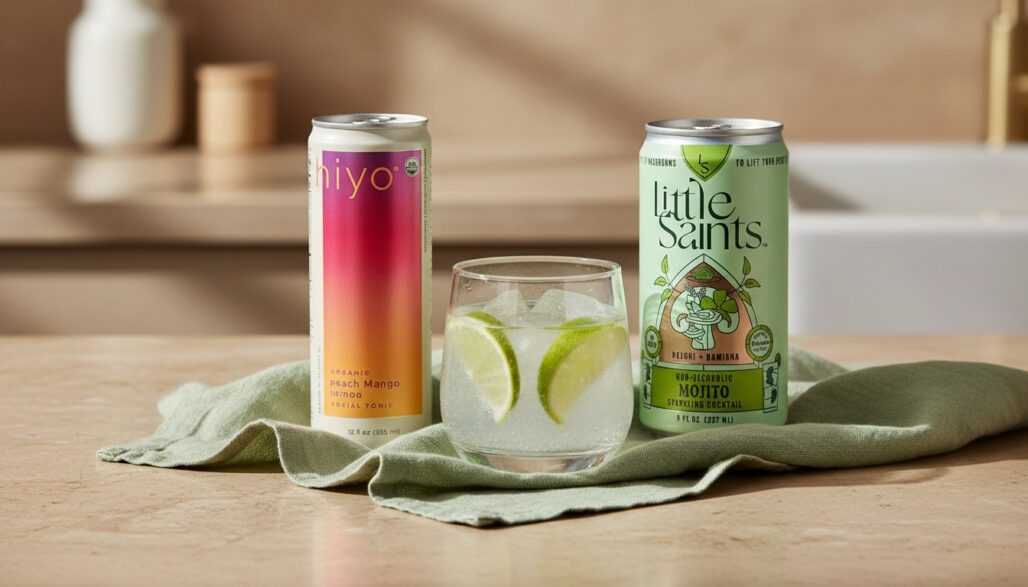
The four examples below are Hiyo, Little Saints, BRĒZ FLOW and Curious Zero. These are label-based examples, not taste-test winners. We checked the manufacturers' pages on September 25, 2026. Their descriptions tell us what they sell and claim; they do not independently establish a health benefit.
Hiyo: a canned seltzer with lion's mane
The Hiyo ingredient and product page lists lion's mane alongside ashwagandha, L-theanine, lemon balm, passion flower and ginger. Its manufacturer FAQ describes the drink as 0% ABV, caffeine-free and without CBD or THC. That fits the brief for a cold evening drink without those ingredients.
Hiyo advertises a 1,700 mg functional blend. That is not 1,700 mg of lion's mane. The blend total cannot tell you the mushroom's individual amount or its beta-glucan content. The brand calls the feeling it markets "the float"; we would not pay a premium on the assumption that this is an established alcohol-like effect.
The classic 12-pack was listed at $44.99 for a one-time purchase, about $3.75 per can before shipping and tax. The subscription price was lower. Use the option you actually intend to order when comparing costs.
Little Saints Mojito: a reishi mocktail
The Little Saints Mojito product page and ingredient list describe a nonalcoholic canned cocktail with organic reishi extract, damiana leaf extract and botanical terpenes. Its mint-and-lime flavor description comes from the manufacturer, not our own tasting.
This is a more direct cocktail-style example than mushroom coffee. It also contains more than reishi, so the whole formula matters if you take medicines or need to avoid a particular ingredient. The listed formula does not include THC or CBD. Check the actual can rather than assuming that every mushroom-branded drink has the same ingredients.
The four-pack was listed at $19.99 for a one-time purchase, about $5 per can before shipping and tax. We did not find a beta-glucan amount in the displayed ingredient list. The presence of reishi alone cannot establish how much beta-glucan is in a serving or how the finished drink will affect you.
BRĒZ FLOW: check the product name, not just the brand
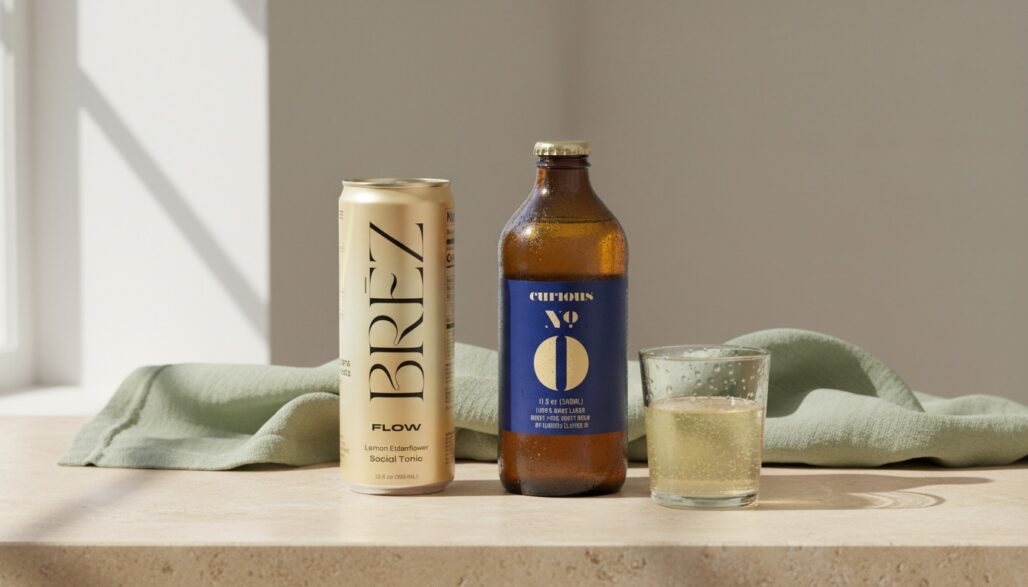
The BRĒZ FLOW ingredient page identifies FLOW as THC- and CBD-free. It lists lion's mane extract, cacao extract, L-theanine and black seed oil, with lemon and elderflower. FLOW is the example here. BRĒZ also sells THC-infused products, so look for FLOW on the can rather than choosing by the BRĒZ name alone.
FLOW was listed at $20 for four cans as a one-time purchase, or $5 per can before shipping and tax. The page advertises 2,200 mg of lion's mane, but that number is not a declared beta-glucan amount. Before calling that an "active dose" or comparing it with a capsule trial, we would need to check the preparation and measurement basis. Cacao appears in the formula; do not assume the drink is caffeine-free without a product-specific caffeine disclosure.
Curious Zero: a lager-style option with lion's mane
The Curious Zero product page lists hops, malted barley, lion's mane extract and maca root. The manufacturer describes it as nonalcoholic and says its drinks contain no THC or CBD. Curious Zero contains gluten, so skip this example if you need a gluten-free drink.
The ingredient panel lists 400 mg of lion's mane extract per bottle. That is an extract amount, not a beta-glucan measurement or proof of the promised effects. The listed one-time prices were $36 for four bottles, or $9 each, and $79 for 12, about $6.58 each, before shipping and tax. The page showed conflicting stock information when checked. Confirm availability before planning an order.
Start with the kind of drink you would enjoy pouring. These examples cover a seltzer, a mocktail, a functional tonic and a lager-style drink. Compare the ordinary price for the pack you want. None of these labels is a reason to expect treatment for stress, sleep problems or alcohol cravings.
First decide what you want to replace
Sometimes you just want a cold glass in your hand while dinner cooks. You do not need a special mushroom effect to enjoy that ritual. Sparkling water or an alcohol-free cocktail can do that too.
If your goal is to feel less anxious, fall asleep more easily or manage alcohol cravings, the decision changes. Enjoying the drink tells you little about whether its mushroom ingredients help with a health problem. A study of a capsule, a laboratory experiment and a trial of the exact drink are different kinds of evidence.
Start with a goal you can check: “I want a drink I enjoy with dinner that contains no alcohol.” Compare that with “I want something that balances my nervous system.” You can judge the first goal from the label and whether you like the drink. The second depends on a health claim that needs its own evidence.
| Your goal | What to check | What the label cannot establish |
|---|---|---|
| Keep an evening ritual | Flavor, preparation, alcohol content and price per serving | A guaranteed feeling of relaxation |
| Avoid evening caffeine | Coffee, tea, cacao and declared caffeine | That a mushroom drink is automatically caffeine-free |
| Avoid intoxication | The complete ingredient list, including THC or muscimol | That alcohol-free means free of other intoxicants |
| Evaluate mushroom content | Named species, ingredient amount and relevant testing | Clinical benefit from a blend’s total weight |
| Stop drinking after prolonged heavy use | A safe plan with a health professional | Protection against alcohol withdrawal |
Mushroom drinks are not one ingredient category
The word “mushroom” on the front of a can tells you very little about everything inside it. Read the complete label before deciding what kind of product you are considering. A coffee blend, a botanical soda and a drink containing a cannabinoid should not be treated as interchangeable.
For this guide, the relevant option is a beverage with named culinary or supplement mushrooms and no added intoxicants. We are not recommending THC drinks or psychoactive mushroom products as substitutes for alcohol. If a product includes those ingredients, it needs a separate safety assessment; a picture of lion's mane does not change that.
A specific warning applies to Amanita muscaria and muscimol. In its letter on Amanita ingredients in conventional food, the FDA describes serious safety concerns and identifies these ingredients as unapproved food additives. An Amanita product is outside the ordinary mushroom-drink category discussed here. This FDA position was checked on September 24, 2026.
Our existing mushroom coffee comparison addresses a different buying decision: coffee products and their mushroom disclosures. Here, the question is what you want to drink in the evening. A coffee alternative you like in the morning may not be what you want with dinner.
Does the research support an alcohol-like feeling?
The study we examined does not establish an alcohol-like effect. A 2023 randomized pilot trial of lion's mane used 1.8 grams daily in capsules. Its chronic analysis included 41 healthy adults, and the intervention lasted 28 days. This was not a trial of a mushroom cocktail or a comparison with alcohol.
The trial found faster performance on one cognitive task after a single dose. After 28 days, the reported stress finding was a trend with a p value of 0.051, rather than a clear result under the usual 0.05 cutoff. Other findings were null or limited negative results. The authors cautioned about the small sample. See the full study in Nutrients (DOI: 10.3390/nu15224842) and its PubMed record (PMID: 38004235).
Watch for advertisements that turn “studied for mood” into “unwind tonight.” A small capsule trial cannot tell us how a particular canned blend will feel at a party. The preparation, amount, other ingredients and outcome would all need to match before treating it as direct product evidence.
We would ask a manufacturer a more specific question: “Has this exact drink, at the labeled serving, been tested in a controlled human study for this claim?” An answer about a mushroom in general does not answer that question. Neither does a customer review describing how someone felt after their first can.
Read the label in the order that affects your decision
Start with the serving size and the whole ingredient list. Check whether the figures describe one can, half a bottle, one scoop or the prepared drink. If you are comparing two products, compare the amount you would actually consume, rather than the most prominent number on either package.
Next, identify the mushroom by name. A total “mushroom blend” figure may be useful as a description of the mixture, but it does not reveal each species' amount. Do not divide that figure equally by the number of mushrooms unless the manufacturer explicitly says the mixture is evenly divided.
For example, a hypothetical 1,000 mg blend of four mushrooms does not establish 250 mg of each. One ingredient might account for most of the mixture. The individual amounts are undisclosed. An evenly divided calculation can look precise while adding information the label never supplied.
If the seller provides a test report, check the product and batch it covers, what the lab measured and the result. A contaminant test and a measurement of mushroom constituents answer different questions. Neither, on its own, demonstrates that the finished drink improves mood.
These are questions to bring to a manufacturer, not a way to certify a product from your kitchen. A clearer label still leaves questions about the finished drink. Our supplement label-reading guide provides more context for reading serving and ingredient information.
Caffeine can change the evening-drink decision
Check the drink's base, not just the mushroom name. The FDA notes that coffee, tea and chocolate contain caffeine. A mushroom product made with one of these ingredients may therefore contain caffeine even when caffeine is not listed as a separately added ingredient.
The FDA's caffeine guidance describes wide variation in sensitivity and lists sleep disruption, jitters and anxiety among possible effects of too much caffeine. Check caffeine before making it your evening drink. A drink's calming design or earthy flavor does not tell you its caffeine content.
If the amount is not stated, ask the manufacturer rather than treating silence as zero. “Decaf” also does not necessarily mean caffeine-free. You can use our caffeine cutoff calculator as a planning aid, while remembering that personal sensitivity is not something a calculator can measure.
Who should check with a clinician or pharmacist first?
The NCCIH guidance on using supplements wisely notes that supplements can interact with medicines and that many have not been studied in pregnancy, breastfeeding or children. A mushroom-containing supplement drink is not automatically appropriate for everyone. A beverage sold as food and a concentrated supplement also deserve separate consideration.
If you take prescription medicines, bring the exact label to your pharmacist. The useful question is about this mixture alongside your actual medicines. A broad statement that “mushrooms are natural” cannot assess several extracts, an added herb and a medication together.
Pregnancy, breastfeeding, upcoming surgery and an existing medical condition are reasons to discuss supplement use with a clinician. Do not use this article as personal clearance. It does not establish the safety of a particular formulation or replace the advice you have received about your own circumstances.
For background, our drug-supplement interactions guide explains why combining ingredients needs attention. Keep taking prescribed medicines as directed. Choosing a different drink is not a reason to change a prescription or its timing on your own.
Is the premium worthwhile for your routine?
Treat the first purchase as part of your drinks budget. Pay for flavor and convenience you actually want. If the premium only makes sense because you expect a promised health effect, ask for evidence on the finished product before committing to recurring deliveries.
Use the ordinary refill price when comparing subscriptions. A hypothetical $36 pack containing 12 servings costs $3 per serving; a $24 introductory price would make only that first pack $2 per serving. Those are illustrative numbers, not prices for a named brand. Delivery charges and the number of servings you really use can change the calculation.
Then compare it with an alternative you already like. Would you still buy it at that price if it made no difference to how you felt? Enjoying the flavor can be enough reason to buy it. You can like a drink and still remain unconvinced by its wellness claims.
If you are ordering for the first time, read the cancellation and renewal terms before deciding between a one-time purchase and a subscription. Check what the next order will cost. This is a purchasing check, not an endorsement of a specific seller.
A practical checklist before pouring
Read these questions with the package in front of you. Stop at an unanswered question that matters to your goal. You do not have to resolve every uncertainty by buying the product first.
- Does the stated alcohol content match the limits you personally need to follow?
- Are all ingredients named clearly, including any cannabinoids or other psychoactive ingredients?
- Does it contain coffee, tea, cacao or another caffeine source, and is the amount disclosed?
- Does the serving size match the amount you plan to pour?
- Can you separate what the label actually reports from what the advertisement promises?
- Does the ordinary price still appeal without assuming a health benefit?
- If you take medicines or need clinical advice, has the exact ingredient list been reviewed for your situation?
Keep a short note. Write down the product, serving, caffeine disclosure, ordinary cost and the unanswered question. It gives you something concrete to compare if the formula or price changes.
FAQ
Can mushroom drinks replace alcohol?
They can be a beverage choice for an alcohol-free routine. They are not established replacements for alcohol's effects or for medical care related to alcohol use. The NIAAA guidance on cutting down or quitting explains when professional help matters.
Will a mushroom drink give me a buzz?
Do not assume that from a mushroom name. The lion's mane pilot trial discussed here did not establish an alcohol-like effect. If a drink contains an intoxicating ingredient, it belongs in a different safety discussion.
Does mushroom mean caffeine-free?
No. A mushroom beverage may also contain coffee, tea or cacao. The FDA's explanation of caffeine sources is a useful starting point; check the specific product's amount.
Does a higher mushroom blend weight mean a better drink?
No. The total does not tell you each ingredient's amount or whether the finished drink has been tested for its advertised claim. NCCIH cautions that commercial supplements can differ from products studied in research.
The bottom line on mushroom drinks instead of alcohol
Choose a drink you enjoy at a price you are willing to pay. The mushroom name alone cannot establish the feeling you will get or a health benefit. Check caffeine and other added ingredients, use the normal price for your comparison, and keep clinical questions separate from beverage preferences.
Editorial disclosure: No product was supplied for this article, and it contains no affiliate product links. UsefulVitamins is published by SIA Digital Publisher. Images are AI-generated editorial illustrations, not photographs of tested products.
