
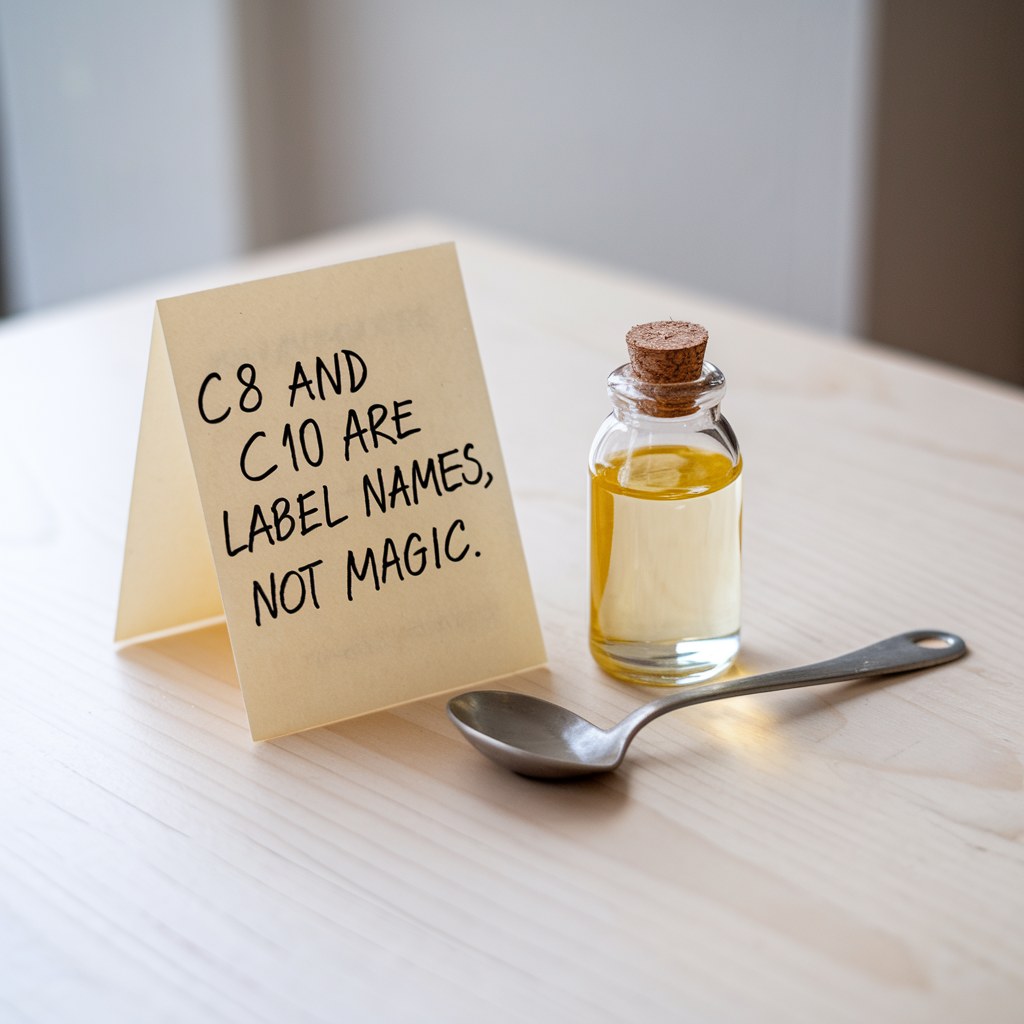
MCT oil bottles can read like a chemistry quiz: C8, C10, C8/C10, caprylic, capric, "from coconut." This page decodes those names, the serving, and the calories. It isn't a keto weight-loss pitch.
Before you decide

Start with the question you actually have. Want to know if a tablespoon of oil fits your day? That's about calories and how your stomach handles it. Want coconut flavor for cooking? You probably want coconut oil, not fractionated MCT. Want a bottle that matches a study that used a specific chain mix? Then the Supplement Facts or Nutrition Facts panel has to say C8, C10, or both. "MCT" alone won't tell you.
We wouldn't buy MCT oil to "burn fat," treat epilepsy, sharpen memory, or replace a meal plan. Those claims follow this category around online. A label can't honestly promise any of them, and this page won't either.
What MCT oil actually is (and how it differs from coconut oil)
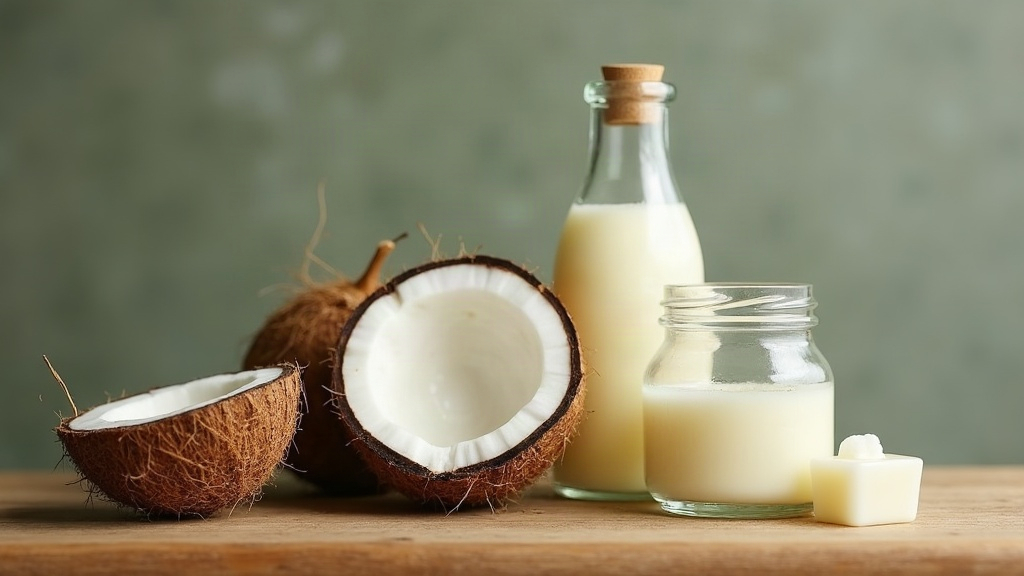
Triglycerides are fats: three fatty acids attached to glycerol. "Medium-chain" means fatty acids of medium carbon length. In food science writing that group usually covers caprylic acid (C8, also called octanoic acid), capric acid (C10, decanoic acid), and sometimes lauric acid (C12). The MCT oil sold as a supplement or specialty cooking oil is usually made by fractionating coconut oil or palm-kernel oil. That concentrates the shorter chains and strips out most of the longer ones.
Coconut oil itself is a different product. You can look up its fatty-acid profile in USDA FoodData Central. Published comparisons that use those food-composition data describe coconut oil as mostly lauric acid (C12), often around half of its fat, with much smaller shares of C8 and C10 and a tail of longer saturated fats. Fractionated MCT oils are commonly described as roughly half to four-fifths C8, with the rest C10 and very little C12. Exact percentages vary by brand. That's why the bottle has to tell you.
You'll notice the difference in the kitchen too. Coconut oil is solid or semi-solid at cooler room temperature and smells like coconut. MCT oil is usually liquid at room temperature and tastes fairly neutral. Being liquid doesn't make it calorie-free.
C8 vs C10 vs C12: reading the carbon-chain names
The number is the chain length:
- C8, caprylic, octanoic: eight carbons. Often sold as the "purest" MCT. A C8-only oil should list caprylic triglyceride or C8 on the panel, not just on a front-label slogan.
- C10, capric, decanoic: ten carbons. Usually paired with C8 in a blend.
- C12, lauric: twelve carbons. Plentiful in coconut oil. Some "MCT from coconut" products still lean on it. If you wanted a C8/C10 oil, that C12 isn't a rounding error. It's a different mix.
A C8/C10 blend isn't automatically better or worse than C8 only. It's just a different composition. When a brand calls one chain "the ketone one" and the other "the cheap one," that's sales copy talking. Some research does measure a rise in blood ketones after people take MCT. In one metabolic study in healthy adults, C8 raised ketones more than C10 or C12. That's a lab measurement. It isn't a weight-loss result, and we won't sell it to you as a health benefit. (The same chain-length shorthand shows up with other fats, like C15:0 in our Fatty15 vs fish oil comparison.)
What a typical Supplement Facts or Nutrition Facts panel lists

MCT oil can be sold as a dietary supplement (Supplement Facts) or as a food oil (Nutrition Facts). Either way, look for serving size, calories, total fat, and an ingredient list that names caprylic triglyceride, capric triglyceride, coconut oil, or palm-kernel oil. If the brand brags about a specific chain ratio, you should be able to find that ratio on the panel or in a clear footnote. An ad isn't enough. If you're new to these panels, our supplement label reading guide walks through them line by line.
The FDA Nutrition Facts label is designed so you can compare packaged foods serving by serving. Fat is listed in grams. Saturated fat gets its own line. MCT oil is a source of saturated fat, and a "clean" clear look doesn't change that.
Serving size, calories, and why "a tablespoon" is not a vague unit
FDA's consumer guidance on the Nutrition Facts label counts each gram of fat as 9 calories. A common oil serving is one tablespoon, about 14 grams of fat. Fourteen grams times 9 is about 126 calories. Some fact sheets round a tablespoon of MCT oil to about 14 grams of fat and about 115 calories. The honest move is to read the number printed for that product's serving. If the serving is a teaspoon, a gram, or a scoop of powder, do the same math.
"A tablespoon" is only a clear unit if the label defines it. A 15 ml serving, a 14 g serving, and a 10 g serving are different calorie piles. Powdered MCT isn't calorie-free either. The powder still brings fat calories, and carriers like acacia fiber or starch change how much a scoop weighs.
Powder vs liquid MCT: what changes on the label
Liquid MCT oil is usually just the triglycerides. Powdered MCT is the oil dried onto a carrier so it mixes into a shake. A scoop is easier to measure. It can also mean you get less oil per gram of powder than the front label suggests. Read the fat grams and the calorie line, not the big "MCT powder" type.
Put MCT in your coffee and you add those fat calories to the cup. That's just arithmetic. Hydration and electrolyte questions live in our complete guide to electrolytes. Keto readers can find electrolytes for keto elsewhere on the site. This article won't double as a keto-flu guide.
A worked example helps. Say a liquid MCT lists a 15 ml serving, 14 g of fat, and 130 calories, and the ingredients are caprylic triglyceride and capric triglyceride. That's a C8/C10 blend, and one serving carries roughly the calories of a tablespoon of any other oil. Now say a second bottle lists 10 g of fat and "MCT from coconut oil" with no chain breakdown. You don't know how much is C8, C10, or leftover C12, so you can't swap it for the first bottle. A powder that lists 9 g of fat plus carbohydrate from a carrier is a third product again. Same category name, different panel.
We also check whether the product uses Supplement Facts or Nutrition Facts. An oil sold as food should look like any other fat on the pantry shelf: serving, calories, total fat, saturated fat. An oil sold as a supplement should still show fat grams if there's more than a trace of fat, because FDA requires Supplement Facts to list the same core nutrients as Nutrition Facts when they're present above zero. If an obvious oil is missing calories or fat grams, notice that before you trust the front of the bottle.
GI tolerance and why "start low" is a label-use note, not a protocol
Medium-chain fats can cause cramping, nausea, or loose stools when you jump from zero to a full tablespoon, especially on an empty stomach. A systematic review of MCT side effects found stomach and gut complaints were the most commonly reported problem, more often at higher doses. Gut upset isn't a sign the oil is working. "Start with a teaspoon" is simply a way to see how your gut handles the labeled serving. It's not a medical protocol, and doubling the serving won't get you a better result.
If a small serving already bothers you, that tells you something. We wouldn't read discomfort as a toxin warning. We also wouldn't read no discomfort as proof the oil is doing something extra.
What MCT oil marketing often oversells
The usual oversells: weight loss, bulletproof-style coffee as a fat-burning ritual, effortless ketosis, and claims about treating the brain or nerves. FDA labeling rules don't turn a cooking oil into a drug. The label still counts 9 calories per gram of fat. Some technical papers discuss slightly lower usable energy from MCTs than from long-chain fats, but for everyday label reading, use the printed calories. We've looked at the wider fat-loss pitch in do fat burner pills work.
US FDA has treated certain MCT uses in food as GRAS in specific contexts. GRAS for a food use isn't an endorsement of a health claim on social media. For how we look at bottles in general, see how we review supplements.
FAQ
Is MCT oil the same as coconut oil? No. Coconut oil has a lot of C12 (lauric acid) plus smaller amounts of C8 and C10. MCT oil is usually fractionated to concentrate C8 and C10.
Is C8 better than C10? They're different chain lengths. The better question is whether the bottle tells you the mix you think you're buying.
How many calories are in a serving? Use the label. FDA counts 9 calories per gram of fat, so a 14 g tablespoon lands around 126 calories.
Can I cook with it? Many MCT oils have a lower smoke point than ordinary cooking oils. The label and intended use matter more than any universal rule from us. Don't assume it behaves like olive oil or coconut oil in a hot pan.
Will MCT oil help me lose weight? We won't make that claim. Count the calories and decide whether the oil fits meals you already eat.
Why do some people get stomach upset? Larger servings of MCT oil can be hard on the gut. That's a tolerance note. Starting below the full labeled serving is common sense, not a therapy plan.
The bottom line
Read MCT oil like any other fat. Check whether the panel lists C8, C10, a blend, or coconut oil that still leans on C12. Count the serving in grams and the calories that come with it. Keep coconut oil in its own jar, and keep weight-loss marketing out of the decision.
Next steps:
- Run any bottle through the calorie math above: grams of fat times 9.
- Learn to read the whole panel with our supplement label reading guide.
- For a different family of fats with its own label math, see our complete guide to omega-3.
- Our broader review rules are in how we review supplements.
This article is for informational purposes and is not medical advice. It is not meant to diagnose, treat, cure, or prevent any disease. Talk with a licensed clinician before starting a supplement, especially if you are pregnant, nursing, taking prescription medication, or managing a chronic condition.
Reviewed by the UsefulVitamins Editorial Team.