
Affiliate disclosure: this article contains affiliate links. As an Amazon Associate, UsefulVitamins.com earns from qualifying purchases at no extra cost to you.
If you're trying to figure out which form of vitamin K2 actually belongs in your daily stack, the short answer is: for almost every reader supplementing K2 for bone and cardiovascular support, 100 to 200 mcg of MK-7 once daily wins on bioavailability, half-life, and cost per active microgram, and MK-4 at nutritional doses is the form to skip. MK-4 clears in a few hours. MK-7 stays in circulation for roughly three days, which is why once-daily dosing actually works for the form most people should be buying.
Summary / Quick Answer: which K2 form gives the best absorption per dollar?
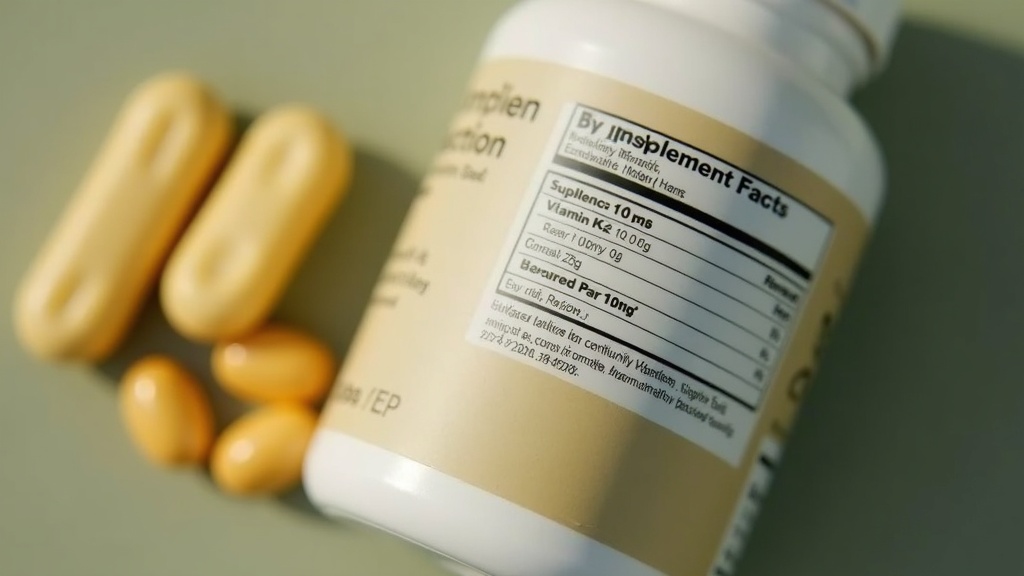
For general bone and cardiovascular support in a healthy adult, MK-7 at 100 to 200 mcg daily, ideally the patented MenaQ7 or K2Vital trans-isomer form, is the K2 to buy.
- Best for daily supplementing adult: MK-7 (menaquinone-7), 100 mcg once daily with a fat-containing meal. About $0.07 to $0.12 per daily dose at typical retail pricing.
- Best for high-need bone or vascular calcification context (clinician-managed): MK-7, 180 to 360 mcg daily. Same form, scaled dose.
- Skip: low-dose 45 mcg MK-4 components in cheap multivitamins, and standalone MK-4 supplements at 1 mg, which sit awkwardly between a meaningful nutritional dose and the 45 mg pharmacological Japanese prescription dose used for osteoporosis.
- Decision shortcut: the half-life difference (1 to 3 hours for MK-4 versus roughly 72 hours for MK-7) is the single most important number on this page.
- Hard stop: if you take warfarin or any other vitamin K antagonist, do not start or stop K2 supplementation without your anticoagulation clinician. INR re-titration is mandatory, not optional.
What bioavailability means for vitamin K2
Vitamin K is fat-soluble. Absorption depends on bile, pancreatic lipase, and incorporation into chylomicrons in the small intestine, then transit through the lymphatic system into circulation. A K2 capsule swallowed dry on an empty stomach is poorly absorbed regardless of form.
The vitamin K family has three biologically relevant members for this conversation. K1 (phylloquinone) is the form in leafy greens and is taken up primarily by the liver, where it supports carboxylation of clotting factors II, VII, IX, and X. K1 is the form your INR is sensitive to on warfarin. MK-4 (menatetrenone) and MK-7 (menaquinone-7) are both K2 forms, but they differ in side-chain length and, more importantly, in how long they stay in circulation.
The mechanism of supplemental interest is extra-hepatic carboxylation. K2 activates osteocalcin (in bone, where carboxylated osteocalcin binds calcium into the hydroxyapatite matrix) and matrix Gla protein, or MGP (in arterial walls, where carboxylated MGP inhibits vascular calcification). The proxy markers in K2 trials are circulating undercarboxylated osteocalcin (ucOC) and undercarboxylated MGP (often reported as dp-ucMGP). Lower undercarboxylated fractions are the biochemical signal that K2 status has improved.
The other proxy is half-life. Once the vitamin is in circulation, how long does it stay at concentrations capable of carboxylating those extra-hepatic proteins? That single number drives whether once-daily dosing produces steady tissue saturation or a transient spike that's gone by lunch.
The forms compared

Vitamin K1 (phylloquinone)
The dietary form from leafy greens, vegetable oils, and some animal foods. Hepatic uptake is efficient, but extra-hepatic delivery is modest because the liver pulls K1 out of circulation quickly. K1 is not what you are buying when you buy a "K2 supplement," and it should not be conflated with menaquinones in dosing discussions. K1 is also the form that matters for warfarin patients, because warfarin works by inhibiting the vitamin K epoxide reductase that recycles K1 for clotting factor activation.
MK-4 (menatetrenone)
MK-4 is a short side-chain menaquinone produced endogenously from dietary K1 by tissue-level conversion, and found at small concentrations in eggs, butter, and certain organ meats. Supplemental MK-4 typically comes as synthetic menatetrenone.
Its defining feature is a half-life of roughly 1 to 3 hours in circulation, documented in the Schurgers 2007 pharmacokinetic study. That short window is the reason the Japanese osteoporosis prescription (Glakay/menatetrenone) is dosed at 45 mg daily across three 15 mg doses. That is roughly a 1,000-fold higher daily dose than the typical 45 mcg "MK-4 complex" in a cheap multivitamin. Retail nutritional MK-4 supplements at 1 mg occupy an awkward middle: too low for the pharmacological osteoporosis effect that the 45 mg trials documented, too high to be a normal dietary intake, and pharmacokinetically gone within hours regardless.
MK-7 (menaquinone-7)
MK-7 is a long side-chain menaquinone produced naturally by the bacterial fermentation that turns soybeans into natto. The patented commercial forms (MenaQ7 from NattoPharma and K2Vital from Kappa Bioscience) are derived from either natto fermentation or synthetic routes and standardized to over 97 percent trans-isomer content. Only the trans-isomer is biologically active. Older or cheaper batches sometimes contained meaningful cis-isomer fractions that were essentially inert.
MK-7 has a circulating half-life of roughly 72 hours, also documented in Schurgers 2007. That long window is the entire pharmacokinetic argument for MK-7 over MK-4 at nutritional doses. A single 100 mcg MK-7 capsule produces measurable elevations in plasma MK-7 for the better part of three days, which means once-daily dosing can build steady tissue concentrations capable of driving osteocalcin and MGP carboxylation. MK-4 at the same 100 mcg dose does not stay in circulation long enough to do the same job.
Other menaquinones (MK-8, MK-9)
Natto also contains smaller fractions of MK-8 and MK-9, which behave more like MK-7 in half-life. Most retail supplements do not feature them separately, and the clinical trial base is concentrated on MK-7.
Form comparison table
| Form | Source | Half-Life | Typical Supplemental Dose | Approximate Cost per Daily Dose |
|---|---|---|---|---|
| K1 (phylloquinone) | leafy greens, supplements | 1-2 hr | 90-120 mcg adult AI | included in multis |
| MK-4 (menatetrenone) | small amounts in animal foods, synthetic | 1-3 hr | 45 mcg (multi) or 1 mg (standalone), or 45 mg Rx | $0.02 (multi) to $0.20 (1 mg) |
| MK-7 (menaquinone-7), trans- | natto, patented MenaQ7 / K2Vital | ~72 hr | 100-200 mcg | $0.07 to $0.12 |
| MK-7 high dose | same | ~72 hr | 360 mcg | $0.20 to $0.30 |
The RCT evidence per form
Schurgers 2007 is the foundational comparative trial for MK-4 versus MK-7 absorption and persistence. Healthy adults received single 1,000 mcg doses of K1, MK-4, or MK-7, with plasma vitamin K tracked over 96 hours. K1 and MK-4 returned to baseline within 8 to 24 hours. MK-7 maintained measurable plasma levels for the full 96-hour window, with a calculated half-life close to 72 hours. That single trial is the source of the "MK-7 is the form that supports once-daily dosing" framing that has shaped the supplement market for the last fifteen years.
The 2013 Knapen postmenopausal trial is the cleanest MK-7 dose-response study in the bone literature. Postmenopausal women received either 180 mcg MK-7 daily as MenaQ7 or placebo for 3 years. The supplement arm showed a statistically significant reduction in undercarboxylated osteocalcin and a modest preservation of bone mineral density at the lumbar spine and femoral neck. The absolute BMD effect was small (around a 0.5 to 1.5 percent difference versus placebo at 3 years), which is real but well below the effect size of bisphosphonates or denosumab. That trial established the 180 mcg dose used in many higher-end clinical supplements.
The 2004 Geleijnse Rotterdam Study is the observational evidence that drove the cardiovascular interest in K2. In a Dutch cohort of about 4,800 adults followed for roughly 7 years, the highest tertile of dietary menaquinone intake (mostly K2 from fermented dairy and meat) was associated with roughly 50 percent lower relative risk of severe aortic calcification and 41 percent lower relative risk of coronary heart disease death versus the lowest tertile, after adjustment. This is an observational signal, not an RCT, and the absolute risk reductions translate to small per-person numbers in a low-baseline-risk population.
The 2014 Caluwe trial in hemodialysis patients tested 360, 720, or 1,080 mcg MK-7 daily in patients with markedly elevated dp-ucMGP. All three doses produced significant reductions in dp-ucMGP at 8 weeks, with the dose-response curve flattening above 360 mcg. That established 360 mcg as a reasonable upper supplemental dose in high-need populations.
The USPSTF recommends osteoporosis screening with bone density measurement for women aged 65 and older as a Grade B recommendation, and for younger postmenopausal women at elevated fracture risk. The USPSTF does not make a specific vitamin K2 supplementation recommendation, and the AHA does not include K2 supplementation in its CV prevention scientific statements. The standard of care for confirmed osteoporosis is bisphosphonates or denosumab where indicated, with calcium and vitamin D as adjunct nutrition and K2 as a layer on top of, not a substitute for, the prescription regimen.
Actionable takeaway: the supplement evidence for K2 is a modest adjunctive signal at the margin of a standard cardiovascular and bone health framework that diet, exercise, blood pressure control, lipid management, and indicated prescription therapy already handle most of.
Cost-vs-bioavailability decision matrix
The math that matters is dollars per active microgram of MK-7 actually delivered, not dollars per bottle and not dollars per "K2 complex."
A 120-count bottle of standalone MK-7 at 100 mcg per capsule, labeled as MenaQ7 or K2Vital trans-isomer form, typically retails for $12 to $20, landing at about $0.10 per daily 100 mcg dose. The 200 mcg version runs roughly $0.18 per daily dose. A D3 plus K2 combination capsule (typical: 5,000 IU D3 plus 100 mcg MK-7) usually lands between $0.08 and $0.15 per day, which is the format most general supplementing adults should be buying.
A standalone 1 mg MK-4 supplement runs $0.15 to $0.30 per capsule, similar money for a form that clears within hours and is dosed at a level that is neither nutritional nor pharmacological. The 45 mg Japanese prescription menatetrenone is a different regulatory category entirely (osteoporosis indication, three times daily, monitored), and it is not what you get in a $0.20 MK-4 capsule.
When does the premium 360 mcg MK-7 dose actually pay off? In a specifically high-need context under clinician oversight: documented postmenopausal osteopenia with elevated undercarboxylated osteocalcin, chronic kidney disease with elevated dp-ucMGP, or significant vascular calcification on imaging in a statin-treated patient. That is the population where the Caluwe and Knapen dose response justifies the higher dose.
For the generally healthy adult adding K2 to a D3 stack for bone and vascular maintenance, 100 mcg MK-7 once daily covers the studied extra-hepatic carboxylation question at the lowest cost per active microgram.
How to choose the right form for your goal
If you are a generally healthy adult adding K2 to a D3 stack, choose MK-7 at 100 mcg daily, ideally as MenaQ7 or K2Vital trans-isomer, taken with the meal containing the most fat in your day. A combined D3 plus K2 capsule (5,000 IU D3 with 100 mcg MK-7) is the most cost-effective and adherent format.
If you are a postmenopausal woman with documented osteopenia or early osteoporosis and your clinician has endorsed K2 as an adjunct to first-line therapy, choose MK-7 at 180 to 360 mcg daily. This is the range supported by Knapen 2013 and the dialysis dose-response work. Standard of care for osteoporosis (bisphosphonate or denosumab when indicated, with calcium and D3) does not change. K2 is the layer on top.
If you are a statin user with a calcium score or imaging that shows meaningful coronary or aortic calcification, MK-7 at 100 to 200 mcg daily is reasonable as a low-cost adjunct. The trial-level evidence for calcification slowing is stronger in CKD and dialysis populations than in general statin-treated adults; the Geleijnse Rotterdam data are observational.
If you are vegan or vegetarian and your dietary K2 intake from natto, eggs, or fermented dairy is low, MK-7 at 100 mcg daily covers the gap. Natto-derived MenaQ7 is not vegan, but synthetic K2Vital is acceptable for strict vegan supplementing.
If you are on warfarin, acenocoumarol, phenprocoumon, or any other vitamin K antagonist, do not start, stop, or change the dose of any vitamin K supplement without your anticoagulation clinician. Per Drugs.com and the NIH ODS Vitamin K fact sheet, vitamin K directly antagonizes warfarin's mechanism. The standard guidance is to keep dietary and supplemental vitamin K intake stable and to coordinate any change with the prescriber, with INR re-titration as needed.
Actionable takeaway: form choice matters far less than confirming you actually need K2 supplementation in the first place, and keeping intake stable if you are on a vitamin K antagonist.
FAQ
Is MK-4 a scam? No. MK-4 at the 45 mg Japanese prescription dose has osteoporosis trial support. The problem is that retail MK-4 supplements at 45 mcg or 1 mg are dosed nowhere near that, and the short half-life means once-daily nutritional MK-4 does not produce sustained tissue saturation. The form is not the issue. The retail dosing is.
What does "trans-isomer" mean and does it matter? Yes. Only the trans-isomer of MK-7 is biologically active. Modern MenaQ7 and K2Vital products are standardized to greater than 97 percent trans-isomer. Older or cheaper unbranded MK-7 may contain substantial cis-isomer, which is effectively inert.
Why are D3 and K2 sold together? D3 increases intestinal calcium absorption. K2 activates osteocalcin and MGP, which respectively route circulating calcium into bone and inhibit its deposition in arterial walls. The pairing is mechanistically sensible, and 5,000 IU D3 with 100 mcg MK-7 is a defensible default for general adult use. It is not a treatment for osteoporosis on its own.
Can I get enough K2 from food? Possibly, if your diet regularly includes natto (roughly 1,000 mcg MK-7 per 100 g serving), fermented dairy like aged Gouda or Brie (roughly 50 to 80 mcg per 100 g), and pasture-raised egg yolks and butter. Most Western diets fall short.
Is high-dose MK-7 dangerous? Doses up to 1,080 mcg daily have been tested without clinically significant adverse effects in non-warfarin populations. The hard limit is the warfarin interaction, not the supplemental ceiling.
Drug-supplement interaction notes
Vitamin K and warfarin (or any vitamin K antagonist) is the single most important interaction in this article. Per Drugs.com and the NIH ODS Vitamin K fact sheet for health professionals, vitamin K is the direct biochemical antagonist of warfarin. Adding K2 to a stable warfarin regimen will lower INR and increase clotting risk; stopping K2 abruptly in a patient stabilized while taking it can raise INR and increase bleeding risk. The standard of care is consistent vitamin K intake (dietary and supplemental) and INR coordination with the prescriber. K2 does not have meaningful documented interactions outside the vitamin K antagonist class at supplemental doses.
Conclusion: the bottom line on K2 bioavailability
For almost every reader supplementing K2 for bone or cardiovascular support, MK-7 at 100 mcg daily, ideally as the MenaQ7 or K2Vital trans-isomer form and taken with a fat-containing meal, is the right answer. The 72-hour half-life is the entire pharmacokinetic argument: it is the reason once-daily dosing produces sustained tissue saturation capable of driving osteocalcin and MGP carboxylation. MK-4 at retail nutritional doses sits in an awkward middle ground, and the 45 mg Japanese prescription dose is a different regulatory category. The high-dose 180 to 360 mcg MK-7 range has trial support for specific high-need contexts (postmenopausal bone loss, CKD, documented vascular calcification under specialist care) but is not necessary for general adult supplementation.
The honest framing is that K2 is a layer on top of standard cardiovascular and bone health care, not a substitute. USPSTF osteoporosis screening, AHA cardiovascular risk management, and the prescription therapies indicated for confirmed disease do most of the work. K2 is a low-cost, low-risk adjunct with a defensible mechanism and a modest RCT signal, and the warfarin interaction is the only hard stop.
Next steps:
- Review how we evaluate supplements for the testing framework used in this article.
- Read more from Michael Ward, MD MPH on guideline-anchored chronic disease supplementation.
- For food sources, dose framing across life stages, and the full mechanism of K2 in bone and vascular biology, see the complete guide to vitamin K2.
Reviewed by Michael Ward, MD MPH, Preventive Medicine, focused on guideline-based chronic disease management.
This article is for informational purposes and not medical advice. Vitamin K2 directly interacts with warfarin and other vitamin K antagonist anticoagulants. Consult a licensed physician before starting, stopping, or changing the dose of any vitamin K supplement, particularly if you are taking anticoagulation, are pregnant, nursing, or managing a chronic condition.
Recommended Products


As an Amazon Associate, UsefulVitamins.com earns from qualifying purchases at no extra cost to you. We only recommend products supported by published research or third-party testing.
