
Search "creatine for cognition" and you'll get two flavors of answer: breathless headlines calling it a brain upgrade, and skeptics insisting it does nothing above the neck. The truth sits in between, and it's more interesting than either side.
Creatine is not a neurotransmitter or a stimulant. It's part of your brain's energy-buffering system, and the question that actually matters is whether topping up that system changes anything you'd notice, and for whom. The short answer: the signal is strongest exactly where the brain is energy-stressed, which increasingly points at the aging brain.
Before you decide
A few people should not start creatine on their own. If you have kidney disease, a single kidney, or any condition affecting renal function, talk to your physician before supplementing, because creatine raises serum creatinine (a routine marker used to estimate kidney function) without necessarily harming the kidney itself, and your doctor needs to know you're taking it so a lab result isn't misread.
The same caution applies if you are pregnant, breastfeeding, or managing a diagnosed neurological or psychiatric condition: creatine is being studied as an add-on in some of those settings, but that is research territory that belongs in a clinician-directed plan, not a self-prescribed experiment.
None of what follows is a treatment for cognitive decline, dementia, or Alzheimer's disease. Those are medical conditions that require diagnosis and standard care, and creatine does not substitute for either.
If none of that applies, the honest first step is naming what you actually want creatine to do. "Be smarter" is not a target the evidence can hit. "Hold cognitive performance through a stretch of bad sleep," "support the aging brain alongside resistance training," or "cover a dietary gap because I don't eat meat" are real, testable goals, and they map onto different parts of the research.
You can see how I weigh mechanism against human-trial reality, and how I handle conflicts of interest, on the how we review supplements page. This article is the cognition-and-aging use case; if you want the full primer on dosing, loading, and safety, that lives in the complete guide to creatine.
How creatine fuels the brain

Here is the mechanism, because it's the whole reason the aging angle is plausible. Your neurons run on ATP, and they spend it in fast, uneven bursts. Mitochondria can't always keep pace with sudden demand, so the brain keeps a rechargeable buffer: the creatine kinase enzyme shuttles a high-energy phosphate between creatine and phosphocreatine, regenerating ATP from ADP almost instantly at the sites where energy is being burned.
Think of phosphocreatine as a local battery that smooths out the spikes between supply and demand. This is not neurotransmission. Creatine doesn't bind a dopamine or glutamate receptor and doesn't change signaling the way a stimulant or a classic nootropic does. It changes the energy economics underneath the signaling.
That distinction sets the realistic ceiling on what creatine can do. If a brain is already well-fueled and not under stress, adding buffer capacity may produce little you can feel, because the system wasn't the bottleneck. The interesting cases are the opposite: brains that are energy-constrained, whether by age, by low dietary intake, or by an acute insult like sleep loss.
We can actually see the supplement reach the brain. Using magnetic resonance spectroscopy, which measures these phosphate metabolites non-invasively, a brain phosphate-metabolite study showed that oral creatine monohydrate increases brain creatine and shifts high-energy phosphate levels, with the regions that started lowest in phosphocreatine showing the largest gains.
That last detail is the mechanistic hook for everything below: the brain tissue with the least reserve responds the most. Crossing the blood-brain barrier is slower and less complete than loading muscle, which is why brain effects emerge over weeks of daily intake rather than from a single scoop.
Who actually benefits (and who doesn't)
Pooling the human trials, the effect on cognition is real but specific. A meta-analysis of randomized trials on memory found creatine improved memory measures versus placebo overall, with a small effect size (SMD 0.29), but the subgroup split is the headline: in older adults aged 66 to 76 the effect was large (SMD 0.88), while in younger participants it was essentially nothing (SMD 0.03).
A separate 2024 systematic review and meta-analysis across 16 trials reached a compatible picture, finding the most robust benefit for memory and measurable gains in processing speed and attention time, while broader "overall cognition" and executive function did not move significantly.
Read those two together and the pattern is consistent: creatine nudges specific, energy-sensitive functions, not a global IQ score, and it does the most where baseline reserve is lowest.
The aging brain is where this matters most, and a 2026 systematic review focused specifically on older adults concluded that the current, still-limited evidence suggests creatine may be associated with cognitive benefits in generally healthy older people, while explicitly calling for higher-quality trials before anyone overstates it.
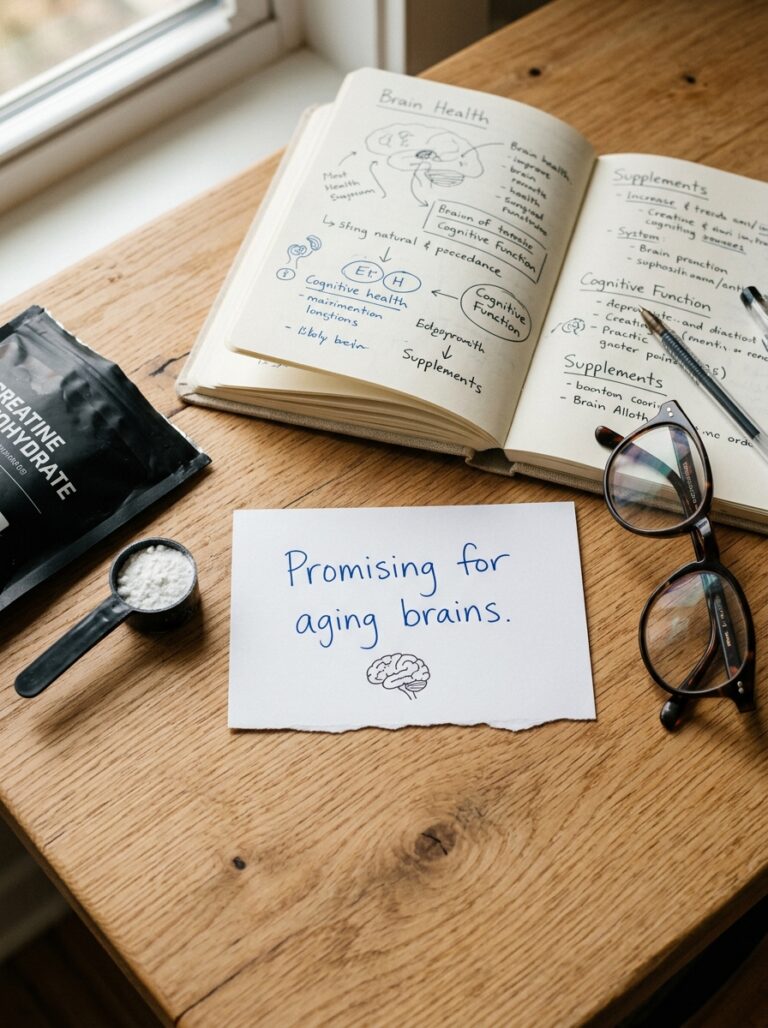
I want to be precise about that phrasing because it's doing honest work: "may be associated with" is not "treats" or "prevents." The aging brain tends to have reduced bioenergetic efficiency, which is exactly the condition the creatine-phosphocreatine buffer is positioned to support, so the mechanism and the modest human signal point the same direction. That alignment is why this article's card reads "promising for aging brains" rather than "proven."
Who probably won't notice much: a well-rested young adult who eats meat and fish, has full creatine stores, and is looking for a cognitive edge in normal conditions. The buffer is already topped up, and the trials in that population reflect it.
Creatine under energy stress: sleep deprivation

The cleanest demonstration of the energy-buffer idea is what happens when you deliberately stress the brain. In a randomized sleep-deprivation trial, a single high dose of creatine monohydrate (0.35 g/kg) partially reversed both the metabolic changes and the cognitive deterioration caused by overnight sleep deprivation, with improvements in word memory and processing speed and reduced subjective fatigue, peaking around four hours after dosing.
Mechanistically this is the cleanest result in the whole literature, because the spectroscopy data showed the brain's high-energy phosphate state shifting alongside the cognitive change, which is the bioenergetic story playing out in real time.
Two honest caveats before anyone treats this as an all-nighter hack. First, it was a single large dose used as a research probe, not a routine protocol, and that gram-per-kilogram amount is far above the everyday 3 to 5 g maintenance dose. Second, it's one study; the finding needs replication before it becomes advice.
What it does do well is validate the core premise: when the brain is forced into energy deficit, the creatine buffer measurably matters. The everyday version of that lesson is unglamorous. Protecting your actual sleep does far more for cognition than chasing a supplement to paper over its loss, and no scoop of powder replaces a night of rest.
The vegetarian and vegan angle
Diet sets your starting line. Creatine in food comes almost entirely from meat and fish, so vegetarians and vegans run lower baseline tissue stores, and that gap is the most intuitive place to expect a supplement to help.
The early evidence supports it. In a double-blind, placebo-controlled crossover trial in 45 young vegetarian adults, 5 g/day of creatine monohydrate for six weeks significantly improved working memory (backward digit span) and a reasoning test (Raven's matrices). It's worth flagging that this is one of the larger reported effects in the field, and effect sizes that large in small early trials often shrink on replication, so I read it as a strong reason to expect benefit in low-baseline groups rather than proof of a dramatic one.
The mechanistic logic is the same thread running through this whole article: the lower your starting stores, the more headroom there is for supplementation to register. If you eat little or no meat and want one supplement with a defensible cognitive rationale, creatine is a reasonable, low-cost candidate. If you eat meat and fish regularly, your stores are likely already high, and the dietary-gap argument mostly doesn't apply to you.
Dose, form, and timing for the brain
Here's the dose-trial-versus-supplement gap I always check. The cognition and memory trials above used plain creatine monohydrate, overwhelmingly at about 5 g/day, taken consistently for weeks. That is the dose with human cognitive data behind it.
Many "brain" or nootropic blends either include creatine at a fraction of that, where you'd never expect the trial result, or reach for boutique forms (hydrochloride, buffered, ethyl ester) that carry marketing claims but no comparative cognitive evidence. Monohydrate is the most studied, the cheapest per gram, and the form used in essentially all the brain research. If you want the full breakdown of why the exotic forms rarely justify their price, I cover it in creatine monohydrate vs HCl vs buffered.
The table below maps the realistic expectation by reader profile. Treat it as honest triage, not a ranking.
| Reader profile | Likely cognitive payoff | Evidence strength | Practical note |
|---|---|---|---|
| Healthy older adult | Most promising, esp. memory | Emerging, consistent signal | 5 g/day; pairs well with resistance training |
| Vegetarian / vegan | Plausible benefit, low baseline | Early RCT support | Diet gap is the rationale; 5 g/day |
| Sleep-deprived / shift worker | Acute buffering under stress | Single trial, needs replication | Fix sleep first; not a stimulant swap |
| Well-rested meat-eating young adult | Little to none for cognition | Null in subgroup analyses | Stores already full; muscle benefit still applies |
On timing, the brain doesn't reward clock-watching the way some marketing implies. Because the cognitive effect depends on slowly raising brain creatine over weeks, daily consistency matters far more than whether you take it morning or night, or before or after a workout. Pick a time you'll actually remember. A loading phase isn't necessary for cognition; it speeds muscle saturation but the brain fills gradually regardless.
Safety and what to watch
For healthy adults, creatine monohydrate has one of the strongest safety records of any supplement. The International Society of Sports Nutrition's position stand concluded that short- and long-term use, at doses up to 30 g/day for as long as five years, is safe and well-tolerated across populations from children to the elderly, and that there is no compelling evidence it harms kidney function in healthy people.
The most common real-world complaints are mild: short-term water retention and occasional GI upset, usually eased by splitting the dose and taking it with water and food.
The genuine cautions are narrow and worth repeating. If you have kidney disease or a single kidney, clear creatine with your doctor first, and tell any clinician ordering bloodwork that you take it, since it can raise measured creatinine and complicate the reading of a kidney panel. If you are pregnant, breastfeeding, take medications that affect the kidneys, or manage a diagnosed neurological or psychiatric condition, treat creatine as something to discuss with your clinician rather than start solo.
And to be unambiguous: creatine is an energy-support nutrient with promising but still-emerging cognitive data, not a treatment for memory loss or any form of dementia. If you or someone you care for has cognitive symptoms that concern you, that warrants a medical evaluation, not a supplement.
The bottom line on creatine for the brain
Creatine works on the brain the way it works everywhere: by buffering ATP through the creatine-phosphocreatine system, not by acting like a stimulant or a neurotransmitter.
That mechanism predicts exactly what the human trials show, which is that the benefit concentrates where reserve is lowest, in older adults, in people with low dietary stores like vegetarians and vegans, and in brains pushed into acute energy deficit by sleep loss, while well-rested, well-fed young adults see little above the neck. The effect on memory and processing speed is real but modest, the aging-brain data is promising rather than settled, and the honest framing is "may support," not "treats."
If you're an older adult or eat little meat and want one inexpensive supplement with a defensible cognitive rationale, plain monohydrate at 5 g/day, taken consistently, is the version the research actually used. Skip the exotic forms and the underdosed brain blends, protect your sleep instead of trying to supplement around it, and if you have kidney concerns or a diagnosed condition, make this a conversation with your doctor rather than a solo experiment.
Reviewed by Maria Rodriguez, MS Nutrition Science, focused on cognitive and mood biochemistry. See more from Maria Rodriguez. This article is educational and is not a substitute for individualized medical advice; talk to your doctor before starting a supplement, especially if you have kidney disease, are pregnant, or are managing a diagnosed condition.
