
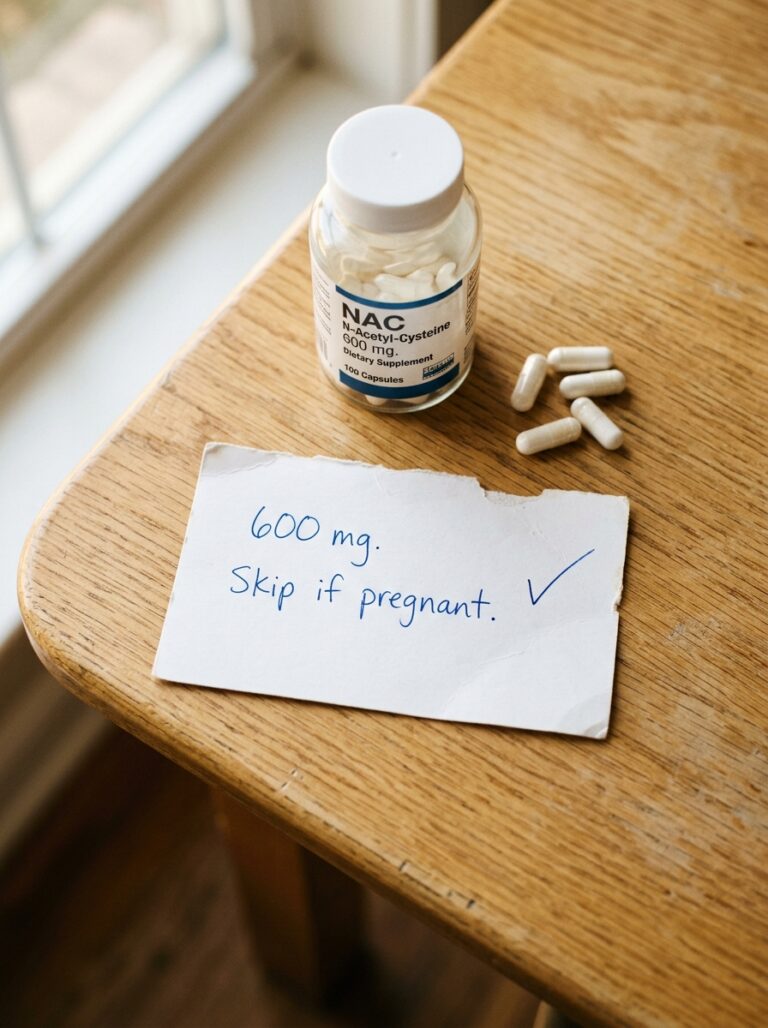
If you're shopping for the best NAC supplements, you've probably seen it sold as a glutathione booster, a liver "detox," and a respiratory aid all at once. The honest version is narrower than the marketing: NAC is genuinely useful for a few specific situations and oversold as a general cleanse. The three products at the bottom are the 600 mg, third-party-tested bottles I'd keep in my own family's cabinet.
This guide walks through what NAC actually does, where the evidence is solid versus hyped, the dose that matters, and who should skip it.
Affiliate disclosure: this article contains affiliate links. As an Amazon Associate, UsefulVitamins.com earns from qualifying purchases at no extra cost to you.
Before you decide
A few people should not start NAC on their own. If you are pregnant or trying to conceive, the safe move is to ask your obstetrician before adding it, not to self-start a supplement. NAC is used in hospitals during pregnancy for acetaminophen overdose, but that is a supervised medical decision, not a reason to take it routinely.
If you have asthma, know that inhaled NAC can trigger bronchospasm, and even oral use deserves a clinician's nod if your airways are reactive.
The same caution applies if you take blood thinners, nitroglycerin, or a stack of other medications, because NAC can interact in ways worth checking with a pharmacist. This is also where the standard-of-care framing matters: if you have a real diagnosis, NAC is a possible layer on top of treatment, not a replacement for it.
Before assuming NAC is your answer, it's worth asking whether your goal even points to a supplement. You can see how I weigh evidence and conflicts of interest on the how we review supplements page.
What NAC actually does
NAC is N-acetylcysteine, an acetylated form of the amino acid cysteine. Its headline job is simple: it supplies cysteine, the rate-limiting building block your cells use to make glutathione, the body's main intracellular antioxidant, though a pharmacology review notes the conversion to intracellular glutathione has to happen first before any antioxidant benefit shows up.
That single fact explains most of the legitimate uses and most of the overreach. Glutathione is real and important, but "I took NAC, so my glutathione went up, so I'm detoxed" skips several steps. NAC has to be absorbed, deacetylated, and converted intracellularly before any antioxidant benefit appears, and a well-nourished body already makes glutathione on its own.
NAC has two long-standing medical roles, both decades old. As a mucolytic, its free sulfhydryl group breaks the disulfide bonds that make mucus thick and sticky, which is why it's used in respiratory conditions with viscous secretions, as the NIH StatPearls monograph on N-acetylcysteine lays out.
Its other established role is as the antidote for acetaminophen (paracetamol) overdose, where it restocks the glutathione that the toxic metabolite depletes in the liver and is highly effective when given early. The time window is the whole story here: given within roughly 8 hours of an acute overdose, NAC is close to 100% hepatoprotective, and its benefit fades the longer treatment is delayed. That dramatic, time-dependent rescue is what cemented NAC's reputation as a "liver" molecule, and it's also where the consumer confusion starts.
The leap people make is from "saves the liver in poisoning" to "cleanses the liver daily," and that leap doesn't hold: emptying a depleted glutathione tank in a toxic emergency is a different event from topping up a tank that's already full. Both of these are clinical, supervised uses, not the reason most people buy a bottle off a shelf. I unpack this distinction further in my look at NAC versus glutathione for liver detox.
What the research shows
Here's where I separate the solid signal from the hype. The strongest supplement-relevant evidence for NAC is in psychiatry, specifically body-focused repetitive behaviors, not in "detox."
The clearest win is trichotillomania (compulsive hair-pulling) in adults. In a 2009 double-blind, placebo-controlled trial of 50 adults, 56% on NAC were much or very much improved versus 16% on placebo over 12 weeks at 1,200 to 2,400 mg/day. A response rate more than three times placebo, in a condition where almost nothing reliably works, is the single most quotable result in the NAC literature, and it's the reason psychiatrists started taking the molecule seriously as a glutamate modulator rather than just an antioxidant.
It's worth being precise about what that means. Trichotillomania sits in a family of body-focused repetitive behaviors, and the proposed mechanism is glutamate modulation in the brain's reward and habit circuits, not antioxidant "cleansing" at all. That distinction is the tell that separates the evidence-backed NAC story from the detox marketing built on the same bottle.
The honest counterweight: the same approach failed in children. A 2013 randomized, double-blind, placebo-controlled pediatric trichotillomania trial found no significant benefit over placebo on any primary or secondary measure. The adult signal does not automatically transfer to kids.
For obsessive-compulsive disorder, the picture is genuinely murkier, and I want to be straight about that. In a multicenter randomized, double-blind, placebo-controlled augmentation trial, NAC titrated to 2,400 mg/day lowered Yale-Brown scores from about 21 to 11 over 10 weeks. Taken alone, that looks impressive.
But individual trials are not the evidence base, meta-analyses are, and here the pooled OCD data are inconsistent: some reviews find a small Y-BOCS improvement, others find no significant separation from placebo, and the overall verdict for treatment-resistant OCD lands at "limited and inconclusive." So I'd file NAC for OCD under "reasonable adjunct to discuss with a prescriber," not "proven," and certainly not as a reason to self-medicate around therapy or an SSRI.
On the trendy "anti-aging" front, the data is early and conditional. A 2023 GlyNAC (glycine plus NAC) trial in older adults reported improved glutathione status and some functional markers, but a separate 2022 randomized trial in healthy older adults showed the glutathione benefit concentrated in people who started deficient. In other words, NAC corrects a deficit better than it supercharges a healthy baseline. For the broader longevity-supplement landscape, I keep a separate guide to longevity supplements.
What to look for when buying
NAC is sold mostly as capsules, and the buying decision is refreshingly simple. The 600 mg capsule is the de facto standard, and most studied protocols are reached by taking one to four of them per day.
Don't chase exotic forms or mega-doses. There's no good evidence that "liposomal" or "buffered" NAC outperforms a standard 600 mg capsule for the uses above, and pushing past 2,400 mg/day mostly buys nausea, not benefit. Plain NAC already absorbs well orally, so the premium delivery systems are mostly solving a problem you don't have.
The one form question worth a moment is sustained-release. A sustained-release NAC can smooth out the dose and may sit easier on the stomach, but it isn't a requirement and won't change whether NAC works for your goal, so treat it as a comfort feature, not a reason to pay double. If you tolerate standard capsules taken with food, you have no reason to upgrade.
Purity is where your money actually matters. Prioritize a third-party-tested bottle, USP or NSF verified where possible, over the cheapest bulk powder, because supplement quality control varies and NAC has a distinctive sulfur smell that tells you nothing about actual potency or contamination. A loud sulfur odor is normal for NAC and is not a sign that the product has "gone bad."
What third-party testing actually buys you is twofold: confirmation that the capsule contains the labeled milligrams, and screening for the heavy metals and stray contaminants that unverified bulk suppliers don't reliably catch. For a single-ingredient amino-acid derivative you may take daily for months, paying a few dollars more for a verified bottle is the highest-leverage decision on this page.
One regulatory wrinkle worth knowing: the FDA has held that NAC was approved as a drug before it was sold as a supplement, which technically excludes it from the supplement definition. In 2022 the agency released final guidance stating it intends to exercise enforcement discretion, so NAC supplements remain widely and legally sold while that review continues. Practically, that means buy from established brands that aren't likely to vanish mid-review.
| Buying factor | What to choose | Worth paying for? |
|---|---|---|
| Dose per capsule | 600 mg standard | Yes, the studied unit |
| Third-party testing | USP, NSF, or independent COA | Yes, the single best signal |
| “Liposomal” or “buffered” claims | Standard capsule is fine | No, no proven edge |
| Sustained-release | Optional, for stomach comfort | Only if standard upsets you |
| Mega-dose (3,000 mg+) | Stay at or below studied range | No, more side effects |
| Cheapest unbranded bulk | Skip unverified sources | No, quality risk |
If your underlying interest is raising glutathione directly, NAC is the precursor route, but it's not the only one, and I compare the trade-offs in my glutathione supplements guide.
Recommended Products
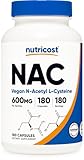


As an Amazon Associate, UsefulVitamins.com earns from qualifying purchases at no extra cost to you. We only recommend products supported by published research or third-party testing.
FAQ
What is the best NAC dose for healthy adults?
600 mg once or twice daily is the standard starting range. Studied psychiatric protocols climb to 1,200 to 2,400 mg/day, but those were supervised. There's no reason for a healthy person to exceed the studied range on their own.
Does NAC actually detox your body?
Not in the way the marketing implies. NAC supplies cysteine to make glutathione, which supports your liver's normal detoxification pathways, but a healthy body already does this. NAC's proven detox role is the supervised hospital treatment for acetaminophen overdose, not a daily cleanse.
Is NAC safe to take in pregnancy?
Don't self-start it. NAC is used in pregnancy under medical supervision for specific situations, but routine supplemental use isn't established as safe, so clear it with your obstetrician first. That's why this guide's card says skip it if pregnant.
Can NAC help with OCD or hair-pulling?
There's real but limited evidence. A 12-week trial found 56% of adults with trichotillomania improved on NAC versus 16% on placebo, and OCD augmentation trials are promising. It's an adjunct to standard care, not a substitute for therapy or medication.
How long until NAC works?
For the psychiatric uses, trials ran 10 to 12 weeks before judging effect, so give it at least that long under a clinician's guidance rather than expecting a quick result.
NAC or glutathione, which should I take?
For most people the precursor is the more practical choice. Standard oral glutathione is poorly absorbed, whereas NAC reliably raises tissue glutathione at studied doses, which is why clinicians reach for the precursor. If you specifically want to supplement glutathione directly, a liposomal or sublingual form is the better-absorbed route, and I weigh those trade-offs in my glutathione supplements guide.
Is NAC FDA-approved as a supplement?
It's complicated, and worth knowing before you buy. NAC was approved as a drug decades before it appeared as a supplement, which technically excludes it from the dietary-supplement definition, but the FDA's 2022 final guidance said it intends to exercise enforcement discretion. In plain terms, NAC supplements remain legally sold, but the unsettled status is another reason to stick with established brands rather than fly-by-night sellers.
The bottom line on NAC
NAC is one of the more legitimately useful supplements on the shelf, which is exactly why it gets oversold. The honest read is that it's the rate-limiting precursor to glutathione, with solid evidence for a short list, mainly adult trichotillomania and as an OCD adjunct, and thin evidence for the "detox" and general-wellness claims it's marketed on.
If you have a defined goal, 600 mg is the unit to build on, third-party testing is the feature worth paying for, and your clinician is the right gatekeeper if you're pregnant, asthmatic, or on other medications.
For most healthy adults with no specific target, the case for daily NAC is weak, and the precursor pathway is better served by eating well and treating the actual condition than by a capsule chosen off a search result.
As an Amazon Associate, UsefulVitamins.com earns from qualifying purchases. Reviewed by Michael Ward, MD MPH, Preventive Medicine, focused on guideline-based chronic disease management. See more from Michael Ward. This article is educational and is not a substitute for individualized medical advice; talk to your doctor before starting a supplement, especially if you are pregnant, asthmatic, immunocompromised, or taking other medications.
