
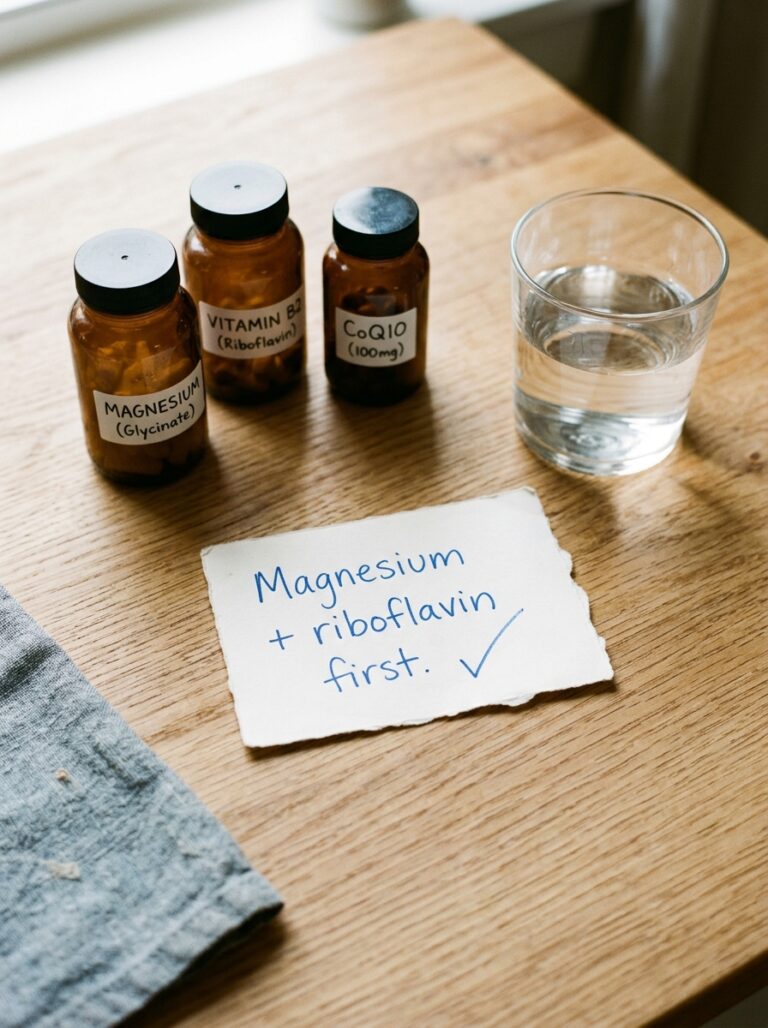
If you're searching for the best supplements for migraines, you've probably seen the same dozen names recycled across every list, ranked by how they sell rather than how they test. The honest version is shorter: the American Academy of Neurology and American Headache Society reviewed this evidence and put magnesium and riboflavin at the top, well ahead of the trendier picks. The three I'd actually keep in my own family's cabinet are at the bottom of this article, and they're the boring, well-graded ones.
Affiliate disclosure: this article contains affiliate links. As an Amazon Associate, UsefulVitamins.com earns from qualifying purchases at no extra cost to you.
Before you decide
Supplements are a layer on top of migraine care, not a substitute for it. If your attacks are frequent or disabling, the first conversation is with a clinician about acute treatment and, where warranted, prescription preventives such as topiramate, propranolol, or a CGRP-targeted drug.
A sudden "worst headache of my life," a headache with fever and a stiff neck, new neurological deficits, or a clear change in your usual pattern are red flags, not supplement problems. Those need urgent assessment, full stop.
If your migraines are mild to moderate and you'd rather start conservatively, the supplement route is reasonable, but it works at the margin of a healthy baseline. Sleep regularity, hydration, caffeine consistency, and identifying triggers do more than most capsules.
A few people should clear supplements with a clinician first: anyone pregnant or trying to conceive, anyone with kidney disease (magnesium clears renally), and anyone on multiple medications. You can see how I weigh evidence grades and conflicts of interest on the how we review supplements page.
What migraine actually is

Migraine is a neurological disorder, not just a bad headache. It involves waves of cortical excitability, activation of the trigeminovascular pathway, and release of inflammatory peptides including CGRP, which is why the newest prescription drugs target that peptide directly.
The hallmark attack is moderate-to-severe, often one-sided, throbbing pain lasting 4 to 72 hours, usually with nausea and sensitivity to light or sound. About a quarter of people get an aura, a reversible visual or sensory warning, before the pain.
Severity ranges widely. Some people get a few attacks a year; others meet criteria for chronic migraine, defined as 15 or more headache days a month. That spread matters because the supplement evidence below was generated mostly in episodic migraine, not chronic.
The thread running through the supplements that work is mitochondrial energy metabolism. Magnesium, riboflavin, and CoQ10 all touch the brain's energy supply, and the leading theory is that migraine-prone neurons run an energy deficit between attacks. That shared mechanism is why these three keep showing up in the trial literature while flashier compounds don't.
Strongest evidence supplements
These three are the ones the guideline bodies actually grade, and they're where I'd start. The AAN/AHS evidence-based update rated magnesium and riboflavin as Level B, "probably effective." CoQ10 sits just behind them on trial strength.
| Supplement | Guideline / evidence | Trial-tested dose | Responder benefit |
|---|---|---|---|
| Magnesium | AAN/AHS Level B (probably effective) | ~600 mg elemental/day | 41.6% vs 15.8% drop in attack frequency |
| Riboflavin (B2) | AAN/AHS Level B (probably effective) | 400 mg/day, single dose | 59% vs 15% responders, NNT 2.3 |
| CoQ10 | RCT-supported; Level C in update | 300 mg/day (3 × 100 mg) | 47.6% vs 14.4% responders, NNT 3 |
Magnesium
Magnesium stabilizes neuronal excitability and blocks the NMDA receptor, the same channel implicated in cortical spreading depression that's thought to start an aura. Migraine-prone people also tend to run lower brain and serum magnesium between attacks.
The anchor trial randomized 81 patients to 600 mg of trimagnesium dicitrate daily or placebo for 12 weeks. In weeks 9 to 12, attack frequency fell 41.6% on magnesium versus 15.8% on placebo. That's a real but modest effect, and it builds over a couple of months rather than overnight.
Dose used in trials: around 600 mg of elemental magnesium daily. Glycinate and citrate are better tolerated and absorbed than oxide, which is mostly a laxative.
Skip or adjust if: you have kidney disease (magnesium clears through the kidneys and can accumulate), or if loose stools become limiting, in which case split the dose or switch the form. I cover form selection in detail in best magnesium for migraines and the broader picture in the complete guide to magnesium.
Riboflavin (vitamin B2)
Riboflavin is a precursor to the flavin cofactors your mitochondria need to make ATP. Feeding that pathway is the proposed fix for the inter-attack energy deficit, and it's a clean, low-risk mechanism.
The defining RCT gave 55 patients 400 mg of riboflavin or placebo for three months. The proportion improving by at least 50% was 59% on riboflavin versus 15% on placebo, for a number-needed-to-treat of 2.3. That NNT is genuinely strong for a nutraceutical, which is why riboflavin earns its Level B alongside magnesium.
Dose used in trials: 400 mg once daily. It's water-soluble and forgiving; the main visible effect is bright yellow urine.
Skip if: there's no hard contraindication for most adults, but as with all of these, run it past your clinician if you're pregnant or on a complex regimen. The benefit typically takes one to three months to show, so don't judge it at two weeks.
CoQ10
Coenzyme Q10 shuttles electrons in the mitochondrial respiratory chain, the third lever on the same energy pathway as magnesium and riboflavin. Lower CoQ10 levels have been linked to more frequent attacks, particularly in children and adolescents.
A double-blind RCT gave 42 patients 100 mg three times daily or placebo. By the third month, the 50%-responder rate was 47.6% on CoQ10 versus 14.4% on placebo, a number-needed-to-treat of 3. The AAN/AHS update placed CoQ10 a notch below magnesium and riboflavin on certainty, but the signal is consistent.
Dose used in trials: 300 mg daily, split into three doses with food, since it's fat-soluble. Ubiquinol is marketed as more bioavailable, though the trial evidence used plain ubiquinone.
Skip or adjust if: CoQ10 can mildly lower blood pressure and may interact with warfarin, so flag it if you're anticoagulated. Form and dosing are covered in best CoQ10 supplements.
Moderate evidence

These have a real mechanism and some positive trials, but the certainty drops, the safety picture is more complicated, or both.
Feverfew has mixed evidence. A Cochrane review of six trials in 561 people found the results heterogeneous, and the updated analysis suggested feverfew cut attacks by a little over half a migraine per month, a small effect from a single moderate trial. The AAN/AHS update rated it Level B, but the underlying data are shakier than that grade implies. If you try it, use a standardized parthenolide extract and give it two to three months.
Melatonin is the most interesting of the moderates. A three-arm RCT compared melatonin 3 mg, amitriptyline 25 mg, and placebo in 196 people: melatonin cut headache days by 2.7 versus 1.1 for placebo, and it matched amitriptyline on efficacy while beating it on tolerability and weight. It's cheap and low-risk, which makes it a reasonable add-on, especially if poor sleep is part of your pattern. Take it 30 to 60 minutes before bed.
Butterbur is the cautionary tale. The 2012 AAN/AHS guideline actually rated it Level A, the highest grade, but that guideline was later retired largely because of liver-safety concerns. Raw butterbur contains pyrrolizidine alkaloids that are hepatotoxic; only PA-free standardized extracts are arguably safe, and cases of liver injury have still been reported in the NIH LiverTox monograph on butterbur. I do not recommend it as a first move, and if anyone uses it, it must be a verified PA-free product with liver monitoring.
Popular but evidence-thin
Vitamin D, fish oil, ginger, and "migraine-formula" multi-blends dominate supplement marketing for headache, but none has guideline-level support for prevention. Vitamin D correction makes sense if you're deficient on a lab test, not as a blanket migraine pill.
Ginger has small data for treating an acute attack's nausea, not for preventing migraine. The proprietary multi-ingredient blends are the worst value: they bury a possibly useful dose of magnesium or riboflavin among a dozen unproven extras at sub-therapeutic amounts, so you pay more for less of what actually works.
What to look for when buying
Match the dose to what the trials used, not to what the label rounds to. That means roughly 600 mg elemental magnesium (check "elemental," not compound weight), 400 mg riboflavin, and 300 mg CoQ10.
Favor third-party verified products, USP Verified, NSF Certified, or ConsumerLab Approved, since supplements aren't pre-market tested for content. Choose magnesium glycinate or citrate over oxide for absorption and gut comfort.
Avoid proprietary blends that don't list per-ingredient milligrams, and skip butterbur unless it's explicitly PA-free with a certificate of analysis. A single-ingredient bottle you can dose precisely beats a kitchen-sink formula almost every time.
When to see a doctor
See a clinician promptly, not a supplement aisle, for any of these: a thunderclap or "worst-ever" headache, headache with fever and neck stiffness, new weakness, numbness, vision loss, or confusion, headache after head trauma, or a headache pattern that suddenly changes.
If you're using acute migraine medication more than about two days a week, you may be heading into medication-overuse headache, which no supplement will fix. And if your attacks stay frequent or disabling despite a fair trial of these, that's the signal to discuss prescription preventives. Supplements are the adjunct; standard care is the foundation.
FAQ
What is the single best supplement for migraines?
Magnesium is the most defensible starting point: it's Level B in the AAN/AHS guideline, cheap, and broadly safe at around 600 mg elemental daily. Riboflavin is its equal partner and easy to add.
How long until migraine supplements work?
Plan on one to three months. The magnesium, riboflavin, and CoQ10 trials all measured benefit at the second or third month, so a two-week trial tells you nothing. Track headache days in a diary so you can judge honestly.
Can I take magnesium, riboflavin, and CoQ10 together?
Generally yes for healthy adults, and they hit the same energy pathway from different angles. Start one at a time so you can attribute side effects, watch for loose stools from magnesium, and clear it with your clinician if you take other medications.
Is butterbur safe for migraines?
Only a verified PA-free extract is arguably safe, and even then liver injury has been reported. The guideline that once rated it highly was retired over safety, so I don't recommend it as a first choice.
Do supplements replace migraine medication?
No. They're adjuncts that work at the margin of standard care. For frequent or disabling migraine, prescription preventives have far stronger evidence, and acute treatment still matters.
The bottom line on supplements for migraine
If you strip away the marketing, the migraine-supplement field comes down to a short, well-graded list. Magnesium and riboflavin are the AAN/AHS Level B picks, CoQ10 is a reasonable third, and everything else is either moderate-with-caveats or popular-but-thin. The effect sizes are real but modest, with numbers-needed-to-treat around 2 to 3 for the best of them.
Treat these as a layer on top of good sleep, hydration, trigger management, and, when needed, prescription care, not as a replacement for any of it. Start with magnesium, add riboflavin, give each a full one-to-three-month trial, and keep a headache diary so you're judging data, not hope.
The three at the bottom are the guideline-graded options I'd keep in my own family's cabinet, for exactly that reason.
Reviewed by Michael Ward, MD MPH, Preventive Medicine, focused on guideline-based chronic disease management. See more from Michael Ward. This article is educational and is not a substitute for individualized medical advice; talk to your doctor before starting a supplement, especially if you are pregnant, have kidney disease, take other medications, or have a headache pattern that has recently changed.
Recommended Products


As an Amazon Associate, UsefulVitamins.com earns from qualifying purchases at no extra cost to you. We only recommend products supported by published research or third-party testing.
