
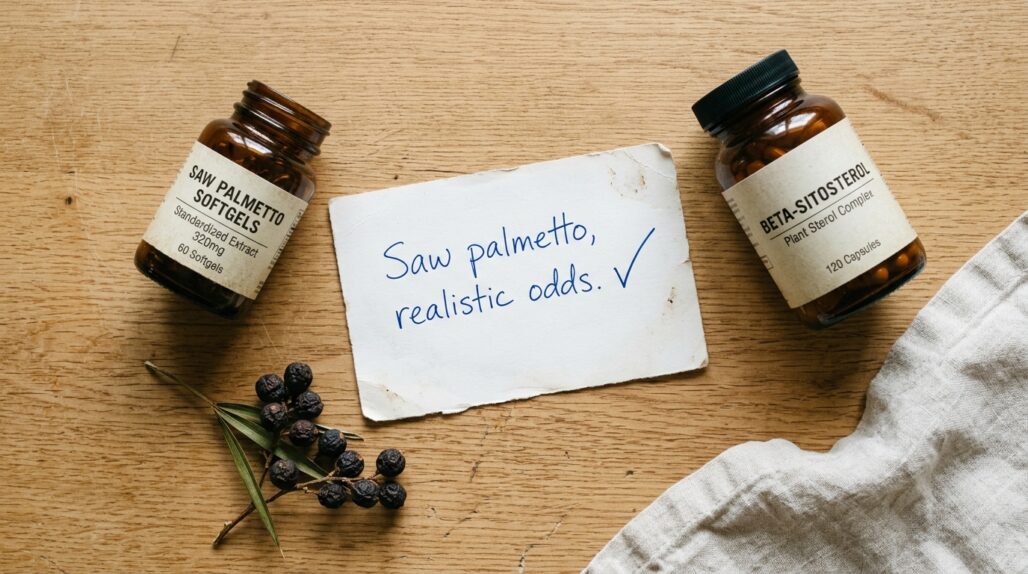
If you're searching for the best supplements for prostate health, you're most likely a man over 50 noticing a weaker stream, more nighttime trips to the bathroom, or a doctor's offhand comment about your prostate. The honest answer is that one or two botanicals have a defensible track record for urinary symptoms, the most famous one performed no better than placebo in its best trial, and nothing on the shelf prevents prostate cancer. The picks at the end are the ones I'd actually keep in my own family's cabinet for a father navigating this, but only after the conversation below.
Affiliate disclosure: this article contains affiliate links. As an Amazon Associate, UsefulVitamins.com earns from qualifying purchases at no extra cost to you.
Before you decide
Do not reach for a supplement to "fix" a urinary symptom you haven't had checked. A weak stream, frequency, urgency, or dribbling in a man over 50 is usually benign prostatic enlargement, but those same symptoms can mask infection, a stricture, or, rarely, cancer.
The first move is a clinician visit and a conversation about PSA testing, not a bottle. Screening is a shared decision, but it has to happen before you start masking symptoms with a botanical that lowers nothing on a blood test except, in some cases, the very marker your doctor is watching.
Skip supplements entirely if you have acute urinary retention, blood in the urine, fever with back pain, or a PSA your doctor has flagged. Those are clinic problems, not cabinet problems.
If you take a blood thinner, have liver disease, or are on a 5-alpha-reductase inhibitor like finasteride, clear any new supplement with your pharmacist first. You can see how I weigh evidence and conflicts of interest on the how we review supplements page.
What prostate issues actually are
The prostate sits below the bladder and wraps around the urethra, so anything that enlarges or inflames it shows up as a plumbing complaint. Three different problems get lumped together under "prostate health," and they need different answers.
The most common is benign prostatic hyperplasia (BPH), a non-cancerous enlargement driven partly by dihydrotestosterone (DHT) acting on prostate tissue over decades. It produces the classic lower urinary tract symptoms: weak stream, hesitancy, frequency, and nocturia. Conventional first-line care is an alpha-blocker (tamsulosin) or a 5-alpha-reductase inhibitor (finasteride), prescribed by a physician.
Prostatitis is inflammation, sometimes from infection, that causes pelvic pain and urinary urgency, often in younger men. It can need antibiotics, so it is firmly a doctor's diagnosis, not a self-treatment target.
Prostate cancer is a separate entity that frequently causes no early symptoms at all, which is exactly why it is detected through PSA testing and exam, not through how you feel. No supplement in this article treats, prevents, or screens for it. If you are worried about cancer, the relevant tool is a urologist and a blood draw, full stop, a point NCCIH echoes in its review of integrative approaches to prostate enlargement.
The supplements that follow are aimed only at the urinary symptoms of BPH, and even there, they are adjuncts to standard care, not replacements for it.
Strongest evidence supplements
These three botanicals have the most human trial data behind them for BPH urinary symptoms. None is a slam dunk, and I'll flag honestly where the best-quality trials disagree with the marketing.
Beta-sitosterol
Why it helps: Beta-sitosterol is a plant sterol structurally similar to cholesterol. Mechanistically, it appears to modulate inflammatory prostaglandin signaling and 5-lipoxygenase activity in prostate tissue rather than shrinking the gland, which is why it eases symptoms without changing prostate size much.
What the trials show: This is the entry with the cleanest symptom data. A Cochrane systematic review of randomized, placebo-controlled trials concluded that non-glucosidic beta-sitosterol improves urinary symptom scores and peak urine flow versus placebo. The landmark German BPH-Phyto double-blind RCT found a roughly 5-point drop in the modified Boyarsky symptom score and improved flow over six months. What it does not do is prevent BPH complications or shrink the prostate, and long-term safety data are thin.
Dose used in trials: Around 60 to 130 mg/day of free (non-glucosidic) beta-sitosterol, the form used in the positive trials.
Form to look for: A standardized free beta-sitosterol or mixed phytosterol extract, not a glucoside-heavy version.
Skip if: You have the rare genetic condition sitosterolemia, or you're relying on it to lower a flagged PSA, which it won't.
Saw palmetto
Why it helps: Saw palmetto (Serenoa repens) berry extract is the most marketed prostate botanical. The proposed mechanism is mild inhibition of 5-alpha-reductase and anti-inflammatory effects in prostate tissue, which is plausible and is why early small trials looked promising.
What the trials show: Here is where I part ways with most roundups that list saw palmetto uncritically. The large, NIH-funded CAMUS trial randomized 369 men and escalated the dose to as high as 960 mg/day, three times the standard 320 mg, over 72 weeks. Saw palmetto did not beat placebo, with the symptom-score result actually favoring placebo by 0.79 points. Earlier reviews were more favorable, but they pooled lower-quality trials; the better the trial design, the smaller the effect. Some men still report relief, which may be real responder variability or placebo, so the honest framing is realistic odds, not a reliable fix.
Dose used in trials: 320 mg/day of a liposterolic (lipidosterolic) extract standardized to 85 to 95 percent fatty acids, taken as one dose or split.
Form to look for: A standardized liposterolic extract, since the CAMUS-style preparations and the older positive trials both used this. Cheap dried-berry powder is not the same intervention.
Skip if: You take a blood thinner (rare bleeding reports) or you expect a guaranteed result. It can also mildly affect PSA, so tell your doctor you're taking it.
Pygeum africanum
Why it helps: Pygeum, the bark extract of the African cherry tree, contains phytosterols and other lipophilic compounds with anti-inflammatory and antiproliferative activity in prostate tissue. It has a long Western herbalist and European pharmacy history for "old man's bladder."
What the trials show: A Cochrane review of 18 randomized trials in 1,562 men found that standardized pygeum modestly improved urinary symptoms, nocturia, and peak flow versus placebo. The catch the review states plainly: the studies were small, short, used inconsistent doses, and rarely used validated symptom scales, so the effect is real but the certainty is low.
Dose used in trials: 100 to 200 mg/day of a standardized bark extract, often split into two doses.
Form to look for: A standardized Pygeum africanum (or Prunus africana) bark extract; sustainability-certified sourcing is a plus given the tree's protected status.
Skip if: You want robust long-term outcome data, which doesn't exist yet, or you have GI sensitivity, since mild nausea and diarrhea are the common complaints.
A note on traditional versus trial dosing: Western herbalists historically used whole-berry saw palmetto decoctions and crude pygeum bark, which are not the same as the standardized milligram-precise extracts the RCTs tested. When you buy, you want the trial-tested extract, not the romantic whole-plant version.
Moderate or mixed evidence

These have a real mechanism and some signal, but the human data are thinner or conflicting. Worth considering with eyes open, not as a first pick.
Stinging nettle root
Worth considering if you want to layer it, with caveats. Nettle root (Urtica dioica) is thought to bind sex-hormone-binding globulin and dampen prostate-cell proliferation. Several small European RCTs, often combining it with saw palmetto, report modest symptom improvement, but the standalone evidence is limited and the combination trials make it hard to credit nettle alone. Typical dose is 300 to 600 mg/day of root extract. Reasonable as an add-on, weak as a sole therapy.
Pumpkin seed oil
Mixed evidence, but the mechanism is plausible. Pumpkin seed (Cucurbita pepo) oil is rich in phytosterols and zinc, and a few trials, mostly from one research group, suggest mild symptom relief in BPH at around 500 mg to 1,000 mg/day of oil or extract. The signal is small, the trials are not large or independent, and food-level pumpkin seeds won't deliver the studied dose. A gentle, low-risk option if you've covered the stronger picks, not a substitute for them.
Popular but evidence-thin
Lycopene is heavily marketed for the prostate, usually on the strength of observational tomato-intake data. When it's actually tested, the story collapses: a systematic review of randomized trials found no significant reduction in BPH incidence and no significant reduction in prostate cancer diagnosis with lycopene supplements, though PSA may dip in men already diagnosed. If you want lycopene, eat cooked tomatoes for the broader diet benefit; don't buy it as a prostate insurance policy.
Zinc is the other perennial. The intuition is that the prostate concentrates zinc, so more must be protective. A meta-analysis of 17 studies and over 111,000 men found no association between zinc intake and prostate cancer risk, and high-dose zinc has its own downsides (copper depletion). Cover a normal intake through diet; for the broader case on dosing, see best zinc supplements. It is not a prostate therapy.
What to look for when buying
Match the label to the trial, not to the marketing. The single most important detail is standardization to the form and percentage used in the positive studies.
| Supplement | Look for this on the label | Trial-matched dose |
|---|---|---|
| Beta-sitosterol | Free (non-glucosidic) beta-sitosterol or phytosterol complex | 60 to 130 mg/day |
| Saw palmetto | Liposterolic extract, 85 to 95% fatty acids (not dried berry) | 320 mg/day |
| Pygeum | Standardized bark extract, sustainable sourcing | 100 to 200 mg/day |
Beyond standardization, insist on third-party testing (USP Verified, NSF, or ConsumerLab) because botanical extracts are a common adulteration target. Avoid "proprietary prostate blends" that list a dozen ingredients with no per-ingredient milligrams, since you can't match any of them to a trial. And ignore any product promising to "shrink your prostate" or "protect against cancer," which is a compliance red flag, not a benefit.
When to see a urologist
Supplements are for mild, stable symptoms. Some signs mean you stop self-treating and get evaluated. If your father is severe enough to be waking three or more times a night or planning his day around bathrooms, the conversation is conventional treatment first, botanical support second.
See a clinician promptly for inability to urinate (acute retention), blood in the urine or semen, fever with pelvic or low-back pain, unexplained weight loss, or new bone pain. Those are urgent, not cabinet-level.
And book the screening conversation regardless of symptoms: a rising or elevated PSA, a nodule on exam, or a strong family history of prostate cancer all warrant a urologist, because, again, no supplement here detects or treats cancer. Masking urinary symptoms can delay a diagnosis that depends on noticing change early.
FAQ
Does saw palmetto really work for an enlarged prostate?
Sometimes, modestly, but the best trial says no. The high-quality CAMUS trial found saw palmetto no better than placebo even at triple the standard dose. Earlier, weaker studies were more positive. Treat it as realistic odds, not a guarantee.
Which is better, saw palmetto or beta-sitosterol?
For symptom-score evidence, beta-sitosterol has the cleaner data, with a Cochrane review supporting improved symptoms and flow. Saw palmetto is more famous but performed worse in its best trial. Neither shrinks the prostate.
Can supplements lower my PSA or prevent prostate cancer?
No. Lycopene and zinc show no proven prevention benefit, and some prostate supplements can artificially nudge PSA, which matters because vitamin E supplementation actually raised prostate cancer risk in the large SELECT trial. Screening belongs to your doctor.
Are these safe to take with finasteride or tamsulosin?
Often, but clear it with your prescriber or pharmacist first, especially saw palmetto if you're on a blood thinner. Adjunct, not replacement is the rule, and you don't want to mask a symptom your doctor is tracking.
Could low testosterone be part of this?
Possibly for libido and energy, but not for urinary flow, which is a prostate-size issue. If hormones are your concern, that's a different workup, covered in best supplements for testosterone.
The bottom line on prostate supplements
If you want one realistic takeaway, it's this: for mild BPH urinary symptoms, beta-sitosterol at a trial-matched dose has the most credible evidence, pygeum is a reasonable second, and saw palmetto is the famous name with honest-but-modest odds after its best trial tied placebo. Lycopene and zinc are diet topics, not prostate therapies, and nothing here touches cancer.
Whatever you try, the effect size is symptom relief on the order of a few points, not a cure, and it sits alongside standard care rather than replacing it.
Next steps:
- Book the PSA and symptom conversation with a clinician before starting anything.
- Choose a standardized, third-party-tested beta-sitosterol or saw palmetto extract matched to the trial dose.
- Review my full evaluation method on the how we review supplements page, and see more from Jonathan Reynolds.
Reviewed by Jonathan Reynolds, ND, focused on botanical and naturopathic protocols. This article is educational and is not a substitute for individualized medical advice. Talk to your doctor or a urologist about urinary symptoms and PSA screening before starting a supplement, especially if you take prescription medication or have a flagged PSA.
Recommended Products


As an Amazon Associate, UsefulVitamins.com earns from qualifying purchases at no extra cost to you. We only recommend products supported by published research or third-party testing.
