
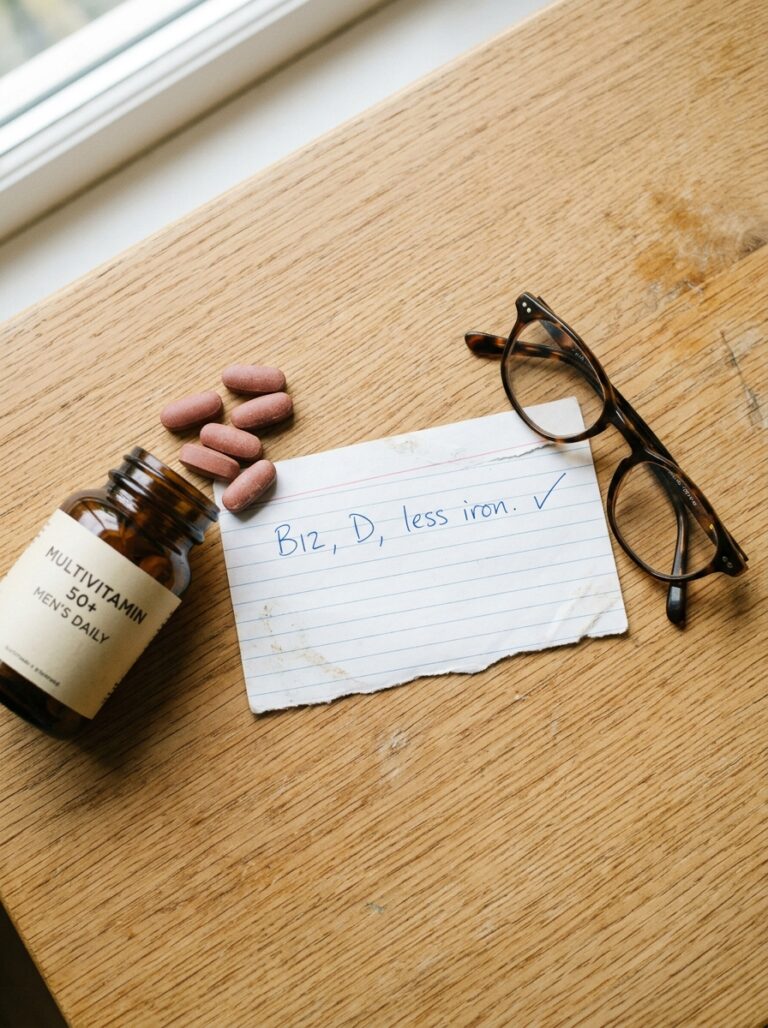
If you're shopping for the best multivitamin for men over 50, the marketing wants you to focus on the words "50+," "silver," or "men's vitality." The label is mostly noise; what actually changes after 50 is narrow and specific, and it comes down to three nutrients. A standard daily multivitamin is a hedge against a thin day's eating, not a treatment, and for an over-50 man the only meaningful tweaks are more usable B12, enough vitamin D, and less iron, not more.
I'll walk through what shifts physiologically after 50, what the trial evidence on multivitamins in older adults actually shows, and how to read a label so you're paying for the right things. The picks at the bottom are the iron-free and low-iron formulas I'd keep in my own father's cabinet.
Affiliate disclosure: this article contains affiliate links. As an Amazon Associate, UsefulVitamins.com earns from qualifying purchases at no extra cost to you.
Before you decide

A multivitamin is a floor, not a fix, and it does not replace the things that actually move the needle after 50. Blood pressure control, a colonoscopy on schedule, lipid management, strength training, and not smoking do far more for a man's next 20 years than any capsule. If you're skipping the standard preventive care, the supplement conversation is premature.
A multivitamin also is not a diagnostic. Persistent fatigue, numbness or tingling, unexplained weight change, or "brain fog" are reasons to see a clinician, not reasons to buy a stronger "men's energy" formula. Real B12 deficiency, low testosterone, thyroid disease, and anemia all need a blood test, not a guess off a shelf.
One specific caution for this age group: do not start a daily iron-containing supplement without a documented reason. A man with hereditary hemochromatosis or unrecognized iron loading can be quietly harmed by routine iron, and a "men's 50+" formula that contains iron is the wrong default. You can read how I weigh evidence and conflicts of interest on the how we review supplements page.
What changes after 50

The first real shift is vitamin B12 absorption, which falls with age even when intake stays the same. Stomach acid and intrinsic factor decline, and a sizeable share of older adults develop atrophic gastritis, which impairs the release of B12 bound to food protein.
This is why the NIH Office of Dietary Supplements advises adults over 50 to get most of their B12 from supplements or fortified foods, where it sits in a free, crystalline form that does not depend on stomach acid to be absorbed. A clinical review of cobalamin deficiency in the elderly attributes most cases to this food-bound malabsorption rather than to a poor diet.
The mechanism is worth understanding because it explains why a steak does not fix it. B12 in food arrives bound to protein, and it takes stomach acid plus the enzyme pepsin to cleave it loose before intrinsic factor can carry it across the gut wall. When acid production falls, that first step stalls, and the B12 you ate passes through undigested even though your diet looks fine on paper.
Atrophic gastritis is the common driver here, and it is more prevalent than most men realize. The American Academy of Family Physicians review of B12 deficiency notes that food-bound malabsorption rises sharply with age and recommends that adults over 50 lean on fortified foods or supplements rather than relying on dietary B12 alone. Crucially, this is not classic pernicious anemia; intrinsic factor can be normal, yet the acid step still fails. That distinction matters because the synthetic B12 in a multivitamin sidesteps the broken step entirely.
Two common medications make it worse. Proton pump inhibitors for reflux and metformin for type 2 diabetes both lower B12 over time, and the effect compounds with age. The same AAFP review puts numbers on it: it suggests screening B12 in anyone on a PPI or H2 blocker for more than 12 months, or on metformin for more than four months, because the deficiency risk climbs with both dose and duration.
Metformin is the sharper concern in this age group because so many men over 50 take it for years. It interferes with B12 uptake in the lower small intestine, and the effect accumulates roughly with each gram-year of exposure, which is why a man who has been on it for a decade can drift into deficiency despite a normal diet. In the REGARDS analysis of older metformin users, multivitamin use was associated with higher serum B12, which is one of the few clean wins for a multivitamin in this group. To be clear, a multivitamin is a hedge, not a substitute for the periodic blood test these medications warrant.
The second shift is vitamin D, because aging skin makes far less of it from sunlight. Cutaneous vitamin D production drops roughly 13% per decade, so a 70-year-old synthesizes about half what he did at 20 from the same sun exposure, on top of generally spending less time outdoors.
It is not only the skin. The kidney's ability to convert vitamin D into its active hormone form also declines with age, and time spent indoors, sunscreen, and covering up at the beach all compound the deficit. The result is that older men are the group most likely to run low even in sunny climates, which is why the recommendation moves with age rather than staying flat. The official RDA actually steps up from 600 IU in midlife to 800 IU (20 mcg) once a man passes 70, a rare instance where the "50+" framing tracks a real physiological change rather than marketing. The point of the multivitamin's dose is to cover that baseline, not to treat a low blood level, which is a separate decision your doctor makes from a 25-hydroxyvitamin D test.
The third shift runs the other direction: iron need goes down, not up. Men never had a monthly route to shed iron, and after midlife the risk skews toward accumulation rather than deficiency, which is why a man's iron requirement is unchanged at a modest level and a "50+" formula should reflect that, not pile it on.
The body has no active mechanism to excrete excess iron; it regulates intake and otherwise stores what it absorbs. In a man without monthly losses, decades of even modest over-supply can quietly build up in the liver, heart, and pancreas, and the StatPearls review of iron overload notes that symptomatic disease is more common in men precisely because premenopausal women bleed off the surplus each month. The same review lists the downstream damage of an overloaded state, including cirrhosis, cardiomyopathy, and the diabetes sometimes called "bronze diabetes," driven by iron-generated oxidative stress in those organs.
This matters most for the man who carries a hemochromatosis gene without knowing it, which is more common than most people assume in those of Northern European descent. For him, a daily iron-containing "men's 50+" pill is pouring fuel on a slow fire, and the formula that should have been a harmless hedge becomes a small daily contribution to an avoidable problem. There is no upside to routine iron for a healthy older man and a real, if uncommon, downside, which is why iron-free is the correct default and supplemental iron belongs in the hands of a clinician treating a documented deficiency.
What the evidence shows
Here is the honest version, because the multivitamin literature is more modest than the ads imply. For a healthy, well-fed man, a daily multivitamin has never been shown to prevent heart disease, cancer, or death. It is insurance against gaps, and that is the right expectation to set.
The most interesting recent signal is cognitive. The COSMOS-Mind randomized trial gave roughly 2,200 adults aged 65 and older a daily multivitamin-mineral or placebo for three years and found the multivitamin group showed a statistically significant benefit on a global cognition composite, with the effect concentrated in episodic memory and executive function.
It helps to know the actual size of that win rather than the headline. The benefit on the global cognition z-score was about 0.07 over three years, which the investigators translated to roughly two years of slowed cognitive aging compared with placebo. That is a meaningful population-level signal, but it is a gentle nudge to the slope of decline, not a reversal, and it was an average across the whole group rather than something a given man will feel.
That finding was reinforced by a meta-analysis of three cognitive studies within COSMOS, which pooled the data and again favored the multivitamin. The effect is real but small, on the order of a modest slowing of age-related cognitive change, not a cure or a guarantee. It is a reason a multivitamin is a defensible low-cost hedge for an older adult, not a reason to expect a transformation. One honest caveat: the participants chose to enroll in a supplement trial and skewed health-conscious, so whether the same edge holds for a man with a genuinely poor diet, or one who is already replete, is still an open question.
On the bone side, the USPSTF gives vitamin D and calcium an "I" rating for fracture prevention in men, meaning the evidence is insufficient to recommend it routinely, and it explicitly recommends against vitamin D to prevent falls in community-dwelling older adults. That is the screening evidence base; it does not override correcting a documented deficiency, which is a different clinical situation your doctor manages with a blood level.
What to look for when buying

Ignore the front of the bottle and read the Supplement Facts panel. Four things separate a sensible over-50 multivitamin from a marketing one: the B12 form, the vitamin D dose, the iron content, and third-party testing. Everything else is largely interchangeable.
For B12, the form matters more than a huge number. You want crystalline cyanocobalamin or methylcobalamin, which absorb without stomach acid; the dose can be modest because the body caps how much it takes up per serving, so 25 mcg is plenty and 1,000 mcg is not a meaningful upgrade for most people.
For vitamin D, 600 to 800 IU (15 to 20 mcg) covers the daily baseline for this age group. Higher doses are common in "50+" products and are not harmful at typical multivitamin levels, but chasing a high blood level should be driven by a test and a clinician, not by the label.
The iron rule is the one most "men's 50+" buyers get wrong. Pick iron-free or low-iron unless a clinician has documented deficiency, because, per the NIH iron fact sheet and a review of iron overload, adult men generally meet their needs through diet and the penetrance of iron-overload disorders like hemochromatosis is far higher in men. Most reputable "men's" and "50+" formulas are already iron-free for exactly this reason.
| Label feature | What to look for | Why it matters after 50 |
|---|---|---|
| Vitamin B12 form | Crystalline cyanocobalamin or methylcobalamin, ~2.4 to 25 mcg | Absorbs without stomach acid as age, PPIs, and metformin blunt food-bound uptake |
| Vitamin D | 600 to 800 IU (15 to 20 mcg) | Skin synthesis drops ~13% per decade; baseline coverage, not megadoses |
| Iron | Iron-free or low-iron (0 mg ideal) | Men have no monthly iron loss; accumulation, not deficiency, is the over-50 risk |
| Third-party testing | USP, NSF, or ConsumerLab seal | Independent check that the label matches the bottle |
| “50+” / “men’s vitality” claims | Treat as marketing; verify the four rows above | The age label alone tells you nothing about B12 form or iron |
If you want the full framework on what a multivitamin can and can't do, I keep a deeper complete guide to multivitamins, and a general best multivitamin for men breakdown for younger men where the iron and B12 calculus is different.
Recommended Products


As an Amazon Associate, UsefulVitamins.com earns from qualifying purchases at no extra cost to you. We only recommend products supported by published research or third-party testing.
FAQ
Do men over 50 actually need a special "50+" multivitamin?
Not the label specifically. What you want is the formula behind it: absorbable B12, adequate vitamin D, and little or no iron. A regular adult men's multivitamin that already meets those three is fine; the "50+" badge is not a requirement.
Is more B12 better in an over-50 formula?
No. The body absorbs only a small fraction of a large oral dose, so 25 mcg of crystalline B12 does the job for most people, and a 1,000 mcg headline number is not a meaningful upgrade unless a clinician is treating a diagnosed deficiency.
Should a man over 50 take iron?
Usually not. Routine iron is the wrong default for men because they have no monthly iron loss and face a higher risk of iron overload. Take iron only if a blood test and your doctor confirm deficiency, and choose an iron-free multivitamin otherwise.
I take metformin. Does that change what multivitamin I should buy?
It raises the stakes on B12. Long-term metformin use lowers B12 over years, so you specifically want a formula with crystalline B12 and you should not treat the pill as a substitute for testing. The AAFP guidance suggests checking a B12 level after about four months on metformin and periodically thereafter; the multivitamin helps cover the gap but the blood test is what catches a real problem.
Should I worry about iron overload if I do not have any symptoms?
For most men, no, but you should not add iron without a reason. Hereditary hemochromatosis is often silent for decades and is more commonly symptomatic in men, so the safe move is simply to choose an iron-free multivitamin rather than to seek out testing on your own. If you have a family history of the condition, liver disease, or unexplained joint pain and fatigue, ask your doctor about iron studies.
Will a multivitamin protect my memory?
The COSMOS-Mind trial found a small, statistically significant cognitive benefit in older adults, equivalent to roughly two years of slowed cognitive aging over three years, which is encouraging. But the effect is modest, and a multivitamin is a low-cost hedge, not a treatment for or prevention of dementia.
How much vitamin D should be in it?
600 to 800 IU (15 to 20 mcg) covers the daily baseline for this age group. If you're worried about your level, ask for a blood test rather than guessing, since the right dose for a documented deficiency is a clinical decision.
The bottom line on men's 50+ multivitamins
A multivitamin is a reasonable, cheap hedge for a man over 50, but it is the smallest lever in the room. Read the Supplement Facts panel, not the front label: you want crystalline B12, 600 to 800 IU of vitamin D, no iron unless prescribed, and a third-party seal. Get those four right and the brand barely matters.
Everything else, the "vitality" and "men's energy" framing, is marketing on top of a fairly standard formula. If you have real symptoms, see a clinician and get a blood test rather than reaching for a stronger pill, and treat the multivitamin as what it is: a backstop for the gaps in an imperfect diet, layered on top of the preventive care that actually drives your next 20 years.
Reviewed by Michael Ward, MD MPH, Preventive Medicine, focused on guideline-based chronic disease management. See more from Michael Ward. This article is educational and is not a substitute for individualized medical advice; talk to your doctor before starting or stopping a supplement, especially if you take metformin or a proton pump inhibitor, have a diagnosed condition, or have a family history of hemochromatosis.
