
Before you decide
This article is general information, not medical advice, and it is not a substitute for the clinician who knows your labs and your history. Nothing here is a reason to start, stop, or change a prescription on your own.
If you are on a statin and tempted to add red yeast rice, or already taking both, the safe move is the same: do not adjust either product yourself, and talk to your prescriber or pharmacist first. Stopping a statin abruptly can be as risky as the interaction itself.
Some people need to be especially careful here. That includes anyone on a strong CYP3A4-inhibiting drug, anyone with liver disease, kidney disease, or a thyroid disorder, anyone over 65, and anyone who has had muscle problems on a statin before.
Call your doctor or pharmacist promptly if you develop unexplained muscle pain, tenderness, or weakness, brown or tea-colored urine, unusual fatigue, or yellowing of the skin or eyes. Those are the warning signs of the muscle and liver injury this combination can cause.
What the interaction actually is
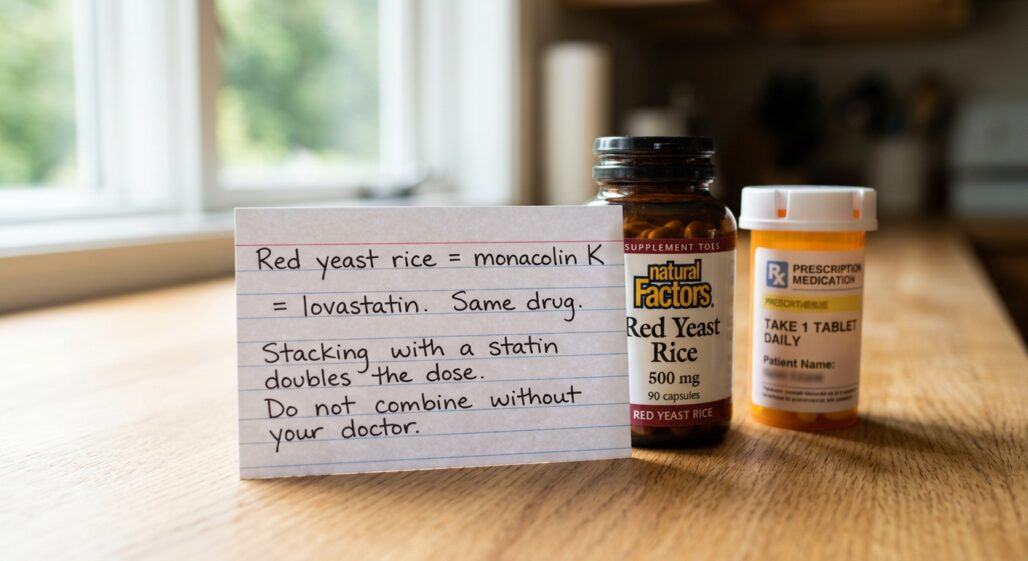
Here is the part most marketing leaves out. Red yeast rice is rice fermented with the mold Monascus purpureus, and during fermentation it produces a family of compounds called monacolins. The most active one, monacolin K, is not statin-like. According to the NIH National Center for Complementary and Integrative Health, monacolin K is structurally identical to the prescription drug lovastatin.
That is the whole problem in one sentence. A "natural" supplement and a pharmaceutical statin can be the exact same molecule.
Mechanistically, both monacolin K and lovastatin are absorbed as an inactive lactone, then converted in the body to a hydroxy acid that inhibits HMG-CoA reductase, the rate-limiting enzyme in cholesterol synthesis. The 2018 EFSA scientific opinion on monacolins spells out this identical pathway in detail. So when you swallow red yeast rice on top of a statin, you are not adding a gentle herbal helper, you are taking a second dose of the same class of drug.
Think of it like topping up a full glass of wine with what you think is grape juice, when it is actually more wine. The label changed; the contents did not. The result is a higher effective statin dose than your doctor prescribed, and a higher chance of the dose-related side effects that come with it.
A 2019 mini-review in the International Journal of General Medicine put it bluntly: despite being sold as a natural alternative, red yeast rice has a side-effect and drug-interaction profile comparable to statin drugs. It is a statin in a supplement bottle.
How big is the effect, and why it is hard to predict
The honest answer is that the size of the dose-stacking is genuinely unpredictable, and that uncertainty is itself a safety problem.
Statins lower LDL cholesterol in a fairly orderly dose-response way. Red yeast rice does too, because it is a statin. But how much active monacolin K sits inside any given capsule is all over the map.
In a landmark analysis published in the Archives of Internal Medicine, Gordon and colleagues tested 12 commercial red yeast rice products and found monacolin K ranging from 0.10 to 10.09 mg per capsule, a roughly 100-fold spread between the weakest and strongest products. Same shelf, same category, wildly different drug doses.
The NIH fact sheet describes a separate 2017 survey that found a more-than-60-fold range across brands, and noted that none of the products listed the monacolin K amount on the label. You cannot dose-adjust a drug you cannot measure.
Now layer that onto a prescribed statin. Your prescriber titrated your statin to a specific milligram target based on your LDL and your risk. Adding an unlabeled, batch-variable second statin blows past that careful titration in a way nobody can quantify in advance. That is the opposite of how dosing is supposed to work.
There is a second multiplier. Both lovastatin and monacolin K are metabolized by the liver enzyme CYP3A4. Strong CYP3A4 inhibitors, including some antibiotics like clarithromycin, antifungals like itraconazole, the calcium-channel blocker verapamil, certain HIV medications, and grapefruit juice, raise statin blood levels and raise myopathy risk. The same trap that makes grapefruit dangerous with statins applies to red yeast rice, because chemically it is a statin.
What this can do to muscle, liver, and kidney
The reason dose-stacking matters is that statin side effects are largely dose-dependent, and the serious ones target muscle.
The EFSA panel documented adverse reactions to red yeast rice monacolins including muscle injury (myopathy), muscle breakdown (rhabdomyolysis), liver injury, and gastrointestinal problems, with some serious events reported at intakes as low as 3 mg/day of monacolins. The panel could not identify any monacolin intake from red yeast rice that it considered free of concern for the general population.
Rhabdomyolysis is the worst-case version. Muscle tissue breaks down and floods the bloodstream with a protein that can poison the kidneys. A 2025 case report in Frontiers in Medicine described a 78-year-old woman who developed severe rhabdomyolysis, acute kidney injury, and respiratory failure after about a month on red yeast rice, with a creatine kinase level of 112,985 U/L, hundreds of times the normal ceiling.
That is from red yeast rice alone. Add a prescription statin, and you are pushing two doses of the same mechanism toward that same muscle and kidney injury.
Liver matters too. Both statins and red yeast rice can raise liver enzymes, and the NIH NCCIH lists liver and kidney damage among red yeast rice's potential harms. Some products are also contaminated with citrinin, a mold toxin that is itself toxic to the kidneys; Gordon's analysis found elevated citrinin in 4 of 12 products.
What to do instead
The practical guidance here is short, because the safe path is narrow.
Do not treat spacing or timing as a fix. With grapefruit you can sometimes separate doses, but you cannot "space out" two doses of the same drug, because the duplication is the problem, not the schedule. Taking your statin in the morning and red yeast rice at night still gives you two statins per day.
If you are already on a statin: do not add red yeast rice. There is no version of stacking that is clearly safe to self-manage, and the supplement gives you no dose you can control.
If you are on a statin and want a more natural approach: that is a real, reasonable conversation, but it belongs with your prescriber. They may be able to switch your statin, lower the dose, or address tolerability directly, which is far safer than substituting an unlabeled second statin.
If you are taking red yeast rice and your doctor wants to start a statin: tell them you take it, and bring the bottle. They cannot dose around a hidden statin they do not know about.
A simple habit that helps: keep one current list of everything you take, prescription and supplement, and show it at every appointment. Our companion app StackMyMed can help you log a stack like this and flag a duplicate-statin conflict to raise, but it helps you spot and space, it does not replace your pharmacist's judgment.
Actionable takeaway: the only safe way to combine these is under a clinician who has decided the math works for you, not by stacking two products and hoping.
Who is most at risk
Some readers can treat this as theoretical caution. Others should treat it as a hard stop until they have spoken to a clinician.
You are in the higher-risk group if any of these apply:
| Risk factor | Why it raises the danger |
|---|---|
| On a strong CYP3A4 inhibitor | Drugs like clarithromycin, itraconazole, verapamil, or some HIV meds, plus grapefruit, raise statin blood levels and myopathy risk. |
| Liver or kidney disease | Both organs clear and are harmed by statins; reduced clearance means higher exposure from the same dose. |
| Hypothyroidism | Untreated low thyroid independently raises statin-related muscle injury risk. |
| Age over 65, or low body weight | Older and smaller adults clear statins more slowly and report more muscle symptoms. |
| Prior statin muscle problems | A past myopathy on a statin predicts trouble with a second statin, which is what red yeast rice is. |
| Pregnant or breastfeeding | Statins are generally avoided in pregnancy; do not use red yeast rice without your OBGYN’s sign-off. |
If you take other supplements alongside your statin, it is worth understanding the broader pattern too. Some interactions cut the other way, like the question of whether vitamin D3 helps with statin muscle pain, and the full map lives in our guide to drug and supplement interactions.
When to see a clinician
Two situations call for a conversation, and one calls for urgency.
Schedule a routine talk with your prescriber or pharmacist if you are considering red yeast rice while on a statin, if you take both now, or if a new prescription is being added to a supplement you already take. This is exactly the kind of overlap our editorial process flags, and you can read about how we review supplements for the standards behind it.
Seek prompt medical attention, not next week, if you develop muscle pain or weakness that you cannot explain, especially with dark or tea-colored urine, severe tiredness, fever, or yellowing of the skin or eyes. Those can signal rhabdomyolysis or liver injury and need same-day evaluation. The NIH NCCIH lists these among red yeast rice's potential harms for a reason.
FAQ
Is red yeast rice really the same as a statin?
The active ingredient, monacolin K, is chemically identical to lovastatin, a prescription statin. So functionally, yes, it works as a statin even though it is sold as a supplement.
Can I take red yeast rice instead of my statin if I tolerate it better?
That is a decision for your prescriber, not a swap to make on your own. Red yeast rice gives you an unlabeled, batch-variable statin dose, which is harder to manage safely than a measured prescription. Never stop a prescribed statin without medical guidance.
My red yeast rice says it is monacolin-free. Is that safer with a statin?
Possibly less potent, but you cannot verify it. The NIH NCCIH notes labels rarely list monacolin K, and content varies enormously between products, so "low" or "free" claims are not reliable enough to combine with a prescription statin.
What if I only take a low dose of each?
Two low doses of the same drug still add up, and you cannot measure the supplement half of that sum. Serious reactions to monacolins have been reported at intakes as low as 3 mg/day even without a second statin, per EFSA.
Does spacing them out by several hours make it safe?
No. Timing helps when an interaction is about absorption, but here the issue is taking the same drug twice. Separating the doses does not undo the duplication.
Can I check my own interactions before calling my doctor?
You can use a tool like our drug and supplement interaction checker to understand the overlap, but treat it as preparation for the conversation, not a replacement for your pharmacist.
Conclusion: the bottom line on red yeast rice and statins
The reason this combination is risky is not exotic. Red yeast rice is a statin wearing a supplement label, so adding it to a prescription statin means taking two statins at once, at a total dose nobody can measure. That stacks the muscle, liver, and kidney risks that statins already carry.
The evidence is consistent across the NIH NCCIH, the 2018 EFSA opinion, and clinical reviews like Farkouh and Baumgärtel: monacolin K behaves like lovastatin, content is unlabeled and unpredictable, and serious harm is real. This is one place where "natural" buys you nothing and costs you control over the dose.
Next steps:
- Do not start, stop, or stack either product on your own.
- Bring the actual red yeast rice bottle to your prescriber or pharmacist and let them decide.
- Watch for unexplained muscle pain, dark urine, fatigue, or yellowing skin, and seek same-day care if they appear.
- For the wider picture, read our guide to drug and supplement interactions.
This article is for informational purposes and not medical advice. Supplements can interact with medications and health conditions. Consult a licensed physician or pharmacist before starting, stopping, or combining any supplement, particularly if you are pregnant, nursing, taking prescription medications such as a statin, or managing a chronic condition.
Reviewed by the UsefulVitamins Editorial Team.
