
Self-injecting a GLP-1 medication for the first time can feel strangely high-stakes — and in some ways it is, because the pen in your hand delivers a precise dose of an FDA-approved prescription drug, not a supplement. Ozempic, Wegovy, Mounjaro, and Zepbound are each independently reviewed and approved by the FDA under separate New Drug Applications: Ozempic (NDA 209637), Wegovy (NDA 215256), Mounjaro (NDA 215866), and Zepbound (NDA 217806). For the full pharmacological picture first, start with the semaglutide complete guide or the tirzepatide complete guide. This article assumes you have a valid prescription and a device in front of you, and it walks through the mechanics: the anatomy of each pen, how to deliver the dose, where to rotate sites, the most common errors, and how to dispose of needles safely. One caveat before we start: compounded versions of GLP-1 medications may use different needles, syringes, or vials than the FDA-approved pen formats described here — this guide covers only the FDA-approved pen devices.
Summary
Subcutaneous self-injection of GLP-1 pens is a learned skill that most patients master within a few doses, but the margin for error matters: incorrect technique can cause incomplete dosing, injection-site problems, or unnoticed delivery failure.
- All four drugs are FDA-approved prescription medications and require a prescribing clinician; they are not available over the counter.
- Ozempic and Wegovy use a multi-dose Novo Nordisk FlexPen; Mounjaro and Zepbound use a single-dose Lilly KwikPen auto-injector — the injection mechanics differ.
- Approved subcutaneous injection sites are the abdomen (at least 2 inches from the navel), the front or outer thigh, and the upper outer arm; rotate within and between sites each week.
- Pens must reach room temperature before injection; injecting a cold medication increases discomfort and may slow absorption.
- The "two clicks" on an auto-injector (Mounjaro/Zepbound) confirm that the full dose was delivered; one click alone is not enough.
- Needles and pens go into an FDA-cleared rigid sharps container — never into household trash or a recycling bin.
- Pregnancy is a contraindication for all four drugs; discontinue as soon as pregnancy is confirmed and contact your prescriber immediately.
- Severe abdominal pain or a severe injection-site reaction requires stopping the medication and seeking emergency care.
Anatomy of a GLP-1 Pen
Understanding what the pen is made of removes the guesswork before the first injection.
Ozempic (semaglutide, Novo Nordisk FlexPen). Multi-dose dial-a-dose prefilled pen. Key parts: dose selector dial, dose counter window (shows 0.25 mg, 0.5 mg, 1 mg, or 2 mg), outer and inner needle caps, and the injection button that must be pressed fully to deliver the dose. The patient attaches a new needle before each injection and removes it immediately after. Needle length is typically 4 mm or 8 mm as dispensed. Do not reuse needles.
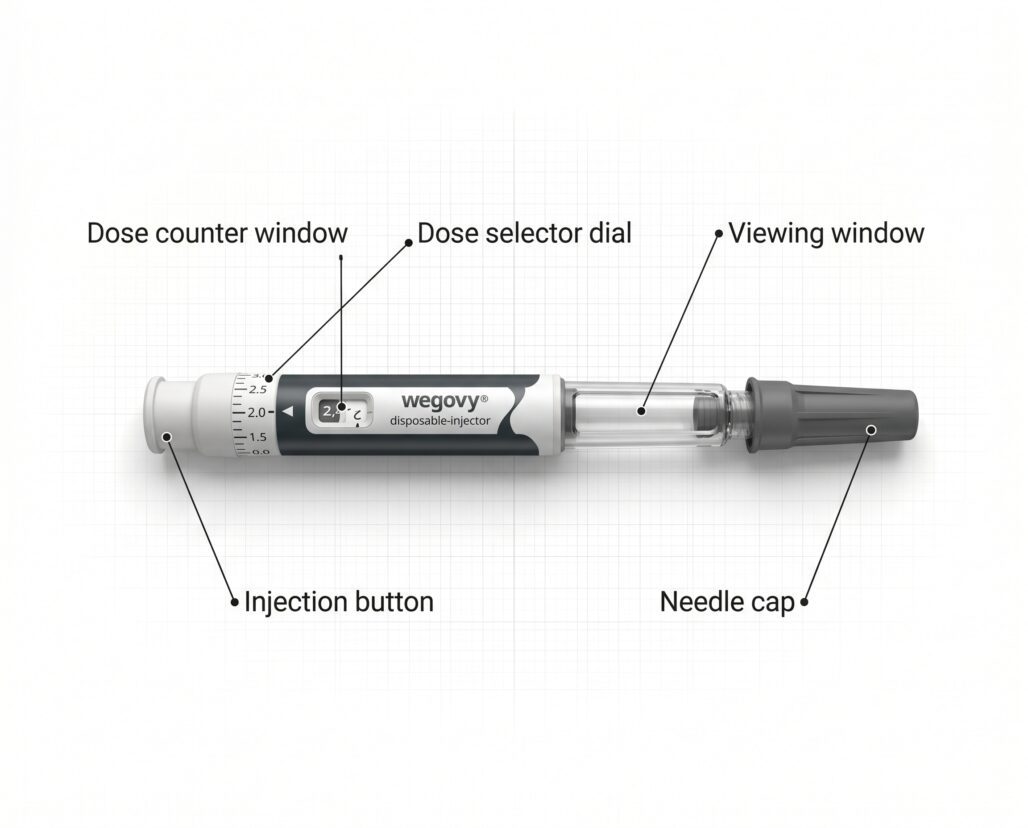
Wegovy (semaglutide, Novo Nordisk disposable pen). Single-dose prefilled pen in five strength tiers (0.25 mg, 0.5 mg, 1 mg, 1.7 mg, 2.4 mg) matching the escalation schedule. Each pen is calibrated for one dose; when the counter reaches zero, dispose of the entire pen. Parts are otherwise identical to the FlexPen family: viewing window, dose counter, injection button, needle that must be attached before use.
Mounjaro and Zepbound (tirzepatide, Lilly KwikPen auto-injector). Single-dose prefilled auto-injectors with a factory-integrated needle behind a retractable needle shield — no separate needle attachment step. Key parts: the clear base cap (removed before use), a viewing window showing the yellow medication, and the gray injection button on the flat end. There is no dose dial; dose is pre-set at manufacture. The needle shield locks automatically on withdrawal.
Step-by-Step: How to Give the Injection
The following sequence applies to all four pens unless noted. Read your specific device's Instructions for Use in full before the first dose; the steps below are educational context, not a substitute for that insert.
Step 1: Gather supplies. Pen, one new needle (Ozempic/Wegovy only), one or two alcohol prep pads, and an FDA-cleared sharps container within reach. Do not lay needles on an unprotected surface.
Step 2: Room temperature. Pens are stored refrigerated at 36 to 46 degrees F. Remove the pen about 30 minutes before injection. Injecting cold medication is more painful and may slow absorption at the site. Do not use a heating pad or microwave to speed things up.
Step 3: Inspect. The solution in all four pens should be clear to slightly yellow. Cloudy, discolored, or particle-containing liquid means do not use; check the expiration date as well.
Step 4: Attach the needle (Ozempic/Wegovy only). Wipe the rubber stopper with an alcohol pad, push the capped needle straight on and turn clockwise until tight. Remove the outer cap and keep it for later recapping; discard the inner cap.
Step 5: Dial the dose (Ozempic only). Turn the dose selector until the counter shows your prescribed dose — one click per unit. Confirm the number in the window. You can dial back if you overshoot.
Step 6: Prime (Ozempic first use or new needle). Point the pen up, tap gently to move air bubbles toward the top, press the injection button until a drop appears at the needle tip. No drop means repeat the prime before injecting.
Step 7: Clean the site. Wipe the chosen area with an alcohol pad and let it air-dry for about 10 seconds. Wet alcohol stings on entry. Approved sites: lower abdomen (at least 2 inches from the navel), front or outer thigh, outer upper arm. Do not inject into reddened, bruised, tender, scarred, or thickened skin.
Step 8: Pinch if needed. For most adults injecting at the abdomen with a 4 mm needle, no pinch is necessary. With an 8 mm needle or at a lean thigh, gently pinch a fold of skin to lift the subcutaneous layer away from muscle before inserting.
Step 9: Inject. Hold the pen at 90 degrees to the skin. For Ozempic/Wegovy: insert the needle fully and press the injection button all the way down. Hold until the dose counter reaches zero, then hold 6 more seconds before withdrawing — partial holds mean incomplete delivery. For Mounjaro/Zepbound: press the clear base firmly against skin, press the gray button, and listen. A first click means injection has started. A second click means the full dose has been delivered. Hold for 5 additional seconds after the second click before lifting away. One click only means the dose was not fully delivered — contact your prescriber.
Step 10: Withdraw and dispose. Pull the pen straight out; do not rub the site. For Ozempic/Wegovy: recap the needle using the one-hand scoop method, unscrew it, and place it in the sharps container. For Mounjaro/Zepbound: the needle shield locks automatically; place the entire pen into the sharps container.
Site Rotation
Rotation is required in all four FDA-approved labeling documents — it is not a suggestion. Repeatedly injecting the same small area causes lipohypertrophy, localized fatty tissue growth that is firm, often painless, and can be invisible to the naked eye. Medication absorbed through lipohypertrophic tissue is erratic, producing inconsistent blood levels and inconsistent clinical effects.
Three approved zones: abdomen (at least 2 inches from the navel), front or outer thigh, and outer upper arm. Within each zone, shift the specific point slightly each injection — a rough clockwise sweep around the abdomen, for example. Rotate between zones on a weekly schedule. Self-injection in the upper arm is possible but requires practice; caregivers find it the most accessible site.
Do not inject at the same site as another injectable. If you also use insulin, use different anatomical zones on the same day, or clearly separated areas within the same zone.
Lipohypertrophy check. Affected tissue feels rubbery and firmer than surrounding skin. If you find it, shift injection points away from the area immediately and notify your prescriber; severe cases may need a prolonged rest from that zone.
Common Mistakes
Most injection errors are predictable, and knowing them in advance is most of the battle.
Cold pen. The single most common first-dose error. Cold semaglutide or tirzepatide stings more and may slow absorption. Always allow 30 minutes at room temperature before injecting.
Short hold. Withdrawing before the dose counter reaches zero (semaglutide) or before the second click plus 5-second hold (tirzepatide) leaves part of the dose in the cartridge or needle. If you suspect an incomplete injection, call your prescriber — do not self-correct with a second injection.
Reusing needles. Blunted, barbed tips cause more tissue trauma, raise lipohypertrophy risk, and increase infection risk. FDA-approved labeling for all four pen devices specifies single use: one needle per injection.
Tensed muscle at injection. Standing with quads engaged or actively flexing the abdomen thins the subcutaneous layer; a longer needle can then reach muscle. Sit or lie down for abdominal and thigh injections.
Skipping the air-dry step. Injecting through wet isopropyl alcohol causes unnecessary stinging. Ten seconds of air-drying is enough.
Wrong storage for in-use pens. An in-use Ozempic pen may be kept at room temperature (up to 77 degrees F) for up to 56 days. Wegovy pens are single-dose and used once per session. Tirzepatide pens are single-dose and should not be re-refrigerated once removed. Confirm the exact window for your specific pen in its Instructions for Use — do not guess.
Pen confusion. The five Wegovy strengths come in differently colored pens; Mounjaro and Zepbound pens look similar but contain different drugs at different doses. Never share pens between patients — cross-contamination and dose error are both real risks.
Sharps Disposal
Used needles and pen injectors are regulated medical sharps. EPA home medical waste guidelines and FDA sharps disposal guidance prohibit placing loose needles in household trash or recycling — both require a rigid, puncture-resistant container with a tight-fitting lid.
Use an FDA-cleared sharps container. These are red, rigid, and puncture-resistant; available at most pharmacies for low cost. Do not substitute a glass jar, cardboard box, or plastic bottle — while some states allow heavy rigid plastic bottles as an interim solution, that is a state-specific exception, not universal guidance.
Disposal when the container is three-quarters full. Seal it — do not overfill or try to compress needles inside. Then check your state's options: many pharmacies, hospitals, and health departments operate community drop-off programs; the FDA's sharps disposal page lists mail-back programs as well. Availability varies by state.
Safe recapping. For pens that require post-injection needle removal (Ozempic, Wegovy), use the one-hand scoop method: lower the needle toward the outer cap lying flat on a stable surface rather than hand-holding the cap toward the needle. Needle-stick injuries are preventable.
When to Call Your Prescriber
These situations require contact with your prescribing clinician before the next scheduled appointment — not a "wait and see."
Suspected dose error. Missed second click on a tirzepatide pen, dose counter that didn't reach zero, or visible medication leaking at the site: call before your next dose. Do not attempt to self-correct with an additional injection.
Injection-site reaction that worsens. A small red mark that fades within hours is normal. Persistent or worsening redness, warmth, swelling, or pain over 24 to 48 hours warrants a call. Signs of infection — pus, spreading redness, fever — require prompt medical evaluation.
Skin lumps or firm tissue at injection sites. This is lipohypertrophy. Report it so your prescriber can advise on rotation strategy and, if needed, refer you to a diabetes educator.
Pregnancy confirmed. All four drugs — Ozempic, Wegovy, Mounjaro, and Zepbound — should be discontinued as soon as pregnancy is confirmed. Call your prescriber immediately; do not manage this transition alone.
Pediatric patients. Wegovy carries an FDA indication for adolescents 12 and older with obesity; Saxenda (liraglutide) also has a pediatric indication. Administration in patients under 18 requires specialist supervision and should not follow the adult self-injection protocol without explicit clinician guidance.
Stop and go to the ER for any of the following: severe or persistent abdominal pain (possible pancreatitis), severe allergic reaction (throat swelling, difficulty breathing, rapid heartbeat), or a severe injection-site reaction with spreading swelling or systemic signs. These are emergency situations, not phone-call situations.

Frequently Asked Questions
Can I inject through clothing? No. Injecting through fabric contaminates the needle and prevents proper site assessment. Always expose the injection site.
What if I miss a dose? For weekly GLP-1 pens: if fewer than 5 days remain until your next scheduled dose, skip the missed dose and resume your regular schedule. If more than 5 days remain, inject as soon as you remember and resume the regular weekly schedule. Do not double-dose. Confirm the exact window with your prescriber, as instructions can vary.
Can I inject in the same place every week? No. Site rotation is specifically required in all four FDA-approved labeling documents. Same-spot injections cause lipohypertrophy and reduce medication reliability over time.
Why does my pen have medication left after the injection? Some dead volume in the needle and cartridge tip is expected. The pens are calibrated to deliver the full labeled dose even with some residual fluid visible. If the dose counter reached zero (semaglutide) or you heard both clicks with a 5-second hold (tirzepatide), the dose was delivered.
What about compounded GLP-1 vials? Compounded versions of semaglutide and tirzepatide may use entirely different vials, syringes, and needle gauges than the FDA-approved pen devices. The FDA has issued public warnings about compounded semaglutide products, including those using unapproved salt forms. This guide does not apply to compounded products; patients using compounded versions should get device-specific instructions directly from the prescribing clinician or compounding pharmacy. The FDA-approved pen format is the reference standard used in clinical trials.
Conclusion
Self-injecting a GLP-1 medication at home is, by most clinical standards, a manageable skill. The pen manufacturers have engineered considerable redundancy into the devices — dose counters, click confirmations, automatic needle shields — specifically to reduce the chance of user error. But "manageable" requires that you know what the clicks mean, why site rotation is not negotiable, and how to tell the difference between a normal post-injection mark and something that deserves a call. The broader context of why these drugs matter and what the evidence shows lives in the semaglutide complete guide and tirzepatide complete guide. The safety foundation that frames any injectable peptide belongs in are peptides safe. This article covers the mechanics. Those cover the science. A licensed prescriber covers you.
This article is for educational and informational purposes only. It does not constitute medical advice, diagnosis, or treatment. Self-injection technique, dosing schedules, and site-rotation protocols should be confirmed with the licensed clinician who prescribed your specific medication. If you experience a medical emergency, call 911 or your local emergency number immediately. Never adjust or skip prescribed doses without consulting your prescriber.
