
Affiliate disclosure: this article contains affiliate links. As an Amazon Associate, UsefulVitamins.com earns from qualifying purchases at no extra cost to you.
Before you buy
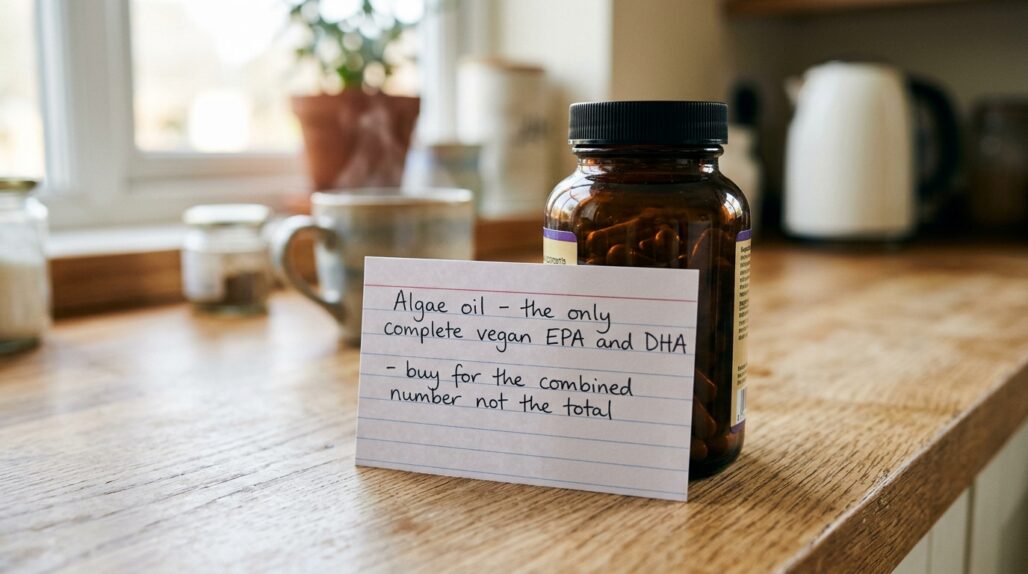
The real decision here is not "which brand," it is "do I get enough EPA and DHA at all." Most vegan omega-3 marketing leads with a big total omega-3 number. That number is close to meaningless.
What your body uses is the combined EPA plus DHA figure, and on algae oil that is usually a fraction of the headline total. A bottle can shout "1,000 mg omega-3" and still deliver well under half of that as the two fats that matter.
The other thing worth knowing up front: algae oil is the original source. Fish get their EPA and DHA by eating algae. So a plant-based algae supplement is not a watered-down substitute – it is the same molecules, skipping the fish entirely.
If you already eat fatty fish like salmon or sardines a couple of times a week, you probably do not need any of this. This guide is for people who do not, or will not, eat fish.
Why algae oil and not flax or chia
You will see flaxseed, chia, and walnut oils sold as omega-3 sources. They contain ALA, a plant omega-3, but ALA is not the form your body runs on.
Your body has to convert ALA into EPA and DHA, and that conversion is poor – the NIH Office of Dietary Supplements omega-3 fact sheet notes the rate is low enough that ALA alone is an uncertain way to reach useful EPA and DHA levels. Most estimates put conversion to EPA in the single-digit percents and conversion to DHA close to negligible.
So a tablespoon of flax oil is not a real swap for fish oil. Algae oil is the only complete vegan source that hands you preformed EPA and DHA directly, no conversion required. The Harvard nutrition group makes the same point: algal oil contains the long-chain omega-3s, mostly DHA, and is the practical vegan route.
That "mostly DHA" detail is the catch that decides which product you buy.
What to actually look for
Ignore the front of the label. Turn the bottle over and read the supplement facts panel for three numbers.
- Combined EPA + DHA per serving – the only figure that maps to research. Aim for a product that gives you a meaningful chunk of your daily target in one or two softgels.
- The EPA-to-DHA split – many algae oils are DHA-only. If you want both, confirm there is real EPA in there, not a token amount.
- Servings per bottle, not softgel count – a "60 softgel" bottle is often only 30 servings, which changes the math on cost.
A quality signal worth checking is third-party testing. For algae oil specifically, look for the IAOS mark, the algae equivalent of the IFOS standard run by Nutrasource's certification program, which verifies omega-3 content and low oxidation. Non-GMO and vegan certification matter for this category too, since the softgel shell itself can contain gelatin or carrageenan.
For the difference between the common oil forms and why it affects absorption, our explainer on triglyceride, ethyl ester, and krill omega-3 bioavailability is the deeper read.
How much EPA and DHA you actually need
There is no single official RDA for EPA and DHA, which is why the dosing feels murky. Here is the honest version.
Most health bodies suggest at least 250 to 500 mg of combined EPA and DHA per day for general health. The American Heart Association's 2017 science advisory suggests roughly 1,000 mg a day of combined EPA and DHA for people with existing coronary heart disease, ideally under a doctor's guidance.
The ceiling worth knowing: the FDA advises that supplement labels not recommend more than 2,000 mg of EPA and DHA per day, citing limited evidence above that. So the useful daily window for most people sits somewhere between 250 mg and 1,000 mg combined.
Algae oil generally delivers less EPA and DHA per softgel than concentrated fish oil, so you may take two softgels where one fish-oil capsule would do. That is normal, not a defect – just read the serving size so you hit your target. If you are weighing the vegan route against a strong fish-oil option, our look at whether Nordic Naturals Ultimate Omega is worth it gives a useful fish-oil benchmark.
The top vegan algae picks, compared
Three products cover most of what is worth buying. They split cleanly into "both EPA and DHA" versus "DHA only," and that is the choice that should drive your pick.
All figures below are the manufacturers' stated label values as of writing. Note that Sports Research markets several vegan SKUs with slightly different numbers, and its own listings have shown some inconsistency, so confirm the panel on the exact bottle you buy.
| Product | EPA + DHA per serving | EPA / DHA split | Serving size | Approx. price |
|---|---|---|---|---|
| Sports Research Vegan Omega-3 | ~630 to 980 mg (varies by SKU) | Has both EPA and DHA | 2 softgels | ~$25 to $35 / 30 servings |
| Ovega-3 500 mg | ~370 mg | 90 mg EPA / 280 mg DHA | 2 mini softgels | ~$20 to $25 / 30 servings |
| Garden of Life Minami Vegan DHA | ~500 mg | 500 mg DHA / no EPA | 2 mini softgels | ~$30 to $39 / 30 servings |
Sports Research Vegan Omega-3 is the most complete of the three. It is the one that reliably gives you both EPA and DHA in a single product, made from cultivated algae in a carrageenan-free vegan softgel, and the company publishes third-party records through Nutrasource (IAOS for omega-3 content, IGEN for non-GMO). For most vegans wanting a true fish-oil replacement, this is the buy. The brand's own Vegan Omega-3 product page is worth reading for the exact label on the SKU you pick.
Ovega-3 is the lower-dose, lower-cost option. It delivers both EPA and DHA but in smaller amounts (about 90 mg EPA and 280 mg DHA per serving), so heavier users may need to dose up. It is a sensible value pick if your target is the lower end of the daily range.
Garden of Life Minami Algae Omega-3 is a strong product, but read the label closely: it is DHA-only with no EPA, plus a touch of astaxanthin. That makes it a fine choice for brain and eye support and a poor choice if you specifically want EPA's contribution.
The value pick and top picks


As an Amazon Associate, UsefulVitamins.com earns from qualifying purchases at no extra cost to you.
UsefulVitamins may earn a commission from purchases made through the links below, at no extra cost to you. This never affects which products we recommend.
For the best all-around vegan omega-3, the Sports Research Vegan Omega-3 is the pick because it carries both fats. If you only want DHA and want to spend less, a DHA-only algae softgel does that job for less money. And if you are price-sensitive and fine with a smaller dose, Ovega-3 is the budget-friendly both-fats option.
If you came here open to fish oil after all, our Nordic Naturals alternatives on Amazon roundup and our guide to the best burpless fish oil with no fishy aftertaste will point you to cheaper non-vegan options that often beat algae oil on cost per gram.
Cost per gram of EPA and DHA
This is where algae oil stings, and it is worth being clear-eyed about it.
Because you pay for cultivated algae rather than a fishing byproduct, vegan omega-3 costs more per gram of EPA and DHA than a decent fish oil – often two to three times more. A standard fish oil can deliver a gram of combined EPA and DHA for well under a dollar; algae oil rarely gets close.
Take Sports Research as the example. At roughly $25 to $35 for 30 servings, and somewhere around 0.6 to 1.0 g of combined EPA and DHA per serving depending on the SKU, you are paying around $1 or more per gram of the two fats that matter. That is the vegan premium, and no algae brand escapes it entirely.
The takeaway is simple. If you need vegan, pay it and move on. If you do not need vegan, fish oil is the cheaper way to the same EPA and DHA.

Storage, freshness, and how to take it
Omega-3s oxidize, and a rancid oil is both useless and unpleasant. Treat algae oil the same way you would treat fish oil.
- Take it with a meal that has some fat to help absorption and cut any aftertaste.
- Store it cool and dark – a cupboard away from the stove is fine; some people keep it in the fridge.
- Buy what you will finish in a couple of months rather than a giant bottle that sits open.
- If it smells off or "fishy," even a vegan oil can have oxidized; that is a sign to stop using it.
Algae oils tend to have no fishy burp to begin with, which is one of the genuine perks people notice when they switch.
FAQ
Is algae oil as good as fish oil? For EPA and DHA, yes – it is the same two fats, just from the source fish eat. The main differences are that algae oil usually costs more per gram and some versions are DHA-only, so check the EPA number if you want both.
How much vegan omega-3 should I take per day? Most guidance points to at least 250 to 500 mg of combined EPA and DHA daily for general health, with the FDA advising labels stay under 2,000 mg. Read the serving size, since algae oils often need two softgels to hit a useful dose.
Can I just take flaxseed or chia instead? Not really. Those give you ALA, which converts to EPA and DHA poorly, so they are not a reliable replacement for a preformed EPA and DHA supplement.
Which vegan omega-3 has both EPA and DHA? Sports Research Vegan Omega-3 and Ovega-3 both contain EPA and DHA. Garden of Life Minami Algae Omega-3 is DHA-only, so skip it if EPA matters to you.
Why is vegan omega-3 so expensive? You are paying for cultivated algae rather than a fishing byproduct, which pushes the cost per gram of EPA and DHA well above most fish oils. If you do not need vegan, fish oil is cheaper for the same fats.
Does algae oil cause fishy burps? Usually not, which is one of its real advantages. If a bottle ever does smell or taste fishy, the oil has likely oxidized and should be replaced.
The verdict
If you want a vegan omega-3 that truly replaces fish oil, buy the one that carries both EPA and DHA – the Sports Research Vegan Omega-3 is that product for most people, and its third-party records back up the content claims.
Go DHA-only with something like Garden of Life Minami only if your goal is brain or eye support and you have decided you do not need EPA. Pick Ovega-3 if you want both fats at a lower dose and a lower price.
And the honest caveat: none of these is cheap per gram, so if you are not committed to vegan, a quality fish oil gets you the same EPA and DHA for less. Your next step is to read the supplement facts panel on whatever bottle you are eyeing, find the combined EPA-plus-DHA number, and make sure it lands in the 250 to 1,000 mg range you are aiming for.
This article is for general information and is not medical advice. Supplements can interact with medications and conditions; talk to your doctor or pharmacist before starting omega-3s, especially if you take blood thinners or are pregnant.
Reviewed by the UsefulVitamins Editorial Team.
