
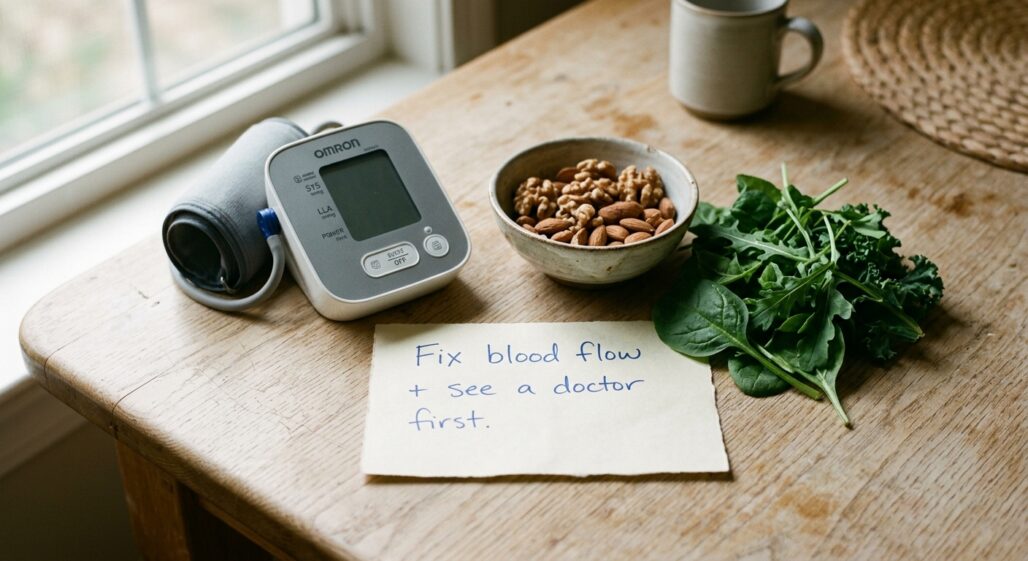
If you are searching for the best supplements for ED, you are probably hoping a capsule will fix the problem quietly, without a doctor's appointment. The honest answer: a few supplements have modest blood-flow evidence, but erectile dysfunction is most useful as a check-engine light for your heart and blood vessels, not as a standalone supplement problem. This article walks through what the urology guidelines say, which supplements actually have trial data behind them, which are popular but evidence-thin, and why the "male enhancement" pills sold next to them carry a real safety risk. The picks at the bottom are the evidence-aligned options I would point my own family toward as adjuncts, alongside seeing a clinician, not magic fixes.
Affiliate disclosure: this article contains affiliate links. As an Amazon Associate, UsefulVitamins.com earns from qualifying purchases at no extra cost to you.
Before you decide

Start with the part most affiliate roundups bury: erectile dysfunction is frequently the first visible sign of cardiovascular disease or diabetes, not just a bedroom problem. The penis runs on small arteries, and those arteries often show trouble before the larger coronary vessels do. The 2018 AUA Erectile Dysfunction Guideline states as a Clinical Principle that men should be counseled that ED is a risk marker for underlying cardiovascular disease that may warrant evaluation.
So the first step is not a supplement. It is a clinician visit with a history, exam, and selective labs, including a morning testosterone level, which the AUA rates as a Moderate Recommendation, Grade C.
Do not buy "male enhancement" pills marketed as a natural fix for ED. The FDA has identified more than 1,000 sexual-enhancement products spiked with undeclared prescription drugs, a point detailed below. If you take nitrates for chest pain, or alpha-blockers or other blood-pressure medications, a hidden dose of sildenafil or tadalafil can drop your blood pressure to a dangerous level. Bring any supplement you are considering to the same clinician.
ED as a vascular check-engine light
Erectile function is a hydraulic event that depends on healthy endothelium, the thin lining of blood vessels that releases nitric oxide and lets arteries dilate. When that nitric-oxide pathway falters, blood flow into the penis falls, and the same dysfunction tends to show up later in the heart's arteries. That is why ED can precede a cardiac event by two to five years in some men.
Severity ranges widely, from occasional difficulty under stress to consistent inability tied to diabetes, smoking, or atherosclerosis. The standard of care is the workup plus, where appropriate, a PDE5 inhibitor such as sildenafil or tadalafil, which remain the first-line prescription therapy in the AUA framework.
Supplements sit on top of that, not instead of it. If you are skipping the cardiovascular evaluation, the supplement conversation is genuinely moot. Most supplements that "help" ED do so by nudging the same nitric-oxide pathway a prescription drug targets more reliably.
Strongest evidence: the nitric-oxide and ginseng options
These three have the most trial support, which is still modest. Read the effect sizes, not the marketing.
L-arginine (high dose)
L-arginine is the direct amino-acid precursor your body converts into nitric oxide, the molecule that relaxes penile arteries. In a 2022 multicentre, double-blind RCT (Barassi et al., n=98, J Endocrinol Invest), men with vasculogenic ED taking 6 g/day for three months had significantly improved IIEF-6 scores, with about 74% improving their ED category, versus no significant change on placebo.
That is a real but modest signal in mild-to-moderate vascular ED, not a fix for severe disease. Dose used in trials: 6 g/day, split as 2 g three times daily with meals.
Skip if you take nitrates or blood-pressure medication without checking with your clinician, since arginine can add a blood-pressure-lowering effect.
L-citrulline
L-citrulline is the smarter delivery vehicle for the same goal. Your kidneys convert it to arginine, and it survives digestion better, so blood arginine often rises more from citrulline than from arginine itself. In a placebo-controlled pilot (Cormio et al., n=24, Urology 2011), 1.5 g/day of L-citrulline moved 50% of men with mild ED to a normal erection-hardness score, versus 8.3% on placebo.
The catch is the size: 24 men, one month, mild ED only. Treat it as a plausible adjunct, not proof. For a deeper look at forms and dosing, see our guide to the best citrulline supplements.
Dose used: 1.5 g/day. Form to look for: plain L-citrulline or citrulline malate with the citrulline content listed per serving.
Panax ginseng (Korean red ginseng)
Panax ginseng is the most-studied botanical here, with ginsenosides thought to support nitric-oxide release. A 2021 Cochrane systematic review (Lee et al.) found a mean difference of 3.52 points on the IIEF-15 erectile-function domain across three trials, but rated the certainty of evidence as low.
A 3.5-point IIEF shift is noticeable but smaller than what a PDE5 inhibitor delivers, and the trials were small and heterogeneous. That is the honest read: a modest signal from low-certainty data. If you are also exploring desire rather than rigidity, our roundup of the best supplements for low libido covers ginseng from that angle.
Dose used in trials: roughly 600 to 1,000 mg of Korean red ginseng extract, two to three times daily. Form to look for: standardized Panax ginseng (not Siberian "ginseng," which is a different plant).
Actionable takeaway: if you try one, pick L-citrulline or Panax ginseng, give it 8 weeks, and judge it honestly against an IIEF-5 score you track yourself.
| Supplement | Evidence strength | Trial dose | Realistic expectation |
|---|---|---|---|
| L-citrulline | Small pilot RCT, mild ED | 1.5 g/day | May modestly support mild cases |
| L-arginine (high dose) | Mid-size RCT, vasculogenic ED | 6 g/day | Modest gain, mild-to-moderate |
| Panax ginseng | Cochrane, low certainty | 600-1,000 mg 2-3x/day | Small IIEF shift |
| Pycnogenol + arginine | Single small crossover RCT | Combined product | Promising but unreplicated |
Moderate evidence: pycnogenol plus arginine

Worth considering if the single-ingredient options underwhelm, with caveats. Pycnogenol (French maritime pine bark extract) is often combined with L-arginine on the theory that it helps the enzyme that makes nitric oxide work more efficiently. In a double-blind, placebo-controlled crossover trial (Stanislavov & Nikolova, n=50, Int J Impot Res 2008), the combination improved erectile function over one month versus placebo.
The honest weakness: this is largely one research group, one small crossover, and a proprietary combination product. The mechanism is plausible and the result is encouraging, but it has not been broadly replicated by independent teams. A 2023 meta-analysis pooling arginine-plus-pycnogenol data suggests benefit, but the underlying trials are small.
Treat it as a reasonable second-line adjunct if single ingredients disappoint, not a first move.
Popular but evidence-thin or risky
This is where most "best supplements for ED" lists oversell, so read it carefully.
DHEA is a hormone precursor widely marketed for ED. The most-cited trial (Reiter et al., n=40, Urology 1999) reported higher IIEF scores on 50 mg/day for six months, but the authors themselves wrote that the sample was too small for relevant statistical analysis. That is a hormone you should not self-dose. Because DHEA is androgenic, it is inappropriate for men with prostate concerns and should only be considered after labs and a clinician's input.
Yohimbine (from yohimbe bark) has older data for psychogenic ED, but a 2022 review in Annals of Medicine notes it can raise blood pressure and heart rate, trigger palpitations, and is genuinely risky in men with hypertension, heart disease, or anxiety. For a condition that flags cardiovascular risk, a stimulant that stresses the cardiovascular system is the wrong tool. I do not recommend it as a self-directed supplement.
"Testosterone boosters" and proprietary "male enhancement" blends are the riskiest category. They rarely list per-ingredient doses, the testosterone-raising claims almost never hold up in trials, and they are the exact products the FDA repeatedly finds adulterated. If low testosterone is the real issue, that is a diagnosis and a prescription, not a blend. See our evidence review of the best supplements for testosterone for why most "boosters" disappoint.
The vascular basics that beat any pill
Here is the part the supplement industry has no incentive to highlight: the interventions with the strongest evidence for erectile function are the same ones that protect your heart, and none of them come in a capsule. The AUA explicitly counsels that diet and increased physical activity improve overall health and may improve erectile function.
Stopping smoking restores endothelial function. Regular aerobic exercise, weight loss if you carry excess abdominal fat, controlling blood pressure, and managing blood sugar all act on the same nitric-oxide machinery that every supplement here is trying to nudge.
A Mediterranean-style eating pattern, rich in leafy greens, nuts, olive oil, and fish, is associated with better erectile function in observational data. These are not glamorous, but they out-perform any single supplement and they treat the underlying vascular problem rather than masking it.
What to look for when buying
A short decision shortcut before you spend money:
Buy single, labeled ingredients, not proprietary blends. You want L-citrulline, L-arginine, or standardized Panax ginseng with the exact dose printed per serving, so you can match the trial doses above.
Look for third-party testing: USP Verified, NSF Certified, or a published ConsumerLab assay. Avoid anything promising "instant," "all-natural Viagra," or "rock hard in minutes," which are the marketing tells of adulterated products.
Check the FDA's medication health-fraud notifications before buying any "male enhancement" product. The FDA has flagged more than 1,000 sexual-enhancement products laced with undeclared sildenafil or tadalafil, hidden drugs that can collide dangerously with nitrates and blood-pressure medication. Our full how-we-review-supplements methodology explains the testing markers we weight.


As an Amazon Associate, UsefulVitamins.com earns from qualifying purchases at no extra cost to you. We only recommend products supported by published research or third-party testing.
When supplements are not enough
Stop self-treating and see a clinician if any of these apply. New or worsening ED in a man over 40 warrants a cardiovascular and diabetes evaluation, full stop, because it may be the earliest sign of arterial disease.
See a clinician promptly if ED comes with chest pain, shortness of breath on exertion, leg pain when walking, or a known heart condition. Sudden, complete loss of erections, painful curvature (possible Peyronie's disease), or ED after pelvic surgery or trauma also need a specialist, not a supplement.
If you have tried lifestyle changes and a reasonable supplement trial for 8 to 12 weeks with no improvement, that is your signal to get evaluated for prescription therapy rather than stacking more capsules.
FAQ
Do any supplements work as well as Viagra?
No. PDE5 inhibitors like sildenafil and tadalafil are the proven first-line therapy. Supplements such as L-citrulline and Panax ginseng may modestly support mild cases, but the effect sizes are smaller and the evidence is weaker.
Is L-arginine or L-citrulline better?
L-citrulline often raises blood arginine more efficiently because it survives digestion better, but L-arginine has the larger, longer trial behind it at 6 g/day. Either is a reasonable trial; both work on the same nitric-oxide pathway.
Are over-the-counter "male enhancement" pills safe?
Treat them as unsafe by default. The FDA has identified more than 1,000 products spiked with hidden prescription drugs that can cause a dangerous drop in blood pressure, especially with nitrates.
Can ED be the only sign of heart disease?
Yes, it can be the first sign. That is why the AUA frames ED as a cardiovascular risk marker and recommends evaluation rather than treating it in isolation.
Conclusion: the bottom line on the best supplements for ED
The two or three supplements with the most evidence, L-citrulline, high-dose L-arginine, and Panax ginseng, offer a modest, real signal for mild-to-moderate ED, on the order of a few IIEF points, while pycnogenol-plus-arginine is promising but thinly replicated. The differentiator most affiliate roundups miss: ED is a vascular check-engine light backed by the AUA guideline, and the "male enhancement" pills sold beside these supplements are exactly the category the FDA keeps finding spiked with hidden sildenafil. Supplements are an adjunct on top of an evaluation and proven therapy, never a substitute.
Next steps:
- Book a clinician visit for a cardiovascular and diabetes workup before self-treating, especially if you are over 40.
- If you trial a supplement, pick a single labeled ingredient (L-citrulline or Panax ginseng), match the trial dose, and give it 8 weeks.
- Compare desire-focused options in our best supplements for low libido guide if low drive, not rigidity, is the main issue.
Learn more about the doctor behind this review on the Michael Ward author page.
As an Amazon Associate, I earn from qualifying purchases. Product recommendations are based on real reviews and independent research.
This article is for informational purposes and not medical advice. Erectile dysfunction can be the first sign of cardiovascular disease or diabetes, and supplements can interact with medications such as nitrates and blood-pressure drugs. Consult a licensed physician before starting any supplement, particularly if you have heart disease, take prescription medications, or have a chronic condition.
Reviewed by Michael Ward, MD MPH, Preventive Medicine, focused on guideline-based chronic disease management.
