
Affiliate disclosure: this article contains affiliate links. As an Amazon Associate, UsefulVitamins.com earns from qualifying purchases at no extra cost to you.
If you are reading this, you are already on an SSRI that a doctor prescribed: sertraline (Zoloft), escitalopram (Lexapro), fluoxetine (Prozac), citalopram (Celexa) or paroxetine (Paxil). Good. This page is not about coming off it or finding a "natural alternative." It is about which supplements are safe to add alongside the medication, which ones are genuinely risky to combine, and what to take to your pharmacist before you start.
What SSRIs actually do to your nutrient levels (and what they do not)
Here is the honest version, because a lot of what circulates online about SSRIs and vitamins is wishful thinking.
SSRIs do not have a clean, single-nutrient depletion the way metformin lowers B12. There is no FDA-acknowledged vitamin deficiency baked into how these drugs work. The claims you see about SSRIs "draining" your B vitamins, magnesium or zinc are theoretical or based on weak, diet-confounded data. Treat them with skepticism.
What the evidence does support is narrower and more specific.
Sodium is the real, label-level effect. SSRIs can lower blood sodium, often through a process called SIADH (the body holds onto too much water). This is FDA-acknowledged: the FDA prescribing information for sertraline carries a hyponatremia warning, and it names the people most at risk: the elderly, anyone on a diuretic ("water pill"), and people who are volume-depleted. This is not a reason to take a supplement. It is a reason not to chase extreme low-sodium diets or aggressive "electrolyte cleanses" while you are on the drug.
Bone density is a softer, observational signal. Long-term SSRI use is linked with lower bone mineral density and a higher fracture risk. One analysis in menopausal women found roughly a 32% higher fracture risk. The catch: this is mostly observational data, and depression itself lowers bone density, so the drug is not the whole story. It is a reasonable nudge to keep your vitamin D and calcium in a healthy range, not proof the SSRI caused a deficiency.
Folate is the interesting one. SSRIs do not deplete folate. But low folate predicts a poorer response to antidepressants, and in two sequential randomized trials published in the American Journal of Psychiatry, the 15 mg/day arm improved response compared with placebo in people who had not fully responded (the significant benefit was seen at the 15 mg dose, not the lower 7.5 mg dose). That is an augmentation story, not a depletion story.
So the framing for the rest of this page: you are not patching a hole the drug punched. You are choosing a few low-risk supplements that have some evidence behind them, and steering well clear of anything serotonergic.
The supplements worth adding, and how to take each
These three are safe to combine with an SSRI. None raise serotonin, and none replaces your medication.


As an Amazon Associate, UsefulVitamins.com earns from qualifying purchases at no extra cost to you.
Some links below are affiliate links. If you buy through them we may earn a small commission, at no extra cost to you. It does not change what we recommend.
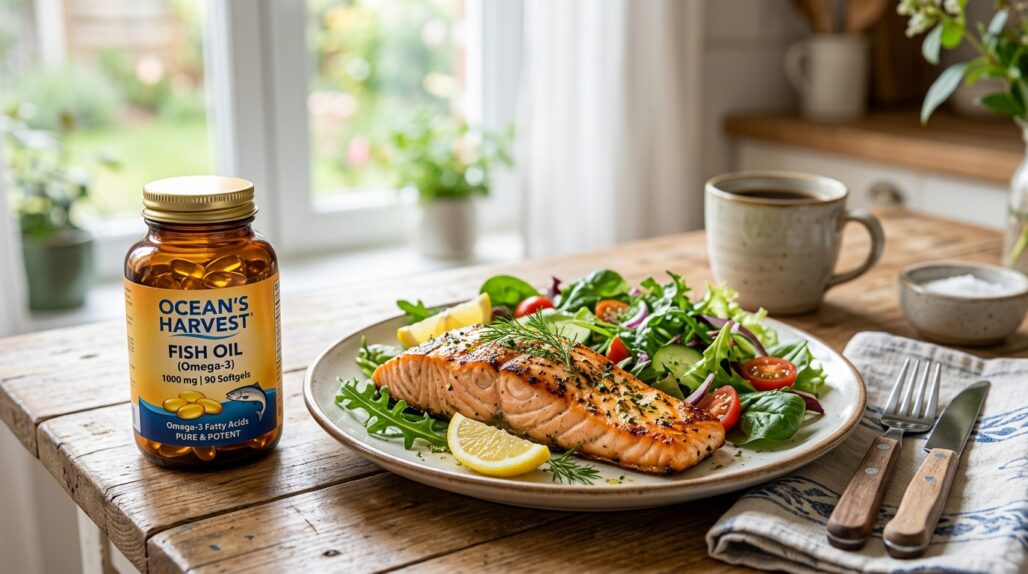
EPA-predominant omega-3 fish oil has the best adjunct evidence of the three. Meta-analyses find that omega-3 helps depressive symptoms most when the formula is mostly EPA rather than DHA, and the benefit shows up specifically in people already taking an antidepressant. Around 1 to 2 grams of EPA per day is the range studied. Take it with a meal that contains some fat. Read the label for the EPA number, not just the total "fish oil" figure. At doses above 3 grams a day, fish oil can lengthen bleeding time, which matters if you also take a blood thinner or aspirin. Most people on a standard dose are fine, but clear high doses with your pharmacist.
L-methylfolate is the active form of folate, the one used in the augmentation trials above. The studied dose was 15 mg, which is much higher than a multivitamin's folate and is prescription-strength in some countries, so talk to your prescriber rather than self-starting it. It does not interact with the SSRI in a dangerous way. If you simply want general folate cover, a normal dietary amount is plenty; the 15 mg figure is specific to the depression-augmentation studies.
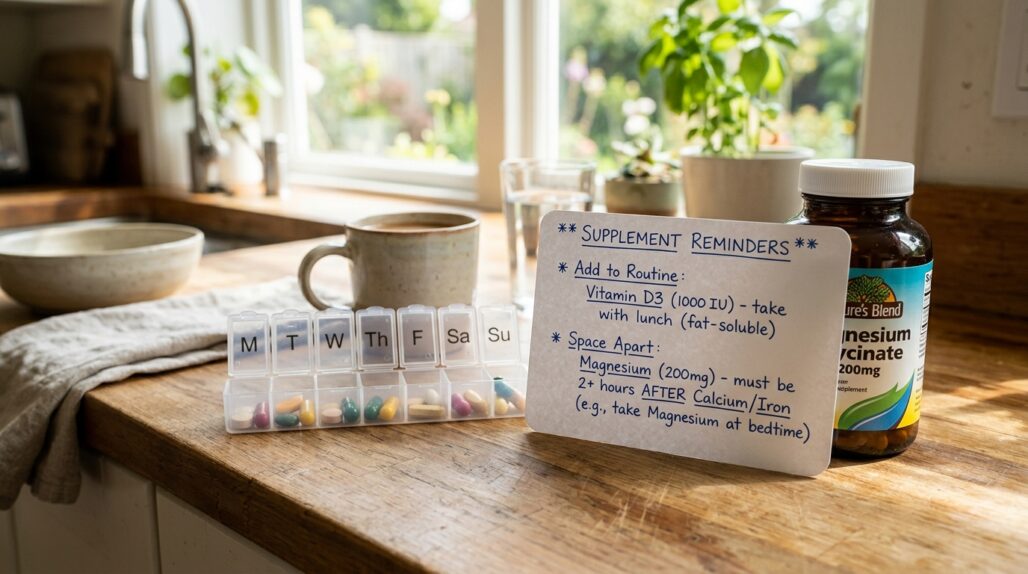
Vitamin D3 makes the list mostly because deficiency is common and because of the loose bone-health signal above, not because SSRIs deplete it. Test first if you can. If your blood level is low, 1,000 to 2,000 IU a day is a sensible everyday dose; higher correction doses should be guided by a result, not a guess. Our vitamin D dose calculator can help you sanity-check a number before you confirm it with your doctor.
Here is the plan in one place.
| Supplement | What it helps with | How to take it (timing/spacing from your dose) | Caution |
|---|---|---|---|
| EPA-predominant omega-3 fish oil | Best adjunct evidence for mood when added to an antidepressant | ~1-2 g EPA daily, with a meal containing fat; no spacing needed from your SSRI | Doses above 3 g/day can raise bleeding time – clear with your pharmacist if you take a blood thinner or aspirin |
| L-methylfolate (active folate) | Augmentation if you have not fully responded; low folate predicts poorer response | 15 mg was the studied dose; take any time, no SSRI spacing needed | High-dose folate is a prescriber decision, not a self-start; can mask low B12 – get B12 checked |
| Vitamin D3 | Corrects common deficiency; supports bone health where SSRIs may nudge it down | 1,000-2,000 IU daily with food; test your level first if you can | Correction doses should follow a blood result, not a guess |
If you want one place to keep track of all this, you can log both your SSRI and any supplement in StackMyMed (our own free app) so that overlaps and possible interactions get flagged for you to ask your pharmacist about. It does not give medical advice and it does not diagnose anything; it just surfaces the things worth raising. The low-tech version works just as well: write your full list on a piece of paper and show it to your pharmacist. Either way, the decision stays with a professional.
What to avoid or space apart with an SSRI
This is the part that matters most, so read it carefully. The danger with SSRIs is not a missing nutrient. It is serotonin syndrome: too much serotonin activity at once, which can come on within hours of adding the wrong thing.
St John's wort – avoid entirely. It raises serotonin and it induces liver enzymes (CYP3A4, 2C9, 2C19), so it causes two problems: it stacks serotonin risk on top of your SSRI, and it can lower the blood levels of other medicines you take. The sertraline label names St John's wort specifically in its serotonin syndrome warning. Drug-interaction databases rate this combination as a major interaction. Do not take it.
5-HTP – avoid. It is a direct serotonin precursor. Your body converts it straight into serotonin, which is exactly what your SSRI is already raising by blocking reuptake. Stacking the two can tip you into serotonin syndrome. Skip it.
L-tryptophan and tryptophan-containing blends – avoid. Same problem as 5-HTP, one step further back in the pathway. The FDA SSRI labels name tryptophan in the serotonin syndrome caution. Watch for it hidden inside "sleep," "calm" and "mood" formulas, where it is often not the headline ingredient.
SAMe – only under your prescriber's supervision. SAMe (S-adenosylmethionine) is serotonergic. Reported cases of serotonin syndrome from SAMe alone are rare, and some trials have combined it with antidepressants under monitoring, but the conservative rule is not to self-combine it with an SSRI. If your doctor wants to try it, that is a different situation from buying it yourself.
Things to clear with your pharmacist first: high-dose ginseng, Rhodiola or saffron "mood stacks" all have additive serotonergic potential, as do over-the-counter cough products containing dextromethorphan and prescription items like tramadol and buspirone (both named alongside tryptophan on the label). None of these are automatically off-limits, but none should be added blind.
One non-serotonin caution: because SSRIs can already lower sodium, do not chase very-low-sodium regimens or aggressive electrolyte "cleanses," especially if you are older or on a diuretic. Keep your sodium intake steady rather than crash-low.
None of the supplements in this section belong in a product card, and you will not find them in ours. They are listed here so you know what to leave on the shelf.
Can you cover this with food instead
For two of the three safe adds, largely yes, and food is the better starting point.
EPA comes from oily fish. Salmon, mackerel, sardines and herring two or three times a week deliver real EPA and DHA. A supplement is a convenient top-up if you do not eat fish, not a replacement for eating well.
Folate is abundant in food. Leafy greens, legumes, citrus and fortified grains are all solid sources, as the NIH Office of Dietary Supplements lays out. The 15 mg L-methylfolate dose from the augmentation studies is a pharmacological amount you cannot reach through diet, but ordinary folate sufficiency absolutely comes from the plate.
Vitamin D is the hardest to get from food. Sunlight and a few foods (oily fish again, egg yolks, fortified products) help, but many people still come up short, which is why a tested deficiency is a fair reason to supplement.
Food first, supplements to fill a gap, and the prescription left exactly as your doctor set it.

FAQ
Can a supplement replace my SSRI? No. Nothing on this page replaces, reduces or substitutes for your antidepressant, and none of it is a “natural alternative.” These supplements may support you while you stay on the medication your doctor prescribed. Any change to the drug, including tapering, is a decision for your prescriber.
Is it safe to take fish oil with sertraline or escitalopram? For most people, yes. EPA-predominant fish oil is not serotonergic and is the best-supported add. The main caveat is at high doses (above 3 grams a day) if you also take a blood thinner or aspirin, where bleeding time can lengthen. Confirm a high dose with your pharmacist.
Why is St John’s wort such a problem? It raises serotonin and speeds up the liver enzymes that clear many drugs. Combined with an SSRI it can cause serotonin syndrome and can also lower the levels of your other medicines. It is named on the FDA label for a reason. Avoid it.
Should I take L-methylfolate? Maybe, if you have not fully responded to your SSRI – that is the situation the 15 mg dose was studied in. It is safe to combine with the drug, but high-dose folate is a prescriber conversation, partly because it can mask a low B12 level. Ask your doctor.
Do I need to worry about low sodium? Be aware of it rather than worried. SSRIs can lower blood sodium, more so if you are older or on a water pill. The practical step is to keep your salt intake steady and avoid extreme low-sodium “cleanses,” not to take a supplement.
What should I do before adding anything? Write down your SSRI and every supplement you are considering, then show the list to your pharmacist or doctor. A free pharmacist medication review takes minutes and catches the serotonergic overlaps that matter most.
The bottom line
If you are on an SSRI, the supplement question is mostly about safety, not deficiency. The strongest, lowest-risk add is an EPA-predominant fish oil, with L-methylfolate and vitamin D3 as sensible extras when there is a reason. The rule you cannot bend: keep anything that raises serotonin – St John's wort, 5-HTP, L-tryptophan, SAMe – well away from your medication, because the combination can cause serotonin syndrome. Seek urgent care if you develop agitation or confusion, a fast or irregular heartbeat, fever, heavy sweating, shivering, or muscle twitching, especially within hours of adding a new supplement, and call your doctor for headache, confusion, severe weakness or unsteadiness, which can signal low sodium. For the bigger picture on related interactions, the supplements-for-birth-control-users guide covers the same St John's wort enzyme problem from a different angle, and you can compare specific products in our best omega-3 fish oil roundup and best folate supplements roundup. Take your full list to your pharmacist before you start anything.
This article is educational and is not medical advice, a diagnosis, or a prescription change. It does not replace your medication or your clinician. Talk to your doctor or pharmacist before adding, stopping, or changing any supplement or prescription. Prices and product details change; check current information before buying.
Reviewed by the UsefulVitamins Editorial Team.
