
Affiliate disclosure: this article contains affiliate links. As an Amazon Associate, UsefulVitamins.com earns from qualifying purchases at no extra cost to you.
If you take levothyroxine, you have probably been told to swallow it first thing, on an empty stomach, and wait before breakfast. There is a reason that instruction is so strict. The thyroid hormone in that tiny pill is absorbed in a narrow window, and a lot of common supplements grab onto it before your body can. So the question for a levothyroxine user is not really "what does this drug drain out of me." It is "what can I safely add, and how do I keep it from stealing my dose."
This page is education, not a prescription change. Nothing here tells you to start, stop, or adjust your thyroid medication. Your dose is set by your TSH blood test and your prescriber, full stop.
Why levothyroxine is about absorption, not depletion
Most "supplements for [drug]" stories are about depletion – the medication quietly lowers a nutrient over months. Levothyroxine is different. It is a thyroid hormone replacement, and it does not deplete vitamins the way metformin lowers B12 or a PPI lowers magnesium. The real issue is absorption interference. Several minerals and foods bind levothyroxine in the gut and reduce how much reaches your bloodstream. Less absorbed dose means your TSH drifts up and you can end up under-treated even though you took every pill.
This is not a fringe theory. The FDA Synthroid prescribing information tells patients to take the pill on an empty stomach, half an hour to an hour before breakfast, and to keep calcium supplements, iron supplements, and antacids at least 4 hours away. That is an FDA-acknowledged instruction, written right into the label. A separate systematic review of levothyroxine and food adds soy, dietary fiber, and coffee to the list of things that lower absorption. These come from the research literature rather than the FDA label, and coffee is the best-quantified (roughly a 30 percent drop), while soy and fiber rest on more limited evidence.
There is a real nutrient angle, but it is indirect. The most common cause of hypothyroidism is Hashimoto's, an autoimmune condition, and Hashimoto's tends to travel with low vitamin D, lower selenium status, and a higher rate of B12 deficiency and pernicious anemia. Those are co-existing deficiencies worth testing for. They are not caused by your levothyroxine. Keep that distinction clear, because it changes what you do: you test and correct a real gap, you do not blanket-dose because of the drug.
The supplements worth adding, and how to time them
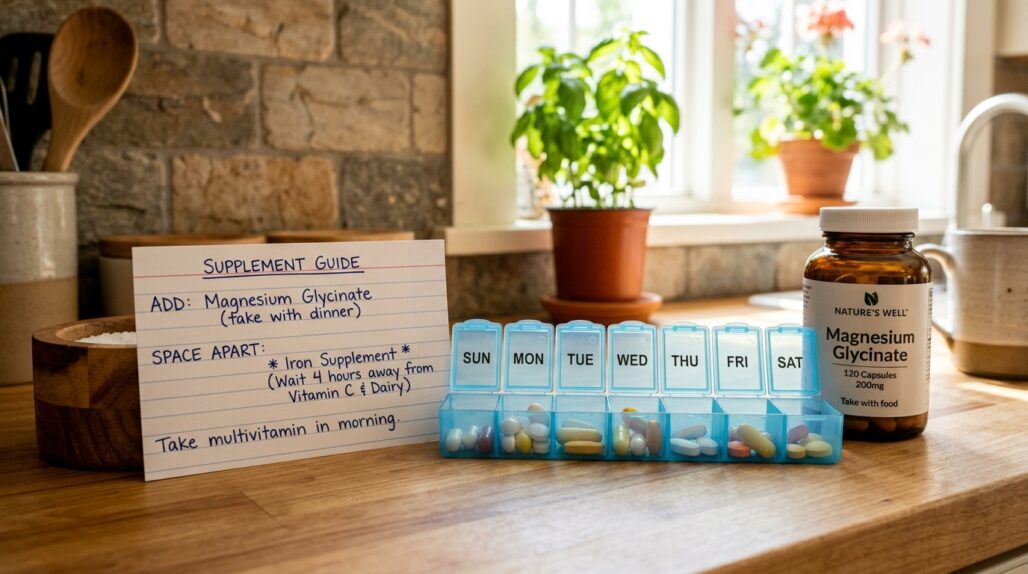
These three are safe to add alongside levothyroxine because none of them bind your dose. The catch is the same for all of them: take your thyroid pill alone, on an empty stomach, and put any mineral-containing product several hours later.
Vitamin D3. This is the easy yes. Low vitamin D shows up often in people with autoimmune thyroid disease, summarized in this review of vitamin D in Hashimoto's. D3 does not interfere with levothyroxine absorption, so timing is flexible. Dose it to your blood level rather than guessing. Our vitamin D supplement guide covers forms, and the vitamin D dose calculator helps you turn a blood result into a sensible amount.
Selenium, if you have Hashimoto's and your level is low. A meta-analysis of selenium in Hashimoto's found it slightly lowered thyroid antibodies (TPOAb); the TSH benefit showed up mainly in people not yet on levothyroxine, so once you are on a dose, expect an antibody effect at most rather than a TSH change. The effect is modest, not a cure, and selenium is easy to overdo. Brazil nuts alone can cover most people. If you supplement, keep it around 200 mcg and do not stack multiple products that each contain selenium. See our selenium supplement notes for forms and the upper limit.
Vitamin B12, if you are deficient. Because pernicious anemia clusters with autoimmune thyroid disease, a fair number of levothyroxine users turn out to be low in B12. Test first. If you are low, a methylcobalamin form is fine and does not bind your thyroid dose. This is a "correct a tested gap" add, not a routine one.
Here is the same plan in one place, with the timing rules that keep each one from touching your dose.
| Supplement | What it helps with | How to take it (timing/spacing from your dose) | Caution |
|---|---|---|---|
| Vitamin D3 | Common gap in hypothyroidism, especially Hashimoto’s | Any time of day; it does not bind levothyroxine, so timing is flexible | Dose to a blood level; do not megadose blind |
| Selenium | May slightly lower thyroid antibodies in Hashimoto’s (TSH effect mainly in untreated patients) | No spacing needed from the pill; once daily | Easy to overdose; keep around 200 mcg and only if low |
| Vitamin B12 (methylcobalamin) | Corrects a tested deficiency that clusters with autoimmune thyroid disease | No spacing needed; does not bind the dose | Test first; add only if you are actually low |


As an Amazon Associate, UsefulVitamins.com earns from qualifying purchases at no extra cost to you.
Some links below are affiliate links. If you buy through them we may earn a small commission, at no extra cost to you. It does not change what we recommend or what your pharmacist should sign off on.
A quick honesty note on the cards above: they are safe-to-add picks only. You will not see calcium, iron, or a "thyroid support" blend in there, because those belong in the next section.

What to avoid or space apart – the part that actually changes your dose
This is the most important section on the page. None of the items below is "bad." Most are useful supplements in their own right. The problem is timing them against a thyroid pill that absorbs in a narrow window.
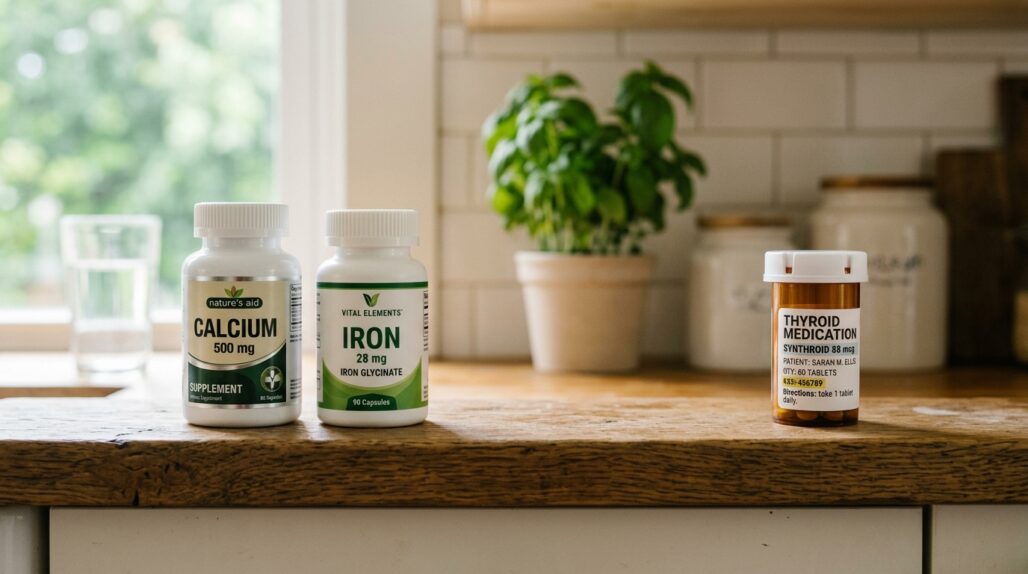
The simple rule: take levothyroxine on an empty stomach, then keep the items below at least 4 hours away (soy and fiber 1 hour, coffee 30 to 60 minutes).
- Calcium (carbonate or citrate), and calcium-fortified juice or dairy. Calcium forms an insoluble complex with levothyroxine and lowers absorption. The FDA label names it directly. Keep calcium at least 4 hours away. Do not stop calcium to "protect" your thyroid pill – just separate them.
- Iron (ferrous sulfate, bisglycinate) and any iron-containing multivitamin. Iron ions bind levothyroxine the same way. Separate by at least 4 hours. This is exactly why thyroid timing and iron timing keep coming up together.
- Magnesium (oxide, citrate) and magnesium-containing antacids. These polyvalent cations also grab the pill and can nudge your TSH up. The clean fix is to take magnesium at night and your levothyroxine in the morning.
- Multivitamins, greens powders, and "thyroid support" blends. Almost all of them contain calcium, iron, magnesium, or zinc, so they break the rule by default. Move them at least 4 hours after your dose. Many also contain biotin, and high-dose biotin distorts thyroid lab tests – it can make TSH look falsely low and T4 falsely high. The American Thyroid Association advises stopping biotin at least 2 days before bloodwork so your numbers are real.
- Soy (isoflavones or protein) and high-fiber or psyllium supplements. Both adsorb levothyroxine and reduce how much you absorb. Separate by at least an hour, and keep your daily soy and fiber intake steady rather than swinging it up and down week to week.
- Coffee, including the pill-with-coffee habit, and high-dose vitamin C. Coffee sequesters levothyroxine, so wait 30 to 60 minutes after dosing before your cup. Vitamin C is the odd one out: it can increase absorption by lowering stomach pH, shown in a study in patients with hypothyroidism and gastritis. Later pH-matched work has muddied how big that effect really is, so the honest takeaway is simply this – starting or stopping high-dose vitamin C can shift your effective thyroid dose, so keep it consistent and tell your prescriber.
A couple of cross-drug cautions, since many readers take more than one thing. If you also take an SSRI, watch serotonergic add-ons. If you take warfarin, big swings in vitamin K can move your INR. And if you are on an ACE inhibitor or ARB, do not self-dose potassium. None of those are levothyroxine interactions, but they matter if you are building a supplement routine on top of several prescriptions.
See your doctor or pharmacist promptly if you notice signs of being over-treated: a rapid or irregular heartbeat, palpitations or chest pain, hand tremor, unusual sweating, unexplained weight loss, anxiety, or trouble sleeping. Chest pain or a racing, irregular pulse needs urgent care. The milder signs may mean a supplement changed how you absorb your dose – for example, you moved your calcium or iron closer to the pill, or stopped a high-dose vitamin C you had been taking. The reverse is also worth flagging: returning fatigue, weight gain, or feeling cold after starting a new supplement can mean it is blocking your dose. Either way, the answer is a TSH recheck, not a guess.
Can you cover it with food first
For most levothyroxine users, the honest answer is mostly yes. Selenium is the clearest example – a few Brazil nuts, plus fish and eggs, will put most people in range without a capsule. Iron and calcium from a steady diet are fine; the issue was never getting them, it was timing them near the pill. Vitamin D is the one that food and sun often cannot fully cover, especially in winter or at higher latitudes. That is why it is the most common genuine supplement here.
Food-first also has a hidden advantage with this drug: the goal is steady intake. A consistent diet keeps your absorption steady, which keeps your TSH and your dose stable. Wild swings – a soy-heavy week, a fiber cleanse, a sudden megadose of vitamin C – are what move the needle.
One practical way to keep all of this straight is to log your prescription and any supplement in one place so the spacing rules and overlaps get flagged before you add something. You can do that in StackMyMed (our own free app), which lets you record your levothyroxine and your supplements together and surfaces things to ask your pharmacist about. It is non-diagnostic – it points out a possible timing conflict, it does not give medical advice. If you would rather skip an app entirely, the low-tech version works just as well: write your full list, including doses and timing, and show it to your pharmacist at your next visit.
FAQ
Can I take my vitamins with my levothyroxine? Not at the same time if they contain calcium, iron, magnesium, or zinc, which most multivitamins do. Take levothyroxine alone on an empty stomach, then take the vitamins at least 4 hours later.
Is there a supplement that can replace my thyroid medication? No. No vitamin, mineral, or “thyroid support” blend replaces, reduces, or substitutes for levothyroxine. The pill replaces a hormone your thyroid is not making enough of, and the dose is set by your TSH. Anyone selling a “natural alternative” to thyroid hormone is selling you a problem.
Does levothyroxine deplete any nutrients? Not in the way some drugs do. Its main supplement issue is that minerals block its absorption. The low vitamin D, selenium, or B12 you sometimes see in hypothyroidism usually come from the underlying autoimmune condition (Hashimoto’s), not from the drug.
Why does it matter when I take selenium or magnesium? Magnesium binds levothyroxine and can lower your dose, so it goes at night while the thyroid pill goes in the morning. Selenium does not bind the pill, so timing is flexible – but it is easy to overdose, so keep it modest and only if your level is low.
I started a greens powder and feel tired again – could that be the cause? Possibly. Greens powders and “thyroid” blends usually contain calcium, iron, or magnesium that can block your dose if taken near it. Move the powder at least 4 hours from your levothyroxine and ask your pharmacist about rechecking your TSH.
Should I stop biotin before a thyroid blood test? Yes if you take high-dose biotin. It can make your TSH look falsely low and your T4 falsely high, which could lead to a wrong dose change. Stop it at least 2 days before bloodwork and tell the lab you take it.
The bottom line
Levothyroxine does not drain your vitamins – it just needs a clear runway. The safest, most useful add for most people is vitamin D3, with selenium and B12 reserved for tested low levels, ideally in someone with Hashimoto's. The rule that protects your dose is the one to memorize: take the pill on an empty stomach and keep calcium, iron, magnesium, and any multivitamin at least 4 hours away. Watch for over-treatment signs – a racing or irregular heartbeat, tremor, unusual sweating – and treat them as a reason to call your doctor and recheck your TSH, not to adjust anything yourself. If you also take an acid reducer, the PPI and omeprazole supplement guide covers the same calcium-form and iron-absorption questions from the other side.
This article is educational and is not medical advice, a diagnosis, or a prescription change. Talk to your doctor or pharmacist before adding, stopping, or timing any supplement around your levothyroxine, and never change your prescription on your own.
Reviewed by the UsefulVitamins Editorial Team.
