
Affiliate disclosure: this article contains affiliate links. As an Amazon Associate, UsefulVitamins.com earns from qualifying purchases at no extra cost to you.
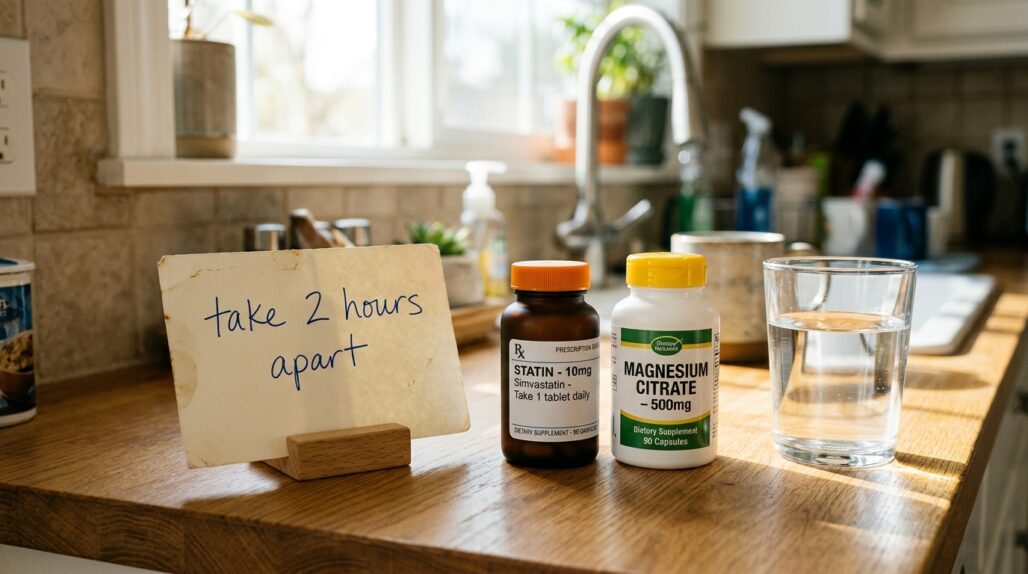
You are holding two bottles: the statin your doctor put you on, and a magnesium supplement you bought yourself. The honest answer is reassuring. For the magnesium most people take, there is nothing to worry about. The single thing worth knowing is that "magnesium" on a label can mean two very different products, and one of them needs a small timing habit.
Do magnesium and statins actually interact?
Mostly, no. It depends entirely on which magnesium you have in your hand.
There are two camps. The first is the everyday magnesium people take for sleep, cramps, or general topping-up: magnesium glycinate, citrate, malate, threonate. For these, standard interaction databases return nothing when you check them against a statin. Drugs.com lists no interactions between atorvastatin and magnesium glycinate. There are no reports of a dangerous additive effect, and nothing that says you have to separate them. Take that magnesium whenever it suits you.
The second camp is magnesium sold as a stomach remedy or laxative: magnesium hydroxide (the active ingredient in milk of magnesia) and magnesium oxide marketed for heartburn. These behave like antacids, and antacids genuinely interfere with statin absorption. That is the part worth knowing.
So the real question is not "magnesium and statins." It is "which magnesium, and is it the antacid kind." Read the bottle. If it says glycinate or citrate, relax. If it says hydroxide or oxide and lives in the heartburn aisle, keep reading the timing section.
The mechanism: why the antacid form matters and the supplement form does not
The interaction here is about absorption and timing, not toxicity. Nothing about magnesium plus a statin is poisonous. The antacid simply gets in the way of the drug in your gut.
Magnesium-containing antacids raise the pH of your stomach and can bind the statin before it is absorbed, so less of the drug reaches your bloodstream. This is well documented in the drug labels, which is about as strong as evidence gets.
For atorvastatin (Lipitor), the FDA prescribing information reports that taking it together with an aluminum-and-magnesium-hydroxide antacid (Maalox TC) lowered atorvastatin blood levels by roughly a third. The key detail the label adds: the LDL-cholesterol-lowering effect was not changed. Less drug measured in the blood, same cholesterol result. The professional Drugs.com interaction record describes the same chelation effect and the same management step: separate the antacid from atorvastatin by about 2 hours.
For rosuvastatin (Crestor), the drop is bigger. The FDA-approved Crestor label on DailyMed reports that an aluminum-and-magnesium-hydroxide antacid taken at the same time cut rosuvastatin exposure by about 50%. When the antacid was given 2 hours after the statin, there was no meaningful change. So the label tells you plainly to take Crestor at least 2 hours before that kind of antacid.
That is the whole interaction. To be clear about what it is not:
- It is not a muscle-damage interaction. Statin muscle aches are a known statin side effect, and magnesium does not cause them or make them worse.
- It is not a “natural alternative” situation. Magnesium does nothing your statin does. It does not lower LDL cholesterol and it does not replace the medication. Do not treat it as a swap.
- It is not a reason to change your statin dose. The fix is timing, never a dose adjustment you make on your own.
Evidence grade, honestly: the antacid-timing piece is high-quality regulatory data straight from the drug labels. The "no problem with chelated supplement magnesium" piece rests on the absence of any documented interaction in the interaction databases, which is reassuring but is an absence of a signal rather than a large dedicated study. For a mineral this widely used alongside statins, that absence is meaningful.
The practical rule: exact timing and who should be careful
Here is the rule in one breath: regular magnesium supplement, no spacing needed; magnesium antacid, 2 hours apart from your statin.
If your magnesium is glycinate, citrate, malate, or threonate, take it with or without your statin, morning or night, with or without food. There is no clash to manage.
If your magnesium is an antacid or laxative form (magnesium hydroxide / milk of magnesia, magnesium oxide for heartburn), put 2 hours between it and your statin. A simple way to do that: many people take their statin at bedtime, so take the antacid earlier in the day, or the next morning. The point is just that the two are not sitting in your stomach together.
A quick at-a-glance version:
| Question | Answer |
|---|---|
| Do they interact? | Only the antacid forms of magnesium (hydroxide, oxide) interact, by cutting statin absorption. Chelated supplements (glycinate, citrate) do not. |
| How do I take them? | Supplement magnesium: any time, no spacing. Magnesium antacid: take your statin at least 2 hours before or after it. |
| Who should be careful? | People using magnesium as a heartburn antacid or laxative, rosuvastatin users (bigger absorption drop), and anyone with reduced kidney function. |
| When should I call a doctor? | New unexplained muscle pain, tenderness, or dark urine (a statin sign). If your kidneys are impaired, also call for ongoing diarrhea, drowsiness, weakness, or a slow heartbeat. |
Who is most at risk of the timing problem? People who reach for magnesium as a heartburn or constipation remedy rather than a daily mineral, and rosuvastatin users specifically, since their absorption drop is larger. None of these people are in danger. They just lose some of the drug's effect if the timing is sloppy, and the fix costs nothing.
A separate group to flag: people with reduced kidney function. Your kidneys clear magnesium, and the NIH Office of Dietary Supplements notes that adequate kidney function is what protects you from magnesium building up. With healthy kidneys, excess magnesium is filtered out. With impaired kidneys, it can accumulate. That has nothing to do with the statin, but it is the one safety angle that matters if your kidneys are not working well, so keep it in mind.
This is education, not a prescription change. If you are unsure which magnesium you have or whether the timing applies to you, that is a 30-second pharmacist question.
What to actually do, and the safe way to take it
For most readers, the easiest answer is to use a non-antacid magnesium in the first place. A chelated form like glycinate or citrate skips the timing question, is gentler on the stomach, and is the form most people want for sleep or cramps anyway. Then take it whenever fits your routine.
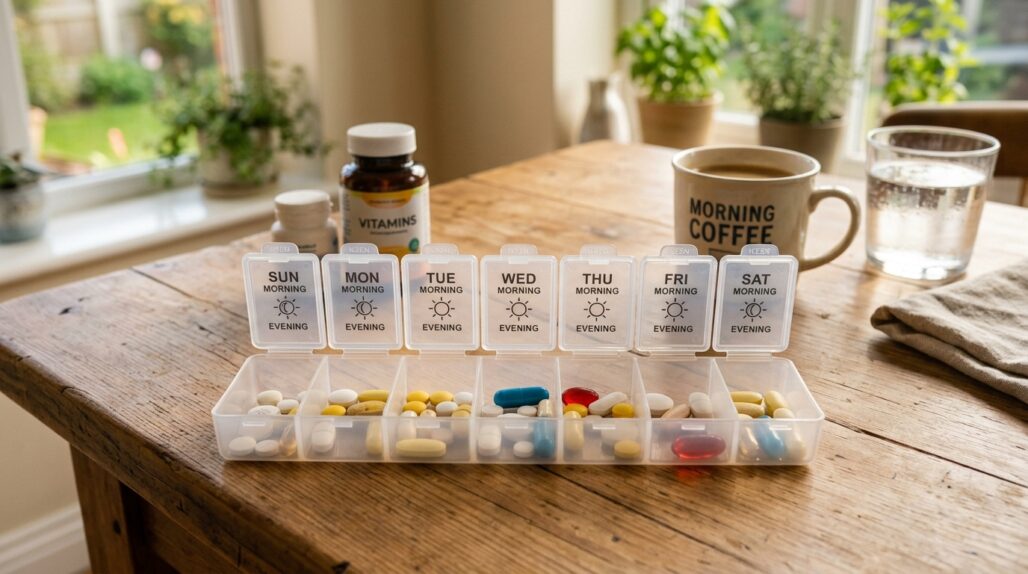
If you specifically need a magnesium antacid for heartburn, keep it, but build the 2-hour gap into your day. An AM/PM organizer makes that automatic: statin in one slot, the antacid in a different one.
One clean way to keep all of this straight is to log both your statin and your magnesium in one place so any overlap is flagged before you add something new. You can do that in StackMyMed (our own free app), which lets you scan the prescription and the supplement together and surfaces timing notes like the antacid one above for you to ask your pharmacist about. It does not diagnose and it does not decide anything for you; it just points out what is worth a question. The low-tech version works just as well: write your full list, every prescription and every supplement with its form and dose, and show it to your pharmacist. Either way, a person who knows your full picture makes the call.


As an Amazon Associate, UsefulVitamins.com earns from qualifying purchases at no extra cost to you.
UsefulVitamins may earn a commission from purchases made through links on this page, at no extra cost to you. Prices are approximate and change often; check current pricing.
The picks below are the easy version of this combination: a non-antacid magnesium so timing never becomes a chore, a pill organizer to keep doses spaced, and a companion many statin users ask about. None of them is the statin, and none replaces it. If you want help matching a dose to your needs, our magnesium dose calculator and our overall best magnesium roundup are good next stops.
What about other statins and other minerals?
The antacid-timing issue is a class effect that shows up for the statins absorbed through the gut, so the same 2-hour habit is a reasonable default for atorvastatin, rosuvastatin, simvastatin, pravastatin, and the rest when a magnesium antacid is involved. Rosuvastatin has the most clearly documented drop, so if you are on Crestor, take the spacing seriously rather than treating it as optional.
The wider pattern is that minerals can bind certain drugs in the gut, and statins are a mild example. The same physics is the reason calcium, magnesium, and iron need spacing away from levothyroxine and from several antibiotics, where the absorption hit can be larger and the spacing rules stricter. If you take more than one of those drugs, the "minerals at a different time of day" habit is worth building once and applying broadly.
One thing readers often look for: a companion supplement for the muscle aches some people get on statins. CoQ10 for statin users is the usual candidate. The evidence on whether it actually relieves statin muscle symptoms is mixed, so treat it as an optional companion rather than a fix, and mention any persistent muscle pain to your prescriber regardless.
Keep the framing straight throughout: none of these supplements is a substitute for your statin, and none of this is a reason to change a prescribed dose. The goal is to take the supplement you want without quietly undercutting the medication.
FAQ
Does magnesium reduce how well my statin works? A magnesium antacid taken at the same time can lower the statin’s blood level. For atorvastatin the cholesterol effect held up anyway; for rosuvastatin the bigger drop is the reason the label asks for 2 hours of spacing. A normal magnesium supplement does not reduce your statin.
Can magnesium help with statin muscle pain? There is no good evidence that magnesium treats statin-related muscle aches, and you should not use it as a substitute for telling your prescriber about the pain. Keeping a normal magnesium intake is fine, but do not expect it to fix the symptom, and do not stop your statin on your own.
Which magnesium is best to take with a statin? A chelated, non-antacid form such as glycinate or citrate, because it has no documented absorption clash and is easy on the stomach. Avoid relying on a magnesium-hydroxide antacid as your daily magnesium if you would rather skip the timing rule.
I take rosuvastatin (Crestor) and milk of magnesia occasionally. What do I do? Keep them apart. Take the Crestor at least 2 hours before the milk of magnesia, per the FDA label. An occasional dose taken well-separated is not a problem; taking them together repeatedly is what undercuts the statin.
Is it ever dangerous to combine magnesium and a statin? Not in healthy people. The combination does not cause a toxic reaction. The one safety caveat is unrelated to the statin: if your kidneys are impaired, high magnesium intake can build up, so that needs a doctor’s input on dose.
Do I need to space my magnesium from other medications too? Sometimes. Minerals can bind drugs like levothyroxine and certain antibiotics more strongly than they bind statins, with stricter spacing. If you take any of those, ask your pharmacist to map out your timing once.
The bottom line
Yes, you can take magnesium with a statin. It is not a dangerous combination, and for the everyday chelated forms (glycinate, citrate) there is no timing rule at all. The only real instruction is for the antacid forms: magnesium hydroxide or oxide can cut statin absorption, so take your statin at least 2 hours before or after them, and take rosuvastatin's spacing especially seriously. Fix the timing, never your dose.
Report any new unexplained muscle pain, tenderness, or dark urine to your prescriber, since that is a statin signal worth checking. And if your kidneys are impaired, get a magnesium dose cleared with your doctor. When in doubt about which magnesium you actually have, show both bottles to your pharmacist. It is the fastest way to a confident answer.
This article is for education and is not medical advice. It does not replace your prescription or a conversation with your own doctor or pharmacist, who know your full health picture.
Reviewed by the UsefulVitamins Editorial Team.
