
You have seen carnosine on supplement shelves, anti-aging skincare labels, and sports nutrition forums. The pitch is appealing: a naturally occurring dipeptide that buffers muscle acid during exercise, scavenges damaging glycation products, and slows cellular aging. But if you have ever swallowed a carnosine capsule and wondered whether any of it actually reached your muscles intact, your skepticism is well-placed. The answer is mostly no — and understanding why leads you to a more useful supplementation decision. The honest verdict: carnosine has real biological functions and credible evidence in specific contexts, but oral bioavailability is a genuine constraint, beta-alanine is usually the smarter supplement for muscle performance, and the anti-aging human data is promising but thin.
What Carnosine Actually Is
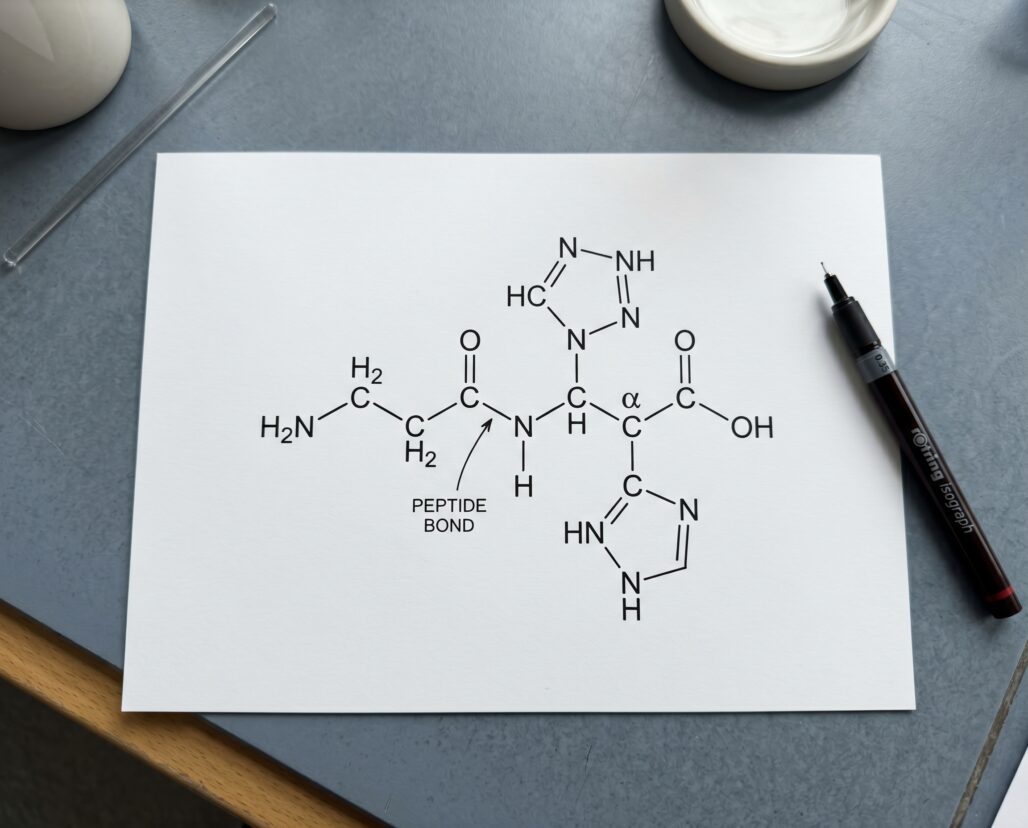
Carnosine is a dipeptide: two amino acids joined by a single peptide bond. The two amino acids are beta-alanine and L-histidine, linked in that order, making the full chemical name beta-alanyl-L-histidine. It is not a synthetic compound or a drug. Your body produces it naturally, primarily in skeletal muscle and brain tissue, where it reaches concentrations of 5 to 10 millimoles per kilogram of wet tissue in fast-twitch muscle fibers — among the highest dipeptide concentrations found anywhere in the body.
The histidine component gives carnosine its usefulness as a pH buffer. Histidine carries an imidazole ring with a pKa around 6.83, which sits close to the physiological pH range of exercising muscle (roughly 6.4 to 7.0). That means histidine-containing compounds can absorb or release protons within the exact pH range where fatigue chemistry operates. Carnosine's concentration in fast-twitch fibers is not accidental: those are precisely the fibers that generate the most metabolic acid during high-intensity effort.
Beyond buffering, carnosine functions as a reactive oxygen species scavenger, a chelator of transition metal ions such as copper and zinc, and a quencher of reactive carbonyl compounds that drive the formation of advanced glycation end products (AGEs). The combination of these properties has made it interesting to researchers studying both sports performance and aging, though the clinical evidence for each application differs considerably. For more on how dipeptides and peptides generally work in the body, see our introduction to peptides.
Carnosine vs. Beta-Alanine: The Bioavailability Problem
Here is the central issue with carnosine as an oral supplement. When you swallow a carnosine capsule, your gut can absorb a meaningful portion of it as the intact dipeptide — a 1991 study (PMID 5423906) found up to 14 percent of ingested carnosine appearing in urine as intact dipeptide over five hours, suggesting intestinal uptake of the whole molecule. But then it meets serum carnosinase.
Human serum carnosinase is an enzyme encoded by the CNDP1 gene that circulates in blood and rapidly cleaves carnosine into its two constituent amino acids — histidine and beta-alanine. Only higher primates produce this serum-circulating form; rodents do not have the equivalent enzyme in blood. A 2024 review in Molecules (PMID 38893364) documents this precisely: intact carnosine is undetectable in human plasma under standard conditions after oral ingestion, and researchers can only measure it when they actively inhibit carnosinase activity in blood samples collected ex vivo.
The practical consequence is that carnosine swallowed as a supplement is largely disassembled in the bloodstream before it reaches skeletal muscle. Your muscles then receive the raw amino acid building blocks — histidine and beta-alanine — rather than the intact dipeptide. Your muscles can reassemble those building blocks into carnosine via the enzyme carnosine synthase, but the rate-limiting step in that synthesis is the availability of beta-alanine, not histidine.
This is why the sports nutrition field largely pivoted from carnosine supplementation to beta-alanine supplementation. By supplying the limiting precursor directly, you bypass the serum carnosinase problem entirely and give muscle carnosine synthase more of what it needs to produce more carnosine in the tissue where it matters. There is also a genetic dimension worth knowing: the CNDP1 gene carries a CTG repeat polymorphism that creates large individual variation in carnosinase activity. People with lower carnosinase activity may absorb meaningfully more intact carnosine from supplements than the average; people with higher activity absorb almost none.
Exercise Performance: What the Evidence Shows
The exercise performance case for carnosine is actually one of the better-supported stories in sports supplementation — but the evidence is built almost entirely on beta-alanine supplementation raising muscle carnosine, not on carnosine supplements themselves.
The International Society of Sports Nutrition (ISSN) published a position stand on beta-alanine in 2015 (PMID 26175657), with a panel of fourteen researchers reviewing the available evidence. Their conclusions were specific. Four to six grams of beta-alanine daily, taken in divided doses over at least two to four weeks, raises muscle carnosine concentrations by approximately 20 to 30 percent after two weeks and 40 to 60 percent after four weeks. The performance effects are clearest for exercise lasting one to four minutes — the zone where intramuscular acidosis is a primary limiter of output. For aerobic exercise up to roughly twenty-five minutes, there is modest benefit. Beyond twenty-five minutes, the evidence becomes sparse.
What kinds of exercise does this translate to? High-intensity interval work, rowing, competitive cycling sprints, and similar efforts in that one-to-four-minute window. Marathon running and long endurance events are unlikely to benefit meaningfully, since sustained-pace aerobic exercise does not push muscle pH into the range where carnosine buffering becomes decisive.
A separate 2010 review by Sale, Saunders, and Harris (PMID 20091069) confirmed the mechanistic picture: beta-alanine availability is the rate-limiting factor in carnosine synthesis because carnosine synthase has a higher Km (lower affinity) for beta-alanine than for histidine, meaning the enzyme is undersaturated with beta-alanine at normal dietary intake levels. Meat and fish provide some dietary carnosine, but conversion to muscle carnosine through normal eating alone does not saturate the synthesis pathway.
Actionable takeaway: If improving performance in high-intensity efforts lasting one to four minutes is your goal, beta-alanine at four to six grams per day in divided doses is the better-evidenced choice over carnosine supplements. Starting with doses around 800 mg or less per serving reduces paresthesia — a harmless tingling or flushing sensation in the skin that roughly half of users experience with larger single doses. The tingling fades within 60 to 90 minutes and disappears with sustained-release formulations or smaller divided doses.
Aging and AGE-Quenching: A Promising but Thin Human Picture
The anti-aging angle for carnosine is mechanistically plausible and supported by extensive laboratory and animal data, but the human clinical trial record is small.
Advanced glycation end products form when sugars react non-enzymatically with proteins and lipids, producing cross-linked, dysfunctional molecular structures that accumulate with age and accelerate tissue damage in conditions like diabetes and chronic kidney disease. Carnosine can intercept reactive carbonyl intermediates — compounds like methylglyoxal and glyoxal — before they complete the glycation cascade, a process called carbonyl quenching.
A 2018 systematic review (PMID 29858687) by Ghodsi and Kheirouri in Amino Acids examined 36 studies on carnosine and AGEs: 19 in vitro, 15 animal, and only 2 human studies. All but two studies showed carnosine could reduce AGE formation. The problem is that "all but two of 36 studies" sounds persuasive until you notice the human count: two. The reviewers explicitly flagged the shortage of human trials as the primary limitation.
The most clinically meaningful human study available is a double-blind, placebo-controlled RCT published in Nutrition Research (PMID 29420997) by Houjeghani and colleagues. Fifty-four adults with type 2 diabetes were randomized to 1,000 mg per day of L-carnosine (two 500 mg capsules) or placebo for twelve weeks. The carnosine group saw statistically significant reductions in fasting glucose (down 13.1 mg/dL), HbA1c (down 0.6 percentage points), triglycerides (down 29.8 mg/dL), carboxymethyl lysine (an AGE marker, down 91.8 ng/mL), and tumor necrosis factor-alpha. Body composition also shifted favorably, with fat-free mass increasing 1.7 percent and fat mass decreasing 1.5 percent. BMI, blood pressure, insulin resistance, and most inflammatory markers did not change significantly.
This is a legitimate RCT with a credible outcome set, and it deserves more credit than the supplement industry typically gives single small trials. But it is one study in a diabetic population, with fifty-four participants, over twelve weeks. Before drawing conclusions about carnosine as a general longevity supplement for healthy adults, this evidence base needs replication at larger scale in different populations. The longevity and anti-aging claims circulating in wellness marketing run considerably ahead of what these two human studies can support.
Actionable takeaway: The AGE-quenching biology is real and the one good RCT is encouraging, particularly for people managing blood glucose. But the human evidence is not yet strong enough to recommend carnosine supplementation as a general anti-aging strategy for healthy individuals.
Topical Carnosine: A Different Conversation
Topical carnosine sidesteps the serum carnosinase problem entirely. Applied to skin, it does not enter the bloodstream in significant quantities, so it never encounters the enzyme that destroys it. The relevant question becomes whether it can penetrate the skin barrier well enough to reach the compartments where glycation occurs.
A 2018 study in Skin Pharmacology and Physiology (PMID 30199874) by Narda and colleagues tested a carnosine-containing facial cream on human skin tissue samples exposed to methylglyoxal, a potent glycation inducer. The cream formulation reduced carboxymethyl-lysine (a key AGE marker) by 150 percent in the epidermis and 122 percent in deeper layers, and reduced pentosidine by 108 and 136 percent respectively. An aqueous carnosine solution without the optimized formulation showed weaker effects.
The important context: this is an ex vivo tissue study, not a controlled clinical trial in living participants. It tells us that a well-formulated topical carnosine product can inhibit methylglyoxal-driven glycation in skin samples — it does not tell us how much this translates to visible anti-aging effects in real people over time. Topical carnosine is a cosmetic ingredient, and marketing claims about topical products are held to a different standard than drug claims. If you are using a skincare product with carnosine, you are applying it in a cosmetic context; you are not administering a drug.
Frequently Asked Questions
Is carnosine the same as beta-alanine?
No. Beta-alanine is one of the two amino acids that make up carnosine. Your muscles use beta-alanine as the rate-limiting precursor to synthesize carnosine. When you take beta-alanine as a supplement, you are supplying the raw material; your muscles build carnosine from it. When you take carnosine as a supplement, most of it is broken down to histidine and beta-alanine in your bloodstream before your muscles can use it as the intact dipeptide.
Does carnosine supplementation cause any side effects?
Oral carnosine supplements in the doses studied (500 to 1,000 mg per day) appear well tolerated in the clinical literature, with no significant adverse effects reported in the available trials. Beta-alanine, the alternative approach to raising muscle carnosine, commonly causes paresthesia — a tingling or flushing sensation in the skin — at single doses above roughly 800 mg. This is harmless and temporary (disappearing within 60 to 90 minutes), and it can be avoided with divided dosing throughout the day or sustained-release formulations.
Can vegetarians and vegans benefit from carnosine supplementation?
Meat and fish are the primary dietary sources of carnosine and beta-alanine. Studies show that vegetarians have muscle carnosine concentrations roughly 26 percent lower than omnivores on average. Beta-alanine supplementation in vegetarians produces the same muscle carnosine increases seen in omnivores, making it a practical way to address the dietary gap. This is one case where beta-alanine supplementation has a clearer rationale for a specific population.
Is carnosine safe for people with kidney disease?
This is a question for a physician, not a supplement article. Carnosinase activity and carnosine metabolism are relevant in the context of diabetic nephropathy (kidney disease associated with diabetes), and the CNDP1 gene polymorphism that affects carnosinase has been associated with differences in kidney disease progression in some populations. Anyone with kidney disease or impaired kidney function should consult their doctor before taking any dipeptide supplement.
Why do some studies use L-carnosine and others just say carnosine?
L-carnosine refers to the naturally occurring form with L-configuration on the histidine residue. This is the form found in human tissue and the form used in clinical research. Some supplement labels say "carnosine" as shorthand for the same compound. D-carnosine (with D-histidine) is a research compound under study for its resistance to carnosinase hydrolysis, but it is not the standard supplement form.
The Bottom Line on Carnosine
Carnosine is a genuine, naturally occurring dipeptide with real biological activity. The mechanisms are not invented — muscle pH buffering, AGE quenching, and antioxidant activity are all documented in real chemistry. The problem is not the biology; it is the gap between the biology and the typical oral supplement. Serum carnosinase breaks down most ingested carnosine before it reaches muscle, which limits how useful carnosine capsules are for the exercise performance application most people buy them for.
If muscle carnosine loading for exercise performance is your goal, beta-alanine supplementation at four to six grams per day in divided doses is the better-supported and more cost-efficient approach. If you are drawn to the AGE-quenching properties and are managing blood glucose or diabetes, the one decent RCT supports 1,000 mg per day of L-carnosine, though it should be taken with full awareness that this is a single small trial. Topical carnosine-containing products are reasonable in a cosmetic skincare context. None of these applications qualify as anti-aging breakthroughs by current evidence standards.
For context on where carnosine fits in the broader landscape of compounds marketed for longevity, our analysis of peptides for longevity examines the human evidence for the most heavily marketed candidates.
Next Steps
- Read What Are Peptides for a grounding in how dipeptides like carnosine are built, absorbed, and used by the body.
- Read Peptides for Longevity to see how carnosine's AGE-quenching claims compare to other anti-aging peptide candidates in terms of human evidence quality.
- If you decide to try beta-alanine, look for a product that specifies the beta-alanine dose per serving, allows easy dose splitting across the day, and ideally carries third-party testing certification.
This article is for informational purposes and not medical advice. Peptides, especially those marketed for therapeutic use, can interact with medications and health conditions. Consult a licensed physician before starting any supplement, particularly if you are pregnant, nursing, taking prescription medications, or managing a chronic condition.
