
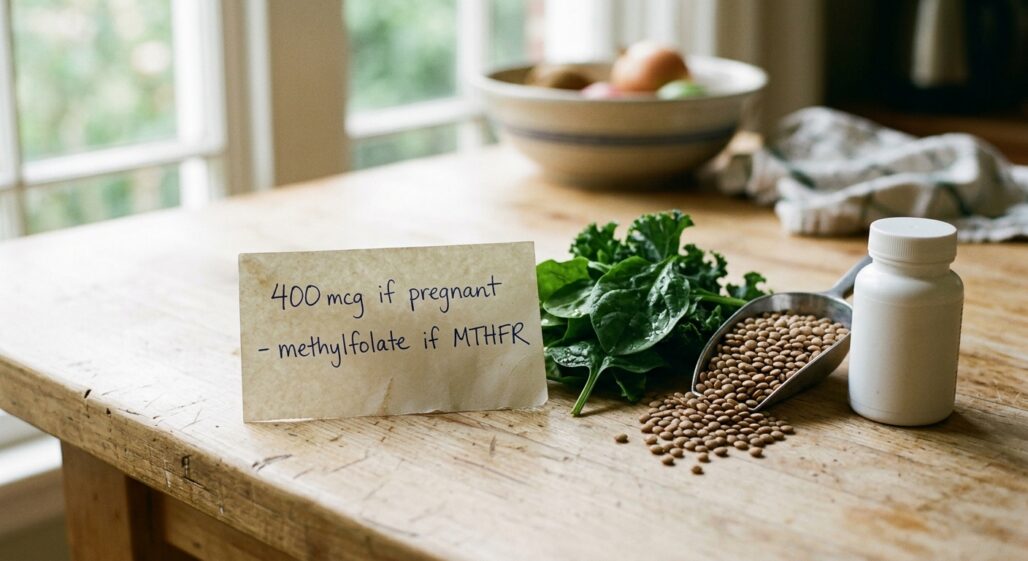
If you are reading about folate, you are probably in one of three camps: planning a pregnancy and trying to do it right, staring at an MTHFR result from a home DNA kit, or wondering whether the methylfolate on the premium shelf is worth triple the price. The short answer: for one specific group, taking folate is one of the best-evidenced things in preventive medicine; for everyone else, the stakes are far lower than the supplement aisle implies. This guide walks through what folate does, the pregnancy recommendation and its guideline grade, what MTHFR honestly means, and how folic acid and methylfolate actually compare in trials.
Before you decide

Standard of care comes first, and here it is unusually clear. The single most important thing this article can tell you: anyone who could become pregnant should take 400 mcg of folic acid daily, because the neural tube closes in the first 28 days, often before a pregnancy is even confirmed. Diet alone is not a reliable substitute during that window.
The most important safety point before you start: high-dose folic acid can correct the anemia of a vitamin B12 deficiency while the nerve damage of that deficiency quietly continues. If you are over 50, vegan, on long-term metformin or acid-suppressing drugs, or have a malabsorption condition, check your B12 status before loading up on folate.
One more thing to settle first. An MTHFR variant on a DNA report is not a diagnosis and is not a reason to panic. The American College of Medical Genetics practice guideline found a lack of evidence for routine MTHFR testing in the workup of blood clots or recurrent miscarriage. For most people, the question is not whether they have the variant, it is whether they are getting enough folate at all.
For how we weigh guidelines against supplement-industry claims, see our supplement review process.
Folate vs folic acid vs methylfolate: what the words mean

These three terms get used interchangeably in marketing, but they are not the same molecule, and the differences matter.
Folate is the umbrella term for vitamin B9 in all its forms, including the versions that occur naturally in food like leafy greens and legumes. Food folate is a mix of forms your gut has to process before your cells can use them.
Folic acid is the synthetic, fully oxidized form used in supplements and in fortified flour, rice, and cereal. It is stable, cheap, and very well absorbed. Your body converts folic acid through several steps into the active form it actually uses.
That active form is L-5-methyltetrahydrofolate, usually shortened to 5-MTHF or "methylfolate," the version that circulates in your blood and does the work inside cells. Methylfolate supplements skip the conversion steps by delivering folate already in its active shape. That is the entire pitch behind the premium products. Whether skipping those steps changes outcomes is the real question, and we will get to the trials.
Because folic acid absorbs better than food folate, the NIH Office of Dietary Supplements measures intake in dietary folate equivalents (DFE), which adjust for that difference. The RDA for most adults is 400 mcg DFE per day, rising to 600 mcg DFE in pregnancy and 500 mcg DFE while breastfeeding.
What folate actually does in the body
Folate is a workhorse in two processes that explain almost everything about why it matters.
First, folate is essential for making and repairing DNA, which is why the demand spikes wherever cells are dividing fast, such as a developing embryo or the bone marrow producing red blood cells. Run low and the marrow churns out oversized, immature red cells, the picture called megaloblastic anemia.
Second, folate helps recycle homocysteine into methionine. When folate is scarce, homocysteine builds up in the blood. For years that link drove the theory that folate-and-B-vitamin supplements would cut heart attacks and strokes by lowering homocysteine.
That theory has largely not held up. Large trials lowering homocysteine with B vitamins did not deliver the cardiovascular payoff the marker predicted, which is exactly why homocysteine is no longer treated as a target to chase with supplements in most patients. It is a useful illustration of a recurring lesson: moving a lab number is not the same as changing an outcome.
Where folate's role is not in doubt is fetal development. Adequate folate around conception is one of the few nutrient interventions with hard, outcome-level evidence behind it.
The pregnancy recommendation: a Grade A you can trust

This is the part of the folate story that is settled, and it is worth stating plainly.
The U.S. Preventive Services Task Force gives folic acid supplementation a Grade A recommendation, its strongest tier, meaning the Task Force found convincing evidence that the benefit substantially outweighs any harm. It advises that all persons planning to or who could become pregnant take a daily supplement containing 400 to 800 mcg of folic acid.
Timing is the crux. The USPSTF recommends starting at least a month before conception and continuing through the first two to three months of pregnancy. The reason is biological: the neural tube closes within the first 28 days after conception, often before a person knows they are pregnant. Waiting for a positive test is frequently too late.
The CDC frames it the same way and adds the population logic: because roughly half of U.S. pregnancies are unplanned, the recommendation extends to anyone who could become pregnant, not only those actively trying. Folic acid at this dose lowers the risk of neural-tube defects such as spina bifida and anencephaly.
One important exception. If you have had a previous pregnancy affected by a neural-tube defect, the CDC advises a much higher dose, around 4,000 mcg daily, but only under a clinician's direction. Do not self-prescribe that dose. If this applies to you, talk to your OBGYN before your next pregnancy.
For broader prenatal nutrient questions, our complete guide to iron covers the other mineral that commonly runs short in pregnancy.
MTHFR, explained without the hype
MTHFR is the most over-interpreted result in consumer genetics, so this section tries to be precise.
MTHFR is a gene coding for the enzyme that converts folate into its active 5-MTHF form. The most-studied variant, C677T, produces a slightly less efficient version of that enzyme; the homozygous (TT) form is genuinely common, carried by an estimated 10 to 15 percent of North American white populations and around 25 percent of Hispanic populations per MedlinePlus.
Here is the part the wellness internet skips. Most people with an MTHFR variant are healthy, and their children are typically unaffected. The variant modestly reduces enzyme activity; it does not switch folate metabolism off. With adequate folate intake, carriers process it perfectly well.
The ACMG practice guideline is blunt about clinical use: it recommends against ordering MTHFR genotyping in the workup of thrombophilia or recurrent pregnancy loss, because meta-analyses disproved the link between the variant and venous clots, and between mild homocysteine elevation and coronary disease. The variant has minimal clinical utility as a test.
The real question is not "do I have the variant," it is "am I getting enough folate," and the answer to that is the same whether you carry it or not. A common variant that affects 1 in 8 people, with no evidence-based treatment beyond the folate everyone should already get, is not a diagnosis. It is a reason to make sure your intake is adequate.
Folic acid vs methylfolate: what the trials actually show
This is where the marketing and the evidence diverge most, so look at the trials directly.
The pitch for methylfolate is that carriers of MTHFR variants cannot convert folic acid well, so they need the pre-activated form. It is a tidy story. The trial data are more sober.
In a randomized controlled trial of 220 women with recurrent miscarriage, researchers compared 5-MTHF against folic acid specifically in carriers of MTHFR C677T and A1298C variants. Serum folate rose more in the 5-MTHF group, but miscarriage rates were no different, and the authors concluded the data did not support any benefit of methylfolate over folic acid even in variant carriers. Better blood number, same clinical outcome.
A 2024 randomized trial of pregnant women in Canada found that (6S)-5-MTHF was as effective as folic acid at maintaining maternal folate status. Its one real distinction: it produced lower levels of unmetabolized folic acid in the blood. That is a measurable biochemical difference, not a demonstrated health advantage.
And the decisive point: every gold-standard trial proving that supplemental folate prevents neural-tube defects used folic acid, not methylfolate. No methylfolate product carries that outcome-level evidence. Choosing the form with the proven track record for the one outcome that matters most in pregnancy is a defensible default.
So methylfolate is legitimate, but the tradeoff is cost and a thinner evidence base. For a carrier who simply prefers the active form, methylfolate is a reasonable choice; it is not a medical necessity, and it does not buy a better pregnancy outcome. We break the form comparison down fully in methylfolate vs folic acid.
| Form | Best for | Outcome evidence | Practical note |
|---|---|---|---|
| Folic acid | Pregnancy, fortification, general adequacy | Strongest; all NTD-prevention trials used it | Cheap, stable, well absorbed |
| L-methylfolate (5-MTHF) | MTHFR carriers who prefer the active form | Equivalent for folate status; no NTD trials | Costs more; lowers unmetabolized folic acid |
| Food folate | Maintenance in non-pregnant adults | Adequate but absorbed less efficiently | Greens and legumes; hard to overdo |
The B12-masking caution and who actually benefits
This is the safety point most folate articles bury, and it deserves to be near the front.
High intakes of folic acid can correct the megaloblastic anemia caused by a vitamin B12 deficiency. That sounds helpful, but it removes the early warning sign while the irreversible neurological damage of B12 deficiency keeps progressing, which is the central reason the NIH sets a folic acid upper limit of 1,000 mcg per day for adults. Reassuringly, the CDC notes that B12 status can be measured directly by lab tests, and that fortification has not made undetected B12 deficiency more likely. The practical rule: if you are in a B12-risk group, get B12 checked rather than relying on anemia to flag it.
The unmetabolized folic acid debate sits in the same uncertain space. Circulating folic acid is common since fortification, and hypotheses link it to immune and other effects, but the CDC states no confirmed health risks have been found and that 400 mcg daily has not been shown to cause harm.
So who genuinely benefits from a folate supplement? The clear winners are anyone who could become pregnant; nearly everyone else is closing a small gap that a decent diet already fills. People with diagnosed deficiency, malabsorption conditions like celiac disease, heavy alcohol use, or those on methotrexate or certain anti-seizure drugs may need it on a clinician's advice. If a clinician is supplementing folate for an anemia, B12 should be assessed alongside it, as our supplements for anemia overview explains.
For most healthy, non-pregnant adults eating greens, beans, and fortified grains, a standalone folate pill is solving a problem they do not have.
Food sources and how easy the RDA is to hit
Folate is one of the more achievable nutrients from diet, which is part of why routine supplementation is unnecessary for many.
Leafy greens, legumes, and fortified grains do most of the work; lentils, spinach, asparagus, broccoli, oranges, and enriched bread and cereal are reliable sources. Because U.S. flour and rice are fortified with folic acid, many people get a meaningful baseline without trying.
A cup of cooked lentils alone supplies a large share of the daily target. Add a serving of greens and a fortified breakfast cereal and most non-pregnant adults clear 400 mcg DFE comfortably.
The honest caveat is the pregnancy window. Even a good diet does not reliably guarantee the periconceptional folate levels the neural tube needs, which is precisely why the supplement is recommended on top of food rather than instead of it. Food first is the right instinct for general health; for prevention of neural-tube defects, a supplement is the belt-and-suspenders that the evidence supports.
FAQ
Should I take folate or folic acid? For pregnancy prevention, folic acid has the proven track record and is the default. For general maintenance, food folate is fine. Methylfolate is an optional alternative, not an upgrade for most people.
Do I need methylfolate if I have an MTHFR variant? No, you do not need it. Trials show methylfolate raises blood folate but has not beaten folic acid on clinical outcomes, even in variant carriers. If you prefer the active form, it is a reasonable choice.
Can folic acid hide a B12 deficiency? It can mask the anemia while nerve damage continues, which is why folic acid has a 1,000 mcg daily upper limit. If you are over 50, vegan, or on metformin, ask for a B12 check.
When should I start folic acid for pregnancy? At least a month before conception, because the neural tube closes within the first 28 days, often before you know you are pregnant.
Is unmetabolized folic acid dangerous? The CDC reports no confirmed health risks at recommended doses. The hypotheses remain unproven, and 400 mcg daily has not been shown to cause harm.
The bottom line on folate
Folate is a rare case where preventive medicine has a crisp, high-grade answer for one group and a much quieter answer for everyone else. If you could become pregnant, 400 mcg of folic acid daily starting before conception is a Grade A recommendation and one of the highest-value things you can do; if you cannot, a good diet almost certainly has you covered. MTHFR is common, over-marketed, and not a diagnosis; methylfolate is a legitimate but unnecessary alternative for most carriers. And whenever folate is in play at higher doses, the B12 question comes with it.
Next steps:
- If pregnancy is possible, start 400 mcg folic acid daily now, before you are trying.
- If you are weighing the premium form, read methylfolate vs folic acid before paying extra.
- If you are in a B12-risk group, ask for a B12 test before taking high-dose folate.
Reviewed by Michael Ward, MD MPH, Preventive Medicine, focused on guideline-based chronic disease management. See Michael Ward's author page and our best folate supplements roundup for product specifics.
This article is for informational purposes and not medical advice. Folate intake interacts with vitamin B12 status and with medications such as methotrexate and some anti-seizure drugs. Consult a licensed physician before starting any supplement, particularly if you are pregnant, planning a pregnancy, nursing, taking prescription medications, or managing a chronic condition.
