
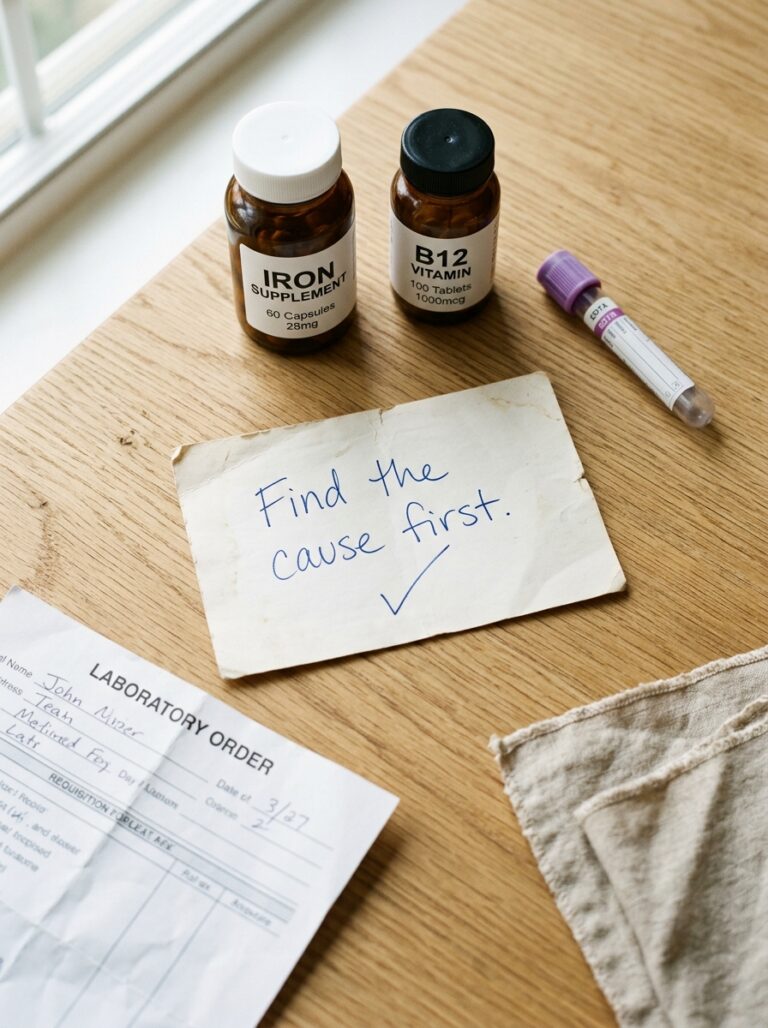
If you're searching for the best supplements for anemia, you've probably already pictured a bottle of iron. Hold that thought, because anemia isn't a diagnosis on its own, it's a finding that has at least three common nutritional causes that need three different supplements. The picks at the bottom are the forms I'd keep in my own family's cabinet, but only after the right one is confirmed.
Affiliate disclosure: this article contains affiliate links. As an Amazon Associate, UsefulVitamins.com earns from qualifying purchases at no extra cost to you.
Before you decide
Do not start iron on your own before you know your anemia is from iron deficiency. Taking iron for a B12 or folate anemia wastes weeks while the real deficiency continues, and routine iron can mask a slow gastrointestinal bleed that needs investigating, not supplementing.
The single most important step is getting basic bloodwork first, a complete blood count plus ferritin, and B12 and folate if the cells are large. That distinguishes the three common causes, and supplementing blind treats the wrong one as often as the right one.
Anemia is also not always nutritional. Chronic disease, kidney problems, thyroid disease, and inherited conditions like thalassemia all cause anemia that no supplement fixes, which is why a clinician should interpret the labs.
You can see how I weigh evidence and conflicts of interest on the how we review supplements page. If you're pregnant, on a blood thinner or proton-pump inhibitor, or managing a diagnosed condition, treat any supplement as something to clear with your doctor first.
What anemia actually is

Anemia means your blood carries less oxygen than it should, because you have too few red cells or too little hemoglobin inside them. The symptoms that send people searching, fatigue, breathlessness on stairs, pale skin, cold hands, are the body running short on oxygen delivery.
The useful split for choosing a supplement is the size of the red cells, a number called MCV on your complete blood count. It points straight at the likely cause.
Small cells (microcytic) most often mean iron deficiency, the world's most common nutritional anemia, where there isn't enough iron to build hemoglobin. Large cells (macrocytic) usually mean a B12 or folate deficiency, because both vitamins are needed to make DNA in developing red cells, and without them the cells grow oversized and few. This large-cell pattern is the textbook megaloblastic anemia described in StatPearls.
There is no first-line drug for nutritional anemia the way there is for many chronic conditions. The "treatment" is replacing what's missing, which is exactly why identifying the deficiency matters more than the brand of supplement.
Strongest evidence supplements
These three nutrients are the answer for the vast majority of nutritional anemia, but each treats a specific deficiency. Match the supplement to your labs, not to the symptom.
Iron (for iron-deficiency anemia)
Why it helps: Iron is the core of hemoglobin, the molecule that carries oxygen. In confirmed iron deficiency, replacing iron rebuilds hemoglobin and resolves the anemia over weeks to months.
The evidence and the modern twist: Oral iron works, but a 2020 study in Haematologica by Stoffel and colleagues found that giving iron on alternate days absorbs better than daily dosing. Total iron absorbed from a 200 mg dose every other day was roughly twice that from 100 mg on consecutive days, because each dose briefly raises hepcidin, the hormone that blocks the next day's absorption. Their earlier Lancet Haematology trials showed the same pattern and that splitting into twice-daily doses only raised hepcidin further.
Dose and form: Trials use 60 to 120 mg of elemental iron. A gentler chelated form like ferrous bisglycinate tends to cause less nausea and constipation than ferrous sulfate at comparable absorption. I cover the salts in detail in the complete guide to iron and rank specific products in best iron supplements.
Skip if: your MCV is high (large cells), your ferritin is normal, or you have hemochromatosis. Iron for a non-iron anemia is useless and not harmless.
Vitamin B12 (for B12-deficiency anemia)
Why it helps: B12 is required to make DNA in red-cell precursors. Deficiency, common in strict vegans and in pernicious anemia where the gut can't absorb it, produces a macrocytic anemia plus, if untreated, nerve damage.
The evidence: Oral B12 is often as effective as injections for maintenance. A review of oral B12 for pernicious anemia notes that roughly 1% of a high oral dose is absorbed passively, without intrinsic factor, enough that 1,000 mcg daily can replenish stores in many patients.
Dose and form: A typical replacement is 1,000 mcg oral cobalamin daily; pernicious anemia or post-surgical malabsorption may need injections your clinician manages. Look for cyanocobalamin or methylcobalamin.
Skip if: your anemia is microcytic with low ferritin, that's iron, not B12.
Folate (for folate-deficiency anemia)
Why it helps: Folate, like B12, builds red-cell DNA, and a shortfall causes the same large-cell anemia. Causes include poor intake, heavy alcohol use, pregnancy, and some medications.
The evidence: Folic acid corrects folate-deficiency anemia reliably. The NIH Office of Dietary Supplements sets the adult RDA at 400 mcg DFE, and clinical doses of 1 to 5 mg daily are standard for treating the deficiency.
Dose and form: 1 to 5 mg folic acid daily until corrected. The critical caution: high-dose folate can hide a B12 deficiency, fixing the anemia while nerve damage progresses silently, so B12 must be checked before treating folate alone.
Skip if: B12 status is unknown, get it tested first.
| Nutrient | Treats which anemia | Cell size clue (MCV) | Typical treatment dose |
|---|---|---|---|
| Iron (ferrous bisglycinate) | Iron-deficiency anemia | Low / small cells | 60 to 120 mg elemental, alternate days |
| Vitamin B12 | B12-deficiency / pernicious anemia | High / large cells | 1,000 mcg oral daily (or injections) |
| Folate (folic acid) | Folate-deficiency anemia | High / large cells | 1 to 5 mg daily until corrected |
How to take iron well

If iron is your confirmed need, how you take it changes how much you actually absorb, and a few habits make the difference between progress and a stalled ferritin.
Take it on an empty stomach if you tolerate it, and separate iron from calcium, dairy, coffee, and tea by a couple of hours, since calcium and the polyphenols in coffee and tea blunt non-heme iron absorption. I unpack absorption mechanics in heme vs non-heme iron bioavailability.
Vitamin C is the famous companion, and it genuinely enhances non-heme iron absorption in absorption studies reviewed by Teucher and colleagues. But here's the honest nuance: a 2020 randomized trial in JAMA Network Open found that adding a vitamin C pill did not improve hemoglobin recovery over iron alone (a 0.16 g/dL difference, well within the equivalence margin).
So a glass of orange juice with your dose is fine, but you don't need to buy a separate vitamin C supplement to make iron work. The bigger lever is the alternate-day schedule above.
Popular but evidence-thin
"Blood-building" herbal and food-based anemia supplements are heavily marketed, from beetroot and spirulina to nettle and "liquid iron" tonics. They appear all over social media as gentle alternatives to iron tablets.
The reality: most deliver small, variable amounts of nutrients with little controlled trial evidence for correcting a true deficiency anemia. If your ferritin is genuinely low, a measured dose of a known iron form will move the needle far more reliably than a botanical blend with an unlisted iron content. They're a poor substitute for treating a confirmed deficiency, and a worse substitute for finding its cause.
When to see a doctor
This is the safety lane, and with anemia it is not optional. See a clinician before self-treating if you have anemia and any of these, because the supplement is the easy part and the cause is the part that matters.
Get evaluated promptly for black or bloody stools, blood in urine, heavy menstrual bleeding, unexplained weight loss, or anemia in a man or postmenopausal woman, where occult gastrointestinal bleeding is the most common cause and the standard workup is endoscopy, per the AGA clinical practice guidelines on iron-deficiency anemia. Blindly taking iron can normalize your labs while a treatable bleed, or even a cancer, goes undetected.
Also see a doctor for numbness, tingling, balance problems, or memory changes with anemia, which can signal B12-related nerve damage that needs prompt treatment, not a folate pill.
FAQ
Can I just take an iron supplement if I feel tired?
No. Fatigue has many causes, and iron only helps if you're actually iron-deficient. Taking it without confirmation can mask a bleed or treat the wrong deficiency. Get a complete blood count and ferritin first.
What's the difference between B12 and folate anemia?
Both produce large red cells, so the blood count looks similar. Only a B12 and folate level distinguishes them, and the distinction matters because folate alone can mask B12 deficiency while nerve damage progresses.
Why does my doctor want a colonoscopy for "just" anemia?
Because in adult men and postmenopausal women, iron-deficiency anemia is often the first sign of slow bleeding in the gut. Finding the source is the point, not the anemia number itself.
Is taking iron every other day really better?
For absorption, often yes. Stoffel's trials found alternate-day dosing absorbs more total iron than daily, by letting the hepcidin spike settle. Confirm the schedule with whoever's monitoring your labs.
How long until iron supplements work?
Hemoglobin typically rises over several weeks, but rebuilding ferritin stores takes months. Don't stop when you feel better, and recheck labs as your clinician directs.
The bottom line on anemia supplements
The right anemia supplement is whichever nutrient your bloodwork shows is missing, iron for microcytic anemia, B12 or folate for macrocytic anemia, and the wrong one is anything chosen before you know. Most "best supplements for anemia" lists skip straight to iron; the more useful move is to diagnose first, then dose smart, including the alternate-day iron trick the evidence now supports.
Next steps:
- Get a complete blood count plus ferritin (and B12/folate if cells are large) before buying anything
- If iron is confirmed, consider a gentle form on alternate days and keep it away from coffee and calcium, see best iron supplements
- See a clinician about the cause, especially if you have any bleeding, neurological, or unexplained-weight-loss symptoms
Reviewed by Michael Ward, MD MPH, Preventive Medicine, focused on guideline-based chronic disease management. See more from Michael Ward. This article is educational and is not a substitute for individualized medical advice; talk to your doctor before starting a supplement, and seek prompt evaluation of any new or unexplained anemia.
Recommended Products


As an Amazon Associate, UsefulVitamins.com earns from qualifying purchases at no extra cost to you. We only recommend products supported by published research or third-party testing.
