
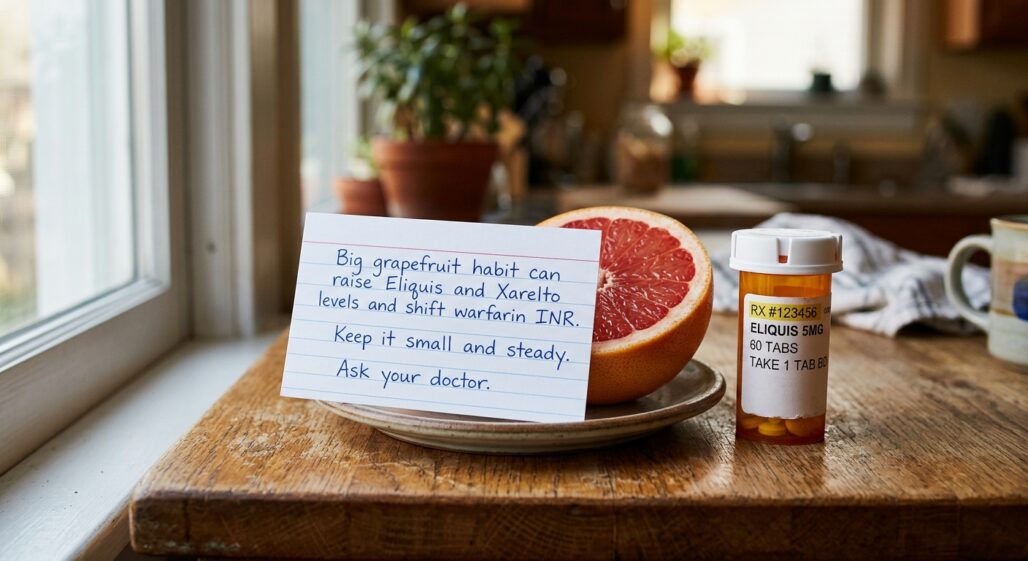
Before you decide
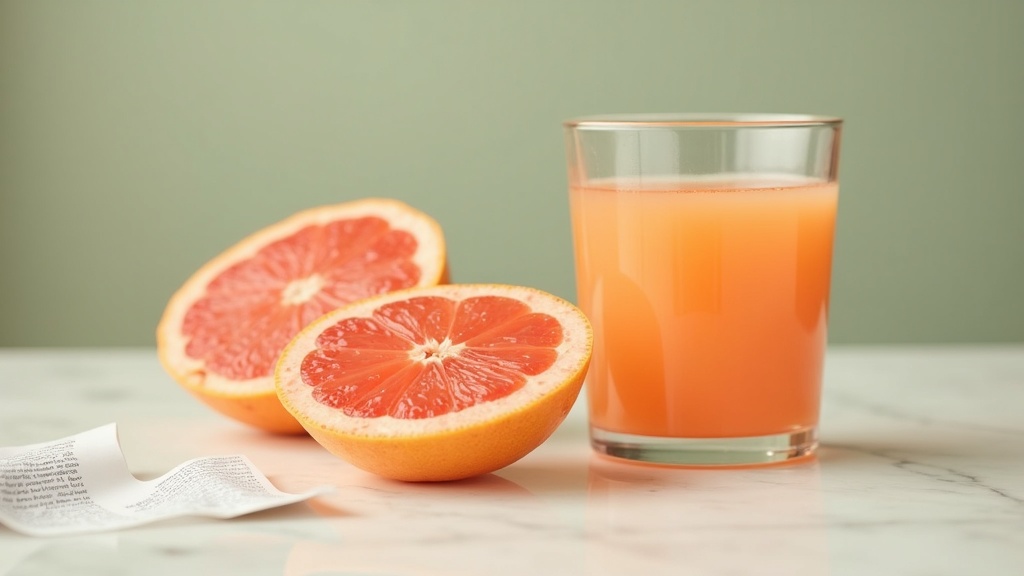
This is general health information, not medical advice, and it does not replace your prescriber or pharmacist. Blood thinners sit in a narrow safety window where both too much drug (bleeding) and too little (clot) are dangerous, so nothing here is a reason to change a dose on your own.
Never stop, skip, or adjust an anticoagulant because of something you read about grapefruit. The standard of care for atrial fibrillation, deep vein thrombosis, and pulmonary embolism is a correctly dosed anticoagulant, and food is a layer on top of that, not a substitute. If you are skipping or self-tapering the drug, the grapefruit conversation is moot.
A few people should be most careful here. Anyone already on a second drug that blocks the same enzyme (certain antifungals like ketoconazole, the antibiotic clarithromycin, some HIV protease inhibitors), anyone with reduced kidney or liver function, and older adults on the 2.5 mg twice-daily Eliquis dose all have less margin for error.
Call your doctor or pharmacist promptly if you notice unusual bruising, gums that will not stop bleeding, pink or red urine, black or tarry stools, or a headache that comes on hard and fast. Those are bleeding warning signs, and they are a reason to seek care the same day, not to wait for your next refill.
What the grapefruit interaction actually is
Grapefruit is not toxic to your blood thinner. The issue is a traffic jam at the gut wall, where your body decides how much of a swallowed drug ever reaches your bloodstream.
Two systems do that gatekeeping. The enzyme CYP3A4 in your intestinal lining chemically breaks down many drugs before they are absorbed, and a pump called P-glycoprotein actively shoves some drug molecules back out into the gut. Together they keep a chunk of each dose from ever entering circulation.
Grapefruit contains furanocoumarins, compounds that disable intestinal CYP3A4 for hours. According to the FDA consumer update on grapefruit and drug interactions, this lets more of the drug slip through, so blood levels run higher than the prescriber planned for. The agency notes that as little as one cup of juice or two grapefruit segments can produce the effect, and that it can persist for a day or more after a single serving.
Both Eliquis and Xarelto are cleared partly by exactly these two systems. That is why a strong enough blocker raises their levels and, in theory, the bleeding risk that comes with them. Warfarin is a different molecule on a different pathway, which is why its grapefruit story is messier, and we will treat it separately below.
How big is the effect, really
Here is where you need numbers, not vibes. No one has run a clean human trial of grapefruit juice plus Eliquis or Xarelto, so we read across from the prescription drugs that block the same enzymes, and from grapefruit's measured effect on similar substrates.
For apixaban (Eliquis), a controlled crossover study by Frost and colleagues in the British Journal of Clinical Pharmacology gave healthy volunteers ketoconazole, a strong dual CYP3A4 and P-glycoprotein blocker. Apixaban exposure (AUC) rose by about 99%, roughly doubling, and peak level climbed about 62%. A moderate blocker, diltiazem, raised AUC by a more modest 40%.
For rivaroxaban (Xarelto), the FDA prescribing information on DailyMed reports that ketoconazole raised rivaroxaban AUC by 50% and peak level by 40%, with matching increases in its blood-thinning effect, and it instructs prescribers to avoid combining Xarelto with strong dual inhibitors.
Now the honest part. Grapefruit is a weaker, gut-only inhibitor than ketoconazole, so the real-world bump from a normal grapefruit serving is almost certainly smaller than those drug-on-drug figures. A 2021 review in the International Journal of Molecular Sciences concluded that grapefruit juice can potentially raise the plasma levels of all direct oral anticoagulants, while flatly noting that direct human interaction trials do not yet exist.
What grapefruit can do to a comparable drug is not trivial, though. In a controlled study in the British Journal of Clinical Pharmacology, grapefruit juice three times daily raised levels of ticagrelor, another antiplatelet drug handled by CYP3A4, to 221% of control. That is a heavy-grapefruit signal, and it is the reason the verdict is "keep it small," not "ignore it."
Warfarin is a separate, mixed picture

Warfarin does not run mainly through the CYP3A4 and P-glycoprotein doorway that controls the newer drugs, so do not assume the Eliquis logic copies over.
The evidence genuinely conflicts. In one small controlled study, ten men stable on warfarin drank three 8-ounce glasses of grapefruit juice daily for a week with no significant change in their prothrombin time or INR. That is reassuring for moderate, steady intake.
Against that sit real case reports. A documented case in SAGE Open Medical Case Reports describes a 65-year-old man on warfarin whose INR jumped from 1.7 to 4.77 after he started eating one whole grapefruit daily for three days; it normalized once he stopped. An INR near 5 is well above the usual 2 to 3 target and carries real bleeding risk.
The practical reading is about consistency, not abstinence. With warfarin, the danger is a sudden change in how much grapefruit you eat, because your INR was calibrated to your old diet. A reader who quietly triples their grapefruit habit between blood draws is the one who gets surprised. This is the same logic UV applies to vitamin K, covered in our piece on the warfarin and vitamin K balance.
What to actually do
The goal is simple: get the benefit of citrus without quietly moving your drug level. Here is the tradeoff, laid out by scenario.
| Your situation | Grapefruit guidance | Why |
|---|---|---|
| Eliquis or Xarelto, no other interacting drug | Occasional half grapefruit is usually low risk; avoid a large daily habit | Grapefruit is a weaker inhibitor than the avoided prescription drugs, but heavy intake stacks the effect |
| Eliquis or Xarelto plus an azole antifungal, clarithromycin, or HIV protease inhibitor | Talk to your prescriber before adding grapefruit at all | The other drug already blocks the same enzyme; grapefruit adds to a load that is already near the avoid line |
| Warfarin, INR in target on your current diet | Keep grapefruit intake steady week to week; do not start or stop a daily habit between draws | Your dose was tuned to your current intake; the risk is the change, not the fruit itself |
A few concrete habits. If you want grapefruit, separate it from your dose and keep the amount the same every week rather than bingeing on weekends. Spacing helps because the gut-enzyme block is strongest right after you eat it.
Watch the hidden sources too. Grapefruit shows up in fruit blends, "red" citrus juices, and the bitter Seville oranges used in marmalade, all of which carry the same furanocoumarins. A morning juice labeled simply "citrus blend" can be doing the same thing as a glass of straight grapefruit juice.
If you juggle several supplements and prescriptions, our companion app StackMyMed can help you log the stack and flag a conflict like this, though it spots and spaces, it does not replace your pharmacist's review.
Who is most at risk
Risk is not evenly spread. The people with the least margin are those whose drug levels are already pushed up by something else, or whose bodies clear the drug slowly to begin with.
That includes patients combining Eliquis or Xarelto with a strong CYP3A4 inhibitor, where the FDA Xarelto label tells prescribers to avoid the combination outright. It also includes older adults, people with impaired kidney function, and anyone on the reduced 2.5 mg twice-daily Eliquis dose, where a doubling of exposure matters more.
Warfarin patients with a history of swinging INRs are the other group to flag. If your INR is already hard to keep in range, a moving grapefruit habit is one more variable you do not need. A stable diet is part of stable anticoagulation.
This is also the moment to mention what we will not cover: this is a food-and-drug-level article, and the broader map of which supplements and foods touch which drugs lives in our interaction reference hub and the dedicated grapefruit drug interactions overview.
When to see a clinician
Bring it up at a routine visit if you take any blood thinner and grapefruit is part of your regular diet, or if you are about to start either one. A two-minute conversation now is cheaper than an unplanned INR check or an emergency bleed later.
Seek care promptly, not at your next appointment, if you have signs of too much anticoagulation: unusual or spreading bruises, bleeding gums or nosebleeds that will not stop, blood in urine or stool, unusually heavy periods, or a sudden severe headache. Those symptoms plus a recent change in grapefruit intake are worth a same-day call.
On the other side, if you are on warfarin and have recently cut grapefruit out, ask whether your INR should be rechecked, because removing an inhibitor can let levels drift the other way. Your anticoagulation clinic would rather hear from you than guess.
FAQ
Can I ever eat grapefruit on Eliquis or Xarelto?
For most people not on a second interacting drug, an occasional half grapefruit is generally considered low risk. The thing to avoid is a large daily habit, and the safest move is to confirm with your own pharmacist who knows your full medication list.
Does grapefruit juice count the same as the whole fruit?
Yes, and juice can be more concentrated. Both the fruit and the juice carry the furanocoumarins that block intestinal CYP3A4, so a daily glass of juice deserves the same caution as the fruit.
How long does one grapefruit affect my gut enzymes?
The effect outlasts the meal. The FDA notes the interaction can persist for a day or more after a single serving, which is why spacing it from your dose only partly helps and keeping the amount small matters more.
What about other citrus like oranges or lemons?
Standard sweet oranges, lemons, and limes do not meaningfully block CYP3A4. The exceptions are grapefruit, pomelo, and bitter Seville oranges (marmalade oranges), which share the same active compounds.
Is grapefruit a bigger deal for warfarin or for the newer drugs?
Mechanistically the clearer signal is with Eliquis and Xarelto, because they ride directly on CYP3A4 and P-glycoprotein. Warfarin's link is real in case reports but inconsistent in controlled data, so for warfarin the rule is consistency rather than avoidance.
Conclusion: the bottom line on grapefruit and blood thinners
Grapefruit and blood thinners are not a hard contraindication for most people, but they are not a free pass either. Large or newly started grapefruit intake can raise Eliquis and Xarelto levels and can shift warfarin INR, so the safe play is to keep your intake small and steady and to clear it with your prescriber.
What this article adds that most search results skip: it pins the magnitude to real numbers (apixaban exposure roughly doubled by a strong blocker, rivaroxaban up 50%, a warfarin INR documented jumping to 4.77) instead of the vague "grapefruit interacts with blood thinners" you will read elsewhere, and it separates the mechanism-clear DOACs from warfarin's genuinely mixed evidence.
Next steps:
- If you take Eliquis or Xarelto, check whether any of your other medicines is a CYP3A4 inhibitor, then ask your pharmacist about your grapefruit habit.
- If you take warfarin, lock your grapefruit intake to a steady weekly amount and tell your anticoagulation clinic if it changes.
- For the wider picture of food and supplement interactions, read our grapefruit drug interactions overview and how we vet this content in how we review supplements.
Reviewed by the UsefulVitamins Editorial Team. See more from the UsefulVitamins Editorial Team.
This article is for informational purposes and not medical advice. Anticoagulants interact with foods, supplements, and other medications, and the safe dose is individual. Consult your prescriber or pharmacist before changing your diet or supplements, and never stop or adjust a blood thinner on your own.
