
Best Peptide Tracker Apps: Honest Comparison for GLP-1 and Prescription Peptide Users
If you just started Wegovy, Zepbound, or another prescription GLP-1 and someone told you to "just download a tracker app," you might have opened the App Store and found forty options staring back at you. So which one is actually worth your time, and do any of them genuinely improve outcomes for people on peptide therapy?
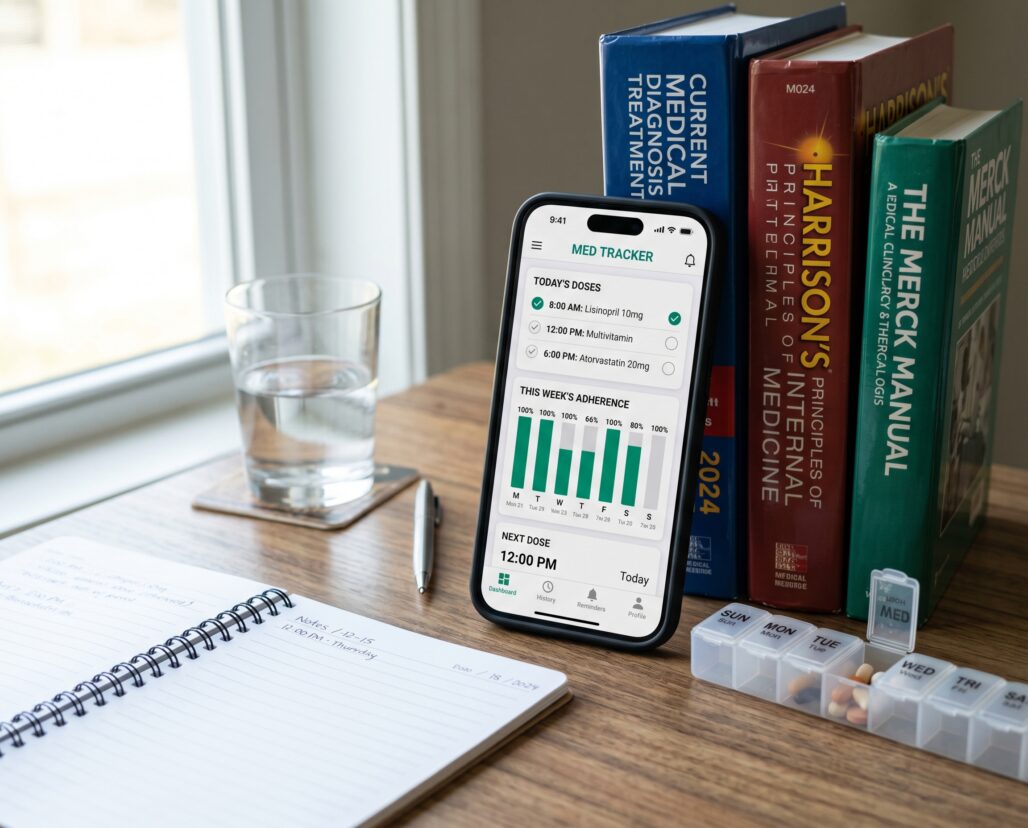
The honest answer: a handful of purpose-built apps are meaningfully useful for prescription GLP-1 users, primarily because they solve a real problem — injection-site rotation, dose titration schedules, and side-effect pattern recognition — that general health apps do not handle well. But no app substitutes for clinical oversight, and some popular options marketed to peptide users are thinner than their App Store screenshots suggest.
Quick Summary
Bolded verdict: For most prescription GLP-1 users, Shotsy or Glapp cover the core injection-tracking needs at no cost. Add Medisafe if you manage multiple medications and need adherence reminders with drug-interaction checks. Use mySugr if you also manage insulin or blood glucose. Found is a telehealth program, not a standalone tracker, and belongs in a different category.
| App | Best For | Cost | Platforms | Injection Site Rotation | Side Effect Log | Lab/CGM Integration |
|---|---|---|---|---|---|---|
| Shotsy | GLP-1 injection tracking | Free (premium optional) | iOS, Android | Yes | Yes | No |
| Glapp | GLP-1 + medication level visualization | Free | iOS, Web | Yes | Yes | No |
| Medisafe | Multi-medication adherence | Free (Pro tier available) | iOS, Android | No | No | No |
| mySugr | Insulin + blood glucose (T1D/T2D) | Free / PRO free w/ Accu-Chek | iOS, Android | No | No | Yes (Accu-Chek, CGM) |
| MyTherapy | GLP-1 reminders, lightweight tracking | Free | iOS, Android | Yes | Yes | No |
| Found | GLP-1 telehealth program with in-app support | Membership fee + medication cost | iOS, Android | No | No | No |
| Apple Health | Centralized weight and biomarker hub | Free (built-in iOS) | iOS only | No | No | Partial |
Not ideal for: Anyone expecting an app to replace the titration guidance of a prescribing physician. These tools log and remind; they do not dose-advise.
Privacy note: Several health apps share aggregated or de-identified data with third parties, including analytics and advertising partners. The FTC has flagged health app data practices as an ongoing area of scrutiny. Always read the privacy policy before entering injection or symptom data.
Why Peptide Users Actually Need a Tracker — And Why Most Don't Use One
GLP-1 receptor agonists like semaglutide (Ozempic, Wegovy) and tirzepatide (Mounjaro, Zepbound) are weekly subcutaneous injections with dose-titration schedules that climb over several months. If you miss a dose or skip a rotation site, you notice: tissue hardens, absorption varies, and nausea tends to cluster in predictable windows after each shot.
A 2025 analysis from Glapp found that users who consistently engaged with their injection data in early treatment showed weight-loss outcomes exceeding clinical trial benchmarks by 25 to 45 percent — a correlation, not a randomized trial result, but directionally interesting.
What a good tracker actually does for you:
- Tells you which injection site is due next, so you stop guessing whether you used the left thigh last week
- Logs side effects by date and dose so you can report a clear pattern to your doctor, not a vague "I felt bad sometimes"
- Sends reminders calibrated to your weekly schedule so a busy Monday does not push the injection to Thursday
- Tracks weight and dose in parallel so you can see whether the titration step changed anything
What a tracker cannot do: tell you whether a dose is working clinically, adjust your prescription, or replace a pharmacist's drug-interaction check.
The Features That Actually Matter (vs. Marketing Fluff)
App Store descriptions for peptide trackers often lead with "beautiful charts" and "AI insights." Those features are worth approximately nothing if the basics are missing.
Look for injection-site rotation logic. A competent tracker should prompt you through a defined rotation (abdomen, outer thigh, upper arm) and remember where you injected last. Rotating sites prevents lipohypertrophy — a fatty lump that forms at overused injection sites and reduces medication absorption. This is a clinical concern, not a cosmetic one.
Look for dose-titration support. GLP-1 starting doses are intentionally low (Ozempic begins at 0.25 mg/week) and step up every four to eight weeks. A tracker accepting only a single fixed dose number will not age well with your prescription.
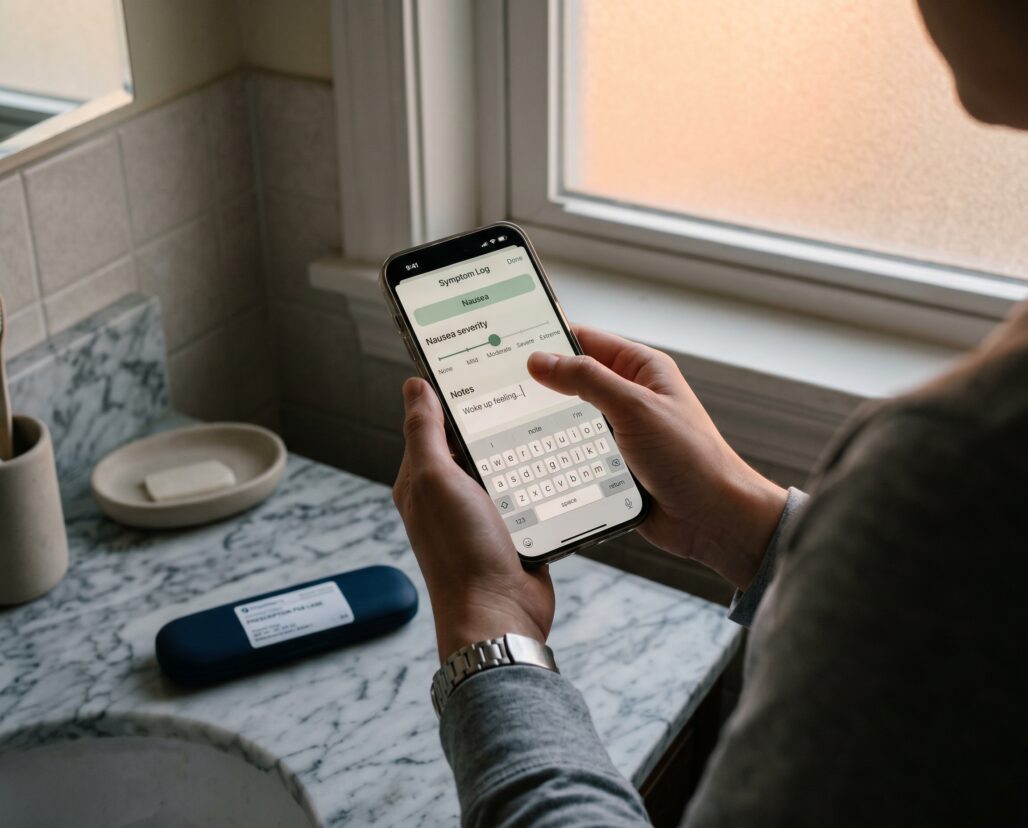
Look for side-effect severity logging tied to the injection cycle. Nausea from semaglutide typically peaks 24 to 72 hours post-injection, then subsides. If an app timestamps symptoms against your injection date, that becomes useful data to bring to an appointment. A generic "how do you feel today" field is not.
Be skeptical of apps that push aggressive calorie counting. GLP-1s suppress appetite by design. Most prescribers advise against layering hard calorie restriction on top of strong appetite suppression. An app optimized for that mode of tracking may work against your treatment protocol.
App-by-App Honest Review
Shotsy: Best Dedicated GLP-1 Tracker
Shotsy covers the fundamentals better than anything else in the category. It tracks dose, injection site, and rotation — including an automatic rotation feature that suggests the next site based on your presets. The side-effect log is customizable: you can record nausea, constipation, fatigue, or heartburn by severity (0 to 10), add notes, and view symptoms overlaid against an estimated medication level chart. Shotsy also exports a PDF summary formatted for sharing with your healthcare provider.
Shotsy version 3.0, released in March 2026, added oral GLP-1 tracking for the Wegovy pill and other oral formulations, a Maintenance Mode for users who have reached their target weight, and multi-medication scheduling for combination regimens.
On iOS, data stays on-device with iCloud syncing. On Android, the app uses Google Firebase. The privacy policy states data is not sold to third parties — verify this yourself before trusting any app with health information. Shotsy integrates with Apple Health to import weight, calorie, protein, and water data, which keeps the tracking picture unified without duplicate entry.
Supported medications include semaglutide (Ozempic, Wegovy, Rybelsus, the Wegovy pill), tirzepatide (Mounjaro, Zepbound), liraglutide (Saxenda, Victoza), and dulaglutide (Trulicity).
Limitation: No lab integration, no CGM connectivity, and no telehealth component. If you want your injection log linked to glucose readings, look at mySugr instead.
Glapp: Best for Understanding Your Medication's Weekly Cycle
Glapp takes a different angle than Shotsy. The central feature is a medication-level visualization that models estimated semaglutide or tirzepatide concentrations across your weekly injection cycle — semaglutide peaks roughly 24 to 72 hours post-injection, Mounjaro peaks between 8 and 72 hours. Seeing this plotted against when you logged nausea or low appetite can explain patterns you would otherwise attribute to bad luck.
Glapp also handles injection-site rotation, side-effect logging, supply management (tracking vials and expiration dates), and a "clinical benchmark" comparison that shows how your weight loss compares to published trial data for your medication and dose. The app includes an AI-powered search called Glapp Wisdom that pulls from medical research and community experience.
Glapp is free, available on iOS and via web browser. It does not offer Android as a native app, though the web version works on Android. There is no lab or CGM integration.
Skeptical note: That 25 to 45 percent outperformance figure comes from Glapp's own data. Selection bias is the obvious problem: people who download and engage with a tracking app are not a representative sample of GLP-1 users. Directionally interesting, not clinically proven.
Medisafe: Best for Multi-Medication Adherence
Medisafe is not a GLP-1-specific app. It is a medication adherence platform designed for people managing complex regimens — multiple drugs, multiple schedules, multiple conditions. Its real value is the drug-interaction checker, which flags potentially dangerous combinations and alerts you before you take a new medication alongside an existing one.
For a GLP-1 user who also takes metformin, a blood pressure medication, or a thyroid drug, Medisafe is more useful than a GLP-1-only tracker because it holds the whole picture. It generates adherence reports you can share with your care team, supports refill reminders, and has a "MedFriend" feature that notifies a designated person if you miss doses.
What Medisafe does not do: injection-site rotation, side-effect pattern logging against an injection timeline, or dose-titration support. It also does not integrate with lab systems or CGM devices. The 5 benefits of digital medication tracking that Medisafe documents — consistency, accountability, drug-interaction alerts, refill reminders, and shareable adherence data — are all legitimate, but none of them are GLP-1-specific.
Best used as: a complement to Shotsy or Glapp, not a replacement for either.
mySugr: Best If You Also Manage Insulin or Blood Glucose
mySugr is a Roche-owned diabetes management app with 7 million registered accounts and a 4.6-star average rating. It tracks blood glucose, insulin doses, meals, and physical activity in a single logbook, and offers a Bolus Calculator for insulin dosing in the PRO tier (free when you connect an Accu-Chek glucose meter).
For a GLP-1 user who is also managing type 2 diabetes with insulin — a common clinical picture — mySugr is the strongest option because it connects lab-quality data (glucose meter readings, CGM data from the Accu-Chek SmartGuide integration, CE-marked as of late 2025) with daily logs. A clinical study linked mySugr use to reduced severe hypo- and hyperglycemic episodes after three months.
mySugr does not do injection-site rotation guidance, and it is not designed for weight management tracking in the same way Shotsy and Glapp are. If you are on a GLP-1 purely for weight management with no diabetes diagnosis, mySugr is probably more complexity than you need.
MyTherapy: Solid Free Option, Lightweight by Design
MyTherapy is a free medication tracker with reminders, side-effect logging, a weight journal, dose-escalation reminders, and an injection-site rotation tracker. It covers the core checklist without the medication-level modeling of Glapp or the polished UI of Shotsy. Rated 4.5 stars on both platforms, no lab integration. For users who want free, clean, and uncomplicated, it is a reasonable default.
Found: A Telehealth Program, Not a Tracker
Found gets recommended frequently in GLP-1 forums, but it is fundamentally different from every other option here. Found is an obesity medicine telehealth service staffed by board-certified clinicians who prescribe and manage GLP-1 therapy. The companion app includes a weight log, behavior change program, and community — but tracking is secondary to the clinical relationship. Medication costs run from roughly $650/month for Wegovy upward without insurance.
If you do not have a prescribing physician, Found is worth exploring as a care pathway. If you already have a prescriber and need a logging tool, it is not the right product.
DIY Alternatives: Paper Logs and Spreadsheets
A paper log with the right columns can match most of what these apps do, at zero cost and with zero data-sharing risk. The columns that matter: injection date, dose (mg), injection site, next site due, side-effect notes (severity 0-10), and weight.
A spreadsheet version adds automatic charting and is easier to share as a PDF. The GLP-1 injection log template in this series offers a printable and spreadsheet version designed specifically for weekly-injection users.
The real limitation of paper is no reminders. If you are the type of person who will forget a weekly injection because Tuesday got busy, a paper log will not fix that. An app with push notifications will.
What These Apps Do Not Do — And Why Grey-Market Peptide Tracking Is a Different Conversation
Every app reviewed here is designed for people using FDA-approved, legally prescribed medications. They are not designed for, and should not be repurposed for, tracking compounded or grey-market peptides.
This matters practically. The FDA has documented its concerns about unapproved GLP-1 drugs, including issues with impurities, incorrect dosing concentrations, and labeling errors in compounded products. Tracking grey-market peptide injections with a logging app does not make the underlying drug safer or verified. The purity, concentration, and sterility of an unregulated compound cannot be confirmed by an app.
If you are researching peptides like BPC-157, CJC-1295, or research-grade compounds, a different set of considerations applies — starting with the question of legality and prescriber oversight in your jurisdiction. That conversation is addressed in the series article on FDA-approved peptides.
No app reviewed here is an endorsement of off-label or unverified peptide use.
Health Data Privacy: A Brief but Important Note
Health data from medication-tracking apps can end up shared with third parties in ways that are not obvious. A BMJ study on medicine-related apps found that 79 percent shared user data with third parties, mostly for analytics or advertising. Regulations have tightened, but the pattern persists.
Before entering injection logs, symptoms, or diagnostic data into any app:
- Read the privacy policy, specifically the third-party data-sharing section
- Check whether the app is HIPAA-compliant if you are based in the United States
- For Shotsy: on-device storage on iOS, Firebase on Android, no data sold to third parties per their stated policy
- For Glapp: verify current data-storage practices at glapp.io
- For Medisafe: healthcare compliance framework; review current policy at medisafe.com
Frequently Asked Questions
Do any of these apps connect directly to my pharmacy or prescriber?
Medisafe has pharmacy and insurance integrations and can generate shareable adherence reports. No app in this review integrates directly with an EHR or pulls prescription data automatically. Found, as a telehealth service, has a clinical team that reviews your in-app activity.
Can I use more than one app at the same time?
Yes, and many users do: Shotsy or Glapp for injection-specific tracking, Medisafe for multi-drug reminders, and Apple Health as a central weight and biomarker hub. Shotsy integrates with Apple Health to reduce duplicate entry.
Are these apps useful for peptides other than GLP-1s — for example, insulin or thyroid peptides?
mySugr is built specifically for insulin users and handles glucose-insulin relationships better than any GLP-1-specific app. For other prescription peptides like synthetic oxytocin (Pitocin), calcitonin-salmon (Miacalcin), or teriparatide (Forteo), Medisafe's general medication reminder framework is the most applicable option from this list. Consult the relevant peptides and blood tests article for what lab markers to monitor alongside therapy.
Is any of these apps free?
Shotsy, Glapp, MyTherapy, and mySugr (basic tier) are all free. Medisafe has a free tier with a Pro upgrade. Apple Health is built into iOS at no additional cost. Found charges a membership fee plus medication costs.
What about Android users?
Shotsy and Medisafe are on both iOS and Android. Glapp is iOS-native with a web version that works on Android. MyTherapy is on both platforms. mySugr is on both platforms.
Conclusion: The Bottom Line on Peptide Tracker Apps
Tracking your GLP-1 injections is not a nice-to-have. Injection-site rotation, dose-titration schedules, and side-effect patterns are clinical details that most people manage poorly from memory alone. The apps that exist for this are genuinely useful tools — the best of them are free, and none of them are complicated.
The practical hierarchy: start with Shotsy or Glapp for injection tracking because they were built for exactly that purpose. Layer in Medisafe if your regimen includes multiple medications and you need interaction alerts. Use mySugr if you are managing blood glucose and insulin alongside GLP-1 therapy. Ignore Found for tracking purposes; it belongs in the conversation about where to get a prescription, not how to log one.
No app makes grey-market peptides safer. No app substitutes for a prescriber's clinical judgment on titration. And no app earns its place in your routine by having the prettiest charts — it earns its place by making it easy to show up on time, in the right site, with a useful record of what happened last week.
Next Steps
- Review which FDA-approved peptides are currently on the market and which conditions they treat
- Learn what lab work to schedule before and during peptide therapy in Peptides and Blood Tests
- Download the GLP-1 injection log template if you prefer a paper or spreadsheet approach before committing to an app
This article is for informational purposes and not medical advice. Peptides, especially those marketed for therapeutic use, can interact with medications and health conditions. Consult a licensed physician before starting any supplement, particularly if you are pregnant, nursing, taking prescription medications, or managing a chronic condition.
