
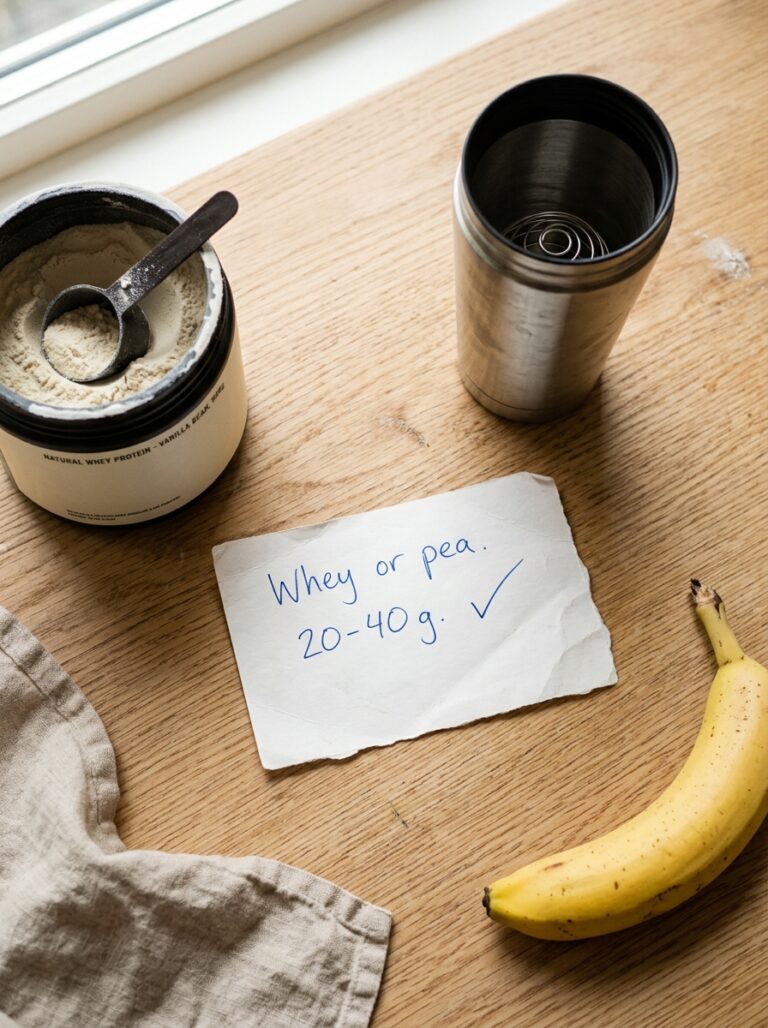
You're standing in front of a wall of tubs that all promise the same thing, and the labels disagree on everything: 20 grams or 30, whey or plant, "fast" or "sustained," with a price spread that makes no sense. The honest place to start is a question almost no label asks. Do you even have a protein gap to fill?
For a lot of people the answer is no, and a powder is a convenience, not a magic supplement. This guide sorts the types, the doses that actually matter, and the handful of groups for whom a scoop earns its place.
Before you decide
A few people should clear protein powder with a clinician first. If you have chronic kidney disease, advanced liver disease, or a metabolic condition that restricts protein, your daily target is a medical number set by your care team, not a fitness-blog default. A high-protein supplement can be exactly the wrong move.
The same caution applies if you have a milk allergy (most whey is dairy) or you react to certain sweeteners and gums. Read the full ingredient panel, not just the protein-per-scoop number on the front.
If none of that applies, the first step is arithmetic, not shopping. Add up what you already eat before you assume you're short. A chicken breast is roughly 30 to 40 g of protein, a cup of Greek yogurt is 15 to 20, two eggs are about 12, a cup of lentils is around 18. Many people clear their target by dinner without a scoop.
A powder earns its place when the math doesn't work: you're plant-based and falling short, you're older and your appetite has dropped, or you simply can't fit enough whole-food protein into a busy day. You can see how I weigh evidence and conflicts of interest on the how we review supplements page.
What protein powder actually is
Protein powder is just dietary protein that's been isolated from a food source and dried into a concentrated, shelf-stable form. Strip a food down to mostly its protein, remove most of the fat and carbohydrate, spray-dry it, and you have a powder. There's nothing inherently exotic about it.
The source determines the rest. Whey and casein come from milk; soy, pea, rice, and hemp come from plants; collagen comes from animal connective tissue. Each carries a different amino acid profile, which is the part that actually matters for what the protein does in your body.
Of the amino acids, the one to know is leucine, the main trigger for muscle protein synthesis — the process by which your body builds and repairs muscle tissue. Proteins richest in leucine, like whey, switch that process on most strongly per gram.
That single fact explains most of the marketing. "Fast" whey floods the blood with leucine quickly; "slow" casein drips amino acids out over hours. Both feed the same machinery. As a dietitian, the point I'd anchor is unglamorous: a powder is food in a tub, and your total protein for the day matters far more than which tub it came from.
How much protein you really need
The federal floor is the Recommended Dietary Allowance of 0.8 g/kg of body weight per day, set by the National Academies. But the RDA is the amount that prevents deficiency, not the amount that's optimal for building or preserving muscle, and that gap is where the confusion lives.
For someone who lifts or wants to hold onto muscle, the better target is higher. The International Society of Sports Nutrition position stand puts the useful range at 1.4 to 2.0 g/kg/day for active people, spread across the day in doses of roughly 20 to 40 g.
Here's the part the supplement aisle won't tell you. A landmark meta-analysis in the British Journal of Sports Medicine found that protein supplementation stopped adding muscle once total intake passed about 1.62 g/kg/day — a hard ceiling on benefit, not a starting point. Beyond it, the extra scoops do essentially nothing for lean mass.
Run the numbers on a 70 kg (154 lb) person: the RDA is 56 g, the muscle-building ceiling is about 113 g. A normal mixed diet often supplies 70 to 100 g before you touch a powder, which is why the gap most people are filling is small, and a single 25 g scoop usually closes it.
Whey vs casein vs plant

This is the comparison the whole category obsesses over, and it matters less than the price difference suggests. The cleanest way to rank protein quality is DIAAS — the Digestible Indispensable Amino Acid Score, which measures how well a protein's amino acids are actually absorbed and used. A comprehensive 2020 DIAAS review scored the common sources, and the pattern is clear: dairy and most animal proteins land highest, soy is solidly high-quality, and single-source pea or rice sit lower on their own.
That lower score for plant proteins is real but easily fixed by eating more total protein or blending sources, which is exactly what good vegan formulas do (pea plus rice covers each other's weak amino acid). On the timing question, a controlled trial on whey vs casein confirmed whey spikes muscle protein synthesis faster while casein sustains it longer — a difference that's interesting but rarely decides anything if your daily total is on target.
| Type | Quality (DIAAS tier) | How it behaves | Best for |
|---|---|---|---|
| Whey (isolate/concentrate) | Excellent, high leucine | Fast digesting, rapid leucine spike | Post-workout, default all-rounder |
| Casein | Excellent, from milk | Slow digesting, sustained release | Before a long gap, e.g. bedtime |
| Soy | High, complete plant protein | Moderate digestion, complete profile | Dairy-free, single-source plant option |
| Pea + rice blend | Good when blended (one fills the other) | Moderate, slightly lower leucine | Vegan diets, dairy intolerance |
| Collagen | Low for muscle (incomplete) | Lacks key amino acids for muscle building | Skin/joint goals, NOT a muscle protein |
The takeaway: for muscle, whey is the high-quality default and a pea-rice blend is the strong plant equivalent. Collagen is the odd one out — it's a fine product for other goals but a poor muscle protein, and I untangle that confusion in collagen peptides vs collagen protein. For the deeper buying breakdowns, see our roundups of the best whey protein powder and the best vegan protein powder.
Who actually benefits
The honest list of people for whom a powder does meaningful work is shorter than the marketing implies. It's a tool for a specific protein gap, not a daily essential for everyone.
Athletes and people who lift top the list, because their 1.4 to 2.0 g/kg target is genuinely hard to hit from food alone, and a scoop is a clean way to add 25 g without cooking. Active women in particular often undereat protein relative to their training, which is why I keep a dedicated guide to the best protein powder for women.
Older adults are the most overlooked group. Aging blunts the muscle's response to protein and appetite often shrinks, so a higher per-meal dose helps preserve muscle and reduce frailty risk — a clear case where a supplement closes a real, age-driven gap.
People on GLP-1 medications like semaglutide are a newer, important group. The appetite suppression that drives weight loss can also drop protein intake sharply, and a 2024 review on lean mass and GLP-1 therapies notes that a meaningful share of the weight lost can be lean tissue. Protecting muscle here means deliberately hitting protein despite low hunger, often easiest as a shake — which is why I built a separate protein powder guide for GLP-1 users.
Vegetarians and vegans round out the list, since plant diets can run lower in protein and in leucine specifically. Who usually doesn't need it: a healthy, non-athlete omnivore who already eats meat, dairy, eggs, or beans across the day is typically at or above their target without spending a cent.
How to choose and use
Once you've decided you have a gap, choosing is simpler than the labels suggest. Match the source to your diet, then check that one scoop delivers 20 to 40 g of protein — the dose range the evidence supports per serving.
Whey if you tolerate dairy and want the cheapest high-quality option; a pea-rice blend if you're plant-based or dairy-sensitive; casein if you specifically want a slow-release option before a long gap. Beyond that, the source is a minor decision compared with hitting your daily total.
On timing, relax. The "anabolic window" was oversold — the ISSN nutrient-timing position stand concludes that total daily protein and even distribution matter far more than slamming a shake within minutes of your last rep. Aim for protein every three to four hours; the exact post-workout minute is noise.
For label quality, look for a short ingredient list, a third-party testing seal (NSF Certified for Sport or Informed Sport) if you compete, and a protein-per-scoop number that isn't inflated by added amino acids. Skip products whose front label brags about a "blend" that hides how much actual protein you get per serving.
Safety and myths
The biggest myth deserves a direct answer: protein powder does not harm healthy kidneys. The fear comes from misapplying advice meant for people who already have kidney disease. A meta-analysis in the Journal of Nutrition found that higher-protein diets did not adversely change kidney function in healthy adults — full stop.
The important caveat is the one in the first section: this clean bill of health applies to healthy kidneys. If you already have kidney disease, protein is restricted for a medical reason, and that's between you and your nephrologist — not a myth to wave away.
The real, common side effects are digestive. Bloating, gas, and loose stools usually trace to lactose in cheaper whey concentrate, or to sugar alcohols and gums used as sweeteners and thickeners. Switching to a whey isolate (lower lactose) or a cleaner-formulated product fixes most of it.
There's no muscle-building cure or metabolic magic happening here, and any product promising one is overselling. Protein powder supports a protein target within a normal diet; it doesn't replace food, training, or medical care. Used as a convenience to close a real gap, it's about as risky as the food it came from.
FAQ
Do I actually need protein powder?
Only if you have a real gap. Tally your daily protein from food first; if you comfortably reach your target (roughly 1.6 g/kg if you train), a powder adds cost, not benefit. It earns its place when food alone falls short.
Is whey better than plant protein?
Whey scores higher on DIAAS and has more leucine per gram, so it's a slightly more efficient muscle-builder. But a well-blended pea-rice plant protein closes that gap, and once your daily total is on target the difference is small.
How much protein is in one scoop?
Most quality powders deliver 20 to 30 g per scoop, which sits right in the evidence-backed 20 to 40 g per-serving range. Check the label, since "blends" sometimes inflate scoop size while delivering less actual protein.
Can too much protein damage my kidneys?
Not in healthy people. The meta-analysis evidence shows no adverse change in kidney function from higher protein in healthy adults. If you have diagnosed kidney disease, that's a separate medical situation requiring your doctor's protein target.
When should I take it?
Whenever it helps you hit your daily total. The post-workout "window" is far less important than total daily protein and spreading it across meals, so pick a time you'll be consistent with.
The bottom line on protein powder
Protein powder is a useful, unglamorous tool: isolated food protein that makes hitting a daily target easier when whole food alone won't. It is not a muscle-building shortcut, and the marketing that frames it as one is selling past the science.
The decision comes down to three honest questions. Do you have a protein gap (most non-athlete omnivores don't), what daily total are you aiming for (about 1.6 g/kg if you train, where the benefit plateaus), and which source fits your diet (whey or a pea-rice blend covers nearly everyone)?
If you're a healthy eater already clearing your target from meals, your money is better spent on groceries. If you're an athlete, an older adult, on a GLP-1, or plant-based, a 20 to 40 g scoop of a quality whey or pea blend is a sensible, safe way to close the gap.
Reviewed by Sarah Thompson, Registered Dietitian, focused on vitamin and mineral nutrition. See more from Sarah Thompson. This article is educational and is not a substitute for individualized medical advice; talk to your doctor before changing your protein intake, especially if you have kidney or liver disease, are pregnant, or are managing a diagnosed condition.
