
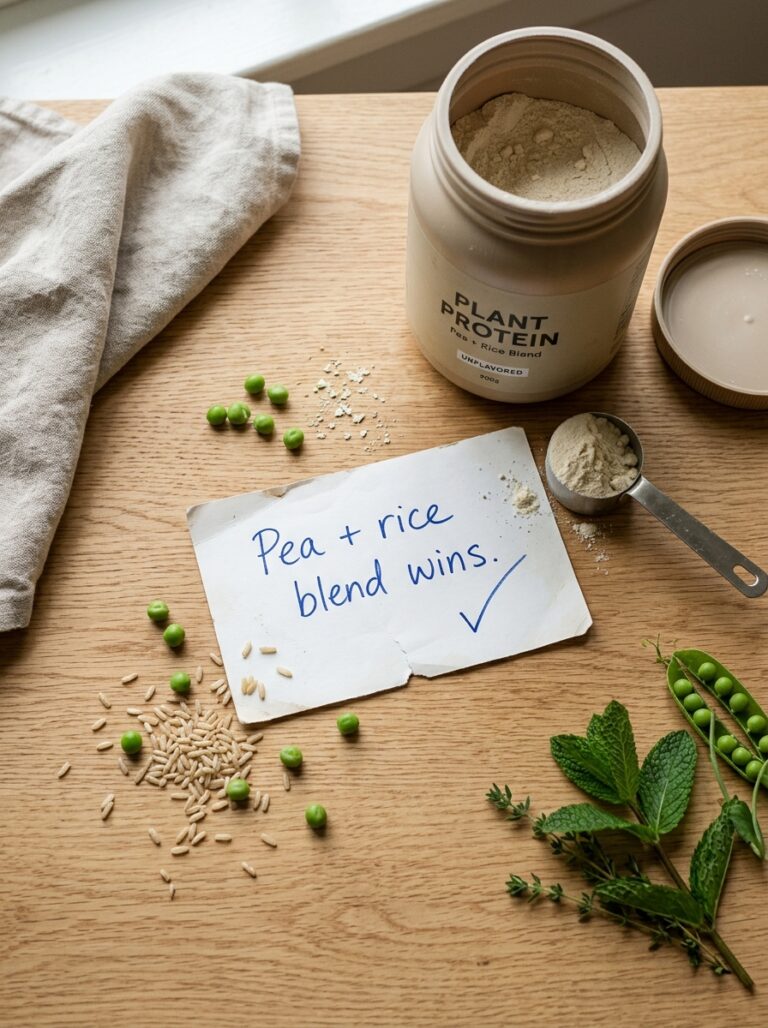
If you're shopping for the best vegan protein powder, you've probably hit the same two worries everyone does: will a plant protein actually build muscle, and does it have to taste like wet cardboard. The short answer is encouraging. A well-built plant blend can match whey for muscle, and the texture problem is mostly solved if you know which blend to buy. The picks at the bottom are the tubs I'd keep in my own family's pantry, so it's worth scrolling once you've got the logic.
This guide walks through why a pea-and-rice blend is the smart default, what the trials actually show, and one dosing tweak that most roundups skip entirely.
Affiliate disclosure: this article contains affiliate links. As an Amazon Associate, UsefulVitamins.com earns from qualifying purchases at no extra cost to you.
Before you decide
A protein powder is a convenience, not a requirement. If you already hit your protein target from beans, lentils, tofu, tempeh, soy milk, and whole grains across the day, you may not need a supplement at all. Most adults need roughly 0.8 to 1.2 g of protein per kilogram of body weight, and active people aiming to build muscle land higher, around 1.6 g/kg.
A powder earns its place when whole-food protein is hard to hit, which is common on a plant-based diet where protein is more diffuse. If you're vegan, pregnant, managing kidney disease, or recovering from illness, run your protein target past your doctor or dietitian before leaning on a supplement, because the right number is individual.
One more honest caveat before the shopping: "vegan" on the label tells you nothing about quality or safety. A clean-tasting, third-party-tested blend and a gritty, contaminated one can both be vegan. You can see how I weigh evidence and conflicts of interest on the how we review supplements page.
Why a pea+rice blend is the default
Here's the core idea that separates a good vegan protein from a mediocre one. Most single plant proteins are "incomplete" — they're low in one or more essential amino acids — and pea and rice happen to plug each other's gaps.
Pea protein is rich in lysine but low in the sulfur amino acid methionine. Rice protein is the mirror image: high in methionine, low in lysine. Put them together and the blend covers all nine essential amino acids at usable levels, which is exactly the complementary-protein strategy dietitians have recommended for decades.
This isn't folklore. An analysis in Frontiers in Nutrition on combining plant proteins showed that mixing legume and cereal proteins produces amino acid profiles you can tune to meet adult requirements, precisely because their strengths and weaknesses are offset. Pea covers the cereal's lysine shortfall; rice covers the legume's methionine shortfall.
The ratio matters more than most labels admit. Protein quality is measured by DIAAS, the digestible indispensable amino acid score, and a tuned pea-rice mix climbs higher than either source alone. Modeling work cited in the DIAAS literature puts a blend's peak score near a roughly 60:40 pea-to-rice ratio, where neither lysine nor methionine is the limiting bottleneck — which is why a product that names both and lists their grams is more trustworthy than one that just stamps "plant protein" on the front.
A fair caveat keeps this honest. The blend's edge is the amino acid floor it guarantees, not a dramatic spike in blood amino acids over pea alone. A 2024 study in the British Journal of Nutrition found that a pea-rice blend raised plasma amino acids no faster than pea isolate (both trailed whey on peak speed), so the reason to blend is completeness and quality, not a faster post-shake surge.
The practical upshot: a labeled pea-and-rice blend is a complete protein you can trust on the amino acid math, without the soy that some people avoid and without the digestive heaviness some report from straight rice protein. That's why it's the verdict on this guide's card.
What the research shows on muscle
The fear that plant protein can't build muscle is the single biggest myth in this category, and the head-to-head trial evidence does not support it. The most-cited study here is a 12-week double-blind RCT by Babault and colleagues in 161 young men, who took 25 g of pea protein, whey, or placebo twice daily alongside resistance training.
The result: biceps thickness gains in the pea group were statistically indistinguishable from the whey group, with both ahead of placebo and the pea advantage strongest in less-trained lifters. The authors concluded pea protein "could be used as an alternative to whey-based dietary products."
That single trial doesn't stand alone. A meta-analysis by Messina and colleagues pooling nine studies found soy protein produced the same gains in strength and lean mass as animal protein during resistance training. A broader 2025 systematic review of plant versus animal protein likewise found no significant difference in muscle strength, with only a small, age-dependent edge for animal protein on absolute mass in younger adults.
It helps to know why this works at the level of the muscle itself, because that's where the skepticism usually lives. The relevant outcome is muscle protein synthesis — the rate at which your body assembles new muscle fiber after a workout — and pea protein triggers it just fine. A 2023 isotope-tracer study in resistance-trained adults measured myofibrillar protein synthesis over the four hours after exercise and found that 25 g of pea protein stimulated it at the same rate as mycoprotein and a blend of the two.
That's the mechanistic punchline that the body-composition trials only imply: despite pea's lower methionine, it switches on muscle-building at the cellular level as effectively as a complete-profile protein. The body doesn't read a protein's label — it reads the amino acids that arrive in the blood, and an adequate pea or pea-rice dose delivers them.
So the honest summary is this: for muscle and strength, a good vegan protein is a close match for whey, with at most a small mass gap in young, hard-training men — a gap that the next point largely closes.
The dosing tweak most roundups skip
Here's where most "best vegan protein" lists go quiet, and it's the most useful thing in this article. Plant proteins are slightly lower in leucine — the amino acid that flips the switch on muscle protein synthesis — so the smart move is to bump the dose, not abandon the protein.
The reason whey has a reputation as the "anabolic" protein is leucine content and digestibility, captured in protein-quality scores. The DIAAS overview by Herreman and colleagues reports whey around 85 and pea around 70 on the standard scale, with whey clearing the "high-quality" threshold of 75 and pea sitting just under it. Lower score, not a failing one.
Because the response is dose-driven, the fix is simple arithmetic. A review of protein quality and muscle by van Vliet and colleagues explains that a modestly larger serving of plant protein delivers the same total leucine as a smaller whey serving — you're just topping up the lower concentration with volume.
The leucine trigger systematic review by Zaromskyte and colleagues pins the practical target: roughly 3 g of leucine per serving to maximally stimulate muscle protein synthesis, which lands around a 25 to 30 g whey dose. To hit the same leucine from a pea-rice blend, aim for 30 to 40 g per serving rather than the default 25.
That's the differentiator: a pea+rice blend matches whey for muscle, and you simply bump the dose a little for the lower leucine. Most roundups never connect the amino-completeness point to the dosing point, so readers either over-worry about plant protein or under-dose it.
What to look for when buying
Once you've settled on a blend, four label features separate a serious product from a marketing one. The table below is the shortlist I'd hand a client.
| Feature | What it tells you | Worth paying for? |
|---|---|---|
| Pea + rice (both named on the panel) | Complete amino profile, not a single deficient source | Yes, essential |
| ~20 to 25 g protein per scoop | Lets you reach a 30 to 40 g muscle dose in 1.5 to 2 scoops | Yes, check the math |
| Third-party tested for heavy metals | Independent check on lead and cadmium, a real plant-protein issue | Yes, important |
| Smooth texture / sprouted or hydrolyzed pea | Less of the chalky grit plant proteins are known for | Yes, drives adherence |
| “Proprietary blend” with no gram amounts | You can’t verify the pea-to-rice ratio or dose | No, skip it |
The heavy-metals line deserves a flag, because it's the one area where plant proteins genuinely lag whey. The Clean Label Project's 2025 protein study tested 160 powders and found plant-based products carried, on average, around three times the lead and five times the cadmium of whey-based ones, since plants pull metals from soil.
That's not a reason to skip plant protein — it's a reason to buy one that publishes third-party testing, and to lean toward vanilla over chocolate, which the same study flagged as far higher in cadmium. The same testing logic applies whether you're choosing this or comparing against whey protein powder.
It helps to put the risk in proportion rather than catastrophizing it. The metals in plant protein come from soil uptake, so the dose you get scales with how much you take and which crop and region it came from — not with anything inherently toxic about peas or rice. A single 30-gram daily serving from a tested brand sits in a very different place than several unscreened scoops a day, every day, for years. Choosing a powder with a published certificate of analysis (look for "tested for heavy metals" with actual numbers, or a third-party seal) is the lever that does almost all the work here.
Taste, texture, and cost
The best protein is the one you'll finish, so two practical filters belong in the decision. Plant proteins are prone to a chalky, earthy, slightly "beany" character — pea especially — and processing is what tames it. Sprouted or fermented pea, hydrolyzed fractions, and a touch of cocoa or natural flavor smooth the grit, while a thin, watery rice-heavy powder often reads as gritty no matter how you blend it.
A few mixing habits matter more than the brand. Blend with cold liquid, give it a minute to hydrate, and use a milk alternative rather than water for a rounder mouthfeel; pea protein in particular thickens as it sits, which can be mistaken for poor quality. If you can buy a single-serving sachet or a small tub before committing to a 5-pound bag, do it — flavor preference is the single biggest predictor of whether a tub gets used or abandoned.
On cost, plant blends are generally mid-priced — usually cheaper than premium whey isolate and dearer than bulk whey concentrate. Compare on price per 30-gram serving rather than per tub, since vegan powders are often lower in protein per scoop and you may need 1.5 scoops to hit a muscle dose. A modestly more expensive blend you actually drink beats a cheap one you don't.
Recommended Products


As an Amazon Associate, UsefulVitamins.com earns from qualifying purchases at no extra cost to you. We only recommend products supported by published research or third-party testing.
FAQ
Is vegan protein as good as whey for building muscle?
For practical purposes, yes. Head-to-head trials show pea protein matches whey for muscle thickness and strength, and meta-analyses find no meaningful strength difference. The small mass edge whey sometimes shows in young men closes when you take an adequate plant dose.
Why pea and rice instead of just pea?
Pea is low in methionine and rice is low in lysine. Combined, they form a complete protein that covers all nine essential amino acids, which a single plant source usually can't do on its own.
How much vegan protein should I take per serving?
Because plant proteins are lower in leucine, aim for about 30 to 40 g per serving to match the muscle-building leucine you'd get from roughly 25 g of whey. For general intake rather than training, a standard 20 to 25 g scoop is fine.
Should I worry about heavy metals in plant protein?
It's worth attention, not panic. Plant proteins test higher for lead and cadmium than whey, so choose a brand that is third-party tested and favor vanilla over chocolate, which tends to be more contaminated.
Why does my pea protein taste gritty, and can I fix it?
The grit is pea's natural earthy texture, not a defect. Use cold liquid, blend rather than shake, let it hydrate a minute, and choose a milk alternative over water. Sprouted, fermented, or hydrolyzed pea formulas, and flavored versions with a little cocoa, are noticeably smoother than plain isolates.
Is vegan protein worth the higher price versus whey?
It depends on which whey you're comparing it to. Plant blends usually cost more than bulk whey concentrate but less than premium whey isolate. Compare price per 30-gram serving, not per tub, since you may need 1.5 vegan scoops to match a whey dose. For most vegans the convenience and amino-completeness justify the mid-range price.
Does soy or hemp work too?
Soy is a complete protein and performs like whey in trials, so it's a fine choice if you tolerate it. Hemp is lower in protein and lysine, making it a better fiber-and-omega add-on than a primary muscle protein.
The bottom line on vegan protein
A vegan protein powder doesn't ask you to compromise on muscle. The right question isn't "plant or whey," it's whether your blend is amino-complete and whether your dose clears the leucine threshold. A labeled pea-and-rice product answers the first; taking 30 to 40 g answers the second.
From there it comes down to two unglamorous checks: third-party testing for heavy metals, and a flavor and texture you'll actually drink day after day, because the best protein is the one that doesn't end up shoved to the back of the cabinet.
If you want the full framework on dosing, timing, and protein targets across all sources, I cover it in the complete guide to protein powder. And before adding any supplement on top of a restrictive diet, ask your doctor about a blood test for the nutrients plant-based eaters most often run low on.
Reviewed by Sarah Thompson, Registered Dietitian, focused on vitamin and mineral nutrition. See more from Sarah Thompson. This article is educational and is not a substitute for individualized medical advice; talk to your doctor before starting a supplement, especially if you are pregnant, managing kidney disease, or following a restrictive diet.
