
Your phone battery dies on shot day. Your app subscription lapses. The telehealth portal logs you out for the third time this month. A paper injection log costs nothing, requires no signal, and never asks for a password. So why do so many people starting Ozempic, Wegovy, Mounjaro, or Zepbound skip keeping one entirely? Usually because nobody handed them a template. A single-page paper log — tracking date, dose, site, time, weight, and side effects — is the single most useful document you can bring to your next prescriber visit.
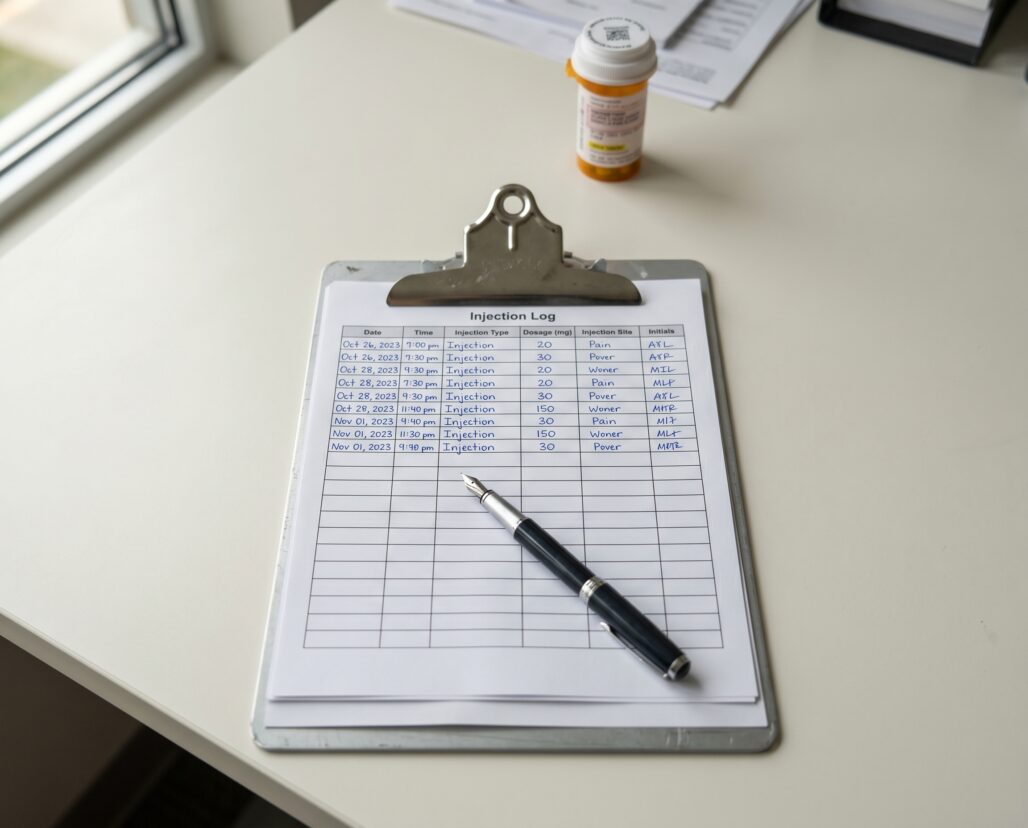
This article explains what to track, why each column earns its space on the page, and presents a ready-to-print template you can copy by hand or reproduce in any spreadsheet. It also covers the injection-site rotation schedule your prescribing information requires, the missed-dose rules that differ meaningfully across the four most common injectable GLP-1 drugs, and the specific situations where your log becomes a clinical document rather than a personal record.
This article does not recommend any specific drug, dose, or treatment plan. All four medications discussed here require a prescription from a licensed physician and are FDA-approved only for specific indications.
Summary
A GLP-1 injection log is a paper or digital record capturing eight data points per dose: date, drug name, dose strength, injection site, time of injection, pre-injection weight, side effects, and any notes. Kept consistently across every dose escalation step, it gives your prescriber the raw data needed to make informed adjustments — and gives you a record of your own response that no app subscription can accidentally erase.
- Ozempic: semaglutide SC, 0.25 mg x4 wk, then 0.5 mg; escalate to 1 mg if needed; max 2 mg weekly.
- Wegovy: semaglutide SC, 0.25 mg x4 wk, then 0.5, 1.0, 1.7, and 2.4 mg at 4-week intervals.
- Mounjaro: tirzepatide SC, 2.5 mg x4 wk, then +2.5 mg every 4 weeks minimum; max 15 mg weekly.
- Zepbound: tirzepatide SC, same escalation as Mounjaro; max 15 mg weekly.
- Injection sites: abdomen, thigh, upper arm; rotate within and between sites weekly.
- Missed-dose windows differ per drug; see the dedicated section below.
- Compounded GLP-1s: this template assumes FDA-approved branded versions; compounded products may carry different concentrations and escalation protocols.
Why a Paper Log Still Beats Most Apps
The honest case for paper is not romantic. It is practical. Most GLP-1 tracking apps either charge ongoing subscription fees, push upsells into the interface, or require creating an account before you can enter a single data point. Every one of those friction points is a reason to skip logging on a tough nausea day.
A printed sheet has none of those friction points. You pick up a pen and write. When your prescriber asks whether the side effects were worse on dose escalation weeks versus maintenance weeks, you can answer immediately. When your pharmacist asks how long ago you took your last dose, the answer is on paper in front of you.
There is a privacy argument worth naming briefly. Paper logs do not sync to servers, do not train models on your health data, and cannot be breached in a data leak. For a drug category that still carries social stigma, that matters to some people.
Apps outperform paper in one area: automatic reminders. If you consistently forget shot day, a smartphone alert is worth more than any logging format. The two approaches are not mutually exclusive — keep the reminder on your phone, the data on paper.
For a curated review of dedicated GLP-1 apps, see our best Ozempic tracker apps guide.
What to Track: The Eight Columns
Each column in the log below serves a specific purpose. Understand the purpose and you will actually fill in the column rather than skipping it.
Date. The most obvious entry is also the most important. Your prescribing information specifies your injection day of the week. Recording the date tells you — and your prescriber — whether you stayed on schedule or whether a day-of-week drift happened over months.
Drug name. If you switch between Ozempic and Wegovy (not interchangeable, but it happens during insurance-coverage changes), or between Mounjaro and Zepbound, you need the brand name recorded. The dose escalation schedules are different across these drugs even when the underlying molecule overlaps.
Dose. Record the dose in milligrams, not just "my usual dose." During escalation steps, the dose changes every four weeks. A log without milligram values makes it impossible to tell whether a side-effect cluster happened at 0.5 mg or 1.0 mg.
Injection site. Record the anatomical zone and the side: left abdomen, right thigh, left upper arm. This column is the enforcement mechanism for site rotation, which both Novo Nordisk and Eli Lilly label as a requirement, not a suggestion.
Time of injection. GLP-1 injectables are dosed weekly, but time of day matters for two reasons: it anchors your missed-dose math (see the missed-dose section), and it helps identify whether morning versus evening dosing correlates with nausea duration for your individual pattern.
Pre-injection weight. Weigh yourself on the morning of your injection day, before eating, and record it. This generates a weekly data series without requiring a separate weigh-in habit. One point per week is enough to see a trend line over a 12-week escalation phase.
Side effects. Use plain language: nausea, vomiting, constipation, diarrhea, fatigue, injection-site redness. Rate severity on a 1-3 scale if you want to spot trends. Recording "none" on good weeks is as informative as recording symptoms on bad ones.
Notes. Free text for anything outside the other columns: a prescriber-ordered dose hold, a travel delay, a meal pattern you think correlated with worse nausea, or a refrigeration lapse.
The Printable Injection Log Template
Copy this table by hand onto ruled paper or reproduce it in any spreadsheet application. Print one sheet per month (approximately 4-5 rows) for weekly injections.
| Date | Drug | Dose (mg) | Site | Time | Pre-weight | Side effects (1-3) | Notes |
|---|---|---|---|---|---|---|---|
Side-effect severity key: 1 = noticed but did not affect daily routine / 2 = disrupted some activities / 3 = severe or required resting
Site abbreviations: LA = left abdomen / RA = right abdomen / LT = left thigh / RT = right thigh / LUA = left upper arm / RUA = right upper arm
Injection Site Rotation: The Pattern That Protects Your Skin
The prescribing information for all four drugs requires rotation among three anatomical zones: the abdomen (at least two inches from the navel), the front of the thigh, and the outer upper arm. The reason is lipodystrophy: repeated injections into exactly the same spot can cause localized tissue changes — either hardened lumps or indentations — that alter how the drug is absorbed. This is the same principle that guides insulin injection rotation and is well documented in the diabetes self-management literature.
A simple rotation cycle that works for weekly dosing: use the abdomen for four consecutive weeks, then move to the thigh for four weeks, then the upper arm for four weeks. Within each zone, alternate left and right sides. That gives you six distinct sub-sites and a 12-week rotation before you return to the starting position.
If you use insulin at any of the same sites, do not inject both drugs in the same location on the same day. The prescribing information for both semaglutide and tirzepatide notes that they can be injected in the same body region as insulin as long as the injections are not adjacent.
Record the site every week in your log. After three months, look at the Site column and verify the rotation actually happened. It is surprisingly easy to drift back to a comfortable preferred site without realizing it.
Missed Dose Rules: They Differ by Drug
This section matters more than most people realize. The missed-dose guidance is not identical across the four drugs, and following the wrong rule could mean either an accidental double dose or an unnecessary week-long gap in therapy.
Ozempic (semaglutide, diabetes): Per the Ozempic FDA prescribing information: if you miss a dose and it has been 5 days or fewer since your scheduled dose day, take it as soon as possible. If more than 5 days have passed, skip that dose and resume your next scheduled injection on your regular day. Do not take two doses in the same week.
Wegovy (semaglutide, weight management): Per the Wegovy FDA prescribing information: if you miss a dose and your next scheduled dose is more than 2 days away (48 hours), take the missed dose as soon as you remember. If your next dose is within 2 days, skip the missed dose and take the next one on your regular day. Do not take two doses within 2 days of each other.
Mounjaro (tirzepatide, diabetes): Per the Mounjaro DailyMed prescribing information: if a dose is missed, administer it as soon as possible if within 4 days of the scheduled day. If more than 4 days have passed, skip the missed dose and resume the next scheduled injection on the regular day. Do not administer two doses within 3 days of each other.
Zepbound (tirzepatide, weight management): Per the Zepbound DailyMed prescribing information: the same rules as Mounjaro apply — administer as soon as possible if within 4 days; skip and resume regular schedule if more than 4 days have passed; do not administer two doses within 3 days of each other.
The key practical difference: Ozempic and Wegovy use different windows (5 days and 2 days, respectively), even though both contain semaglutide. Always follow the prescribing information for your specific branded product, not the general class guidance.
Your log makes this math trivial. If you record every injection with a date and time, you can look at the last entry and calculate elapsed time in under ten seconds, even without a calculator.
When to Bring Your Log to Your Prescriber
A log in a drawer is a record. A log at a prescriber visit is a clinical tool.
During dose escalations. Both semaglutide and tirzepatide require increases at minimum four-week intervals, and your prescriber may delay escalation if side effects are significant. Without a written record, the conversation relies on your memory of events from six weeks ago. A severity-scored log gives your prescriber actual data to work with.
If you experience severe abdominal pain. Pancreatitis is a known serious risk with all four drugs. The FDA labeling for both semaglutide and tirzepatide instructs patients to stop the drug immediately and seek emergency care if they develop severe abdominal pain that does not resolve. If you do go to an emergency room, your injection log tells the treating clinician your drug name, your current dose, and when you last injected — information they need and may not have time to obtain from your pharmacy. Do not wait. Go to the emergency room and bring the log.
If you become pregnant. All four drugs should be discontinued before or as soon as pregnancy is detected, per their respective prescribing information. Semaglutide has a longer half-life than tirzepatide; your prescriber needs to know your last dose date to advise on timing. Your log provides that date precisely.
At any annual review. Twelve months of weekly weight measurements and side-effect entries create a dataset your prescriber cannot reconstruct from pharmacy refill records. Weight trend, dose-response pattern, and the lifestyle factors that appear in the Notes column are all visible in one place.
If you switch drugs or pharmacies. Coverage changes sometimes force a brand switch. Your complete injection history — doses, sites, side effects — lets the new prescriber calibrate rather than start from zero.
For a comparison of digital tracking options, see our guides on best peptide tracker apps and best Ozempic tracker apps.

FAQ
Do I have to log my weight every week?
No rule requires it. But if you are going to log anything, weight on injection morning is the highest-signal data point because it is consistent (same day, same conditions each week) and directly relevant to your treatment goals. A weekly measurement also smooths out the day-to-day noise you get from daily weigh-ins, which fluctuate with hydration, sodium intake, and bowel regularity.
Can I use this template if I take a compounded GLP-1 formulation?
This template assumes FDA-approved branded versions of semaglutide and tirzepatide. Compounded GLP-1 products may carry different dose concentrations, different escalation protocols, and different volumes per injection than the branded drugs, and the missed-dose rules on this page are drawn from the FDA-approved prescribing information. Discuss any compounded formulation with the prescribing physician before applying these escalation schedules.
What if my prescriber told me a different escalation schedule than the one above?
Your prescriber may have legitimate clinical reasons to hold you at a dose longer, skip an escalation step, or reduce your dose. The schedules above are the FDA-approved standard escalation paths, not mandatory instructions for every patient. Follow your prescriber's guidance and record what you actually took, not what the label says.
Is it safe to inject in the same site every week?
No. Both Novo Nordisk and Eli Lilly prescribing information require rotation among sites to reduce the risk of lipodystrophy. See the site rotation section above.
Conclusion
The log template in this article is not a medical device or a clinical protocol. It is a sheet of paper with columns. Its only job is to make the information your prescriber needs as easy as possible to produce at the right moment — whether that is a dose escalation visit, a side-effect conversation, or an emergency room intake form. The four drugs covered here — Ozempic, Wegovy, Mounjaro, and Zepbound — are rigorously tested, FDA-approved prescription medications, and using them effectively means being an active participant in your own monitoring.
For a deeper review of semaglutide's clinical evidence and dosing, see our semaglutide complete guide. For tirzepatide, including the SURMOUNT-5 head-to-head data, see our tirzepatide complete guide.
Medical disclaimer: This article is for general informational purposes only and does not constitute medical advice, diagnosis, or treatment. The dosing schedules, missed-dose rules, and safety information presented here are derived from FDA-approved prescribing information as of the publication date and are subject to change. Individual responses to GLP-1 receptor agonists vary. Always follow the specific guidance of your licensed prescriber and the current prescribing information for your exact drug and formulation. Do not start, stop, or change any medication without consulting a qualified healthcare provider. If you experience severe abdominal pain, signs of an allergic reaction, or any other serious symptoms, stop the medication and seek emergency medical care immediately.
