
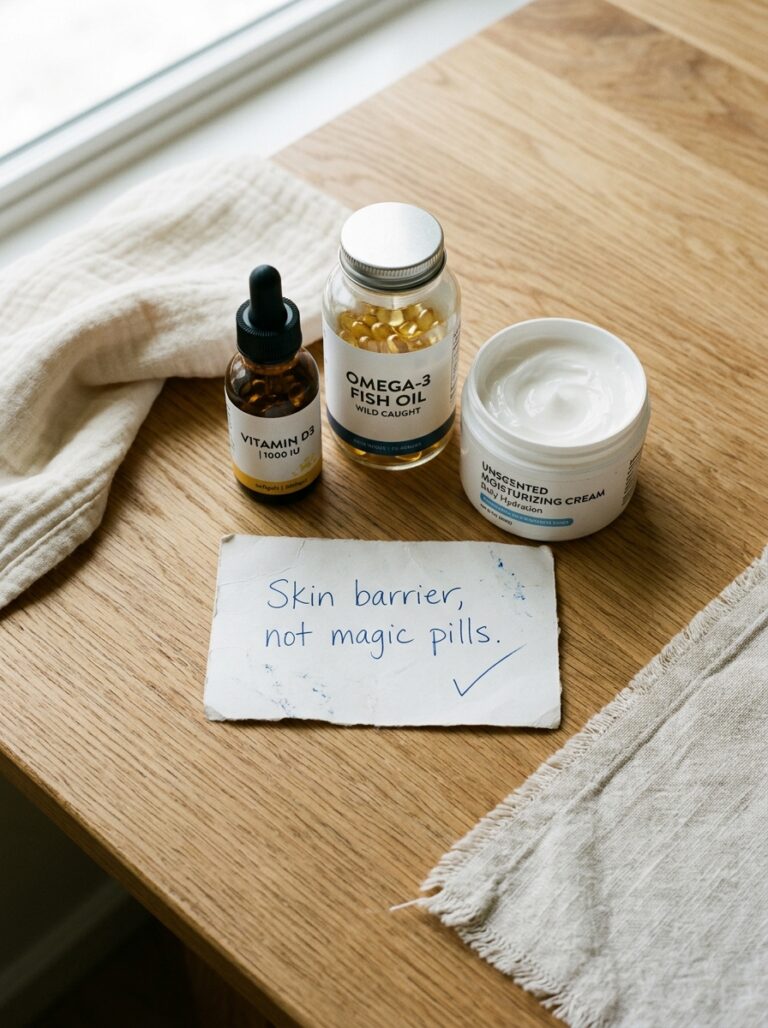
If you're searching for the best supplements for eczema, you've probably already tried the creams and want to know which pills actually move the needle. The honest answer is that eczema is a skin-barrier problem first, so the supplements that help are the ones correcting a real gap, not a shelf of cure-all capsules. The two or three I'd reach for in my own family's cabinet sit at the bottom of this article, but they earn their place only after the basics are in.
Affiliate disclosure: this article contains affiliate links. As an Amazon Associate, UsefulVitamins.com earns from qualifying purchases at no extra cost to you.
Before you decide
No supplement is first-line for eczema, and a few people should not self-treat at all. If your skin is weeping, crusted, spreading fast, or painful, that can signal infection and needs a clinician, not a capsule. The same goes for infants and anyone whose eczema is severe enough to disrupt sleep or daily life.
The step that actually changes eczema for most people is unglamorous: a fragrance-free moisturizer applied liberally and often, paired with whatever anti-inflammatory treatment your doctor has prescribed. A 2016 expert review in Asia Pacific Allergy called moisturizers "the basic requirement for optimal treatment of AD regardless of the severity," because they restore the barrier and cut water loss through the skin.
Supplements are adjuncts to that foundation, not replacements for it. Before adding anything, it's worth asking your doctor for a vitamin D blood test, since that single number changes whether one of the best-supported options here even applies to you. You can see how I weigh evidence and conflicts of interest on the how we review supplements page.
What eczema actually is
Eczema, or atopic dermatitis, is a chronic inflammatory skin condition driven by two things working together: a leaky skin barrier and an overactive immune response. It shows up as itchy, dry, inflamed patches that flare and settle in cycles.
The barrier side is structural. Many people with eczema carry changes in a protein called filaggrin, and a 2024 pathophysiology review describes how that defect raises water loss through the skin and lets allergens and microbes slip in. That's why the skin is dry and reactive even between flares, and why barrier repair with moisturizer is the foundation of care.
The immune side is what turns a dry patch into an angry, itchy one. Inflammatory signals ramp up, the itch-scratch cycle damages the barrier further, and the loop feeds itself.
Severity ranges widely, from a few seasonal dry patches to widespread disease. Conventional first-line treatment is consistent emollient use plus topical anti-inflammatories such as corticosteroids or calcineurin inhibitors, which is the standard supplements are added on top of, never instead of.
Strongest evidence supplements
These are the three with the most credible human trial data behind them for eczema. Notice that the best evidence is for fixing a deficiency, not for a generic "skin support" blend.
| Supplement | Best-supported use | Evidence strength | Typical studied dose |
|---|---|---|---|
| Vitamin D | Eczema in people who are low, or winter flares | Strongest; RCTs plus meta-analysis | 1,000 to 2,000 IU/day |
| Omega-3 (EPA/DHA) | Adjunct for itch and lesion severity | Modest, mixed; slow to show | DHA up to ~5 g/day in trials |
| Probiotics | Prevention in at-risk infants; small adult treatment effect | Better for prevention than treatment | Strain-specific, ~1 to 10 billion CFU |
Vitamin D
Vitamin D is the supplement with the clearest signal in eczema, and it's no coincidence that flares often worsen in winter when sun-driven vitamin D drops. It helps regulate skin immune function and supports the production of antimicrobial peptides in the skin barrier.
A randomized trial in the Journal of Allergy and Clinical Immunology gave Mongolian children with winter-related eczema 1,000 IU of vitamin D daily for a month and saw severity scores fall further than placebo (an adjusted EASI change of −6.5 versus −3.3). A later meta-analysis of vitamin D trials found supplementation improved eczema severity overall, while noting the effect was clearest in people who started out low.
Dose used in trials: typically 1,000 to 2,000 IU/day; correcting a documented deficiency may warrant more under medical guidance.
Form to look for: vitamin D3 (cholecalciferol), which raises blood levels more reliably than D2.
Skip if: your vitamin D is already in range. There's a difference between the dose that fixes a deficiency and the dose that just stacks up, so ask your doctor for a blood test before assuming you're low rather than dosing blind.
Omega-3 fatty acids
Omega-3s are a reasonable adjunct, with a modest and slow effect rather than a dramatic one. EPA and DHA are anti-inflammatory fatty acids, and the thinking is that they dampen some of the immune signaling that drives eczema flares.
The human data is mixed but not empty. A double-blind trial in the British Journal of Dermatology gave adults with atopic eczema 5.4 g of DHA daily for eight weeks and saw SCORAD severity scores fall from about 37 to 28.5, while the control group barely moved. Other trials show no clear benefit, which is why this sits as an adjunct, not a centerpiece.
Dose used in trials: varied widely; the positive DHA trial used 5.4 g/day, higher than a standard fish-oil capsule delivers.
Form to look for: an EPA/DHA fish oil with the actual EPA and DHA milligrams listed, not just "fish oil 1,000 mg." Most US adults fall short of the fish intake that would cover this, so a supplement closes a real dietary gap; I go deeper in the complete guide to omega-3.
Skip if: you're on blood thinners without clearing it first, since high-dose fish oil can affect bleeding.
Probiotics
Probiotics are the supplement most oversold for eczema, but the evidence splits sharply between prevention and treatment. The rationale is that early gut and skin colonization help train the developing immune system away from allergic responses.
For prevention, the signal is real: a systematic review of probiotics in children found they can reduce the occurrence of eczema in at-risk infants. For treating established eczema in adults the effect is smaller; a 2025 meta-analysis in the Indian Journal of Dermatology pooled seven trials in 275 adults and found a statistically significant but modest drop in SCORAD severity.
Dose used in trials: strain-specific, commonly in the 1 to 10 billion CFU range; effects attach to the named strain, not "probiotics" as a category, as I explain in the complete guide to probiotics.
Form to look for: a named genus, species, and strain code, with the CFU count guaranteed at expiry.
Skip if: you're severely immunocompromised or critically ill, where probiotics need physician oversight.
Moderate and mixed evidence

A handful of supplements have a plausible mechanism but thinner or more conflicting human data. They're worth considering only after the foundation is in place.
Zinc gets attention because the mineral supports skin healing and is involved in barrier function. The catch is that supplementing helps mainly people who are actually zinc-deficient, and trials in unselected eczema patients haven't shown consistent benefit. Food sources cover this requirement for most people who eat broadly, so this is a blood-test question, not a default add.
Vitamin E and other antioxidants appear in small studies with occasional positive signals, but the trials are small and the results don't replicate cleanly enough to recommend them as a strategy. A varied diet rich in vegetables, nuts, and seeds covers the antioxidant angle more reliably than a high-dose capsule.
Gamma-linolenic acid (GLA), from evening primrose or borage oil, was once a popular eczema supplement. Larger reviews have generally failed to find a meaningful benefit over placebo, which is why it's slid from "promising" to "mixed at best."
Popular but evidence-thin
Collagen is widely marketed for skin and shows up in eczema searches constantly. The actual evidence that oral collagen improves eczema is essentially absent, since most collagen research targets wrinkles and skin elasticity in aging, not the barrier and immune dysfunction that drive atopic dermatitis. If you want to try it, expect nothing for eczema specifically.
Turmeric and curcumin are promoted for "inflammation" broadly, but the eczema-specific human data is thin and oral curcumin absorbs poorly. A genuinely anti-inflammatory diet does more for most people than a curcumin capsule, and neither replaces barrier care.
What to look for, and the diet angle
When you do buy, a named, third-party-tested product beats a proprietary "skin complex" blend every time. Look for USP Verified, NSF Certified, or ConsumerLab Approved seals, vitamin D listed as D3, and a fish oil that prints its actual EPA and DHA milligrams. Skip anything making cure claims or hiding doses inside a blend.
On the diet side, the most useful framing is gap-filling, not megadosing. If your dietary intake already meets the requirement, more isn't better; the supplement that helps is the one closing a real gap. Oily fish twice a week covers most of the omega-3 case, sunlight and fortified foods cover much of the vitamin D case in summer, and a broad plant-rich diet covers the antioxidants.
Eczema can also overlap with food sensitivities in some people, but elimination diets should be guided by a clinician, not self-prescribed, because unsupervised restriction risks creating new nutrient gaps. For the wider picture of nutrients that support skin integrity, see my guide to the best supplements for skin health.
When to see a dermatologist
Supplements are not the move when eczema crosses into territory that needs medical treatment. See a clinician if your skin is infected (weeping, yellow crusting, rapidly spreading, or painful), if flares aren't controlled by moisturizer plus your current treatment, or if the itch is disrupting sleep and daily function.
Eczema in infants, sudden severe flares, and skin that isn't responding to standard care all warrant professional assessment. A dermatologist can prescribe the anti-inflammatory treatments that genuinely control disease, and confirm whether something other than eczema is going on. None of the supplements here is a substitute for that care; they sit alongside it.
FAQ
What is the single best supplement for eczema?
If you're low, vitamin D has the strongest evidence, especially for winter-pattern flares. But it's only "best" when you're actually correcting a deficiency, which is why a blood test comes first. In someone with normal vitamin D, no supplement reliably outperforms good moisturizer use.
Can supplements cure my eczema?
No. Eczema is a chronic, relapsing condition, and no supplement cures it; the goal is fewer and milder flares. The supplements with real evidence are adjuncts that may help at the margins, layered on top of barrier care and any prescribed treatment.
Do probiotics help adult eczema?
The effect is modest. A meta-analysis found a small reduction in adult eczema severity, but the evidence is stronger for preventing eczema in at-risk infants than for treating it once established. Strain matters more than the CFU number on the front of the bottle.
Should I take omega-3 for eczema?
It's a reasonable adjunct if your diet is light on oily fish. Expect a modest, slow effect rather than a quick fix, and choose a product that lists its EPA and DHA amounts. Clear high-dose use with your doctor if you take blood thinners.
Does diet change eczema?
For most people, a broad, varied diet supports the requirement better than any single capsule. Targeted supplements earn their place only when the diet leaves a real gap, such as low vitamin D in winter or minimal fish intake. Elimination diets should be clinician-guided.
The bottom line on eczema supplements
The most useful thing I can tell you is that eczema responds to barrier repair and standard treatment far more reliably than to any supplement, so moisturizer and your prescribed care come first, always. That framing is what separates this from the roundups selling pills as a cure.
Among supplements, vitamin D has the strongest evidence and it's largely a deficiency story, clearest in people who are low or who flare in winter, which is exactly why a blood test should precede the bottle. Omega-3 is a modest, slow adjunct worth considering if your diet is thin on fish, and probiotics are better at preventing eczema in at-risk infants than treating it in adults.
Next steps:
- Apply a fragrance-free moisturizer liberally and often, and keep using any treatment your doctor prescribed.
- Ask your doctor for a vitamin D blood test before supplementing, rather than dosing blind.
- For the broader nutrient picture, read the best supplements for skin health.
Reviewed by Sarah Thompson, Registered Dietitian, focused on vitamin and mineral nutrition. See more from Sarah Thompson. This article is educational and is not a substitute for individualized medical advice; talk to your doctor before starting a supplement, especially if you are immunocompromised, pregnant, treating an infant, or managing a diagnosed condition.
Recommended Products

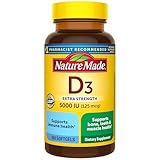

As an Amazon Associate, UsefulVitamins.com earns from qualifying purchases at no extra cost to you. We only recommend products supported by published research or third-party testing.
