
Every few years the fitness industry rediscovers a compound that sounds tailor-made for the thing bodybuilders want most: burn fat without touching muscle, avoid the diabetogenic side effects of full growth hormone, and do it all with a small synthetic peptide that slips through the regulatory net. HGH Fragment 176-191 — sometimes written Frag 176-191, sometimes labelled AOD-9604 — fits that description almost too neatly. So why is there no FDA-approved drug based on it? Why did the Australian pharmaceutical company that ran actual human trials stop before Phase III? HGH Fragment 176-191 is a 16-amino-acid synthetic peptide with real lipolytic activity in obese mice, no evidence of efficacy in humans, no approval as a drug or dietary supplement under any regulatory framework, and explicit prohibition by WADA — which makes the gap between the marketing and the science considerably wider than most vendor pages will tell you.
Summary: What Is HGH Fragment 176-191 and What Does the Data Actually Show?
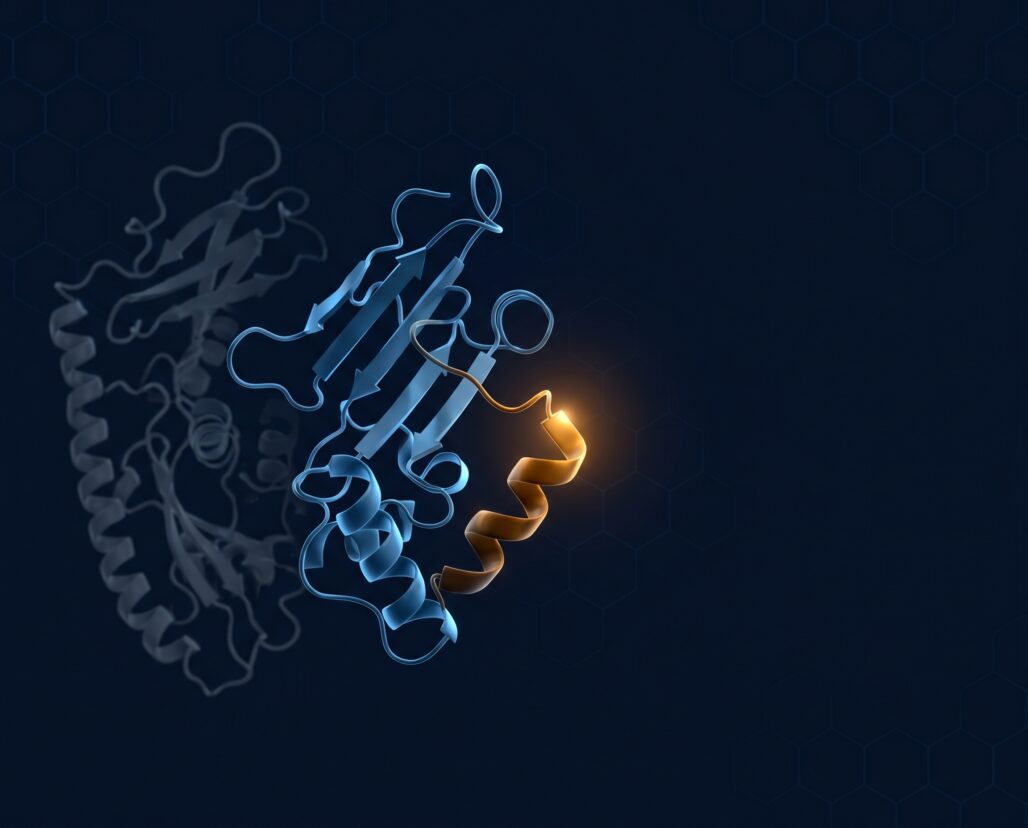
HGH Fragment 176-191 is a synthetic truncation of the C-terminal end of human growth hormone, covering residues 176 through 191 of the 191-amino-acid parent hormone. Three mouse studies published between 2000 and 2001 by Heffernan, Ng, and colleagues at Monash University found that the fragment — and its modified cousin AOD-9604 — reduces body weight gain, increases fat oxidation, and suppresses lipogenic enzyme activity in obese rodents. No Phase III human trial has ever been completed. The compound is not FDA-approved as a drug or dietary supplement. It is explicitly named on the WADA prohibited list alongside AOD-9604 under Section S2.2.3 (Growth Hormone Fragments), prohibited at all times.
Best for: Understanding why a plausible mouse study does not translate into a proven human therapy.
Not ideal for: Anyone expecting a clinically validated fat-loss agent. The human efficacy evidence does not exist.
What to look for: If a vendor cites "clinical studies proving fat loss in humans," ask for the trial registration number and endpoint measured. The published literature stops at Phase IIa status reports and animal pharmacology.
Decision shortcut: If you compete in a tested sport, HGH Fragment 176-191 and AOD-9604 are prohibited by WADA regardless of how the vial is labelled. If you are untested, the practical question remains: are you comfortable with a compound whose entire efficacy case rests on obese-mouse data from the early 2000s?
For a broader foundation, the site's general peptide overview covers what peptides are as a class, and the peptide safety review frames the risk questions before you evaluate any individual compound.
What HGH Fragment 176-191 Actually Is: A Clipped C-Terminus
Human growth hormone (hGH) is a 191-amino-acid protein produced by the anterior pituitary. Its receptor-binding domain sits at the N-terminus and mid-section of the chain. Researchers at Monash University found that the C-terminal end — roughly the last 15 to 20 residues — was not necessary for receptor binding, yet isolated fragments from that region showed measurable effects on fat cells in early cell-culture work.
HGH Fragment 176-191 is a synthetic version of residues 176 through 191 of native hGH: 16 amino acids, cheap to synthesize, and stable in lyophilized form. Crucially, it does not bind the classical growth hormone receptor in the same way as intact hGH. Heffernan et al. confirmed that the closely related AOD9604 "does not compete for the hGH receptor and nor does it induce cell proliferation" (PMID 11673763). That receptor independence is the central marketing claim: all the fat-burning benefit of growth hormone, none of the growth-promoting side effects.
That claim is derived from mouse data. Whether the same receptor independence translates to meaningful human fat loss at any tested dose is a question the published literature does not answer.
The Mouse Studies: What Heffernan and Ng Actually Found
The foundational research on HGH Fragment 176-191 and its AOD variants comes from a cluster of studies from Monash University, most involving obese C57BL/6J mice or ob/ob (leptin-deficient) mice — the standard rodent models for studying obesity pharmacology.
Early work from Ng and colleagues at Monash University established that isolated C-terminal hGH fragments could trigger cellular mediators in fat and liver cells, establishing that this region of the molecule had independent biological activity (PMID 3285107).
The most cited efficacy study is Heffernan et al. (2000), published in the American Journal of Physiology — Endocrinology and Metabolism. The team administered a synthetic fragment called AOD-9401 orally to obese C57BL/6J mice for 30 days. The treated mice showed reduced body weight gain from day 16 onward compared to saline controls, with equivalent food consumption between groups, meaning the effect appeared metabolic rather than appetite-suppressive. In adipose tissue, lipogenic activity fell and lipolytic activity rose. In vitro testing on isolated human adipose tissue cells also showed lipolytic response, which the authors cited as a translational signal (PMID 10950816).
A follow-up study in 2001, published in the International Journal of Obesity, compared full-length hGH directly with AOD9604 (a modified C-terminal fragment) using mini-osmotic pumps in obese and lean mice over 14 days. Both compounds reduced body weight gain and increased plasma glycerol — a marker of lipolysis — in obese animals. Importantly, AOD9604 did not trigger the hyperglycemia or reduced insulin secretion observed with some hGH dosing regimens, which researchers presented as a potential safety advantage (PMID 11673763).
A third study, published in Endocrinology in late 2001, investigated whether the beta-3 adrenergic receptor (beta-3 AR) was the mechanism behind the lipolytic action. Both hGH and AOD9604 upregulated beta-3 AR gene expression in fat tissue. But when the researchers tested the compounds in beta-3 AR knockout mice — animals genetically incapable of signaling through that receptor — chronic treatment still produced some metabolic effects, which ruled out a simple direct pathway through beta-3 AR. The mechanism remained incompletely characterized (PMID 11713213).
Taken together, these three studies represent the scientific core of every vendor claim about HGH Fragment 176-191. They are rodent pharmacology studies, published in legitimate peer-reviewed journals, with plausible mechanistic findings. They are also two decades old, conducted with proprietary modified fragments (AOD-9401 and AOD9604) rather than the bare 176-191 sequence sold in most grey-market vials, and they have not been replicated in human randomized controlled trials.
Why It Never Moved Past Mice: The Human Evidence Gap
Here is where the story diverges sharply from vendor marketing. Metabolic Pharmaceuticals acquired AOD-9604 and initiated Phase I and Phase IIa clinical trials, with Phase IIa underway by early 2002 (PMID 15134286). Reviews of the obesity drug pipeline still listed it as a candidate through 2006 and 2007 (PMID 16625817).
No Phase III human efficacy trial for AOD-9604 or bare HGH Fragment 176-191 has been published. Metabolic Pharmaceuticals did not bring the compound to regulatory submission. The reasons were never detailed in a published paper, which is itself informative: when a compound clears Phase II with strong results, companies publish the data to attract partners. The silence is the signal.
The in vitro human adipose tissue finding from Heffernan et al. (2000) — fat cells in a dish responding to the compound — is the closest thing to human data in the primary literature. Cell-culture results do not tell you whether subcutaneous injection in a living person at a grey-market dose produces meaningful fat loss or at what cost to other biological systems. The efficacy case is built entirely on animal data. No published randomized controlled trial in humans has tested this compound for fat loss, body composition change, or any other marketed outcome.
AOD-9604: The Modified Sibling
AOD-9604 deserves its own explanation because the two terms are frequently used interchangeably in grey-market forums, but they are not identical. The bare HGH Fragment 176-191 sequence spans residues 176 to 191 of native hGH without modification. AOD-9604 is a modified version of that sequence with a tyrosine residue added at the N-terminus, a change designed to improve stability and bioavailability.
The Monash University research conducted by Heffernan, Ng, Thorburn, and colleagues primarily studied AOD-9401 and AOD9604, not the bare 176-191 sequence. This means the mouse evidence that circulates in bodybuilding communities — often cited as proof that "Frag works" — was actually generated on modified fragments. Whether the bare 176-191 sequence behaves identically in vivo is an assumption, not a demonstrated fact.
A separate page on this site covers AOD-9604 in more detail, including the regulatory history that led the FDA to address its use in compounding.
Regulatory Status: FDA and WADA
HGH Fragment 176-191 is not FDA-approved as a drug or dietary supplement. This is not a technicality or a matter of pending approval — there is no approved indication, no approved formulation, and no regulatory pathway under which a consumer can legally obtain this compound in the United States as a therapeutic product.
The FDA has also addressed its presence in compounding. In 2016, the agency finalized a rule removing several peptides — including AOD-9604 — from the list of bulk drug substances permitted in compounded preparations under 503A and 503B of the Federal Food, Drug, and Cosmetic Act, citing insufficient evidence of clinical use or safety. That action closed the one semi-legitimate route by which US compounding pharmacies could supply the compound. The grey-market channel — overseas research chemical suppliers — is unaffected by those rules, which is why vials continue to circulate.
On the anti-doping side, WADA is unambiguous. The current Prohibited List cites under Section S2.2.3 — Growth Hormone, Its Analogues and Fragments — "growth hormone fragments, e.g. AOD-9604 and hGH 176-191." These are non-Specified Substances, prohibited at all times: both in-competition and out-of-competition use is banned for athletes in the tested pool. A positive test carries the same sanction as a positive for full-length synthetic growth hormone.
If you are a tested athlete — at any level, in any sport that falls under a WADA signatory organization — using HGH Fragment 176-191 or AOD-9604 is a prohibited act, regardless of how the supplier labels the product.
The Grey-Market Stack Reality: CJC-1295 and Ipamorelin
In grey-market bodybuilding communities, HGH Fragment 176-191 is rarely used in isolation. The most common protocol combines it with CJC-1295 (a GHRH analog) and ipamorelin (a GHRP-class GH secretagogue). The logic is layered: CJC-1295 raises baseline GH output, ipamorelin amplifies the GH pulse, and Frag 176-191 provides targeted lipolytic activity without driving IGF-1 or blood glucose in the way full GH would.
This stack architecture is pharmacologically coherent on paper. It is also completely untested in humans as a combination. There is no published randomized controlled trial of any combination of HGH Fragment 176-191, CJC-1295, and ipamorelin in humans. The stack exists as forum consensus extrapolated from rodent pharmacology and individual pharmacokinetic profiles of each component studied in isolation.
The bodybuilding peptides overview on this site covers how these stacks are constructed and why the evidence base for most of them is thinner than forum consensus implies.
Beyond the evidence gap, grey-market vials introduce practical quality risks: variable purity, bacterial endotoxin contamination from improper lyophilization, and no post-market safety surveillance. The 2001 Monash mouse studies used pharmaceutical-grade AOD9604 manufactured to research specifications. A vial from a research chemical website has no equivalent quality assurance.
Pregnancy and nursing are a complete avoidance scenario. No safety data for HGH Fragment 176-191 or AOD-9604 exists for pregnant or nursing individuals, and the compound should not be used under any circumstances during those periods.

Frequently Asked Questions
Does HGH Fragment 176-191 burn fat in humans? No human clinical trial has demonstrated that. The fat-loss evidence comes from obese mice given pharmaceutical-grade modified fragments. In vitro results on isolated human fat cells show a lipolytic response, but cell-culture findings do not reliably predict whole-body outcomes in living people.
Is HGH Fragment 176-191 the same as AOD-9604? No. AOD-9604 is a modified version with a tyrosine residue added at the N-terminus. The two are chemically distinct, and most of the published mouse research used AOD-9604 or AOD-9401, not the bare 176-191 sequence.
Can a compounding pharmacy in the US prescribe HGH Fragment 176-191? No. The FDA removed AOD-9604 from the permitted bulk drug substance list in 2016. Compounding pharmacies may not lawfully compound this peptide.
Is HGH Fragment 176-191 detectable on drug tests? Yes. WADA explicitly names hGH 176-191 and AOD-9604 in Section S2.2.3. Anti-doping laboratories test for growth hormone fragments using mass spectrometry and immunoassay methods.
What is the evidence for the CJC-1295 and ipamorelin stack with Frag? There is no published randomized controlled trial of that combination in humans. The stack is forum consensus extrapolated from individual compound profiles and rodent pharmacology.
Does HGH Fragment 176-191 cause insulin resistance? Mouse studies found no glucose impairment at studied doses, unlike full hGH. Whether this holds in humans at grey-market doses over extended periods is not established by any published human data.
If you are managing a protocol like this, StackMyMed (our companion app) keeps your doses, timing, and interaction checks in one place. It does not replace medical advice — bring the log to your clinician.
Conclusion
HGH Fragment 176-191 sits in an uncomfortable position: the evidence that launched it is real, peer-reviewed, and published in legitimate journals, and it stops at mice. A cluster of Monash University studies from 2000 to 2001 established that a modified C-terminal hGH fragment reduces body fat accumulation and increases fat oxidation in obese rodents through mechanisms that bypass the classical hGH receptor. An Australian pharmaceutical company then ran early-phase human trials that were never completed and never published, and ultimately did not produce an approved drug.
What filled the void is a grey-market ecosystem selling vials of varying purity, often stacked with CJC-1295 and ipamorelin in a protocol whose combined effect has never been tested in any published human trial. The compound is explicitly banned by WADA, is not FDA-approved as a drug or dietary supplement, and cannot be lawfully compounded in the United States.
The science that exists is worth understanding honestly. The three Heffernan and Ng studies cited above are indexed on PubMed and readable in full. For the regulatory picture specific to AOD-9604, the dedicated AOD-9604 page covers that ground. What is not supportable is the vendor claim that HGH Fragment 176-191 is a clinically proven fat-loss peptide backed by solid human research. The human research does not exist.
Medical Disclaimer: This article is for informational purposes only and does not constitute medical advice, diagnosis, or treatment. HGH Fragment 176-191 and AOD-9604 are not FDA-approved drugs or dietary supplements and are not intended to diagnose, treat, cure, or prevent any disease or health condition. Consult a licensed healthcare provider before making any decisions about peptides, hormones, or related compounds. Do not use any unapproved peptide during pregnancy or while nursing.
