
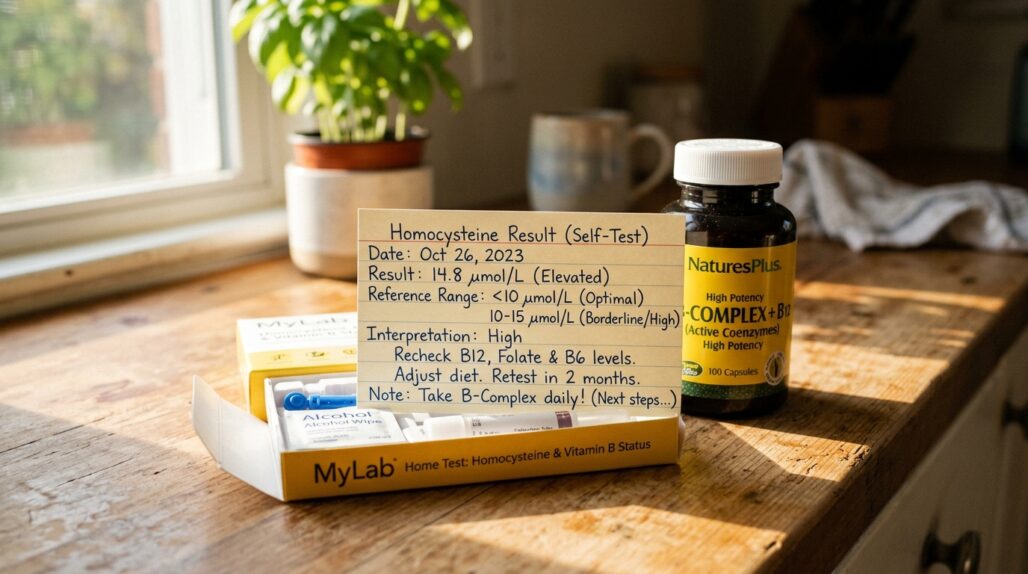
Affiliate disclosure: this article contains affiliate links. As an Amazon Associate, UsefulVitamins.com earns from qualifying purchases at no extra cost to you.
What homocysteine actually is
Homocysteine is an amino acid your body makes when it breaks down methionine, a building block from protein. Normally your cells recycle it back into methionine or convert it into cysteine. Both of those exits depend on B vitamins. When you are short on folate, B12, or B6, homocysteine backs up in the blood, and that is what a blood test picks up.
The test is usually ordered as total plasma homocysteine, reported in micromoles per liter (umol/L). According to MedlinePlus from the NIH, it is sometimes used to check for a B12 or folate deficiency, to investigate a rare inherited disorder, or as one input into cardiovascular risk thinking.
Here is the part worth sitting with: a high number is a signal, not a diagnosis. It tells you a metabolic pathway is running short on something. The useful response is to find out which B vitamin is missing, refill it, and confirm the number came down. This page is educational. It is not a substitute for your own doctor reading your full results.
What your homocysteine number means
Lab reference ranges vary, but the figures below are widely used. The StatPearls hyperhomocysteinemia review on the NIH Bookshelf describes a normal range and a graded scale for what counts as elevated.
| Homocysteine level | Common label | What it usually suggests |
|---|---|---|
| About 5-15 umol/L | Standard normal range | Within the typical clinical reference range |
| Above ~15 umol/L | Mild elevation (16-30) | Often a folate, B12, or B6 gap; sometimes diet, age, or kidney function |
| 31-100 umol/L | Intermediate | Needs a doctor; look harder for B12 deficiency or other causes |
| Above 100 umol/L | Severe | Uncommon; can signal an inherited disorder – urgent medical workup |
A note on the "optimal" debate. Some functional-medicine practitioners aim for a homocysteine below about 7 umol/L and call anything above that suboptimal. That tighter target is an opinion, not clinical consensus. The standard reference range tops out around 15 umol/L, and the research linking small differences inside the normal band to real-world outcomes is thin. We mention the lower target so you recognize it when a clinic quotes it, but the honest position is that the standard range is the one your doctor will use.

Test first, then act, then re-test
The protocol below puts the free and low-cost moves before any capsule, because they matter and because skipping them wastes a re-test.
Step 1 – confirm B12 before anything. This is the one safety step you should not skip. Folate (and especially high-dose folic acid) can lower homocysteine and correct anemia while a hidden B12 deficiency keeps quietly damaging nerves. As the NIH Office of Dietary Supplements explains in its folate fact sheet, high folic acid intake can mask a B12 deficiency. So check B12 first. If it is low or borderline, that is a doctor conversation before you load up on folate.
Step 2 – food and lifestyle, the biggest free levers. Folate-rich foods do real work here: leafy greens, legumes, lentils, beans, and eggs for B12. Cutting back on heavy alcohol use helps, since alcohol interferes with folate. If you smoke, that pushes homocysteine up too. None of this costs anything, and it often moves the number on its own.
Step 3 – the B-complex, dosed sensibly. A combined product covers all three exits in the pathway. The table maps each vitamin to its job and a reasonable starting dose.
Some links below are affiliate links; if you buy through them we may earn a small commission at no extra cost to you. We only point to test kits and supplements we would use ourselves.


As an Amazon Associate, UsefulVitamins.com earns from qualifying purchases at no extra cost to you.
| Nutrient and form | Typical daily dose | What it does + evidence | Re-test |
|---|---|---|---|
| Folate (as L-methylfolate or folic acid) | ~400-800 mcg | Main driver of homocysteine lowering; strong human evidence it lowers the number | 8-12 weeks |
| Vitamin B12 (methylcobalamin) | ~500-1,000 mcg | Runs the remethylation exit; needed if B12 is the cause; strong evidence | 8-12 weeks |
| Vitamin B6 (P-5-P or pyridoxine) | ~10-25 mg | Runs the transsulfuration exit; modest added effect; moderate evidence | 8-12 weeks |
| At-home homocysteine test | Baseline + one re-test | Screening aid only; confirm any abnormal result with a clinic lab | Repeat at 8-12 weeks |
For reference, the StatPearls review cites a study regimen of 0.8 mg folic acid, 0.5 mg B12, and 20 mg B6 used over a long period. Those are in the same ballpark as the doses above. Keep folic acid at or under the 1,000 mcg daily upper limit set by the NIH unless a doctor directs otherwise. You can sense-check folate forms with our methylfolate vs folic acid guide and dial in your B12 amount with the B12 dose-by-form calculator.
The MTHFR twist (and why it matters less than the internet says)
If you have searched homocysteine, you have hit MTHFR. The MTHFR gene codes for an enzyme that converts folate into its active form, L-methylfolate. A common variant called C677T reduces that enzyme's activity – roughly 35% lower in people with one copy and around 70% lower in people with two copies, per the genetics literature.
The logical leap is that carriers should take L-methylfolate (the already-active form) instead of plain folic acid. It is a reasonable idea, and for many people methylfolate is a fine choice. But the head-to-head data is softer than the marketing. A 2023 randomized trial in healthy adults found homocysteine dropped on both folinic acid and L-methylfolate, with no clear winner overall. The NIH fact sheet notes 5-MTHF "might be better" for some C677T carriers, which is a careful "might," not a promise.
Two practical takeaways. First, you do not need a genetic test to act – the B-complex works either way, and a methylated form is a safe default if you want to hedge. Second, do not self-diagnose MTHFR as the reason for your symptoms. A high homocysteine with a known gene variant is still mostly a nutrition-and-cause question, and a real workup beats a genotype printout.

Manage your expectations about the heart
A lot of homocysteine content implies that lowering the number protects your heart. The B vitamins genuinely lower homocysteine. The harder question is whether that translates into fewer heart attacks and strokes, and the best evidence says mostly no.
The Cochrane review of homocysteine-lowering trials pooled 15 randomized studies and 71,422 people. B6, B9, and B12, alone or combined, showed no reduction in heart attacks or in death from any cause versus placebo. There was a small, uncertain signal for fewer strokes – roughly 143 people treated for 5.4 years to prevent one stroke. That is a real but modest effect, and not a reason to treat a B-complex like a cardiac drug.
So why test and treat at all? Because a high homocysteine is a useful flag for a B-vitamin gap that is worth fixing on its own terms, and because the workup can surface a B12 deficiency or kidney issue you would want to know about. Lowering the number is satisfying and easy. Just hold the heart claims loosely.
The re-test checkpoint (do not skip this)
This is where most people drop the thread. They start a B-complex, feel vaguely virtuous, and never check whether it worked. The whole point of a measurable marker is the re-check.
Re-test homocysteine in 8 to 12 weeks. B vitamins act fairly quickly on this number, so two to three months is plenty to see a clear move. Use the same conditions if you can – similar time of day, fasting if your first test was fasting – so you are comparing like with like.
A simple way to keep the loop honest: log your baseline result and set a reminder for the re-test. You can do that in StackMyMed (our own free app), which lets you record the number and ping you when the re-test window opens, or just as easily with a note in your phone and a calendar reminder. The tool does not matter. Comparing two numbers does. If the second result has not budged, that is a sign to revisit B12 status, dosing, or the underlying cause with a doctor rather than doubling the dose on your own. To understand absorption and timing while you wait, our complete guide to folate is a useful read.

See a doctor if
At-home homocysteine tests are screening aids. They are convenient for tracking a trend, but a finger-prick result is not a clinical diagnosis. Talk to a doctor, and do not rely on a home kit alone, if any of these apply:
- Your homocysteine is very high (above roughly 30 umol/L), which can point to a B12 deficiency, kidney disease, or an inherited disorder that needs investigation.
- You have nerve symptoms like numbness or tingling, balance problems, or signs of anemia – these can mean a B12 deficiency that folate would mask.
- You have a personal or family history of blood clots, early heart disease, or stroke.
- You are pregnant, trying to conceive, on a blood thinner, or taking a medication that affects B12 (such as long-term metformin or a proton pump inhibitor).
In all of these cases, the right move is a doctor-ordered panel and a real conversation, not a self-started high-dose regimen.
FAQ
What is a normal homocysteine level? The standard reference range is roughly 5 to 15 umol/L, though labs differ slightly. Above about 15 umol/L is generally called elevated, and the higher the number, the more reason to look for a cause with a doctor.
Will B vitamins really lower my homocysteine? Yes, reliably. Folate, B12, and B6 all feed the pathways that clear homocysteine, and the number usually drops within a couple of months. What is less certain is whether that drop protects your heart – large trials have not shown a clear cardiovascular benefit.
Do I need methylfolate instead of folic acid if I have MTHFR? Not necessarily. Methylfolate is a reasonable default and bypasses the enzyme step, but head-to-head trials have not shown it clearly beats folic acid for lowering homocysteine. You do not need a genetic test to start a sensible B-complex.
How soon should I re-test? Around 8 to 12 weeks after starting. That is long enough for B vitamins to move the number, and re-testing is the only way to know whether your protocol actually worked rather than just feeling productive.
Can I just take high-dose folic acid? Be careful. High folic acid can correct the homocysteine number and any anemia while hiding a B12 deficiency that keeps damaging nerves. Keep folic acid at or under the 1,000 mcg daily upper limit and check B12 first.
Is an at-home homocysteine test accurate enough to act on? It is fine for screening and for tracking a trend over time, but it is not a clinical diagnosis. Confirm any abnormal or decision-changing result with a doctor-ordered lab test before making big changes.
The bottom line
A high homocysteine is usually a fixable B-vitamin gap, not a verdict about your heart. Check B12 first, lean on folate-rich food and less alcohol, then add a methylated B-complex at sensible doses. Treat any "optimal under 7" target as one opinion among several, and keep folic acid under the NIH upper limit. Most importantly, re-test in 8 to 12 weeks so you actually know whether the number moved. If your result is very high, or you have nerve symptoms or a clotting history, that is a doctor's job, not a home kit's. For the iron side of fatigue testing, our sibling page on choosing a folate supplement pairs well with this one.
This article is for education only and is not medical advice or a diagnosis. At-home tests are screening aids, not a substitute for clinical testing. Talk to your doctor or pharmacist before starting, stopping, or changing any supplement or medication, especially if you are pregnant, on a blood thinner, or managing a chronic condition.
Reviewed by the UsefulVitamins Editorial Team.
