
Affiliate disclosure: this article contains affiliate links. As an Amazon Associate, UsefulVitamins.com earns from qualifying purchases at no extra cost to you.
What the 40:1 ratio actually means
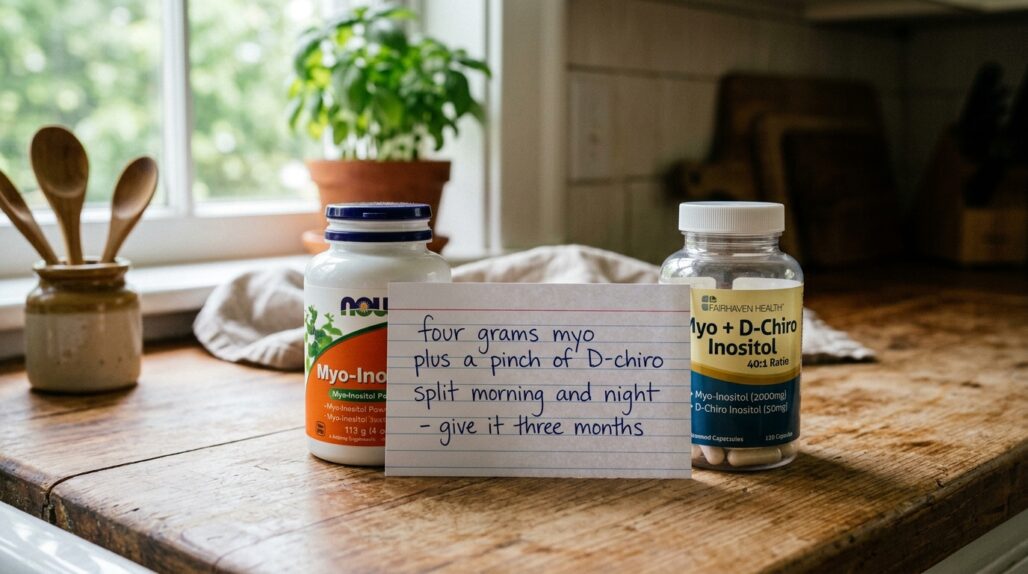
PCOS supplements love to print "40:1" on the label without saying what it refers to. It is the ratio of the two inositol forms inside the bottle: 40 parts myo-inositol to 1 part D-chiro-inositol.
Both are naturally occurring sugar alcohols your body already makes and gets from food. The FDA lists inositol as Generally Recognized as Safe under 21 CFR 184.1370, which is why you can buy it without a prescription.
The reason the ratio matters is that healthy plasma carries these two forms at roughly 40 to 1. Researchers settled on 40:1 because it copies that natural balance rather than flooding the body with one form, and the review of inositols in PCOS on PMC frames it as the physiological plasma ratio for exactly that reason.
This is a support supplement, not a cure. PCOS is a clinical diagnosis, and inositol sits alongside whatever plan your doctor has set, not in place of it.
Why not just take more D-chiro-inositol
For a while the supplement world chased high-dose D-chiro, on the logic that if a little helps insulin, more must help more. The data pushed back.
A comparison study tested seven different myo-to-D-chiro ratios in PCOS patients, from D-chiro alone up through 80:1. The 40:1 ratio published in European Review came out best for restoring ovulation, while ratios that leaned heavily on D-chiro performed worse.
The plain-language version: too much D-chiro-inositol can blunt the ovary's response instead of helping it. Your ovaries seem to want mostly myo-inositol, with only a small D-chiro contribution for insulin signaling.
So the small 100 mg of D-chiro in a 40:1 product is deliberate. It is enough to support blood-sugar handling without tipping the balance the wrong way.
The dose, and the label math
Most trials that showed benefit used 4 g of myo-inositol daily, usually split as 2 g twice a day. Pair that with about 100 mg of D-chiro-inositol and you land on 40:1.
A clean 40:1 product is usually dosed as 2 g myo plus 50 mg D-chiro per serving, taken twice daily, landing on the 4 g myo / 100 mg D-chiro daily target most often recommended for PCOS. A 40:1 combination at a lower daily dose also improved endocrine and insulin-resistance markers in overweight PCOS women on PMC.
Here is how the daily numbers add up:
| Component | Morning dose | Evening dose | Daily total |
|---|---|---|---|
| Myo-inositol | 2 g | 2 g | 4 g |
| D-chiro-inositol | 50 mg | 50 mg | 100 mg |
| Resulting ratio | 40:1 | 40:1 | 40:1 |
One number trips people up: 4 g is grams, 100 mg is milligrams. Some labels list everything in milligrams (4,000 mg myo, 100 mg D-chiro) and the size difference looks alarming until you realize it is the whole point of a 40:1 blend.
If you would rather not eyeball any of this, our best supplements for PCOS guide walks through which formats already come pre-blended at 40:1 so you do not have to do the arithmetic yourself.
Powder versus capsules
Four grams of myo-inositol is a lot of capsule to swallow, often four to six pills a day. Powder gets you the full dose in one stir and tends to cost less per gram.
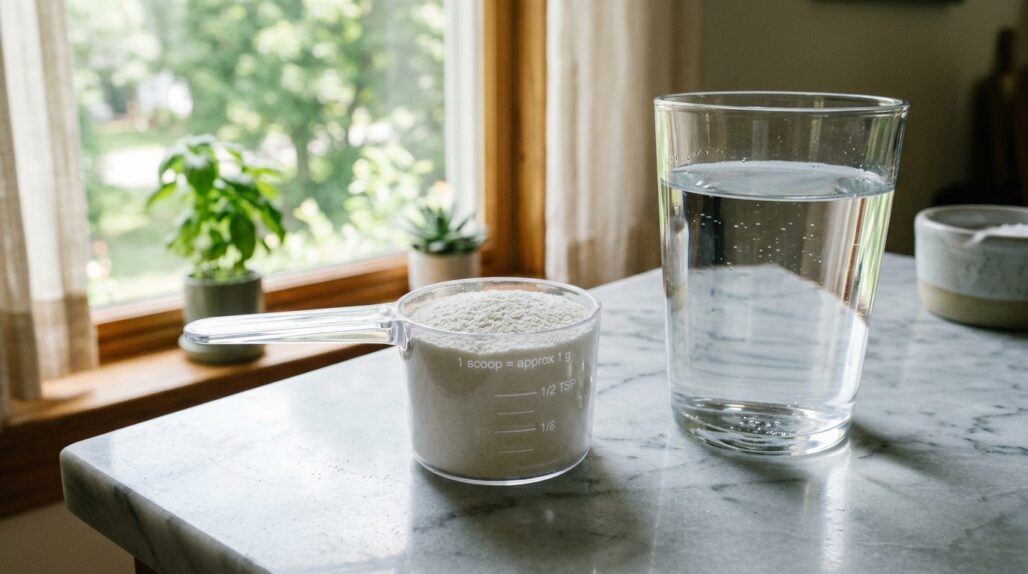
The tradeoff is precision. With powder you measure with the included scoop; with capsules the dose is fixed, which some people find easier to stay consistent with. Neither absorbs meaningfully better, so pick the one you will actually keep taking.
How long before anything changes
This is the hardest part to sit with. Inositol is not a fast supplement, and there is no first-day signal to tell you it is working.
In the trials, metabolic markers like HOMA-IR tended to move around the 3-month mark, and menstrual regularity often took longer still. The review on PMC describes insulin-resistance improvements near three months and cycle changes building out toward six.
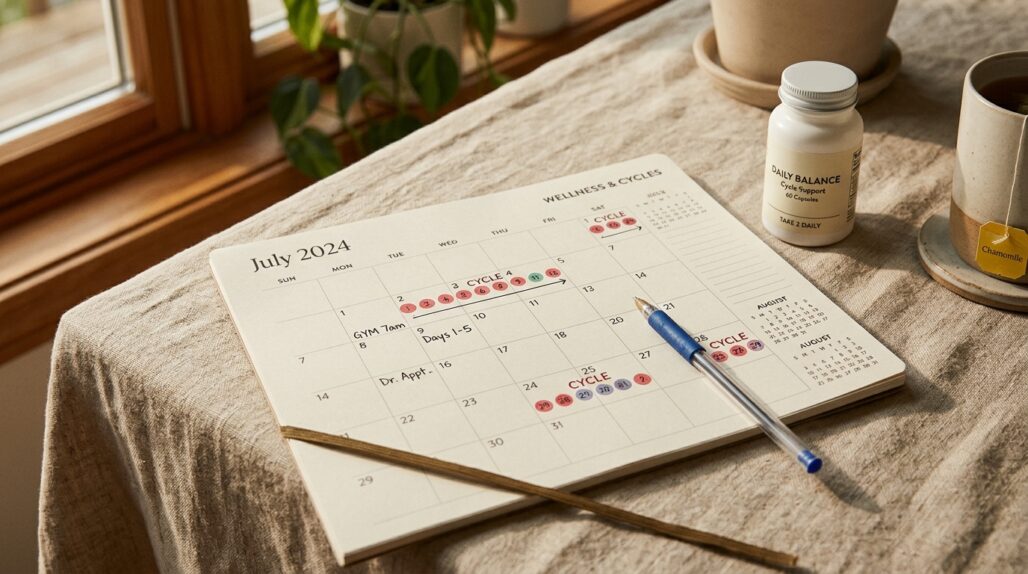
Use roughly a 3-month trial as your first checkpoint. Cycles are the clearest real-world sign, so tracking them on a calendar or app gives you something to look back on.
| Stage | What is happening | What you might notice |
|---|---|---|
| Weeks 1-2 | Building a daily habit, body adjusting | Usually nothing yet, maybe mild gut adjustment |
| Weeks 3-8 | Insulin signaling support builds | Subtle metabolic shifts, often invisible without labs |
| Around month 3 | HOMA-IR and androgen markers studied here | First fair point to reassess with your doctor |
| Months 3-6 | Menstrual regularity studied over this window | More predictable or more frequent cycles for some |
If nothing has shifted after a fair 3 to 6 month run, that is useful information, not a failure. It is a reason to revisit the plan with a clinician rather than to keep buying bottles indefinitely.
With or without food, and staying consistent
You can take inositol with or without food, and the timing is flexible. There is no strict "before bed" or "empty stomach" rule the way there is with some other supplements.
The practical reasons to take it with a meal are comfort and memory. Taking it with food can soften any mild stomach upset, and tying it to breakfast and dinner makes the twice-daily habit easier to keep.
What matters more than timing is that you take it every day. Inositol works by gradually nudging your physiology, so a dose missed here and there blunts the slow build you are paying for.
For the morning-and-evening split, a simple anchor works: one serving with your first meal, one with your last. The blood level you are after is steady, not spiked.
Safety, side effects, and the metformin overlap
Inositol has a reassuring safety record. It is generally well tolerated up to about 12 g a day, and the doses used for PCOS sit well under that.
The most common side effects are mild gut symptoms like nausea or loose stools, and they cluster at the high end. They usually fade, and starting at the lower part of the range before building up can help if your stomach is sensitive.
The interaction worth flagging is with diabetes and PCOS medication. Both inositol and metformin improve insulin sensitivity, and a network meta-analysis on PMC puts them in the same family of insulin sensitizers. Stacking them is something a doctor sometimes does on purpose, but it is their call, not a DIY one.
Do not start, stop, or change a prescription on your own. If you already take metformin, a glucose-lowering drug, or anything else daily, run inositol past your prescriber first, and our drug and supplement interaction checker is a fast first pass before that conversation.
If you are pregnant, trying to conceive, or managing a fertility plan, that is another reason to loop in your clinician. Inositol is studied in pregnancy, but the decision should be theirs to make with you.
Which form to buy
The honest framing: the ratio and the daily dose matter far more than the brand. A pre-blended 40:1 product that gives you 4 g myo and 100 mg D-chiro a day is doing the same job whether it is powder or capsule.
Buy on three things in order: the correct 40:1 ratio, a full 4 g myo-inositol daily dose, and the format you will stick with. Price per serving is the tiebreaker, since you are committing to months, not days.
If you are already loaded up on PCOS products, it is worth a sanity check with our supplement self-audit before adding another bottle, and our overview of peptides for PCOS covers where inositol sits relative to other options people ask about.
We may earn a commission from purchases made through the links below, at no extra cost to you. We only suggest forms that match the studied dose.
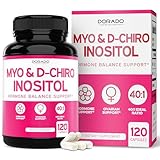


As an Amazon Associate, UsefulVitamins.com earns from qualifying purchases at no extra cost to you.
FAQ
Is the 40:1 ratio really better than myo-inositol alone? The 40:1 blend was the best performer in the head-to-head ratio comparison, but plain 4 g myo-inositol is also well studied and effective on its own. The added D-chiro is a small refinement, not a requirement.
Can I just take more to get faster results? No. More does not work faster, and doses above roughly 12 g a day mainly add gut side effects. Stick to the studied 4 g of myo-inositol and give it time.
Should I take inositol with food or on an empty stomach? Either is fine. Taking it with a meal can ease mild stomach upset and makes the twice-daily habit easier to remember, but it does not change how well it works.
Can I take inositol and metformin together? Sometimes, but that is a decision for your prescriber. Both lower insulin resistance, so combining them should be supervised rather than self-managed.
How long until my periods become regular? Cycle changes were studied over about three to six months, not weeks. Track your cycles and reassess with your doctor at the three-month mark rather than judging it early.
Is inositol safe to take long term? It has a strong safety record at PCOS doses and is FDA-recognized as safe as a food ingredient. Even so, anything you take for months deserves a periodic check-in with a clinician.
The bottom line
For PCOS, the dose with the most evidence behind it is 4 g of myo-inositol plus about 100 mg of D-chiro-inositol a day, split morning and evening, which is the 40:1 ratio. That ratio wins because it copies the body's natural balance instead of overloading D-chiro.
Give it a fair 3-month run, take it consistently with or without food, and use cycle tracking as your real-world readout. To skip the label math, lean on our best supplements for PCOS guide for products already blended at 40:1.
Inositol supports a PCOS plan, it does not replace one. The next step is a short conversation with your doctor or pharmacist, especially if you take metformin or are trying to conceive.
This article is general education, not medical advice. PCOS is a medical condition, and decisions about supplements or medication should be made with a qualified healthcare professional who knows your history.
Reviewed by the UsefulVitamins Editorial Team.
