
If you've been researching peptides and noticed that the label on a collagen powder looks nothing like the label on a compounded injectable, which looks nothing like the insert inside a branded GLP-1 pen, the short answer is: those three formats operate under entirely different regulatory frameworks, and they communicate completely different things. Confusing one for another is how people over-trust grey-market vials or under-understand the actual risk profile of something with a 40-page FDA-reviewed safety document. This guide decodes each label type honestly, explains what the fine print legally means, flags the patterns that signal a product is making claims it cannot support, and points you to FDA-Approved Peptides and How to Buy Peptides Legally for the broader regulatory picture. You will also learn the single most reliable question to ask before acting on any peptide label.
Summary / Quick Answer: What Does a Peptide Label Actually Tell You?
A peptide label tells you exactly as much as the regulatory framework behind it requires — which varies from several hundred pages of FDA-reviewed clinical data down to a single phrase designed to avoid FDA jurisdiction entirely.
- Best for: Anyone holding a peptide product and trying to assess what level of regulatory review it received before reaching their hands.
- Not ideal for: People looking for a guarantee of safety or efficacy from label language alone. Labels describe what a product is permitted to say, not necessarily what it can do.
- What to look at first: Whether the label is an FDA prescribing information document (Tier 1), a Supplement Facts panel (Tier 2), or a research-use disclaimer (Tier 3). The tier determines everything else.
- Decision shortcut: Find the words "Full Prescribing Information" or a National Drug Code (NDC) number on the label. If neither appears, you are not looking at an FDA-approved drug label.
What you'll find in this guide
- The three categories of peptide labels
- FDA prescribing information — Tier 1
- Supplement Facts panels — Tier 2
- Research peptide disclaimers — Tier 3
- Red flags on any peptide label
- Frequently asked questions
The Three Categories of Peptide Labels
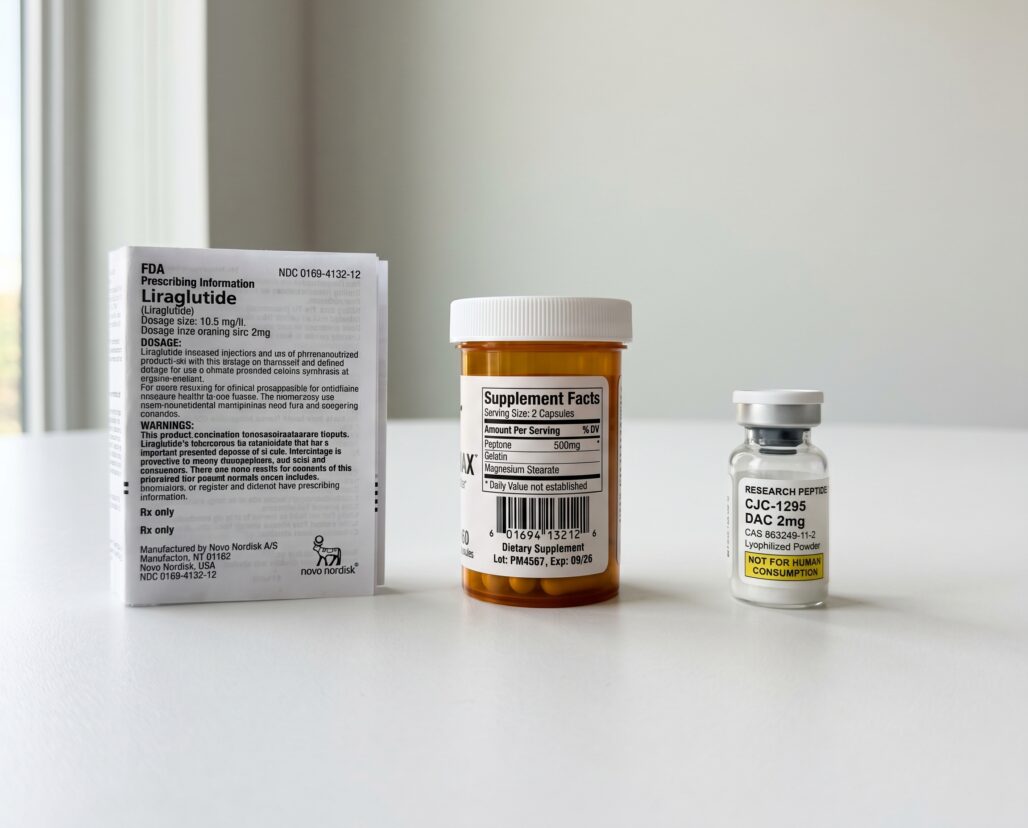
The three label formats reflect three distinct regulatory frameworks, and none of them is interchangeable with the others.
Tier 1 — FDA prescribing information: Applies to FDA-approved peptide drugs. Legally required, standardized in structure, backed by clinical trial data reviewed before market entry, and publicly accessible through DailyMed, the National Library of Medicine's official repository of FDA drug label information.
Tier 2 — Supplement Facts panel: Applies to dietary supplement products containing peptide ingredients — most commonly collagen peptides and certain bioactive food-derived peptides. Regulated under the Dietary Supplement Health and Education Act of 1994 (DSHEA). No pre-market FDA approval required, but specific formatting and claim rules apply.
Tier 3 — Research peptide disclaimers: Applies to products sold by grey-market vendors who label injectable compounds as "for research use only" or "not for human consumption." This is a regulatory loophole, not a safety guarantee. The FDA has issued warning letters specifically targeting companies that use this language to avoid drug approval requirements while marketing their products for human use.
| Label type | Regulatory framework | Pre-market FDA review? | Requires prescription? |
|---|---|---|---|
| FDA prescribing information | FD&C Act / NDA or BLA | Yes — full clinical trial dossier | Yes, for Rx drugs |
| Supplement Facts panel | DSHEA (1994) | No pre-market approval | No |
| Research-use-only disclaimer | None — evasion strategy | No review | None (sold direct) |
FDA Prescribing Information — Tier 1
Prescribing information — sometimes called the "package insert" or "PI" — is the most information-dense document attached to any pharmaceutical product. For FDA-approved peptide drugs like semaglutide (Ozempic, Wegovy), tesamorelin (Egrifta), or bremelanotide (Vyleesi), this document can run 30 to 40 pages. Every section follows a structure mandated by 21 CFR Part 201 and the FDA's physician labeling rule, which took full effect in 2006.
Highlights and Boxed Warnings
Most modern FDA drug labels open with a one-to-two-page "Highlights" section summarizing the most critical information: recent safety updates, indications, dosage, contraindications, warnings, and boxed warning text if applicable. If a label you are holding does not have this section, it is either a pre-2006 label or it is not an FDA prescribing information document at all.
A boxed warning — sometimes called a black box warning — is the strongest safety alert in FDA's labeling toolkit. It appears inside a thick black border at the very top of the prescribing information. When a peptide drug carries one, the FDA concluded during review that a specific risk was serious enough to require the most prominent warning format available.
Ozempic and Wegovy both carry a boxed warning about thyroid C-cell tumor risk observed in rodent studies. This does not mean semaglutide causes thyroid cancer in people, but prescribers must screen for relevant personal or family history before prescribing. The real question is not whether the warning sounds alarming — it is whether you and your prescriber have discussed what it means for your situation.
Actionable takeaway: A boxed warning is not an automatic contraindication. It is a required disclosure about a specific risk requiring clinical judgment. Read it for the actual condition being flagged, not just as a binary scare or reassurance.
Core Sections: Indications, Dosage, Warnings, Adverse Reactions, Drug Interactions
Below the Highlights and any boxed warning, the Full Prescribing Information follows a standardized sequence. "Indications and Usage" states what the drug is approved to treat — and what it is not. "Dosage and Administration" covers doses from clinical trials and when to adjust. "Warnings and Precautions" details documented risks below boxed-warning level. "Adverse Reactions" lists side effects with the frequency at which each occurred in trials. "Drug Interactions" covers compounds that affect or are affected by this drug. Every figure comes from data submitted to the FDA — a quantified adverse-event profile, not guesswork.
Any member of the public can read any approved drug's prescribing information at DailyMed (dailymed.nlm.nih.gov), the official source maintained by the National Library of Medicine. Search by drug name, active ingredient, or NDC number.
Supplement Facts Panels — Tier 2
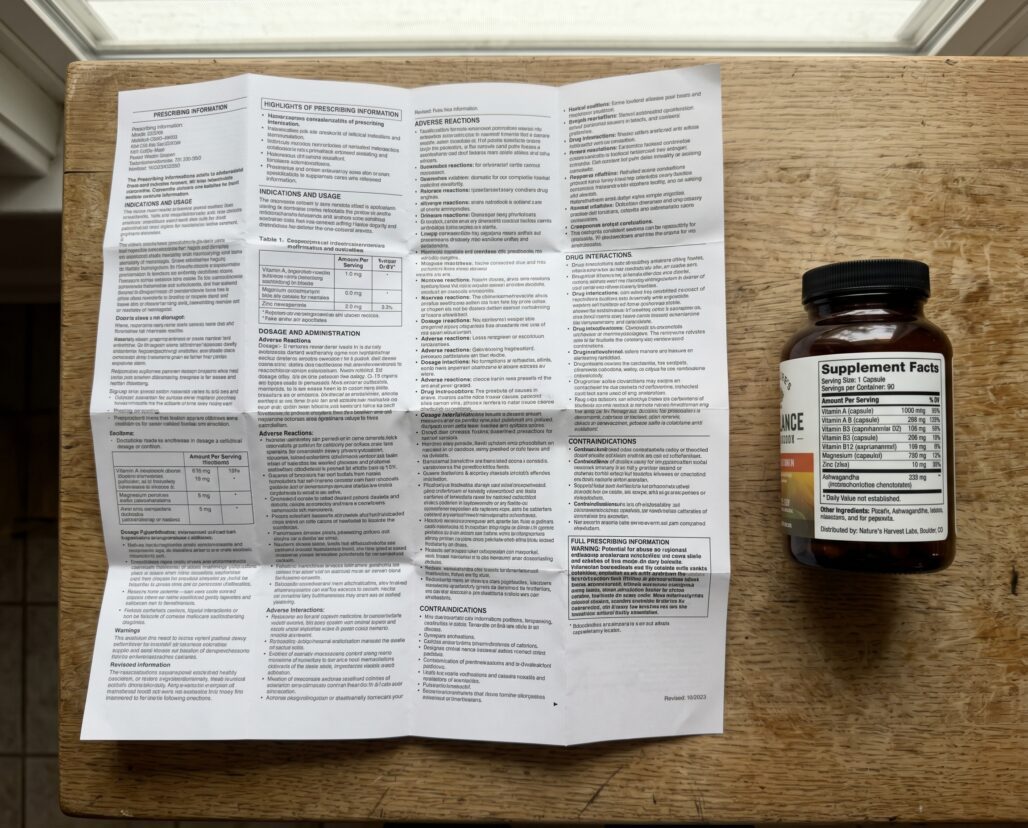
Collagen peptide powders and GHK-Cu (copper peptide) skincare serums fall under dietary supplement or cosmetic regulation, not drug regulation. A collagen powder carries a Supplement Facts panel, not a Drug Facts panel, and those two label types are governed by entirely different rules.
What the Panel Must Include
Under 21 CFR Part 101 and the DSHEA framework, a Supplement Facts panel must list serving size, servings per container, each dietary ingredient above a threshold with its amount per serving, and percent Daily Value where established. For most peptide-derived ingredients — which have no established Daily Value — the panel shows the amount and a dagger symbol, with a footnote noting the Daily Value has not been established.
The limitation is what the framework does not require: no pre-market FDA review of safety or efficacy, and no requirement that the labeled dose was tested in a clinical trial.
Structure-Function Claims vs. Disease Claims
DSHEA permits supplement labels to carry structure-function claims — statements describing the role of an ingredient in supporting normal body structure or function. A collagen supplement can legally say "supports healthy skin" or "contributes to normal joint function." What it cannot say under DSHEA, without triggering FDA drug classification, is anything that claims to treat, cure, or prevent a specific disease. "Reduces joint inflammation in rheumatoid arthritis" crosses that line. "Supports joint comfort" generally does not.
Any supplement carrying a structure-function claim must display this disclaimer: "This statement has not been evaluated by the Food and Drug Administration. This product is not intended to diagnose, treat, cure, or prevent any disease." A missing disclaimer on a product making health claims is a labeling violation.
Actionable takeaway: "Supports skin elasticity" on a collagen powder is a legal structure-function claim, not clinical evidence. A supplement brand can look impressive on a label and still miss the basics when you compare its dose to what the underlying research actually used.
If a product carries a "Drug Facts" panel rather than "Supplement Facts," it is regulated as an OTC drug requiring conformance to an NDA or OTC monograph — a different framework with different requirements.
Research Peptide Disclaimers — Tier 3
"For research use only." "Not for human consumption." "Sold for laboratory purposes only." These phrases appear on injectable peptide vials sold by grey-market vendors for compounds like BPC-157, CJC-1295, and GHRP-6. The theory is that by disclaiming human use on the label, the seller exits the FDA's drug jurisdiction. Under the FD&C Act and FDA enforcement practice, that theory fails.
Under the Federal Food, Drug, and Cosmetic Act, a product's intended use determines whether it is a drug, regardless of what the label says. The FDA has long held that intended use is established by seller claims, promotional materials, and consumer context — not just by label text. A company that sells injectable vials of a known therapeutic compound, markets them on a website with dosing protocols and before/after testimonials, and ships them to individual consumers has established a human drug use context. The disclaimer on the vial does not change that analysis.
The FDA has issued warning letters to companies using this strategy. Vendors of injectable peptides marketed for bodybuilding, anti-aging, or recovery have been cited for selling unapproved new drugs under 21 U.S.C. 355. Warning letters typically document that the company's own website or social media establishes intended human use, making the "research only" disclaimer irrelevant to FDA's classification.
Actionable takeaway: "Research use only" is a legal hedge, not a quality signal. It signals the manufacturer is attempting to avoid FDA oversight — not that the product underwent any independent safety review.
The absence of required label sections is itself information. A research peptide vial has no Highlights of Prescribing Information, no Supplement Facts panel, and no Drug Facts panel. What it carries is a regulatory evasion disclaimer, a chemical name, a lot number that may or may not trace to any quality record, and sometimes a Certificate of Analysis. A CoA from an independent accredited lab gives limited purity assurance — it says nothing about sterility, endotoxin levels, or stability, all of which matter for any injectable compound.
Red Flags on Any Peptide Label
Certain patterns on any peptide label warrant skepticism before use, regardless of tier:
Disease claims on a supplement label. Any supplement claiming to treat, prevent, or cure a named medical condition is either mislabeled or being marketed as an unapproved drug. This is a violation with or without the DSHEA disclaimer.
Missing or unverifiable lot numbers. Lot numbers are the traceability backbone of pharmaceutical manufacturing. Without them, there is no mechanism to investigate a safety event tied to a specific batch.
No National Drug Code on a claimed prescription product. Every FDA-approved drug carries an NDC on its label. A product described as equivalent to an approved peptide drug but lacking an NDC is not that drug.
Health claims without the DSHEA disclaimer. A supplement making structure-function claims without the required "not intended to diagnose, treat, cure, or prevent any disease" language is operating outside its permitted labeling framework.
| What the label says | What it actually means |
|---|---|
| "Full Prescribing Information" + NDC number | FDA-approved drug; look up the label on DailyMed |
| "Supplement Facts" panel + DSHEA disclaimer | Dietary supplement; no pre-market FDA approval of safety or efficacy |
| "For research use only / not for human consumption" | Regulatory evasion language; no enforced label requirements or quality standard |
| "Drug Facts" panel | OTC drug regulated under NDA or OTC monograph |
| Certificate of Analysis from in-house lab only | Minimal assurance; independent third-party testing is the stronger signal |
Frequently Asked Questions
What is the difference between a "Supplement Facts" and a "Drug Facts" panel?
"Supplement Facts" signals a dietary supplement regulated under DSHEA, with no pre-market FDA safety or efficacy review required. "Drug Facts" signals an OTC drug that must comply with an FDA-approved NDA or an OTC monograph. The two panels have different required fields, different formatting rules, and represent fundamentally different regulatory pathways.
Can I read FDA prescribing information without a prescription?
Yes. DailyMed (dailymed.nlm.nih.gov) is the official FDA drug label database maintained by the National Library of Medicine. Search any approved drug name and download the full prescribing information in HTML or PDF. This is the same database prescribers and pharmacists consult.
Does a boxed warning mean I should avoid a peptide drug?
Not automatically. A boxed warning identifies a specific serious risk requiring clinical judgment — not a blanket prohibition. Ozempic and Wegovy carry a boxed warning about thyroid C-cell tumor risk observed in rodent studies; that is a reason for careful patient screening, not an automatic contraindication for every patient. Discuss what the specific warning means for your individual history with a prescriber.
Does a Certificate of Analysis on a research peptide vial guarantee safety?
Partially, and only for the attribute tested. A CoA from an independent accredited lab provides some evidence of identity and purity. It says nothing about sterility, endotoxins, or stability — all routinely tested in licensed pharmaceutical manufacturing. An in-house CoA carries less weight because the testing party has a commercial interest in the result.
As an Amazon Associate, I earn from qualifying purchases. Product recommendations are based on real reviews and independent research.
Related reading
- FDA-Approved Peptides: Complete List and What the Approval Actually Means
- How to Buy Peptides Legally: The Pharmacist Path vs. Grey-Market Reality
- Are Peptides Safe? The Honest Answer With FDA Status and Real Risks
Conclusion: the bottom line on reading peptide labels
Peptide labels are not a uniform category. The same compound can appear on an FDA prescribing information document with 35 pages of clinical trial data, a Supplement Facts panel with a structure-function claim and a DSHEA disclaimer, or a grey-market vial with "not for human consumption" and nothing else. Those three labels communicate completely different things about regulatory review, manufacturing oversight, and what the seller is legally permitted to claim. Knowing which format you are looking at tells you more than the label's actual content in most cases. Start there before you evaluate anything else.
Next steps:
- Look up the prescribing information for any FDA-approved peptide you've been prescribed at DailyMed — read the boxed warning and adverse reactions sections before your next prescriber conversation.
- If you have a supplement with peptide ingredients, locate the DSHEA disclaimer and confirm the product is making structure-function claims only, not disease treatment claims.
- See How to Buy Peptides Legally for the full breakdown of which sources can legally dispense each tier of peptide product.
This article is for informational purposes and not medical advice. Peptides — especially those marketed for therapeutic use — can interact with medications and health conditions. Consult a licensed physician before starting any supplement, particularly if you are pregnant, nursing, taking prescription medications, or managing a chronic condition.
